You may be in Italy looking at a beautiful piazza, hearing church bells, ordering good coffee, and still feeling flat, angry, lonely, or ashamed that you're not happier. That conflict is common in trailing spouse depression. It often affects American women who moved for a partner's job, marriage, or international assignment and then discover that daily life in Milan, Rome, or elsewhere in Italy feels far more isolating than the fantasy they were sold.
The painful part is that the outside story often looks privileged. Inside, it can feel like grief. You may have lost your work identity, your routines, your friendships, your financial independence, and the version of yourself that felt competent. That isn't weakness. It's a psychological response to disruption, dependency, and disconnection.
As a clinical psychologist, I want to say this clearly. If you feel unlike yourself since moving to Italy, there is a name for the pattern, and it deserves care. You don't need to wait until things become unbearable to take it seriously.
Understanding Trailing Spouse Depression in Italy

Trailing spouse depression is the depressive distress that can develop when one partner relocates mainly to support the other partner's career or life path. It is often discussed under the label trailing spouse syndrome, which is not a formal medical diagnosis but is widely recognised as a real expat mental health pattern, especially where isolation and identity loss are present.
Why Italy can intensify the experience
Italy can be emotionally generous, but it can also be hard to enter if you arrive without your own structure. Your partner may immediately gain colleagues, purpose, and a daily rhythm. You may gain paperwork, silence, and long hours alone.
That mismatch matters. In practice, many American women describe the same collision:
- The Italy dream vs daily reality. You expected beauty, culture, and adventure. You found waiting rooms, forms, errands, and a lot of time by yourself.
- Support without recognition. You're doing invisible labour that keeps the household functioning, but it may not feel valued.
- Connection without belonging. You can be surrounded by people and still feel socially stranded.
Trailing spouse depression is often a normal response to an abnormal transition.
What it can feel like
It doesn't always begin as obvious depression. Often it starts as a subtle shift in identity and energy.
You may notice:
- A constant low mood that you keep dismissing
- Irritability toward your partner, even when you love them
- Loss of confidence in ordinary tasks
- A sense of shrinking, as if your world has become smaller
- Guilt for struggling, because you think you should feel grateful
Many women tell me the hardest part is not the sadness itself. It's the self-blame. They assume they're failing to adapt, failing to appreciate the opportunity, or failing to be resilient enough.
They're not failing. They're reacting to cumulative loss.
The Psychological Roots of Expat Depression
Trailing spouse depression usually has understandable roots. It tends to grow where three things meet: loss of role, loss of autonomy, and loss of reliable connection. When those combine, mood often drops and self-doubt rises.
A 2024 Milan-area survey found that 42% of trailing spouses reported clinically significant depressive symptoms, and risk was 2.8 times higher when spouses lacked professional networks. The same data also noted that maladaptive schemas such as Self-Sacrifice mediated 65% of these cases, according to Therapsy's summary of the Milan findings.
When career loss becomes identity loss
For many American women in Italy, the move is not only geographical. It interrupts a professional identity built over years. You may have been competent, busy, recognised, and financially independent. Then suddenly your day has no external structure and no clear feedback.
That change often triggers painful thoughts:
- “I'm behind.”
- “I'm dependent now.”
- “My partner's life kept moving. Mine stopped.”
- “If I'm not working, who am I?”
In CBT, we would call these automatic thoughts. In Schema Therapy, we look deeper and ask which old emotional patterns the relocation has activated.
The schemas often triggered by this move
Schema Therapy is useful here because it explains why some women feel not just disappointed, but destabilised.
Common schemas in trailing spouse depression include:
- Self-Sacrifice. You prioritise everyone else's adaptation and minimise your own needs.
- Dependence. You start to feel incapable, even if you were highly capable before.
- Unrelenting Standards. You tell yourself you should adapt quickly, gracefully, and without complaint.
- Defectiveness or shame. You interpret struggle as proof that something is wrong with you.
If the move has activated an old pattern, self-help alone may not reach the real wound.
Italy can sharpen this process because daily life demands energy for language, administration, and social decoding. Even practical details can become emotionally loaded. If the move included pets, for example, the logistical burden can add stress before you've even settled.
Many women also realise that what looked like simple sadness is partly culture shock. If that resonates, this guide on culture shock in Italy and how to cope may help you recognise the pattern earlier.
What works better than denial
Trying to “stay positive” rarely works if the underlying issue is identity disruption. Busyness can distract you, but it won't necessarily restore a sense of self.
What helps more is targeted work that addresses both layers:
| Challenge | What usually doesn't help | What tends to help |
|---|---|---|
| Loss of role | Telling yourself to be grateful | Rebuilding structure and purpose deliberately |
| Dependency | Avoiding the topic with your partner | Naming the imbalance clearly and early |
| Shame | Comparing yourself to other expats | Understanding the schema or belief underneath |
| Isolation | Waiting for friendship to happen naturally | Creating repeated points of contact |
Specific Symptoms and Risk Factors in Italy
A lot of women recognise trailing spouse depression only when it has already affected sleep, relationships, and motivation. The symptoms are often broader than sadness. In Italy, they also interact with very specific environmental stressors.
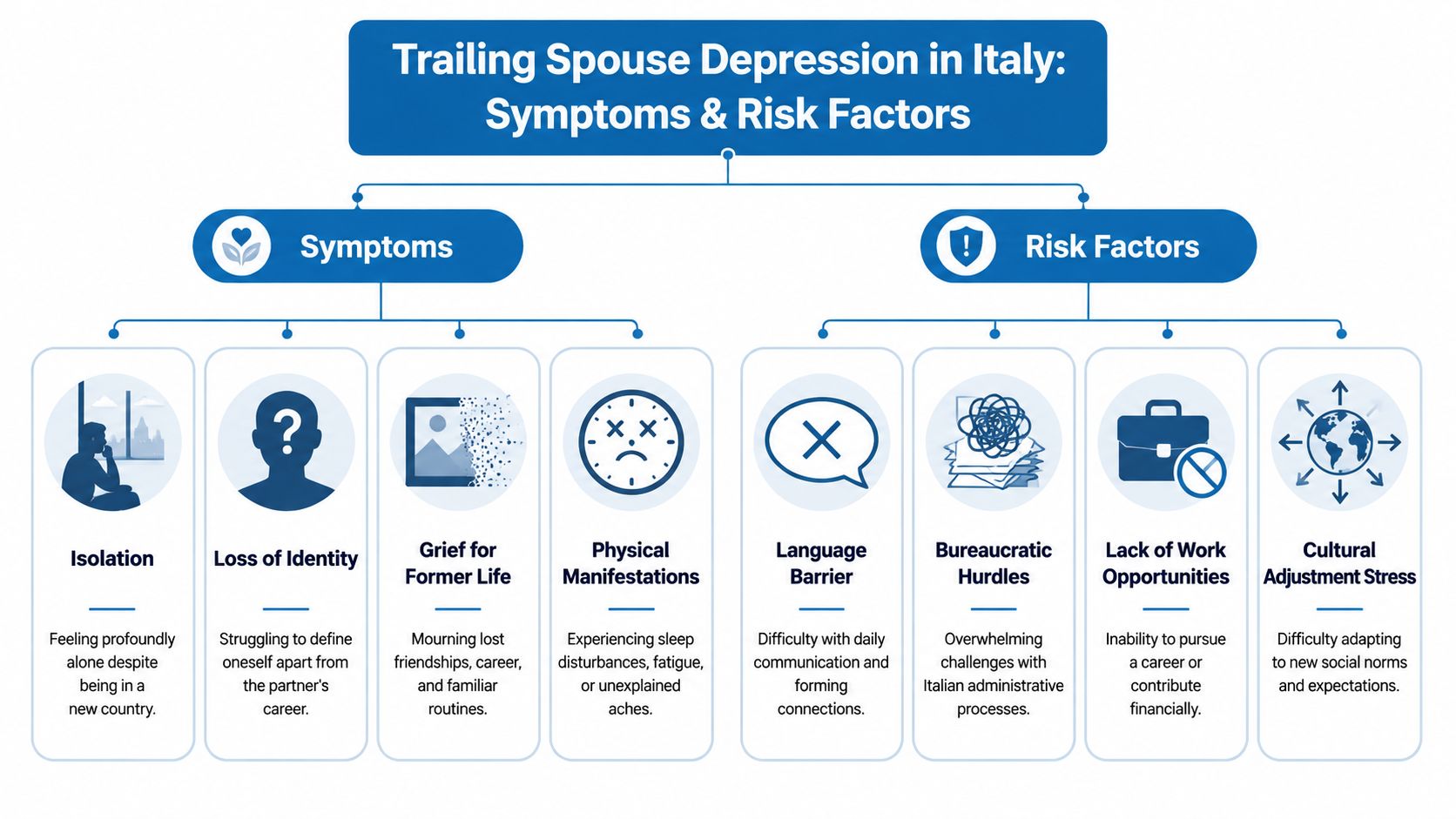
A Rome-based study found a 37% incidence of adjustment disorder with depressed mood among trailing spouses, linked to social isolation. Average social network size fell from 12.4 contacts before the move to 2.1 after relocation, according to Therapsy's Rome study summary.
Symptoms that often show up first
Some signs are emotional. Others are behavioural or physical.
Watch for patterns such as:
- Withdrawing socially even when opportunities exist
- Crying more easily or feeling emotionally numb
- Snapping at your partner over minor things
- Trouble sleeping, early waking, or sleeping too much
- Loss of appetite or comfort eating
- Exhaustion without clear cause
- Brain fog and indecision
- A reduced sense of pleasure, even in a beautiful setting
These symptoms can be confusing because they don't always look dramatic. They often look like “I'm just tired” or “I'm still adjusting.” Sometimes that's true. Sometimes it's the beginning of something more entrenched.
Italy-specific risk factors
Italy has its own psychological friction points for trailing spouses. The issue isn't that Italy is uniquely harmful. It's that the culture and systems can feel difficult to enter without language fluency, work structure, or your own social anchor.
The risk factors I see most often are these:
- Language fatigue. Even basic interactions can become draining when you need to stay alert all day.
- Bureaucratic overload. Residence paperwork, healthcare access, school systems, banking, and administrative steps can leave you feeling helpless.
- Relational culture differences. Social life in Italy often depends on introductions, shared circles, and unspoken norms. Americans may expect more direct, low-context communication and faster inclusion.
- Gender role tension. Some women feel pushed into a more dependent or domestic role than they expected.
- Invisible comparison. You compare your current life to your former self, and you compare your adaptation to your partner's visible progress.
You can love Italy and still suffer in Italy. Those two truths can exist together.
For a fuller look at how social disconnection affects expats emotionally, this article on expat loneliness in Italy is a useful companion.
A practical distinction
It helps to ask one simple question. Is this mainly unfamiliarity, or is my world becoming smaller?
Normal adjustment feels uncomfortable but gradually expands. Depression tends to narrow your life. You stop initiating. You stop hoping. You stop imagining that things can improve.
That narrowing is important to notice early.
Evidence-Based Self-Help and Coping Strategies
Self-help can be meaningful when it is structured, realistic, and repeated. It works best when it restores three things that trailing spouse depression often strips away: rhythm, agency, and contact.
The identity shift here can be severe. Research also shows that while married people generally have lower depression rates, the combination of relational strain and social disconnection in the trailing spouse position can push distress toward levels more comparable to divorced or widowed groups, as discussed in this peer-reviewed paper on depression patterns.

Rebuild structure before motivation returns
Many women wait to feel better before creating routine. That usually backfires. In depression, action often has to come first.
Try this for two weeks:
- Wake at the same time each weekday. Your nervous system calms when days become predictable.
- Leave the house once in the morning. Even a short walk creates a boundary between rumination and movement.
- Set one practical task and one meaningful task daily. For example, “call the farmacia” and “attend Italian class”.
- Use visible planning tools. A paper diary, Notes app, or calendar can externalise the day when your mind feels foggy.
Create contact that repeats
One-off social events are often overrated. Repetition is what builds belonging.
Better options include:
- Weekly language classes
- A recurring volunteer role
- A neighbourhood exercise class
- A co-working day if you work remotely
- A standing coffee or market walk with one person
Purposeful activities such as volunteering, language courses, or remote work can reduce risk by restoring direction and identity. That matters more than looking busy.
Protect your mind from self-attack
CBT can help you catch thoughts that deepen depression. Start by writing down one recurring thought each day. Then ask:
- What happened just before this thought?
- What emotion did it trigger?
- What am I assuming about myself?
- What would I say to a close friend in the same situation?
This isn't forced positivity. It's cognitive accuracy.
Gentle mindfulness can also help interrupt spirals. This guide to mindfulness gives a practical starting point.
Practical rule: choose habits that create identity, not just distraction.
Talk with your partner differently
Many couples get stuck in the same unhelpful script. One partner says, “Just give it time.” The other feels even more unseen.
A better conversation sounds more specific:
| Instead of saying | Try saying |
|---|---|
| “I'm unhappy here” | “I've lost structure, identity, and daily contact, and it's affecting my mood” |
| “You don't get it” | “Your work gives you built-in belonging. I don't have that yet” |
| “I need more help” | “I need us to treat my adjustment as a real family issue, not a private weakness” |
When Self-Help Is Not Enough to Feel Better
Self-help is useful, but it has limits. If your symptoms are persistent, deepening, or starting to affect safety, relationships, or functioning, the next step is professional support.
One clear threshold is duration. When depression symptoms persist for more than two weeks, that warrants closer attention and often professional help, as discussed in this article on trailing spouse syndrome.
Signs that you shouldn't ignore
You may need more than self-guided strategies if:
- Nothing feels enjoyable anymore
- Your sleep or appetite has changed significantly
- You feel worthless, trapped, or chronically hopeless
- Your relationship is becoming dominated by resentment or withdrawal
- You can't stop ruminating about the life you left
- You're using alcohol or other substances to cope
A 2025 Cigna EAP study for expats in Milan and Rome found that 29% of trailing partners reported increased alcohol or other substance reliance after relocation. Clinically, that matters because it often signals that the distress has moved beyond ordinary adjustment and into self-medication.
What doesn't work at this point
Trying harder is not a treatment. Neither is pretending the problem is only logistical.
If your mood is deteriorating, more willpower usually leads to more shame. You may start telling yourself that other women manage this better, that you're overreacting, or that you just need to be busier. Those thoughts often delay care.
Professional support is not the dramatic option. It's the proportionate one.
How Therapy Can Help Rebuild Your Life in Italy
Therapy for trailing spouse depression should do more than give emotional comfort. It should help you understand what happened to your sense of self, reduce depressive symptoms, and rebuild a life in Italy that feels like yours, not only your partner's.

What good therapy focuses on
The work is usually practical and emotional at the same time. In sessions, we often look at four areas:
- Identity reconstruction. Who were you before the move, and who are you now?
- Grief processing. What have you lost that nobody has properly acknowledged?
- Relationship recalibration. How has the move altered fairness, dependency, and communication?
- Re-entry into life. What concrete steps will reconnect you with purpose, people, and confidence?
Therapy helps because it gives language to what has felt diffuse. Once the pattern is named, it becomes easier to treat.
How different approaches help
Different methods target different layers of trailing spouse depression.
CBT
Cognitive Behavioural Therapy helps identify and challenge the thought patterns that keep depression in place. If your mind repeatedly says, “I'm useless here” or “I've ruined my career,” CBT helps test those beliefs and build more balanced alternatives. It also focuses on behavioural activation, which means restoring action even before motivation fully returns.
EMDR
EMDR is often associated with trauma, but it can also help process disturbing experiences linked to relocation, loss, and sudden identity disruption. Some women carry intense emotional charge around the move itself, a career ending, a painful sacrifice, or the shock of feeling invisible in a new country. EMDR can help the nervous system process those memories differently.
Schema Therapy
Schema Therapy is especially useful when relocation has triggered old wounds. If the move has activated patterns such as self-sacrifice, dependence, or shame, insight alone usually isn't enough. Schema work helps you recognise the younger emotional logic driving the present struggle and respond from a steadier adult position.
Therapy is not about convincing you to like your new life. It's about helping you live it with more agency, clarity, and self-respect.
Why language matters in therapy
If you already spend your days translating, guessing, and monitoring your Italian, deep emotional work in a non-native language can feel exhausting. Many expat women need a space where they don't have to perform fluency.
That is why matching matters. The fit with the therapist, their experience with expat identity loss, and your ability to speak naturally all influence how safe and effective the process feels. This guide on finding the right therapist for expats in Italy can help you think through what to look for.
Your Practical Next Steps to Finding Support
If you recognise yourself in this article, don't wait until you're in crisis. Trailing spouse depression responds better when it's addressed early, before isolation hardens into chronic hopelessness or severe relationship strain.
A simple next-step plan looks like this:
- Write down your current symptoms clearly. Include mood, sleep, motivation, isolation, resentment, and any substance use.
- Name the main losses. Career, home, friendships, independence, language confidence, community, or identity.
- Tell your partner in concrete terms. Focus on impact, not blame.
- Choose one professional contact point this week. Don't keep researching indefinitely.
- Use a relocation-specific mental health checklist. This resource on moving to Italy and mental health can help you organise what's happening.
What to look for in support
Not every therapist understands the expat experience well. Look for someone who can work with:
- Depression and adjustment together
- Intercultural dynamics
- Identity loss after relocation
- Couple strain linked to unequal adaptation
- Evidence-based methods such as CBT, EMDR, or Schema Therapy
Good support should help you feel more oriented, not more judged. You should come away with both understanding and a plan.
FAQ
Is trailing spouse depression a real condition
Yes, it's a real psychological experience even though trailing spouse syndrome isn't a formal medical diagnosis. The distress is commonly linked to isolation, identity loss, and disrupted structure after relocation. Naming it often reduces shame and helps people seek support sooner.
Why do I feel worse in Italy when I wanted this move
Because wanting the move and grieving its consequences can happen at the same time. Many American women arrive with hope, then face language fatigue, bureaucracy, loss of work identity, and deep loneliness. That conflict can produce depression without meaning the move was a mistake.
Can self-help be enough for trailing spouse depression
Sometimes, especially when symptoms are mild and you still have motivation, routine, and social contact. Structured habits, purposeful activity, and clear communication can help stabilise mood. If symptoms persist, intensify, or affect daily functioning, self-help is no longer the right level of care on its own.
What type of therapy helps most with trailing spouse depression
The best therapy depends on what is driving your distress. CBT helps with depressive thought patterns and behavioural shutdown, EMDR can process painful relocation-related experiences, and Schema Therapy helps when old patterns such as self-sacrifice or dependence have been triggered. Many women benefit from a combination.
Is it normal to resent my partner after moving for their career
Yes, that reaction is common and usually signals pain rather than lack of love. Resentment often grows when one partner has immediate purpose and community while the other loses both. It's important to address it directly before it turns into chronic disconnection.
When should I seek professional help
Seek help when low mood lasts more than two weeks, when you're withdrawing from life, or when sleep, appetite, hope, or functioning have clearly changed. You should also reach out sooner if alcohol or other substances are becoming a coping tool. Early support is often simpler and more effective than waiting.
If you're struggling with trailing spouse depression in Italy, you don't have to keep carrying it alone. Book your first free assessment call with THERAPSY. It's free, confidential, and without commitment. You'll speak with Dr. Francesca Adriana Boccalari, Clinical Director, who will listen carefully and help match you with the right therapist in your language, online or in person across Italy.
Not sure whether what you are feeling is depression?
Our free online depression test takes two minutes. It is based on the PHQ-9, the screening questionnaire used by clinicians worldwide, and it is anonymous – no email required to see your result.
If the result suggests you could use support, the next step is a free first call with a licensed therapist who speaks your language, online or in person across Italy.