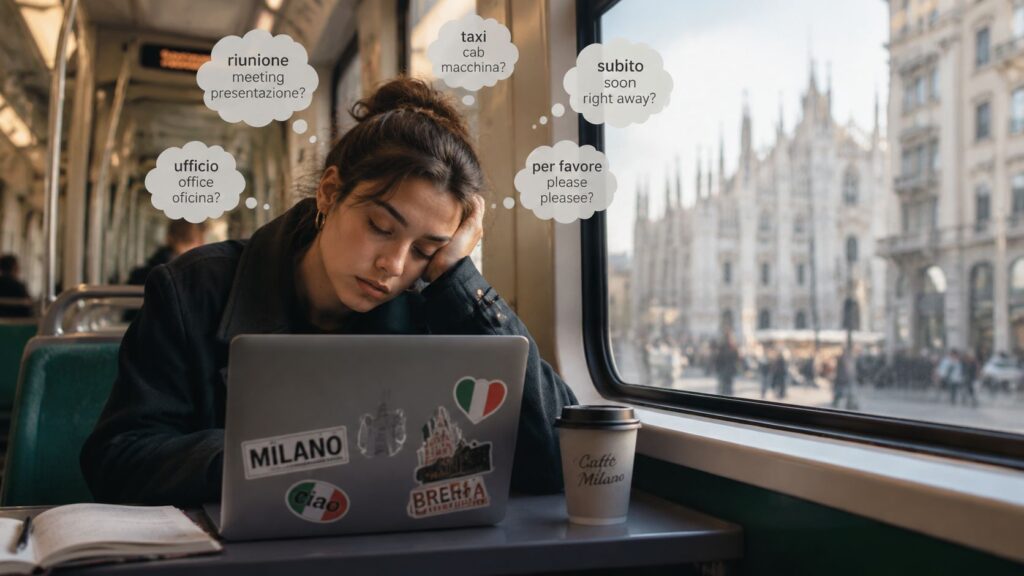
Quick answer: Expat therapy Italy means accessing licensed psychotherapy with a therapist who speaks your native language, either online or in person across Italian cities. In 2026, expats can choose between the public Psicologo di Base service, the Bonus Psicologo subsidy, and private multilingual platforms. Most expats opt for private multilingual care because of language match, faster access, and continuity over time.
Therapsy is a multilingual psychotherapy service in Italy that connects expats with therapists who speak their native language.
Why this guide matters in 2026
You moved to Italy for a job, a relationship, a master’s degree, or a slower pace of life. The first weeks felt like a film. Then the bureaucracy hit, your support network shrank to a phone screen, and the noise in your head started speaking a language no Italian colleague can quite hear. Expat therapy Italy is not a luxury. It is one of the few interventions with measurable outcomes when adaptation stress, loneliness, anxiety, or a strained relationship start eating into your days.
This guide is for you if you are looking for expat therapy Italy in 2026 and want a clear picture of what has actually changed in the past twelve months. We will cover the new public Psicologo di Base service rolled out under the National Mental Health Plan, the confirmed Bonus Psicologo 2026, real session costs, the language question, the AI chatbot debate, and how to choose a therapist without losing six months in the search. Therapsy has supported over 13,000 sessions across 21 Italian cities and 14 languages, so the perspective here is grounded in what works.
What does expat therapy Italy actually look like?
Expat therapy Italy is a structured clinical relationship with a licensed psychotherapist, conducted in the language you think and feel in. The format follows international standards: 45 to 60 minute sessions, usually weekly, with a treatment plan tailored to your goals. What changes for expats is the linguistic and cultural layer. A migration-informed therapist understands that grief over a country you chose to leave is real, that your accent does not predict your emotional vocabulary, and that “going home for Christmas” is a clinical event, not a logistical one.
In Italy, three professional figures can offer support, and the distinction matters. A psicologo holds a five year degree in psychology and can provide assessment, counselling, and support. A psicoterapeuta is a psicologo or a medical doctor who has completed four additional years of specialization and is authorized to treat clinical disorders. A psichiatra is a medical doctor who can prescribe medication. Expat therapy Italy almost always means working with a psicoterapeuta, registered with the Ordine degli Psicologi of their region. At Therapsy, every therapist is regularly licensed and listed on the regional Ordine register.
The Italian Constitution recognizes the right to health, and access to therapy is not restricted by nationality. Whether you hold a permesso di soggiorno, an EU residency card, or a tourist visa with intent to stay, you can begin a therapeutic process.
Why does language matter so much in expat therapy Italy?
Expat therapy Italy works better in your mother tongue because emotional processing is deeper and more accurate in the first language. A study of 182 multilingual clients published in Language and Psychoanalysis by Dewaele and Costa (2013) found that clients switch back to their first language precisely when the emotional tone rises, and use that switch strategically when speaking about trauma and shame. Therapy depends on naming feelings precisely. The English word “embarrassed” carries a different texture than the Spanish “verguenza” or the German “Scham”, and those textures contain clinical information.
Working in Italian when Italian is your second or third language adds cognitive load to a setting that is already cognitively demanding. You spend energy translating instead of feeling. You skip nuance. You agree faster than you should. Therapsy was built to remove that tax. Every match starts from the question of which language gives you the shortest distance between feeling and word.
Beyond words, there is culture. A Lebanese expat in Milan grieving the family she left behind is not having the same conversation as a Dutch software engineer who relocated for a startup. A migration-informed therapist holds both stories without flattening either. This is the standard at Therapsy and the reason Italian therapists with deep international training sit at the core of the clinical team.
What changed in the Italian mental health system in 2026?
The Italian National Mental Health Plan 2025-2030 was officially approved by the Unified Conference of State and Regions, and 2026 is the first year of structural implementation. Two changes affect expats directly.
Psicologo di Base: free public access through Community Houses
The Plan introduces the Psicologo di Base, a public primary care psychologist embedded in the Case di Comunita and territorial health districts. According to Quotidiano Sanita, each health district must have at least two primary care psychologists, coordinated with the Department of Mental Health, Community Houses, schools, and municipal social services. Eleven regions, including Lombardy, Lazio, Tuscany, and Campania, have already activated the service, and the Budget Law has allocated 255 million euros over 2026-2028.
In practice, the public service offers a limited cycle of free sessions, usually four to eight, focused on assessment and short-term support. Languages other than Italian are rarely guaranteed, waiting lists in metropolitan areas can stretch to months, and continuity beyond the initial cycle is not the rule. For an expat needing weekly therapy in English, French, or Russian, the Psicologo di Base is a useful entry point but rarely a sustainable solution.
Bonus Psicologo 2026: up to 1,500 euros for private therapy
The Bonus Psicologo has been confirmed in the 2026 Budget Law with 8,5 million euros of funding. Per INPS guidance, the bonus covers therapy sessions up to 50 euros each, with a total ceiling of 1,500 euros for ISEE up to 15,000 euros, 1,000 euros for ISEE between 15,001 and 30,000 euros, and 500 euros for ISEE up to 50,000 euros. The new rule is strict: recipients must complete at least one session within 60 days of approval or the benefit expires.
Expats with Italian fiscal residency and an Italian ISEE are eligible. The therapist must be regularly licensed and listed on the Ordine degli Psicologi. Therapsy’s clinical roster meets this requirement, so a session booked through Therapsy can be covered by the bonus if the patient qualifies. Applications are expected to open in the second half of 2026.
How much does expat therapy Italy cost in 2026?
Expat therapy Italy costs between 60 and 120 euros per session in the private sector in 2026, depending on the city, the therapist’s specialization, and the format. Milan and Rome sit at the upper end. Online sessions tend to cost ten to twenty percent less than in-person ones because therapists save on commute and clinic rent. At Therapsy, individual therapy starts from 70 euros per session, couples therapy from 100 euros, and psychiatric consultations from 110 euros.
Three cost factors expats often underestimate. First, taxation: psychotherapy is tax deductible in Italy at 19 percent if the therapist is licensed and the payment is traceable. Second, insurance: international health policies such as Cigna, Allianz Care, and AXA frequently cover outpatient mental health, and Therapsy is a partner of Cigna, so Cigna policyholders can access reimbursement directly. Third, the Bonus Psicologo 2026 stacks on top of insurance for eligible residents, lowering the net cost further.
A practical example. A weekly session at 70 euros over twelve weeks costs 840 euros gross. With 19 percent tax deduction, the net cost falls to 680 euros. If the patient holds Italian fiscal residency and an ISEE under 15,000 euros, the full amount can be reimbursed under the Bonus Psicologo within the 1,500 euro annual ceiling. The European average for an equivalent course of therapy, per Eurostat data on household health expenditure, is roughly 30 percent higher.
Can ChatGPT or AI chatbots replace expat therapy Italy?
AI chatbots cannot replace expat therapy Italy, and 2026 research has made the risks concrete. A study published in March 2026, summarized by ScienceDaily, tested OpenAI’s GPT models, Anthropic’s Claude, and Meta’s Llama with three licensed clinical psychologists reviewing the transcripts. The team identified fifteen distinct ethical risks across five categories, including the lack of contextual adaptation, where models offer generic advice without grasping the user’s clinical history or cultural background. The American Psychological Association and the World Health Organization advise against substituting AI for therapy.
For expats the risk is amplified. When no one in your immediate environment speaks your language, ChatGPT feels like the only conversation partner who understands. It does not. The conversation is fluent, the empathy is simulated, and the chatbot has no way to detect rising suicidal ideation, dissociation, or psychotic onset. A November 2025 New York Times investigation documented nearly fifty mental health crises during chatbot conversations, including three deaths.
This does not mean AI has no place. It can help you organize thoughts before a session, draft a journal entry, or summarize what you want to bring up. It cannot hold the relationship that therapy depends on. Therapsy was built on the opposite bet: that human, migration-informed, multilingual care is what expats actually need, and that scaling access to it is more useful than scaling chatbots.
How do you choose the right expat therapy Italy provider?
Choosing the right expat therapy Italy provider is a five step process that you can complete in less than ten days.
- Define your goal in one sentence. “I want to stop having panic attacks before client meetings” is workable. “I want to feel better” is not.
- Pick your language. Use the language you dream in, swear in, or count in. That is your first language even if your CV says otherwise.
- Decide format. In-person if you need ritual and physical separation from your daily environment, online if you travel often or live outside a metropolitan area. Most expats benefit from a hybrid: in-person for the first cycle, online for continuity.
- Check credentials. The therapist must be a psicoterapeuta registered with the Ordine degli Psicologi. You can verify the number on the regional Ordine website.
- Book a free assessment call. Therapsy offers a free 15 to 30 minute call with the matched therapist before any payment. Use it. If something feels off, ask for a different match. Fit is a clinical variable, not a customer service one.
The fastest way to compress these steps is to use a multilingual platform. Therapsy handles credentialing, language matching, and assessment in one workflow, with most expats moving from first contact to first session within five to seven days.
What do real clients say about Therapsy?
Therapsy holds a 4.8 out of 5 rating on Trustpilot, classified as “Excellent”, based on reviews across multiple languages. The recurring themes in client feedback are three. First, the speed and accuracy of the language match: clients report being matched with a therapist who speaks their native language within 12 hours of submitting the form. Second, the depth of the first free assessment call, often described as the moment when the expat realised therapy could work in Italy after all. Third, the continuity of care across moves between cities or between in-person and online formats, which is a structural advantage of a multilingual platform over a single private practice. Verified reviews on Therapsy’s Trustpilot profile mention therapists by name across the clinical team, including therapists who have published in international journals or trained abroad.
Frequently asked questions about expat therapy Italy
Can I do expat therapy Italy without speaking Italian?
Yes. Expat therapy Italy is widely available in English and other languages through multilingual platforms such as Therapsy, which currently offers care in 14 languages. The public Psicologo di Base service is typically delivered in Italian only, so non-Italian speakers usually rely on private multilingual providers.
Do I need a referral from a doctor to start therapy?
No referral is required for private expat therapy Italy. You can contact a multilingual psychotherapy provider directly. A referral may be needed only if you access therapy through the public Servizio Sanitario Nazionale.
Is online therapy in Italy as effective as in-person therapy?
Online therapy in Italy is clinically equivalent to in-person therapy for most conditions, including anxiety, depression, and adjustment disorders, according to a 2021 meta-analysis published in JAMA Psychiatry. Therapsy offers both formats and lets clients switch without changing therapist.
Can I use my international health insurance for expat therapy Italy?
Many international insurers, including Cigna, Allianz Care, and AXA, cover outpatient mental health in Italy. Therapsy is a Cigna partner, so Cigna policyholders can access direct reimbursement workflows. Check your policy for session limits and whether prior authorization is required.
What is the difference between psicologo, psicoterapeuta, and psichiatra?
A psicologo provides assessment and counselling, a psicoterapeuta provides clinical treatment of disorders, and a psichiatra is a medical doctor who can prescribe medication. Expat therapy Italy is usually conducted by a psicoterapeuta.
Can I claim the Bonus Psicologo 2026 if I am not an Italian citizen?
Yes, if you hold Italian fiscal residency and an Italian ISEE you can apply for the Bonus Psicologo 2026 regardless of citizenship. Submit the application via the INPS portal once the 2026 window opens, expected in the second half of the year.
How long does therapy in Italy usually last?
Most expats engage in 12 to 24 weekly sessions for focused work on a specific issue, and longer for personality structure or trauma. The free first assessment call at Therapsy includes an honest estimate of the expected duration based on your goals.
Is what I share in therapy in Italy confidential?
Therapy in Italy is bound by professional secrecy under Italian law (Codice Deontologico degli Psicologi) and by GDPR. Therapsy applies an additional internal data protection protocol so that clinical notes are never shared outside the therapist-patient relationship.
About the author
This article was written by Dr. Francesca Adriana Boccalari, Clinical Director at Therapsy and Co-Founder. Dr. Boccalari is a licensed psychologist with the Ordine degli Psicologi della Lombardia (registration number 16241), graduated with honors in Clinical Psychology from Vita Salute San Raffaele University. Her specializations include Cognitive Behavioral Therapy, certified EMDR, Schema Therapy, and training in Metacognitive Interpersonal Therapy. She has trained in Milan, New York, and Singapore, holds institutional affiliations with IED, Istituto Marangoni, and Sacac in Singapore, and brings over ten years of clinical experience to her work with international clients. Therapsy maintains a 4.8 out of 5 “Excellent” rating on Trustpilot.
Last updated: May 2026
Ready to start expat therapy Italy with someone who speaks your language?
Therapsy is a multilingual psychotherapy service in Italy designed for expats, international students, and intercultural couples. 14 languages – 21 Italian cities – 80 locations – Online and in person – Free first call – 4.8/5 Excellent on Trustpilot.
Book your free 15 minute assessment call on Therapsy
Therapsy – Multilingual Psychotherapy in Italy. Your language. Your therapist. Your pace.
Sources
- Dewaele, J.-M. & Costa, B. (2013). Multilingual Clients’ Experience of Psychotherapy. Language and Psychoanalysis, 2(2), 31-50
- Quotidiano Sanita – PANSM 2025-2030 and the Psicologo di Base
- INPS – Bonus Psicologo official page
- ScienceDaily – 2026 study on ChatGPT and ethical risks in therapy
- Eurostat – household health expenditure in Europe
Related questions readers ask next
- How do I find an English speaking psychiatrist in Italy?
- Is therapy covered by Italian public health insurance for non-EU residents?
- Can intercultural couples do therapy together in two languages?
- What should I expect in the first therapy session in Italy?
- How does therapy in Milan differ from therapy in Rome or Florence?
- Are Italian therapists trained to work with grief from migration?
- Can a teenager born to expat parents in Italy access therapy in English?
- How do I switch therapist if the first match does not work?
Editorial standards
This article was written by Dr. Francesca Adriana Boccalari, Clinical Director at Therapsy and licensed psychologist (Ordine degli Psicologi della Lombardia n. 16241), and reviewed on 26 May 2026. The information provided is for educational purposes and does not substitute a professional consultation.