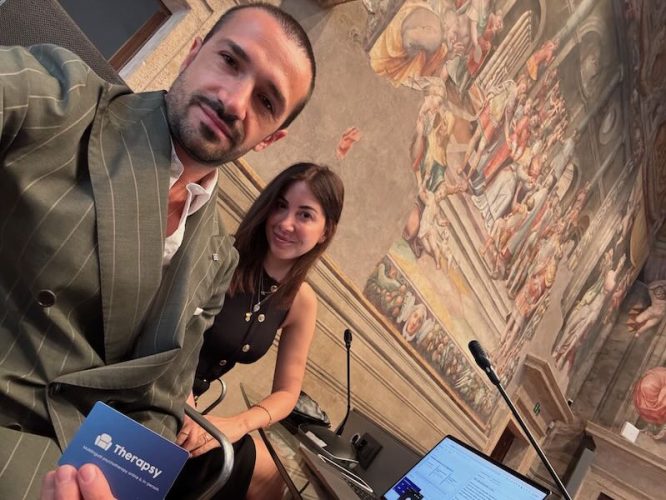
Quick answer: International student mental health is one of the most underserved gaps in the Italian university system. Most internal counselling desks operate only in Italian, leaving thousands of foreign students without real support in their language. On June 24, 2026, Therapsy presented this gap to the joint Housing and Right-to-Study commissions of CRUI. This article reports what we said, the data behind it, and what universities can do this academic year.
Therapsy is a multilingual psychotherapy service in Italy that connects expats and international students with therapists who speak their native language, online or in person across 24 Italian cities.
Why we are writing about international student mental health right now
On June 24, 2026, we were invited to speak to the joint Housing and Right-to-Study commissions of the Conferenza dei Rettori delle Università Italiane (CRUI) – the body that represents all Italian university rectors. We were there with one clear message: international student mental health in Italy is no longer a marginal issue, and the current support model is not designed for the students that universities work hardest to attract.
Italy hosts roughly 5.56 million foreign residents (ISTAT, 2025) and welcomes more than 65,000 international students each academic year (OECD, 2024). Yet the public mental health infrastructure – including university counselling desks – rarely operates beyond Italian and a basic level of English. The result is a predictable structural mismatch: the students universities work hardest to attract are the ones least likely to find help in a language that fits their inner life. Improving international student mental health is therefore not a side benefit. It is part of the academic offering.
What does international student mental health look like in Italy today?
International student mental health in Italy is shaped by three pressures at once: academic load, migration, and isolation. International students leave home, families, languages, and social safety nets to study in a country where the bureaucracy is slow, the housing market is hostile, and the rhythm of social life is rarely explained on the syllabus. The mental health cost of this transition is documented and substantial.
WHO Europe (2023) reports that one in two young adults in Europe experiences at least one mental health episode during higher education. International student mental health, specifically, is the intersection of all three: youth, transition, and minority status in the host culture.
At Therapsy, the international students who reach us most often describe four overlapping issues: exam-related anxiety, loneliness, identity stress (the feeling of being neither fully here nor fully at home), and crisis episodes linked to family or relationship news from their country of origin.
Why language and culture decide whether students get real help
International student mental health is gated by language before it is gated by money. Therapy is a verbal craft. Naming a panic attack, describing grief, finding the precise word for shame: this is the work itself, not the wrapper around it. Asking a student to do that work in a second or third language is asking them to leave most of their inner life at the door.
The research is now consistent. Emotional processing is deeper, faster, and more accurate in a person’s first language (Dewaele & Costa, 2013). Bilingual clients in psychotherapy regularly report that switching to their mother tongue unlocks material they had been circling around for months in the host-country language. The implication for international student mental health is direct: a counselling desk that offers only Italian, or Italian plus broken English, is filtering for a small subgroup of international students who happen to be linguistically and culturally comfortable – and missing everyone else.
Culture matters as much as language. A student from Iran processing family expectations, a student from Brazil navigating a queer identity at a Catholic-leaning university, a student from Ukraine carrying war news in the background: each of them needs a clinician who speaks not only the words but the cultural script. Therapsy’s clinical team is built around exactly this principle – 14 languages, 50+ therapists, more than 13,000 sessions delivered since 2023.
What we told the CRUI on June 24, 2026
We opened with a simple statement that summarises Therapsy’s reading of international student mental health in Italy: “Universities are not failing on care – they are failing on coverage.” The internal psychological desks that exist are run by competent professionals. The problem is that they were never designed to serve a multilingual, multicultural student population, and bolting English onto an Italian-only service does not fix it.
We then presented three numbers from inside Therapsy: more than 1,500 people have reached us directly (the majority international students or young expats), 13,000+ sessions delivered, less than one therapist in a hundred accepted into the network. The vetting ratio matters: international student mental health is a clinical area where the wrong match – a therapist without intercultural training, or without the language – can do more harm than no therapist at all.
We closed with four concrete forms of partnership that universities can activate without restructuring existing services. None of them require new hires. None of them require building a clinical service from scratch. All four are operational today.
How are Italian universities currently handling international student mental health?
Most Italian universities offer some form of internal psychological counselling, and many have invested seriously in the last five years. The structural gap is rarely about willingness – it is about coverage. Internal desks usually run in Italian, with one or two clinicians available in English, and capacity is calibrated to a domestic student population. When the international cohort grows – and at many Italian universities it has doubled in the last decade – the desk does not grow with it.
The result is a quiet rationing of international student mental health support. Waiting lists stretch. Sessions are capped. Students who need a clinician in Mandarin, Arabic, Russian, Portuguese, or Farsi are typically told the service is not available in their language and pointed toward the private market. The private market in Italy is fragmented, expensive at the entry point (a single session can run €80-120 in Milan), and almost impossible to navigate without an Italian-speaking guide.
This is the gap Therapsy was built to close. Not as a replacement for internal services, but as the multilingual layer that internal services were never designed to be.
What can a university actually do this academic year?
International student mental health is one of the few areas where universities can move quickly without restructuring. The four partnership formats we presented to the CRUI are designed to plug into existing services within weeks, not semesters.
- Full management of an internal multilingual desk. Therapsy operates the desk end-to-end, online or in person, across 14 languages. The university defines the rules of access; Therapsy handles intake, matching, clinical delivery, and reporting.
- Top-up coverage for the existing desk. The internal desk continues to serve students it can serve. Therapsy handles the international and multilingual overflow – the cases the desk cannot match.
- Direct access in our studios and online. Students go to one of 24 Italian cities where Therapsy has physical studios, or anywhere in the world online. The university covers the entry session or a fixed quota.
- Tailored solutions for housing, mobility, and academic transition stress. Group formats, workshops, or focused one-to-one programs for specific student populations.
Each format can run alongside the internal service. None of them require the university to hire new staff or absorb fixed clinical costs.
How does Therapsy support universities and their international students?
Therapsy is a multilingual psychotherapy service in Italy with three differentiators that matter specifically for international student mental health.
First, human matching with clinical vetting. Every match is made by Francesca Boccalari, Therapsy’s Clinical Director, after a free 15-30 minute call with the student. Less than one therapist in a hundred passes our vetting. We do not use a self-service search bar because international student mental health is not a marketplace problem – it is a clinical pairing problem.
Second, a multilingual and multicultural network. 14 languages, 50+ therapists, each with documented intercultural training. We do not “speak English” in the airport sense. We have therapists who can hold sessions in Arabic, Russian, Portuguese, French, Spanish, German, Ukrainian, and others – and who understand the cultural script behind the words.
Third, online and in person, anywhere. Sessions can run online with a therapist anywhere in the world, or in person across 24 Italian cities. International student mental health does not stop when the student goes home for Christmas or moves to a different city for an internship. The continuity of care matters, and our infrastructure is built for it.
What does therapy with Therapsy look like for an international student?
The path is deliberately short. International student mental health support has to be easy to enter, or it is not support at all.
A student writes to Therapsy through the website or a referral from the university. Within 12 hours, Francesca Boccalari or her team schedules a free 15-30 minute call to understand the situation: what the student is going through, their language, their cultural background, their preferences. From that conversation, the student is matched with a therapist from the network. The first therapy session usually takes place within a week of the initial call. Sessions are online or in person, at the student’s choice. The student can change therapist at any point.
Everything we publish in the international student mental health space starts from this same path: a real call, a real clinician, a real match. There is no chatbot triage, no algorithm-based matching, no questionnaire that decides on a clinician for you.
Client voices: international students who found their therapist
Real testimonials from real Therapsy clients (verified on Trustpilot, where Therapsy holds a 4.8/5 “Excellent” rating).
“What made a huge difference for me was seeing a professional who understood my culture and language. Therapsy responded right away, took great care of finding me a therapist, and from the very first session I felt understood.” – Polina V., March 2026 (grief therapy with Dr. Eleni Karliampa, via Trustpilot)
“Reliable service with English-speaking Italian doctors. I contacted Therapsy via the website and got the response almost immediately. I had a specific request and it was handled professionally from the start.” – Anastasia E., November 2025 (via Trustpilot)
“Wonderful support abroad tailored to my needs. I started using Therapsy a few months ago and have had a very pleasant experience so far. Finding someone who could understand my situation as an expat made all the difference.” – Ana, April 2025 (via Trustpilot)
“I have enjoyed my experience working with Therapsy very much. More specifically my therapist Dr. Vincenzo – therapy in a language that actually fits my inner life has changed how much I get out of the sessions.” – Krista M., March 2026 (via Trustpilot)
How to get started – for a student, for a university
International student mental health support with Therapsy can be activated by a student directly or by a university partner.
If you are an international student:
- Go to therapsy.it and request a free first call.
- Within 12 hours, Francesca Boccalari, our Clinical Director, or her team reaches out to schedule a 15-30 minute conversation.
- You describe what you are going through, your preferred language, your cultural background, any logistical preferences.
- You receive a matched therapist within a few days. You can change therapist at any point.
- The first paid session typically takes place within one week of the initial call.
If you are a university representative (rector’s office, right-to-study desk, international office, student welfare):
- Email info@therapsy.it or call +39 393 4331887.
- We arrange a 30-minute video call to map your current setup, your international student population, and which of the four partnership formats fits best.
- We send a tailored proposal within five working days.
- The format can be operational within the same academic semester.
FAQ: international student mental health in Italy
What is international student mental health?
International student mental health refers to the psychological and emotional wellbeing of students studying outside their home country. It covers anxiety, depression, loneliness, adjustment stress, identity issues, and crisis episodes that are amplified by migration, distance from family, and life in a host culture. Therapsy is built specifically to support international student mental health in Italy.
How much does therapy cost in Italy?
A private therapy session in Italy ranges from €60 to €120 depending on the city and the clinician. At Therapsy, sessions typically range from €70 to €90, with a free 15-30 minute initial call before any commitment. Some Italian universities cover or subsidise sessions for international students through partnerships like ours.
Does insurance cover therapy in Italy?
Most public health coverage in Italy does not include private psychotherapy. Some private insurance plans reimburse a portion of the cost, and many international student health policies include a mental health benefit. Check your policy or ask your university’s international office. Therapsy can issue invoices that are accepted by most insurers and university reimbursement schemes.
What languages does Therapsy offer?
Therapsy currently offers therapy in 14 languages: Italian, English, French, Spanish, German, Portuguese, Ukrainian, Russian, Greek, Arabic, Urdu, Hebrew, Hindi, and Persian (Farsi). The full list and the matching therapists are visible on our team page. Language coverage is one of the reasons Therapsy is positioned to support international student mental health at scale.
Do I need a referral to start therapy?
No. You can contact Therapsy directly through our website and request a free first call. No medical referral, no university letter, no proof of residence is required. The first call is with a senior coordinator, not with a chatbot.
What is the difference between a psicologo and a psicoterapeuta in Italy?
A psicologo holds a master’s degree in psychology and is registered with the Italian professional order. A psicoterapeuta has completed an additional four-year specialisation in psychotherapy and is qualified to deliver clinical therapy. All Therapsy clinicians who deliver therapy are psicoterapeuti or licensed psychiatrists.
Can my Italian university partner with Therapsy?
Yes. We currently work with universities and right-to-study bodies that want to expand international student mental health coverage without restructuring their internal service. Partnership formats include full management of an internal desk, top-up coverage for the existing desk, direct access in our studios and online, and tailored programs. Contact info@therapsy.it to start the conversation.
Is therapy with Therapsy available online?
Yes. All Therapsy sessions can be delivered online with the same clinical standard as in-person sessions. International students who move between Italian cities, or who return home during academic breaks, can continue therapy without interruption.
About the author
This article was written by Dr. Francesca Adriana Boccalari, Clinical Director and Co-Founder at Therapsy. Dr. Boccalari is a licensed psychologist registered with the Ordine degli Psicologi della Lombardia (n. 16241), graduated with honours in Clinical Psychology from Vita Salute San Raffaele University, and specialised in Cognitive Behavioural Therapy, EMDR, and Schema Therapy, with training in Transcultural Mental Health Initiatives. She has more than ten years of clinical experience, has trained in Milan, New York, and Singapore, and holds institutional affiliations with IED, Istituto Marangoni, and SACAC (Singapore). Therapsy holds a 4.8/5 “Excellent” rating on Trustpilot. Last updated: June 2026.
Ready to talk to someone who speaks your language?
Therapsy – Multilingual Psychotherapy in Italy. Your language. Your therapist. Your pace.
14 languages | 24 Italian cities | 90+ locations | Online and in person | Free first call | 4.8/5 Excellent on Trustpilot
Request your free first call at therapsy.it
Sources
- ISTAT (2025) – Foreign residents in Italy. istat.it
- OECD (2024) – Education at a Glance: International students in Italy. oecd.org/education
- WHO Europe (2023) – Mental health of young people in Europe. who.int/health-topics/mental-health
- Dewaele, J.-M., & Costa, B. (2020) – Multilingual clients in psychotherapy. Journal of Multilingual and Multicultural Development. tandfonline.com
Related questions
- How can I find an English-speaking therapist in Milan?
- What is the best way to deal with exam anxiety as an international student in Italy?
- Does the Italian public health system cover psychotherapy for foreign students?
- What are the signs of culture shock and how is it different from depression?
- How do Italian universities currently support international students’ mental health?
- Is online therapy as effective as in-person therapy for international students?
- What languages can I find a therapist in across Italy?
- How do I talk to my Italian university about mental health support?
Editorial standards
This article was written by Dr. Francesca Adriana Boccalari, Clinical Director at Therapsy and licensed psychologist (Ordine degli Psicologi della Lombardia n. 16241), and reviewed in June 2026. The information provided is for educational purposes and does not substitute a professional consultation. If you are in crisis, please contact emergency services or a qualified clinician in your country.