You moved to Lucca for the beauty, the pace, maybe the work, maybe love, and now the quiet is starting to feel heavy. You can walk the walls, sit near Piazza San Michele, and still feel oddly alone, especially when the thought of explaining your life in Italian feels like one more job after the workday ends. If you're looking for an English speaking therapist in Lucca, the need is real, the search is reasonable, and the right support is available.
The problem in a city like Lucca is not whether therapy exists. It's whether the support matches your language, your schedule, and the way expat stress shows up, as loneliness, anxiety, burnout, relationship strain, or that flat feeling that everything looks fine from the outside but doesn't feel fine inside.
What it feels like to need therapy in Lucca as an English speaker
On the outside, Lucca can look like the kind of place that should make you feel better by itself. Quiet streets, old stone, evening light, a smaller rhythm than Florence or Pisa. Then real life settles in, and the postcard effect wears off.
The harder part is often not dramatic. It's the accumulation. You keep translating admin, social nuance, work emails, and your own feelings. By the time you need to talk about grief, panic, resentment, or identity loss, your brain is already tired.
The emotional reality expats don't say out loud
A lot of English-speaking residents in smaller cities feel guilty for struggling. They assume they should be grateful, settled, and functional because the setting is beautiful. That guilt can delay help-seeking far longer than the actual problem deserves.
Practical truth: the place can be lovely and still not feel like home.
That is why an english speaking therapist Lucca search is not a luxury search. It's a fit search. In a city this size, the pool of English-speaking clinicians is naturally thinner than in bigger hubs, so the smart move is to look both locally and beyond the city, instead of waiting for the perfect office to appear around the corner.
For readers who want a broader frame on multilingual care in Italy, the basics are laid out in Therapsy's multilingual psychotherapy for expats. That wider lens matters in Lucca because local choice exists, but the market is still smaller and more fragmented than in major urban centers.
What this guide covers
You'll find a direct way to think about language fit, local options, online options, what to ask before you book, how common therapeutic approaches are described, and how pricing is typically structured when you're comparing services.
The goal is simple. If you're in Lucca and you need to talk in English, you should know exactly how to move from “I need help” to “I know who to contact next.”
Why language-concordant care matters more than location
Language-concordant care means therapy happens in the client's preferred language. That sounds simple, but it changes the work in a major way because therapy is not just information exchange, it's emotional precision, memory, nuance, and timing.
Speaking about painful things in a second language can feel like trying to describe a colour you can almost see, but can't quite name. The result isn't just inconvenience. It's distortion.
What gets lost when the language is wrong
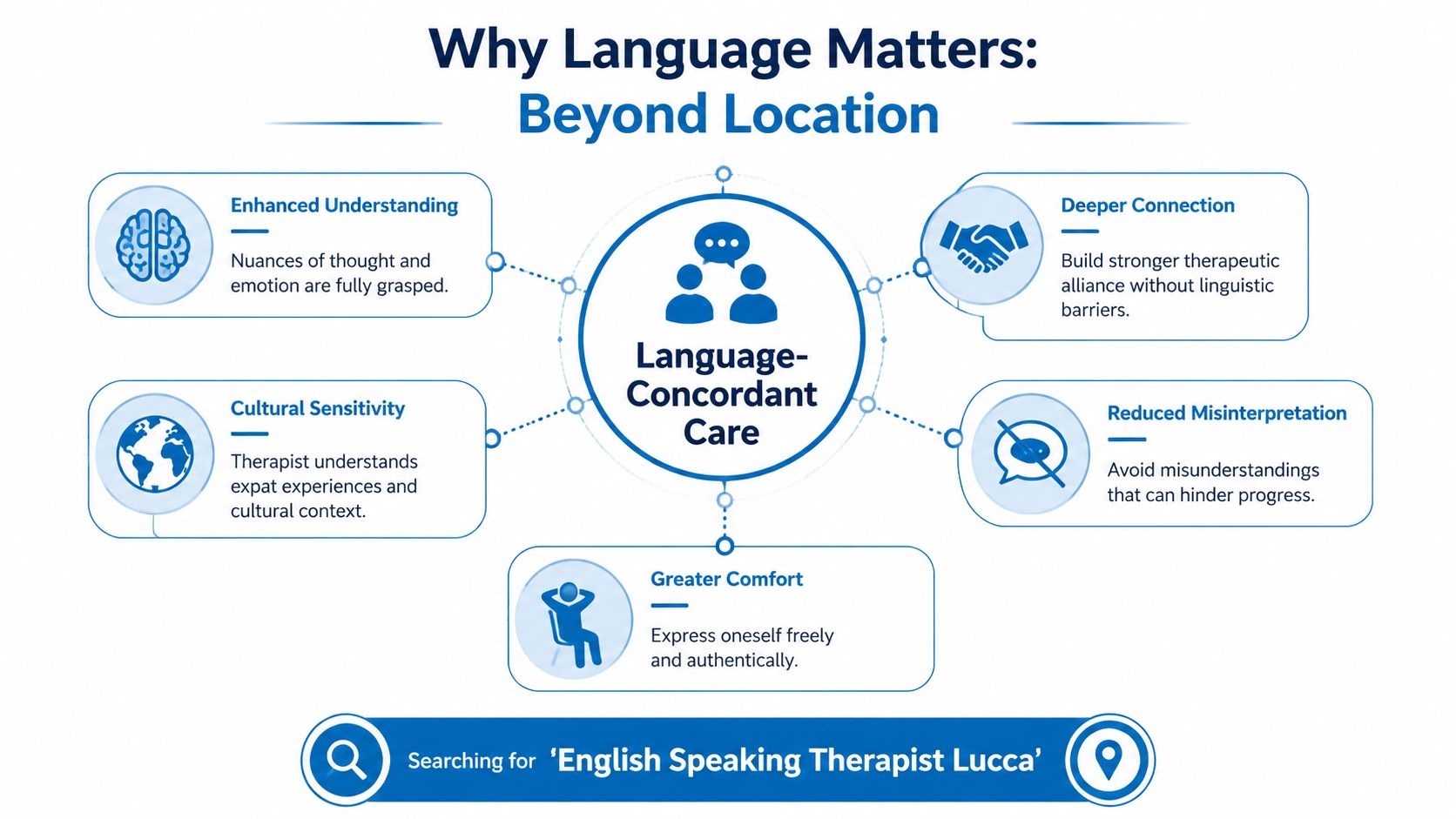
When therapy happens in the wrong language, the client spends energy translating instead of feeling. That increases cognitive load, which means there's less room for subtle emotions, body sensations, and the small details that help a therapist understand what's really going on.
- Enhanced understanding starts when emotional labels are accurate, not approximate.
- Deeper connection develops faster when the client doesn't have to monitor grammar while also talking about shame or fear.
- Reduced misinterpretation matters because a small language mismatch can change the meaning of a whole session.
- Greater comfort makes honest disclosure easier, especially for expats and international students.
A client's preferred language is not a cosmetic preference. It shapes the quality of the clinical conversation.
That's why a therapist who “speaks English” isn't always enough. The better question is whether the therapist can work clinically in English, understand cultural context, and handle emotional material without flattening it.
Why online care solves a Lucca problem
In a smaller city, the local pool can be limited. Online sessions solve that problem cleanly because they let you work with a therapist whose language and specialization fit your needs, even if that therapist isn't physically based in Lucca. That is especially useful if you need a niche approach, a rarer language, or continuity during travel.
For people who want a practical comparison of remote care in Italy, online therapy in English in Italy is a useful reference point.
If your energy is limited, the simplest rule is this, choose the setup that lets you speak most naturally, not the one that looks closest on a map.
The three pathways to English-speaking therapy in Lucca
There are three sensible ways to find therapy in Lucca if English is your preferred language. The right one depends on how urgent the need is, how much flexibility you need, and whether you care more about being local or being well matched.
| Pathway | Local availability | Language options | Flexibility | Best for |
|---|---|---|---|---|
| Local private practitioner | Limited but real | Usually narrower | Lower than online | People who want an office in Lucca and can travel locally |
| Online multilingual service | Broad access from anywhere in Italy | Wider, including English and other languages | Highest | Expats who want continuity, choice, or rare specialties |
| Hybrid care | Available when a service supports both formats | Depends on the provider | High | People who split time between cities or travel often |
What the Lucca market actually looks like
In a smaller market you should not expect abundant choice. If a therapist's schedule, language, or specialization doesn't fit, the right next move is often online rather than settling for an imperfect local match.
How to think about continuity
Local care can work very well if you want face-to-face sessions and the therapist fits. Online care works better when you want consistency across travel, access to a broader language range, or the option to stay with the same therapist if you move again.
Simple decision rule: choose the format that protects continuity first, convenience second.
For many Lucca residents, the best solution is hybrid. Start where the fit is strongest, then keep the format flexible if your work, family, or travel schedule changes.
What to ask on your first call or message
The first contact should feel practical, not intimidating. You're not interviewing a stranger for fun, you're checking whether this person can help you in the language and format you need.
The questions that matter most
Start with the basics. Ask whether the therapist is licensed, what their main specializations are, and whether they regularly work with expats or international clients. Then ask whether they work clinically in English, not just conversationally.
- Qualifications and registration: you want a real professional license, not just language fluency.
- Clinical language level: ask whether therapy, not just small talk, happens comfortably in English.
- Therapeutic approach: CBT, EMDR, Schema Therapy, or another model all lead sessions in different directions.
- Session length and frequency: find out what they usually recommend so your schedule is realistic.
- Fees and cancellation policy: get clarity before you commit, because uncertainty creates friction later.
- Online or in-person options: ask whether switching formats is possible if your life changes.
- First sessions: know what they do in the beginning, because the first meetings should feel structured.
Why these questions are not rude
They're not rude. They're responsible. A good therapist will welcome them because they show you're serious and thoughtful, not casual.
Ask about logistics early. Stress is harder to manage when it's paired with unclear fees or unclear expectations.
The same goes for privacy and travel. If you're in shared accommodation, confirm how online confidentiality is handled. If you travel often, ask how rescheduling works and whether the therapist can keep continuity without making you start over every time.
A practical checklist can help here, and how to talk to a therapist gives a useful framework for that first contact. The point is not to sound polished. The point is to leave the call knowing whether the person can work with you well.
Therapeutic approaches and realistic price benchmarks
Therapy profiles can look like alphabet soup until you know what each approach is trying to do. The short version is that the method should fit the problem, not the other way around.
What the common approaches actually mean
CBT, or Cognitive Behavioural Therapy, focuses on identifying and changing the thoughts and habits that keep distress going. It's often a practical choice for anxiety, avoidance, panic, and repeated negative spirals.
EMDR is commonly used for trauma and PTSD. It helps clients process disturbing memories without having to retell everything in a highly detailed way every session.
Schema Therapy works well when the same painful pattern keeps repeating in relationships, work, or self-image. It looks at older emotional templates that still shape present reactions.
Systemic-relational therapy pays close attention to relationships, family dynamics, and the roles people keep playing. It's useful when the distress makes sense only in the context of a couple, a family, or a move abroad.
Humanistic and Bioenergetic approaches are often chosen when the goal is more self-awareness, emotional contact, and body-based regulation. They can be useful for people who feel disconnected from themselves or chronically tense.
Ethnopsychotherapy is especially relevant in cross-cultural settings. It takes culture, migration, identity, and belonging seriously instead of treating them as side issues.
What pricing looks like when it's stated clearly
Therapsy's published pricing gives a transparent benchmark for expats comparing options in Italy. Individual therapy starts from €70, couples therapy from €100, psychiatric consultations from €110, and psychodiagnostic assessment from €255 as a 3-session package, with no surcharge for online versus in-person sessions. For anyone budgeting around weekly care, that transparency matters. How much therapy costs in Italy is the clearest place to check the current structure.
Transparent pricing helps you decide based on fit, not on surprise.
If you're comparing an English speaking therapist in Lucca with someone online, ask whether the fee changes by format, because that detail can affect long-term continuity more than people expect.
How the matching and booking process actually works
The best intake process is simple, human, and low-pressure. You should know who is answering you, how fast they'll respond, and whether you're being matched by a person or by a form.
The usual flow
First, you send a short request with a few details about your situation and language. Then a real person reviews it and responds within 12 hours, not days.
Next comes a free conversation with the Clinical Director. That call is used to understand your preferences, your language, your availability, and the kind of support you want.
After that, you're matched with a therapist whose background fits your needs. If the fit isn't right, rematching should be possible without drama.
Why human matching matters
A form can capture symptoms. It can't always capture tone, confidence, hesitation, or cultural nuance. Human matching is better because therapy often fails when the therapist is technically qualified but still not the right emotional or linguistic fit.
That is especially important in a city like Lucca, where the local pool is smaller and the best match may be online or in another Italian city. In that situation, the goal is not proximity. It's reliability.
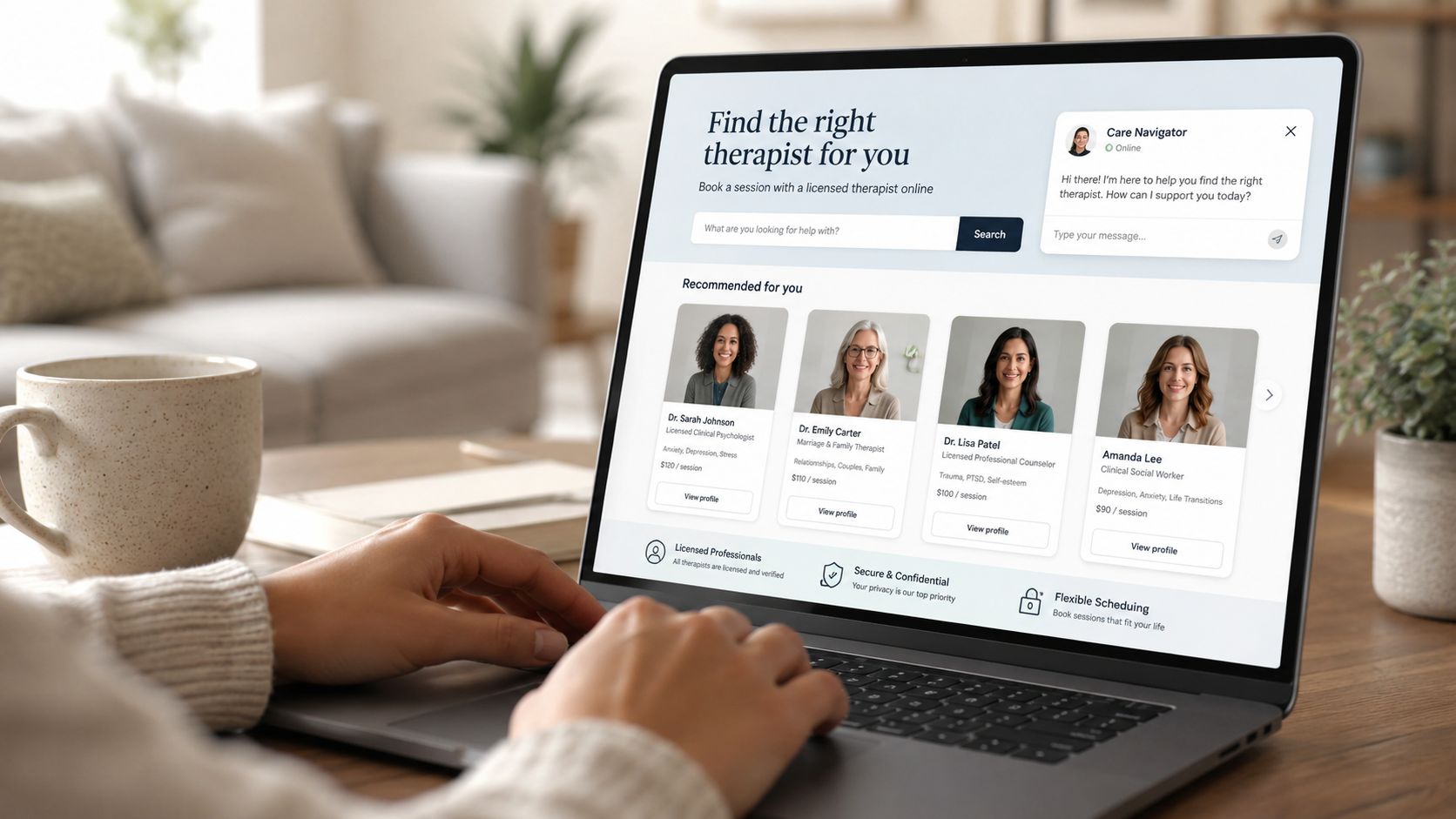
For people who want a single service that handles multilingual matching and flexible session formats, Therapsy offers that kind of setup in Italy, with English-language care available online and in person. If you're juggling work, privacy concerns, or frequent travel, that model reduces friction fast. Therapist matching explains the process in more detail.
Frequently asked questions from expats in Lucca
Reaching out is the hard part. Once you do it, most of the fear drops quickly because the process becomes concrete instead of imagined.
How fast can I start therapy in Lucca?
Usually faster than people expect if you use a service with human matching. The key is to contact the therapist or service directly, ask about availability, and be ready to share your language and schedule preferences clearly.
A smaller city can mean fewer local slots, so online care is often the quicker route when timing matters. If you need support soon, don't wait for the perfect office to appear.
Is therapy in English as effective as therapy in Italian?
Yes, if English is your real emotional language. Therapy works best when you can speak naturally, name feelings accurately, and avoid constant translation in your head.
If you're fluent in Italian and think emotionally in Italian, that may work too. The right language is the one that lets you be precise, not the one that looks most convenient on paper.
What if I can't find a local English-speaking therapist in Lucca?
Use online therapy or widen the search to nearby cities and multilingual services. In a smaller market, that's often the most practical solution, not a compromise.
Broader Italian networks prove helpful, connecting you to clinicians who can work in English even if they aren't physically based in Lucca. That keeps continuity stronger than waiting weeks for a local opening.
Are online sessions private enough?
Yes, if the setup is handled correctly. Privacy depends on the therapist's platform, their confidentiality practices, and your own environment at home.
If you live with roommates or family, choose a room with a closed door, use headphones, and test the connection before the first session. That's usually enough to make online therapy feel safe and manageable.
The English-speaking therapists we work with in Lucca
Therapsy works with a therapist who receives in person in Lucca and in Pietrasanta, and also sees patients online.
Dr. Alessia Ranieri is a psychologist and psychotherapist working in English and Italian. Her practice is built around four areas that matter to anyone who has moved country: identity and life transitions, relocation and cross-cultural life, intercultural couples, and work stress, leadership pressure and burnout. She holds a PhD in Leadership Development from Henley Business School in the United Kingdom and lectures in Adolescent Psychology.
You tell Therapsy what you are looking for, a member of our clinical team reads your request, and they introduce you. The first call is free.
Do I need a serious problem to justify therapy?
No. You do not need to be in crisis to benefit from support. Many expats start because of loneliness, adjustment stress, relationship strain, burnout, or the slow feeling that they're losing themselves.
If daily life feels harder than it should, that's reason enough to talk to someone. You don't have to wait until you're overwhelmed.
If you want help finding an English speaking therapist in Lucca without wasting time on guesswork, THERAPSY can match you with a licensed clinician through a free first assessment call, with English-language care available online and in person across Italy. It's a practical option when you want a human conversation first and a clear path to the right therapist next. Visit THERAPSY and book that first free call when you're ready.