You may be searching for an English speaking therapist in Milan after weeks of telling yourself you could handle it alone. Work is functioning, classes are still happening, messages home are upbeat enough. But inside, something feels off. You might be anxious for no clear reason, exhausted by constant adaptation, stuck in a relationship strain that became sharper after moving, or lonely in a city full of people.
Looking specifically for a psychologist rather than a psychotherapist? See english speaking psychologist in Milan – it explains the difference between the two professions in Italy.
That experience is common among expats and international students in Milan. The hard part isn't only deciding to get support. The hard part is finding qualified care in a system that wasn't designed with foreign residents in mind. Language, titles, insurance, and booking pathways can all feel unclear at once.
Therapy for expats in Italy is not just about finding someone who speaks English. It's about finding a licensed clinician who understands intercultural stress, communicates clearly, and offers a format you can actually sustain.
When people look for an English speaking therapist in Milan, they usually need more than a list of names. They need a practical path. That's what follows.
Starting the Search for Therapy in Milan
Milan can hold two realities at the same time. It can be exciting, fast, ambitious, and full of possibility. It can also be emotionally demanding in ways that aren't obvious from the outside.
A typical search starts late in the evening. Someone types "English speaking therapist Milan" after a hard day at work, after another awkward doctor appointment in Italian, after a relationship argument that was really about stress, distance, and not feeling understood. By that point, the search itself can feel like one more burden.
Why this feels heavier than it should
Many expats don't struggle because they're weak. They struggle because daily functioning in another country uses energy all the time. You translate, adapt, explain yourself, and monitor social cues. That pressure adds up.
Common reasons people start looking for therapy include:
- Anxiety that changed shape after moving – You may have managed stress before, but relocation can turn ordinary pressure into panic, rumination, or insomnia.
- Culture shock that lingers – Early excitement often gives way to disorientation, irritability, and grief for what used to feel easy.
- Identity strain – Professionals, students, and partners often feel less confident abroad because their normal ways of coping don't work as well.
- Isolation – Even socially active people can feel emotionally alone when their deeper support system lives elsewhere.
A broad directory can help you see what's available nearby, especially if you want to start with location and format rather than a cold Google search. If you need a practical starting point, therapists near you in Italy can make the first step feel less scattered.
What usually helps at the beginning
Don't try to solve the whole problem in one sitting. Start by narrowing three things:
- Language – Do you need native-level English, or are you comfortable with a bilingual clinician?
- Format – Are you realistically more likely to attend online or in person?
- Need – Are you looking for therapy, assessment, medication support, or help deciding?
Looking for therapy when you're already overwhelmed often creates a second layer of stress. A good search process should reduce confusion, not increase it.
The goal isn't to find a perfect profile immediately. It's to move from emotional urgency to a manageable shortlist.
Understanding Milan's Therapy Landscape
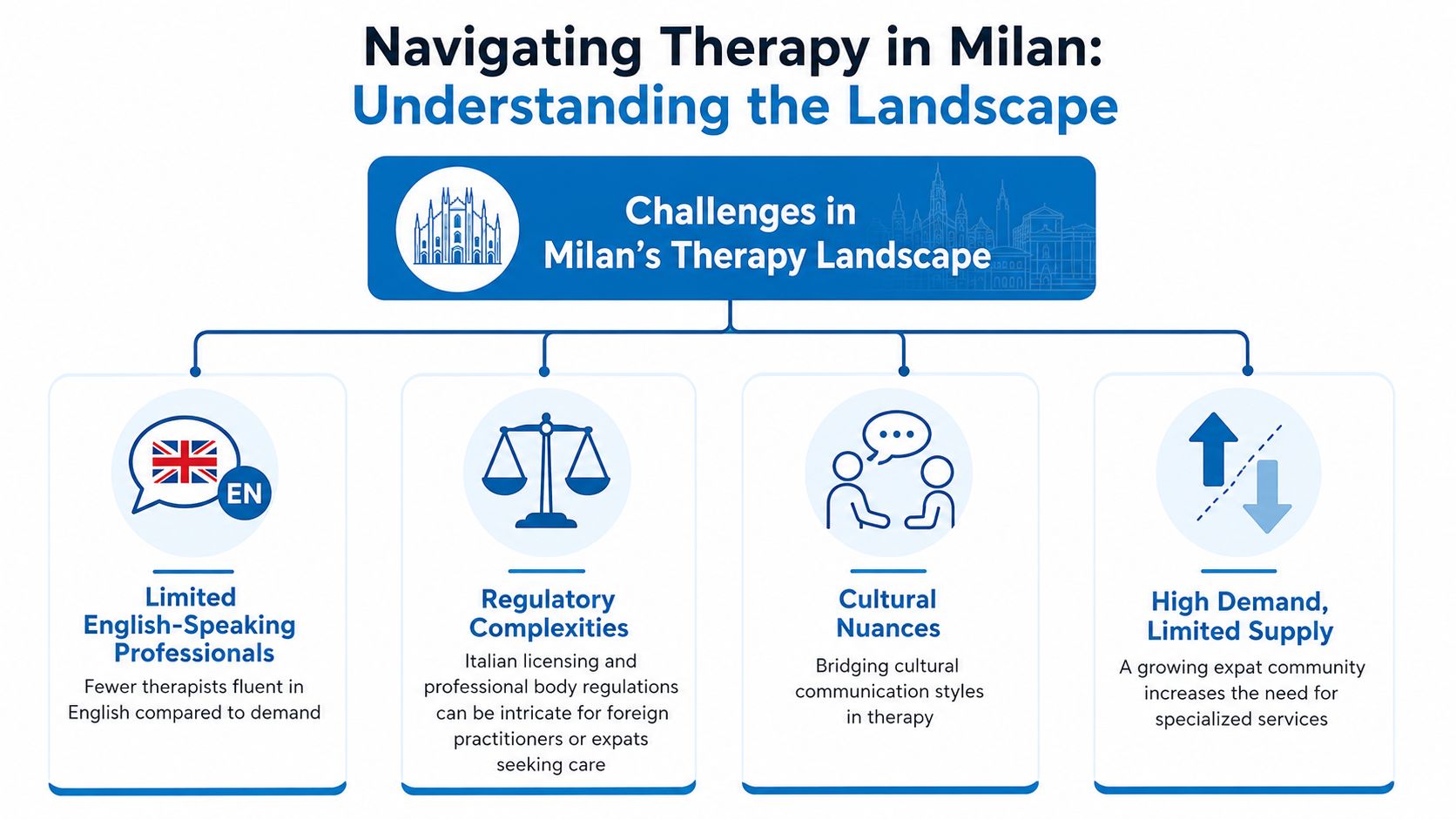
Finding an English speaking therapist in Milan isn't difficult because you're searching badly. It's difficult because the local system has real structural constraints.
Milan feels this shortage sharply because it hosts a large international population while the supply of multilingual clinicians remains limited.
In fact, psychologist availability inside Italy’s public health system is limited: the number of psychologists in the National Health Service fell from 9.5 to 8.5 per 100,000 inhabitants between 2013 and 2017 and then stabilised at that low level, according to the WHO European Observatory on Health Systems and Policies. Because most clinicians work privately, expats in Milan often turn to private, English-speaking care to get timely support.
Why supply feels tighter than expected
Milan attracts foreign professionals, international students, and intercultural couples, so demand is concentrated. At the same time, English fluency alone isn't enough. Clinical qualification matters, and in Italy that narrows the field further.
The same source notes that about 15% of licensed psychologists hold psychotherapist credentials.
In Milan, the search problem is not only language. It's language plus licensing plus specialization plus availability.
That is why many expats contact several professionals before finding the right fit.
If you're specifically looking at local options, therapy in Milan for expats and international residents gives a city-focused starting point.
The title confusion that trips people up
This is one of the most important distinctions to understand.
| Italian title | What it means | What to know |
|---|---|---|
| Psicologo | Psychologist | A licensed psychologist can provide psychological support and assessment. That title alone does not automatically mean they are qualified to provide formal psychotherapy. |
| Psicoterapeuta | Psychotherapist | A psychologist or medical doctor with additional psychotherapy training. This is usually the title expats need when they want ongoing talk therapy. |
| Psichiatra | Psychiatrist | A medical doctor specialized in psychiatry. They can prescribe medication and may work alongside a psychotherapist. |
For many expats, this distinction only becomes visible after a disappointing first consultation. Someone may speak excellent English and seem warm, but their scope of practice may not match what you need.
The same regulatory complexity also explains why digital discovery is uneven. Many practices aren't optimized for international patients, and many directories don't clearly separate titles, methods, and reimbursement pathways.
What this means in practice
When a search feels frustrating, don't assume the problem is your expectations. Milan has genuine bottlenecks.
The most useful mindset is this:
- Treat title verification as essential
- Assume availability may be limited
- Expect some screening before a good match appears
- Prioritize fit over speed, but don't ignore urgency
Actionable Search Strategies for Expats
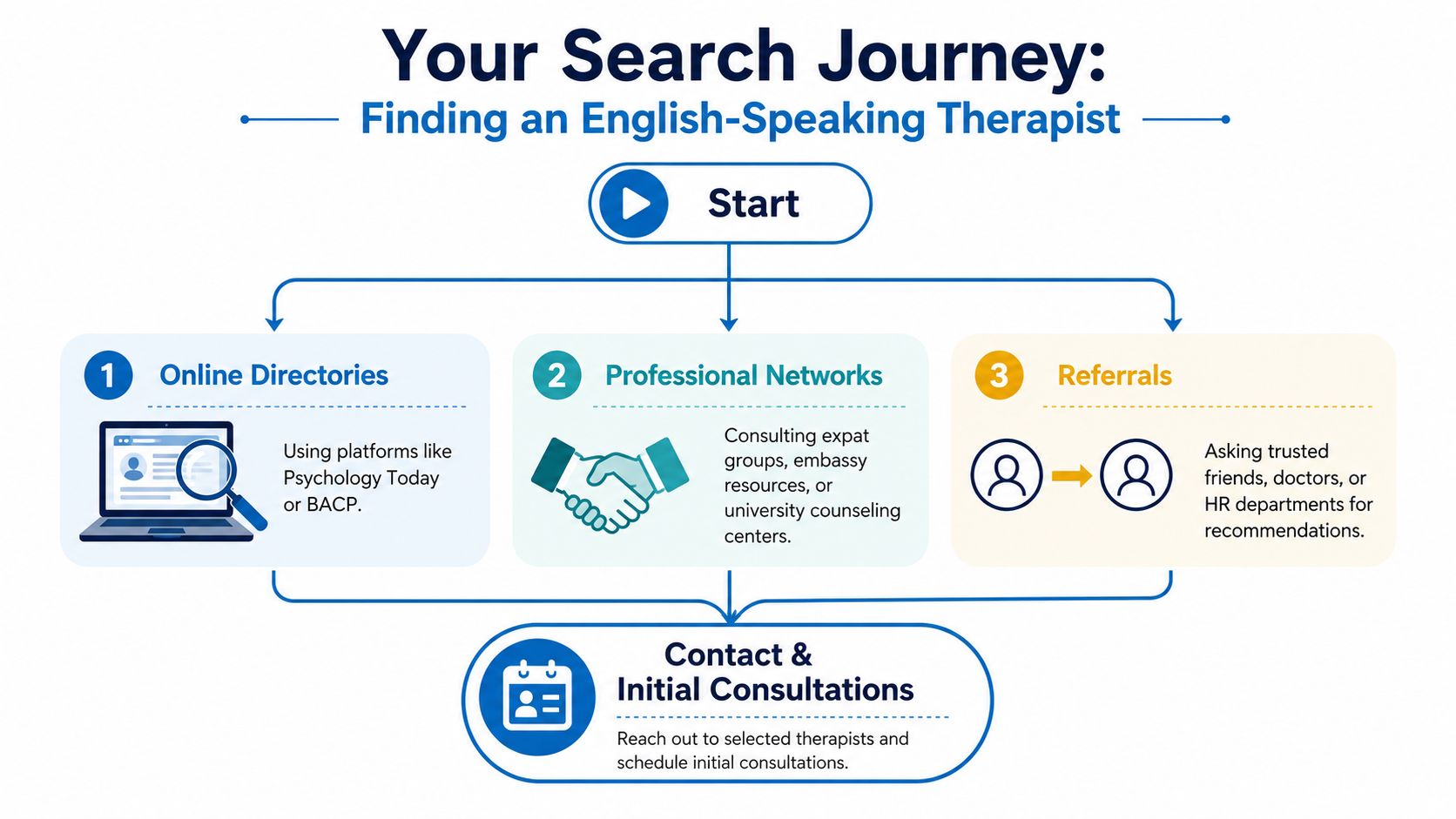
Once you understand the situation, the search becomes more practical. You don't need endless tabs open. You need a few reliable pathways.
That means a random search often isn't enough.
Pathway one through curated expat-focused searches
Start with platforms or services designed for international residents rather than general local listings. The advantage is simple. These options usually filter for language, format, and issues relevant to relocation.
A focused guide on finding the right therapist for expats in Italy can save time because it frames the search around actual expat needs rather than generic wellness categories.
What to look for in a listing:
- Clear professional title – You should be able to tell whether the person is a psicologo, psicoterapeuta, or psychiatrist.
- Language transparency – "Speaks English" can mean many things. Look for signs that English is used regularly in clinical work.
- Issue specificity – Culture shock, burnout, trauma, relationship strain, and identity stress are more useful indicators than a generic list of every possible concern.
Pathway two through trusted networks
A recommendation from the right community can be useful, especially in Milan where informal networks often fill the gaps left by formal systems.
Good places to ask include:
- University support desks if you're a student.
- HR or employee assistance channels if you work for an international company or institution.
- Expat communities where people share lived experience.
- Medical professionals you already trust such as a GP or specialist who works with international patients.
This approach works best when you use recommendations as a shortlist, not as proof of fit. Therapy is personal. A therapist who helped one person through homesickness may not be the best clinician for trauma, panic, or couple conflict.
Pathway three through direct matching support
If you're already overloaded, a matching service can reduce the emotional labor of searching. Instead of comparing dozens of profiles, you speak with someone who helps narrow the field based on language, goals, and practical constraints.
One option is Therapsy, which offers therapy in 14 languages, online and in person across 20+ Italian cities and 50+ physical locations, with 50+ therapists, 1,000+ clients served since 2023, and a Trustpilot 4.8/5 "Excellent" rating. The process includes a free first assessment call and human matching by the Clinical Director rather than automated questionnaires.
A search framework that works better than random browsing
Try this sequence:
- First, define the need – anxiety, burnout, trauma, depression, relationship issues, or adjustment stress.
- Then choose the minimum essential criteria – language, online or in-person, availability, and budget.
- Then contact a small number of suitable options – not too many.
- Finally, evaluate the response quality – clarity, professionalism, and whether your questions are answered directly.
Practical rule: A good therapist search is more like careful filtering than shopping. The aim isn't maximum choice. The aim is a safe and workable fit.
What usually doesn't work:
- contacting many clinicians with no criteria
- choosing only by neighborhood prestige
- assuming fluent English equals intercultural competence
- booking before checking title, method, and logistics
How to Evaluate a Potential Therapist
A shortlist is only the start. The next task is deciding who is qualified for your situation and who feels like a credible fit.
Approximately 72% of expats seeking therapy in Italy are young adults aged 20 to 39, and this group often seeks support for anxiety, culture shock, and isolation, according to Therapsy's overview of expat therapy demand. That matters because the right therapist for this age group usually needs more than technical skill. They need experience with transitions, identity stress, and intercultural adaptation.
The first layer of evaluation
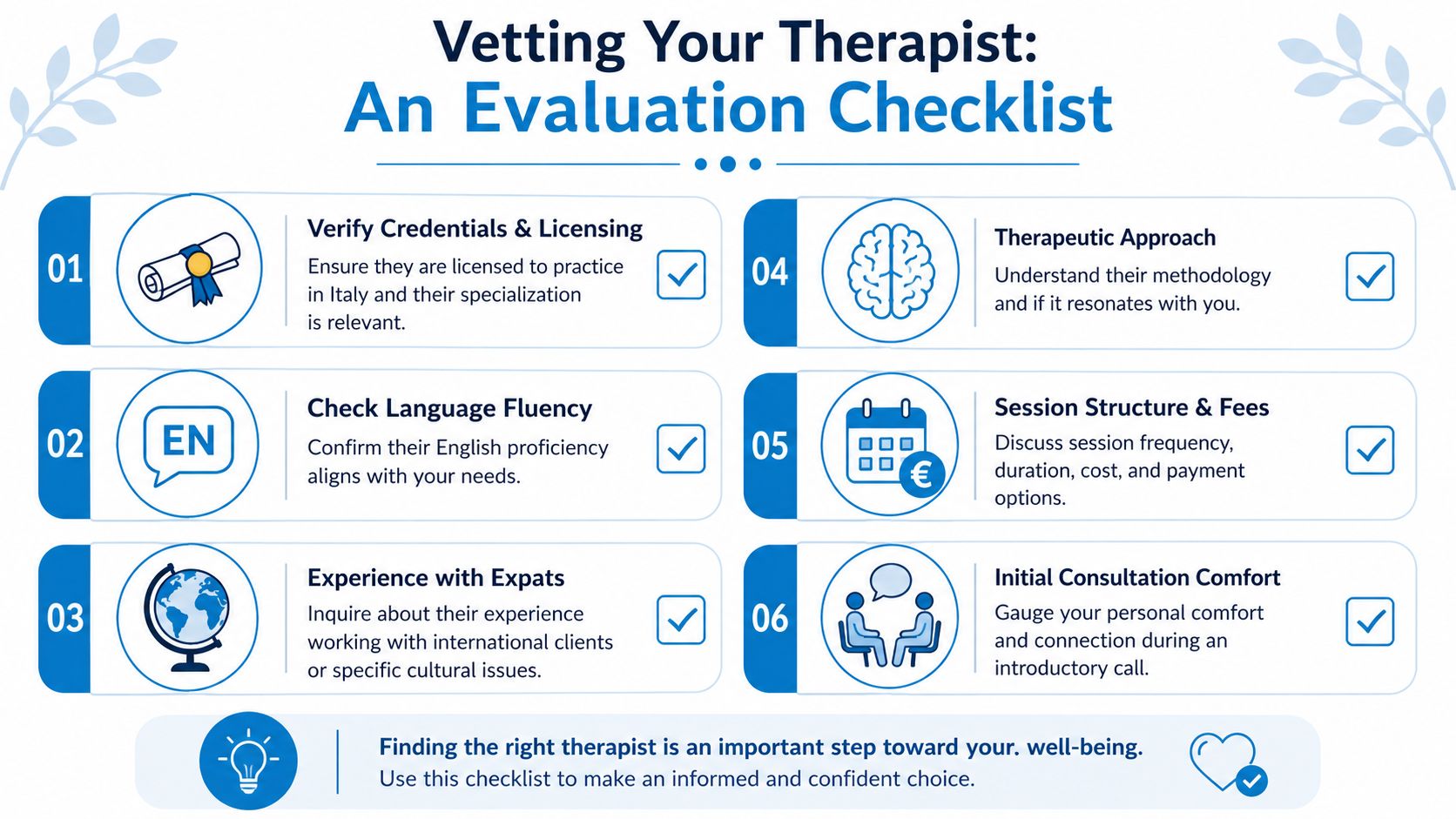
Before you think about personality, check the basics.
- Licensing – Confirm the therapist is registered and practicing legally in Italy.
- Title match – Make sure their title fits the care you're seeking.
- Language comfort – You should be able to discuss subtle emotional experiences without feeling linguistically trapped.
- Experience with expats – This doesn't need to be their only focus, but it should be part of their real clinical experience.
A therapist can be excellent and still not be right for your current needs.
Understanding therapy approaches in plain language
Different methods suit different problems. You don't need to become an expert, but it helps to know what you're hearing.
| Approach | Plain-language meaning | Often helpful for |
|---|---|---|
| CBT | Cognitive Behavioral Therapy helps you identify patterns in thoughts, feelings, and behaviors | Anxiety, panic, stress, depression, avoidance |
| EMDR | A trauma-focused method that helps the brain process distressing experiences differently | Trauma, disturbing memories, some forms of panic |
| Schema Therapy | Explores deeper recurring emotional patterns often rooted in earlier life experiences | Repeated relationship patterns, low self-worth, chronic emotional pain |
| Systemic-relational therapy | Looks at how problems are shaped by family, couple, or social systems | Couple conflict, family tension, intercultural relational stress |
Green flags and red flags
Green flags often sound ordinary. That's a good sign.
Green flags
- Clear answers about credentials, methods, and fees
- Comfort with intercultural themes such as belonging, homesickness, bicultural identity, or partner differences
- Collaborative tone rather than a rigid or superior style
- Reasonable boundaries around scheduling, confidentiality, and expectations
Red flags
- Vague credentials
- Inflated promises
- No explanation of therapeutic approach
- Pressure to commit quickly without enough clarity
- A style that makes you feel more confused than supported
The first sign of fit is not instant emotional relief. It's usually a sense that the therapist understands what you're asking and responds in a grounded, coherent way.
A good evaluation combines both head and gut. Credentials keep you safe. Relational fit helps the work progress.
Making First Contact and What to Ask
The first message doesn't need to be polished. It only needs to be clear enough to start a useful conversation.
Many people delay outreach because they think they must summarize everything correctly. You don't. A therapist isn't judging your writing. They're looking for enough information to say whether they can help, whether they have availability, and whether a first call makes sense.
A simple message template
You can write something like this:
Hello, I'm looking for therapy in English in Milan. I've been dealing with anxiety and adjustment stress since moving to Italy. I'm interested in knowing whether you work with expats, whether you offer online or in-person sessions, and your current availability. Thank you.
Short is fine. Honest is better than polished.
What to ask in the first call
Think of the first consultation as a two-way assessment. You're not only asking to be accepted. You're checking whether this therapist is right for you.
Useful questions include:
- Have you worked with expats or international students facing culture shock, burnout, or isolation?
- How would you describe your approach to therapy in simple terms?
- Do you work more in a short-term focused way, or longer-term?
- What would the first few sessions usually involve?
- Do you offer online, in-person, or both?
- How do fees, cancellations, and scheduling work?
- If it doesn't feel like the right fit, what happens next?
These questions do more than collect information. They show you how the therapist thinks. Some answer directly and clearly. Others stay abstract. That difference matters.
What to listen for
Pay attention to these signals during first contact:
- Clarity – Are answers straightforward?
- Warmth – Do you feel spoken to like a person, not a case?
- Clinical realism – Are expectations balanced, without overpromising?
- Cultural understanding – Do they grasp the difference between ordinary stress and migration-related stress?
You don't need a perfect emotional click in one call. But you do need enough confidence to imagine speaking openly with this person.
Online vs In-Person Therapy in Milan
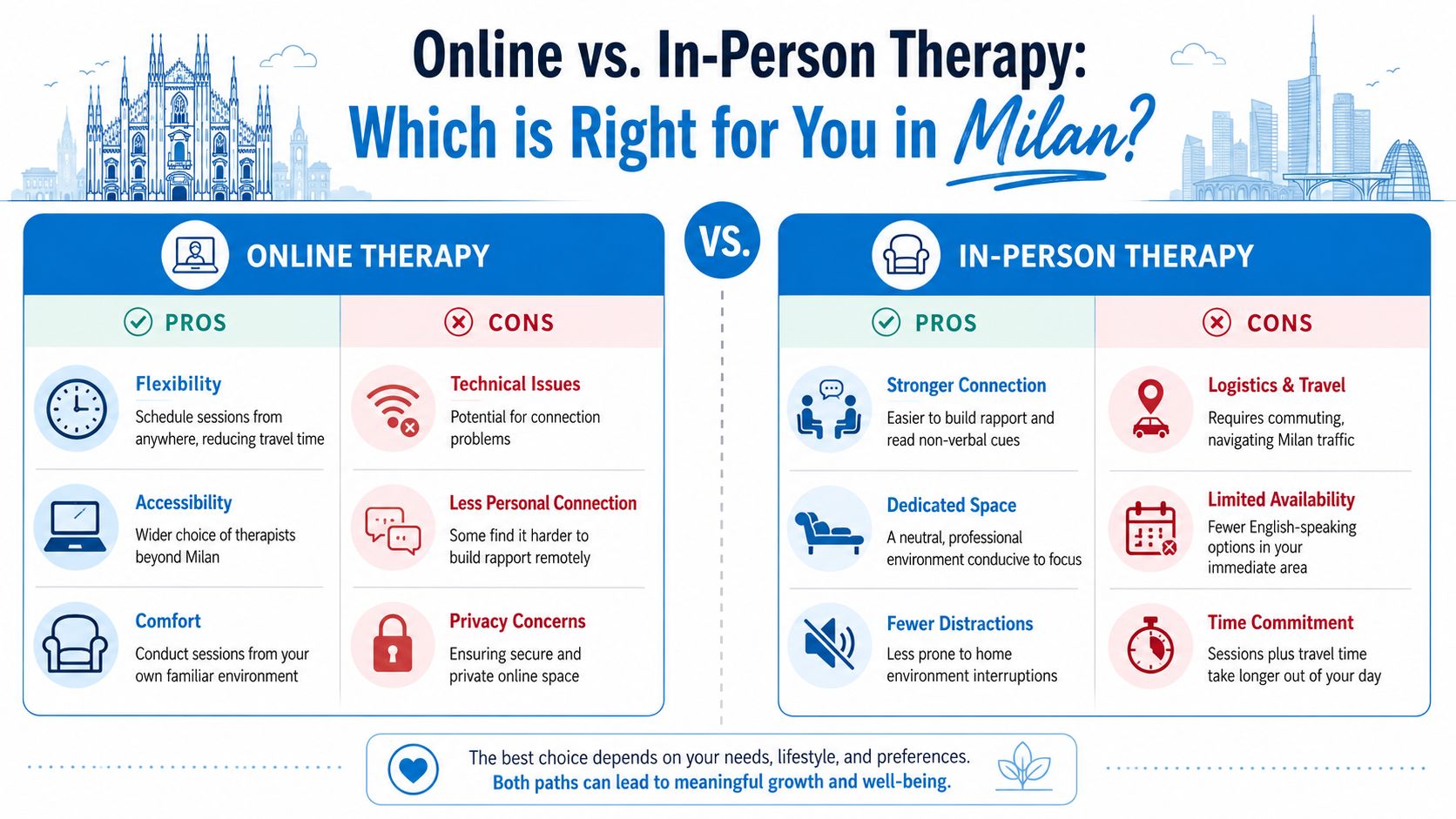
For expats in Milan, this decision is often practical before it's philosophical. Commutes, privacy, work schedules, and energy levels shape what is sustainable.
Both formats can work well. The better choice is usually the one you'll attend consistently and use sincerely.
When online therapy tends to work better
Online therapy is often the more realistic option if your week is already tight. It removes travel across the city, widens your access to English-speaking clinicians, and can be easier to maintain during work peaks or travel.
It may suit you if:
- Your schedule changes often
- You want a wider therapist pool
- You feel safer opening up from home
- You live outside the central areas of Milan
A deeper comparison of online and in-person therapy for expats in Italy can help if you're still unsure.
When in-person therapy tends to help more
Some people think more clearly in a dedicated physical space. The act of leaving home, entering a therapist's office, and having a consistent setting can support focus and emotional containment.
In-person sessions may be a better fit if:
- Home doesn't feel private enough
- You struggle to take online sessions seriously
- You rely heavily on nonverbal connection
- You want a stronger ritual around therapy
A realistic side-by-side view
| Factor | Online therapy | In-person therapy |
|---|---|---|
| Access | Broader choice of therapists | More limited by geography |
| Convenience | Easier around work and study | Requires travel time |
| Privacy | Depends on your home setup | Usually easier in a dedicated office |
| Atmosphere | Familiar environment | Clear separation from daily life |
| Consistency | Often easier to maintain | Better for some people who need structure |
The most effective therapy format is usually the one that creates the fewest practical obstacles between you and regular attendance.
You don't need to choose based on an ideal image of therapy. Choose based on real life in Milan.
Navigating Costs and Insurance
Money affects access. It also affects stress. If costs and reimbursement are unclear, many people postpone therapy longer than they want to.
That delay is common. Emerging 2025 data indicates that 68% of Milan expats delay therapy due to bureaucratic confusion around the SSN and insurance reimbursement, according to this overview of therapist access in Italy.
What private therapy usually means financially
For private care in Italy, session fees vary by clinician, training, and format. A transparent benchmark matters because uncertainty keeps people stuck.
Current pricing at Therapsy is:
- Individual therapy from €70/session
- Couple therapy from €100/session
- Psychiatric consultation from €110/session
- Psychodiagnostic assessment from €255
- First assessment call is free
If you want a fuller breakdown, therapy costs in Italy for expats gives more practical context.
Insurance and reimbursement without the usual confusion
International insurance may cover therapy, but coverage depends on the plan and the documentation required.
Before starting, ask your insurer:
- Which professional title is covered
- Whether prior authorization is required
- Whether online sessions are reimbursable
- What must appear on the invoice
- Whether you pay first and claim later, or use direct billing
Many expats often lose time. They assume the plan "probably covers therapy" and only check the details after several sessions.
The SSN trade-off for expats
Italy's public system can be difficult to access if you need timely therapy in English. The issue isn't only waiting. It's also bureaucracy, documentation, and the fact that many public pathways were not built around multilingual expat care.
That doesn't mean public care is never relevant. It means that for many foreign residents in Milan, especially those seeking psychotherapy in English with predictable scheduling, private care is the more workable route.
Some international professionals also have access through institutional partnerships and employer-linked insurance arrangements. If that's your situation, it's worth asking directly rather than assuming you must deal with the whole system alone.
Frequently Asked Questions
Is it hard to find an English speaking therapist in Milan
Yes, it can be hard, but it's possible with the right search strategy. The main challenge is not only language. It's finding a clinician whose qualifications, experience, and availability match what you need in a city where international demand is high.
Do I need a psicologo or a psicoterapeuta
For ongoing talk therapy, a psicoterapeuta is often the better fit. A psicologo may provide support and assessment, while a psichiatra is relevant if medication or psychiatric evaluation is needed.
How quickly should I know if a therapist is the right fit
You usually don't need many sessions to sense whether the basic fit is there. The first signs are clarity, safety, and the feeling that the therapist understands both your emotional concerns and your intercultural context.
Is online therapy a second-best option
No, online therapy isn't automatically a weaker option. For many expats, it is the format that makes therapy possible and consistent, especially when travel, work pressure, or location would otherwise interrupt care.
What if I feel anxious even speaking English about personal issues
That is more common than people expect. Stress can make even your strongest language feel less available, and some people also carry social anxiety around self-expression, so a practical guide to speaking English can be a useful companion resource while you prepare for therapy.
What if the first therapist I contact isn't the right one
That doesn't mean therapy won't work for you. It usually means the matching process needs refinement around method, personality, cultural understanding, or practical logistics.
The English-speaking therapists we work with in Milan
Therapsy works with seventeen therapists who receive in person in Milan and also see patients online. These are some of them, chosen to show the range of languages and specialisms available in the city.
Dr. Alexandra Kraslavski offers sessions in Hebrew as well as English and Italian, and works with a difficult relationship with food, weight and addiction.
Dr. Alina Charnavusava offers sessions in Russian. A Gestalt psychotherapist, she works on anxiety, sleep difficulties and relational difficulties, and has extensive experience with managers in international companies.
Dr. Eleni Karliampa offers sessions in Greek. She is Greek and lives in Italy as an expat herself, and works specifically on cultural identity and migration difficulties.
Dr. Maria Luisa Vampa works in French as well as English and Italian. A doctor before becoming a psychotherapist, she works with couples of every kind: intercultural, adoptive, blended and LGBTQ+ families.
Dr. Eleonora Montorfano offers sessions in German. She specialises in addiction, personality disorders, ADHD and burnout.
Dr. Matteo Innocenti is a psychiatrist and psychotherapist, so diagnosis, medication and the therapeutic work can be held by one clinician. He is a recognised expert in eco-anxiety.
Dr. Svetlana Loginova offers sessions in Russian and specialises in eating disorders and body image and in international couples.
This is a selection, not the full list: you can see everyone on our therapists page. You do not have to choose yourself. You tell Therapsy what you are looking for, a member of our clinical team reads your request, and they introduce you to whoever fits. The first call is free.
Will therapy help with culture shock and identity loss
It can help you make sense of those experiences and respond to them more skillfully. Approaches like CBT, Schema Therapy, attachment-based work, and intercultural psychotherapy can be especially useful when distress is tied to relocation, belonging, or repeated relationship patterns abroad.
Book your first free assessment call – no commitment, just a conversation with our Clinical Director who will listen and match you with the right therapist for you. Visit THERAPSY.