If you're looking for somatic therapy in English in Italy, you're often not just looking for a definition. You're trying to answer a more immediate question: Can I find a therapist who understands trauma, stress, burnout, or anxiety in a way that feels real in my body, and can I do that in English while living in Italy?
For many expats and international young adults, distress doesn't arrive as a neat thought. It shows up as a tight chest before a work call, a stomach knot after another bureaucratic dead end, shallow sleep, irritability, numbness, or the strange feeling of being constantly "on" even when nothing is wrong. You may know you're stressed, but you can't fully explain it, especially in a second language.
Somatic therapy in English in Italy is a body-centred form of psychotherapy that helps people notice and work with physical sensations as part of emotional healing. It can be especially useful when stress, trauma, or burnout live in the body more loudly than they live in words.
Understanding Somatic Therapy Principles
What somatic therapy actually means
Somatic therapy is a body-centred psychotherapy approach linking physical sensations with emotional processing. Harvard Health describes it as an approach that focuses on how emotions appear in the body and uses techniques such as body awareness, pendulation, and titration to help people work through trauma-related distress in a gradual way, as explained in Harvard Health's overview of somatic therapy.
That can sound abstract at first. In practice, it means a therapist doesn't only ask, "What were you thinking?" They may also ask, "What are you noticing in your chest, throat, stomach, jaw, or breathing right now?"
For an English-speaking person in Italy, that matters. Sometimes the body tells the story before language catches up.
Definition: Somatic therapy treats bodily sensations as meaningful clinical information, not as background noise.
How it differs from talk therapy
Talk therapy often starts with thoughts, memories, and relationships. Somatic therapy still values those things, but it pays close attention to the body's signals.
A few examples make this easier to grasp:
- After an argument: You may say you're "fine", but your shoulders stay lifted and your hands stay cold.
- During burnout: Your mind wants to rest, but your body stays braced as if something urgent is still happening.
- After a past trauma: You may not have clear words for it, but your body reacts fast to sound, touch, closeness, or uncertainty.
This doesn't mean the body is separate from emotion. It means the body is one of the places emotion is happening.
What therapists often focus on
Somatic work may include:
- Body awareness: noticing breath, posture, tension, heaviness, shakiness, warmth, numbness, or pressure
- Pendulation: moving gently between discomfort and steadier states
- Titration: approaching difficult material in small, manageable doses
- Orienting: helping the nervous system recognise the present environment as different from past danger
If you want a simple self-regulation practice outside therapy, some people find paced breathing helpful. It isn't a replacement for therapy, but it can help you begin noticing the link between breath and state.
If this body-first approach speaks to you, nervous system regulation therapy can also help clarify how therapists work with stress patterns that feel physical as much as emotional.
Why this can feel so validating for expats
Living abroad often creates a specific kind of strain. You may be safe, functional, and high-performing on paper, but still feel unsettled inside. The body absorbs the effort of adaptation: different rules, different rhythms, less family support, more self-monitoring, more translation.
Somatic therapy gives those reactions a place to be understood clinically, not dismissed as overreacting.
The Science of How Your Body Holds Stress
Some people arrive in therapy saying, "I know I'm not in danger, but my body acts like I am." That's one of the clearest reasons somatic work can help.
The nervous system doesn't only respond to what is happening now. It also responds to what it has learned to expect. When stress has been chronic, or when trauma has left the system on alert, the body can stay organised around protection long after the original situation has passed.
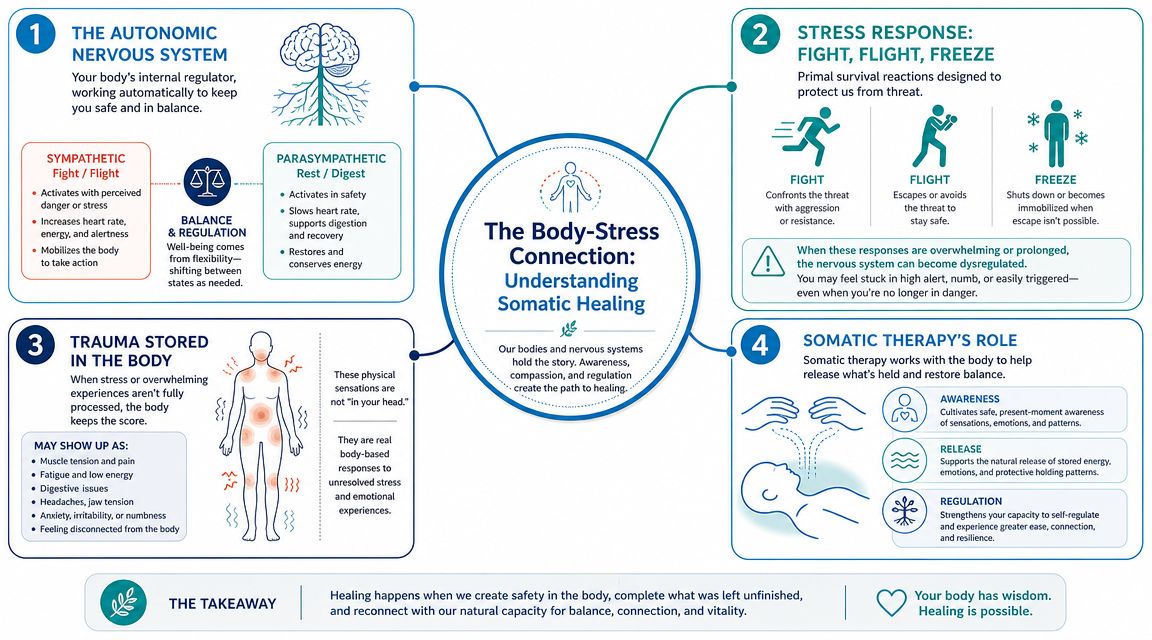
A simple way to understand the autonomic nervous system
You can think of the autonomic nervous system as the body's automatic safety system. It constantly asks, often outside awareness, "Am I safe enough to settle, connect, think clearly, and rest?"
When the answer is no, the body may shift into survival states such as:
- Fight: tension, irritability, defensiveness, anger
- Flight: restlessness, overworking, racing thoughts, inability to stop
- Freeze: numbness, collapse, fogginess, shutdown, feeling stuck
These aren't character flaws. They're protective responses.
The body can remain prepared for danger even when the mind understands the threat is over.
This is one reason people can feel confused by their own reactions. They may judge themselves for being "too sensitive" when what they're experiencing is a nervous system that learned to protect them efficiently.
Why somatic therapy is considered clinically meaningful
A key modality in this area is Somatic Experiencing, a body-oriented trauma treatment. A peer-reviewed review found preliminary evidence that it reduces PTSD-related symptoms and may also improve affective symptoms, somatic complaints, and well-being. The review also noted resource-orientation and touch as method-specific factors, as described in this review of Somatic Experiencing research.
That matters because it places somatic work inside trauma treatment, not outside it.
For readers who want another plain-language example of body-focused wellbeing resources, this short piece on Birch Wellness Center Winnipeg shows how some centres explain whole-person care in accessible terms. It's not an Italy-specific therapy guide, but it can help readers notice the difference between general wellness language and structured clinical care.
Three ideas that often change how people understand themselves
Resourcing
This means helping you find sensations, memories, images, postures, or actions that support steadiness. A resource might be the feeling of your feet on the floor, a remembered place, or the sense of your back against a chair.
Titration
This means not diving all at once into overwhelming material. The therapist helps you approach activation in smaller pieces so your system can stay engaged without being flooded.
Pendulation
This means moving between tension and ease, activation and settling, discomfort and stability. That movement helps the body learn that stress can rise and fall without taking over everything.
If physical symptoms and emotional distress are closely linked for you, psychosomatic therapy for emotional healing may also be a useful framework to explore.
What to Expect in a Somatic Therapy Session
Many people worry that a somatic therapy session will feel strange, overly physical, or hard to follow. In reality, it often feels slower, more collaborative, and more ordinary than expected.
A first session usually begins much like other psychotherapy sessions. You talk about what brings you in, what has been difficult, and what you hope will feel different. The difference is that the therapist also listens for how your experience appears in the body.

What you might hear in the room
You might hear questions like:
- "What do you notice in your body as you say that?"
- "Does that feeling have a shape, temperature, pressure, or movement?"
- "What happens if we stay with that sensation for just a moment?"
- "Do you notice any shift when you slow your breathing?"
The therapist isn't testing you. They're helping you build a language for your internal experience.
What you might actually do
A session may include gentle, simple interventions such as:
- noticing contact between your body and the chair
- tracking a wave of tightness in the chest
- observing whether your jaw clenches when discussing a certain topic
- experimenting with posture, breath, or very small movement
- pausing when activation rises too quickly
You don't need to perform anything. You don't need to produce dramatic insight. Often the work is subtle.
Practical rule: A good somatic session should feel paced, respectful, and consent-based. It shouldn't feel like you're being pushed past what your system can hold.
What about touch
Touch is one of the most misunderstood parts of somatic therapy. In some somatic modalities, touch may be part of the method. In others, it isn't used at all.
If touch is ever considered, it should be clinically intentional, clearly explained, and based on explicit consent. You always have the right to say no. Many excellent somatic sessions happen without any touch at all.
What online somatic therapy looks like
Online sessions can still be effective for somatic work because much of the process involves guided awareness, pacing, observation, grounding, and nervous system tracking. A therapist may ask you to notice your breath, your feet, your muscle tension, your urge to move, or the way your attention shifts while you speak.
If you're anxious about beginning therapy, reading about a first psychological session can make the experience feel more familiar before you start.
Who Can Benefit from Somatic Therapy
Somatic therapy can be helpful when distress doesn't stay only in thoughts. It often suits people whose emotions arrive through the body first.
That can include trauma, chronic stress, burnout, anxiety, and psychosomatic symptoms. It can also help people who say things like, "I understand what's happening logically, but my body doesn't get the message."
Common expat struggles that have a body component
If you're living in Italy and functioning in English while adapting to a new environment, your body may carry strain in ways you don't immediately recognise.
Some common examples include:
- Burnout after relocation: The move looked exciting from the outside, but your sleep, concentration, and energy never really stabilised.
- Anxiety hidden inside competence: You're doing your job, attending classes, or managing family life, but your stomach is tight every morning.
- Freeze in daily life: Bureaucracy, language barriers, and repeated uncertainty leave you mentally blank or physically shut down.
- Homesickness that becomes physical: You feel heavy, flat, restless, or disconnected rather than openly sad.
- Trauma reactivated by change: The stress of moving, isolation, or loss of routine stirs older survival responses.
When somatic therapy may be especially worth considering
This approach can be a strong fit if:
- Words feel insufficient: You talk about your stress clearly, but nothing shifts.
- Your body reacts fast: Startle, panic, numbness, exhaustion, bracing, or shutdown happen before you've made sense of them.
- You feel disconnected from yourself: You live from the neck up and struggle to notice hunger, fatigue, tension, or comfort.
- You carry psychosomatic symptoms: Emotional stress appears through pain, digestive discomfort, tension, or unexplained physical unease.
Somatic therapy isn't only for acute trauma. It can also support people who have spent a long time adapting, pleasing, pushing through, or staying hyper-functional.
What it doesn't mean
Choosing somatic therapy doesn't mean abandoning structured psychotherapy. In many cases, the most useful work integrates body awareness with evidence-based approaches such as CBT, EMDR, or Schema Therapy.
The value of somatic work is that it helps the body participate in healing, not just the thinking mind.
Finding English Somatic Therapy Across Italy
Many readers encounter a common hurdle. Understanding the method is one thing. Finding a qualified English-speaking clinician in Italy is another.
The practical difficulty isn't only awareness. It's access and fit. You may be in Milan or Rome and still feel unsure how to evaluate someone. Or you may live outside a major city and wonder whether somatic therapy in English in Italy is realistically available to you at all.
What the wider market suggests
Globally, somatic therapy is no longer a fringe concept.
That figure doesn't tell you where to book in Bologna or Palermo. But it does tell you something useful. Seeking body-based trauma-informed care in Italy aligns with a growing international mental health category, not a passing wellness fad.
How people usually look for care
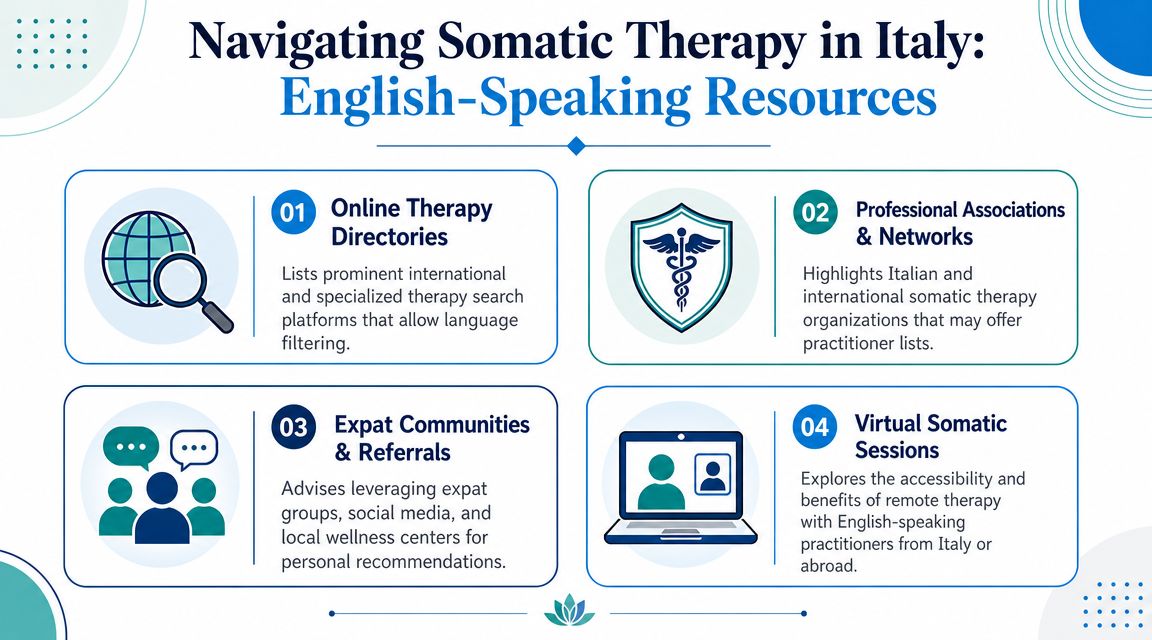
In practice, English-speaking clients in Italy often use a mix of routes:
- General therapist directories with language filters
- Referrals from expat communities, friends, universities, or colleagues
- Online therapy providers that can match by language and issue
- Private practices in major cities offering trauma-informed psychotherapy
Each route has limitations. Directories can be broad but uneven. Personal referrals may reflect chemistry rather than clinical fit. Local availability outside large cities can be patchy.
Why online access matters in Italy
Online somatic-informed psychotherapy has become especially important for people who live outside major urban centres, travel often, or want continuity while moving between cities or countries.
One practical option is finding an English-speaking therapist in Italy, including online and in-person care. Therapsy offers psychotherapy in 14 languages, with online and in-person sessions across 24 Italian cities and 90+ physical locations, and uses a human matching process led by the Clinical Director rather than automated questionnaires. For expats who need body-aware, trauma-informed support in English, that kind of structure can reduce the guesswork.
What to prioritise over location alone
A therapist being nearby isn't enough. For somatic therapy, the more important questions are:
- Do they have recognised trauma training?
- Can they explain their approach clearly?
- Are they comfortable working in English?
- Do they understand expat stress, intercultural identity, and the strain of living between systems?
- Can they offer online continuity if your location changes?
If you find someone who is clinically solid, linguistically fluent, and a good relational fit, online care may be more helpful than forcing an in-person option that isn't right for you.
How to Choose Your English Speaking Somatic Therapist
Choosing a somatic therapist shouldn't feel like guesswork. The right questions can quickly tell you whether a clinician is grounded, qualified, and suitable for your needs.
A useful starting point is this: look for recognised trauma-method training and ask how they work. That matters because one major gap for expats is knowing whether an English-speaking therapist in Italy is properly trained, as noted in this discussion of therapist fit and qualification questions.
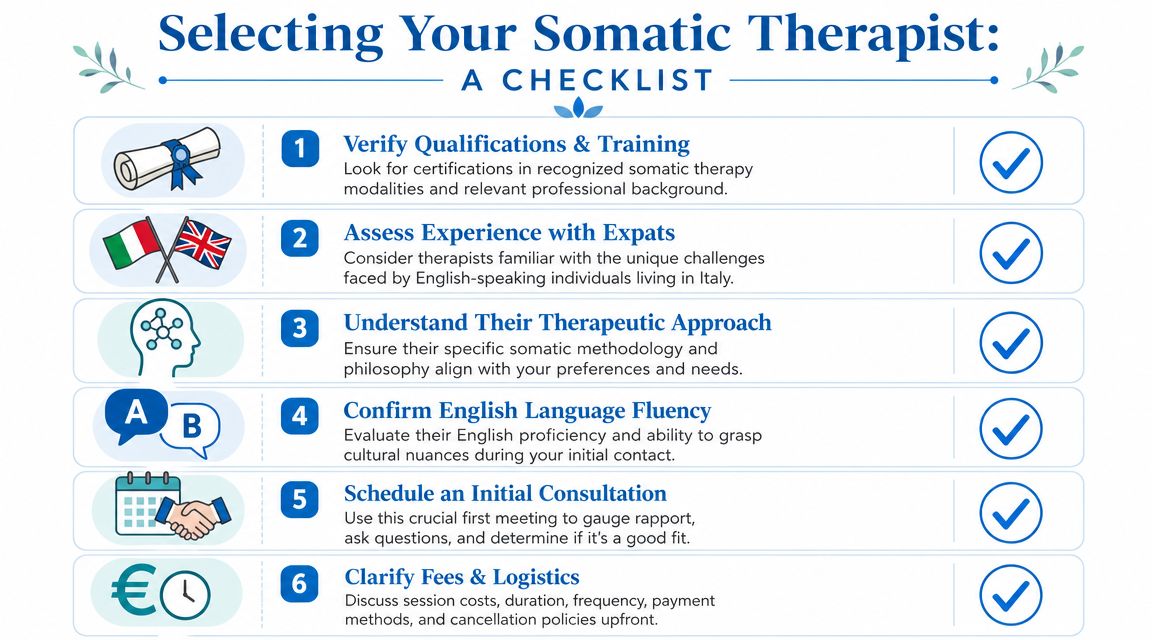
What to check before you book
Use this shortlist when evaluating a therapist:
- Professional licence: They should be a licensed mental health professional working within psychotherapy, not only a wellness practitioner.
- Trauma-specific training: Look for recognised modalities such as Somatic Experiencing, EMDR, Sensorimotor Psychotherapy, or related trauma-informed training.
- Clear scope of practice: They should be able to explain what somatic work is, what it isn't, and when another approach may be more suitable.
- English fluency: Not just conversational English, but the ability to understand nuance, shame, ambiguity, and emotional complexity.
- Experience with international clients: Expat life changes how stress, identity, belonging, and relationship strain appear in therapy.
Questions worth asking in a consultation
You don't need to sound clinical. You just need direct questions.
Ask about method
- What kind of somatic therapy are you trained in?
- How do you integrate body work with psychotherapy?
- How do you work with trauma, anxiety, or burnout?
Ask about pacing and safety
- What happens if I become overwhelmed in session?
- Do you use touch, and if so, how do you handle consent?
- Can this work be done online?
Ask about fit
- Have you worked with expats or multilingual clients before?
- How do you approach situations where stress is tied to relocation, culture shock, or language fatigue?
A good therapist should be able to answer these questions without becoming defensive, vague, or overly mystical.
When matching support helps
For many clients, the hardest part isn't therapy itself. It's deciding who to trust first. A structured service can reduce that burden if someone knowledgeable vets clinicians for training, language, and fit before you begin.
If you'd like a clearer framework for that process, finding the right therapist for expats in Italy can help you think through what matters beyond a simple directory listing.
FAQ
Is somatic therapy a legitimate form of psychotherapy
Yes, somatic therapy is a legitimate psychotherapy approach when practised by a properly trained mental health professional. It is best understood as body-centred psychotherapy rather than generic bodywork, and some modalities, including Somatic Experiencing, have preliminary evidence for trauma-related symptom relief. The key is to look for a licensed clinician with recognised trauma training.
Can I find somatic therapy in English if I don't live in Milan or Rome
Yes, many people can access this support online even if local in-person options are limited. This is especially important in Italy, where specialist English-language therapy may be concentrated in larger cities. Online work can still include grounding, body tracking, pacing, and other somatic elements when guided well.
What's the difference between somatic therapy and mindfulness or yoga
Somatic therapy is psychotherapy, while mindfulness and yoga are practices that may support wellbeing but aren't the same as clinical treatment. Somatic therapy focuses on the relationship between bodily sensations, emotional processing, trauma responses, and therapeutic change within a structured clinical setting. A therapist also helps with pacing, safety, formulation, and integration.
What issues can somatic therapy help with
Somatic therapy is often considered when people experience trauma, anxiety, chronic stress, burnout, or psychosomatic symptoms. It can be especially helpful when distress shows up through tension, numbness, stomach issues, shakiness, poor sleep, or a persistent sense of being on edge. Many expats also seek it when adaptation stress feels physical as much as emotional.
Does somatic therapy involve touch
Sometimes, but not always, and it should never happen without explicit consent. Many somatic therapists don't use touch at all, especially online. If touch is part of a therapist's modality, they should explain why, how, and when it is used, and you should always feel free to decline.
How much does therapy cost in Italy
Costs vary by provider, format, and level of specialisation. At Therapsy, individual therapy starts from €70 per session, couple therapy from €100, psychiatric consultation from €110, and psychodiagnostic assessment from €255 for 3 sessions. A free first assessment call can help you understand fit and options before committing.
Is somatic therapy covered by insurance
Sometimes, but coverage depends on your policy and provider network. Private international insurance or employer-supported plans may reimburse psychotherapy in some cases, while public coverage works differently and can be more limited for English-speaking private care. It's worth checking directly with your insurer before you start.
How long does it take to notice a difference
It depends on your goals, history, symptoms, and the quality of the therapeutic fit. Some people notice early changes in awareness, grounding, or body regulation, while deeper trauma work usually takes longer. The most realistic expectation is gradual change rather than a dramatic instant release.
If you're trying to find support that feels clinically grounded, culturally sensitive, and possible in real life, book your first free assessment call with Therapsy. It's a no-commitment conversation with our Clinical Director, Dr. Francesca Adriana Boccalari, who will listen carefully and match you with the therapist who fits your needs, language, and situation.