Bari can be a beautiful place to build a life. You can finish work and walk by the sea, learn your favorite bakery order in Italian, and start feeling that the city is opening to you. At the same time, daily life can feel heavier than it looks from the outside. Small bureaucratic tasks take too much energy. Casual conversations can leave you feeling behind. Even good days can carry a low hum of strain.
That's why the search for an English-speaking therapist in Bari is often about much more than language. It's about finding one place where you don't have to translate your feelings, soften your words, or explain every cultural reference before you can talk about what hurts. For many expats and international students in southern Italy, that kind of space can make the difference between merely getting through the week and fully settling into life here.
If you're a young adult living in Bari and wondering whether therapy in English is possible, practical, and worth pursuing, the short answer is yes. The process is more straightforward when you know what to look for, how Italian qualifications work, and what kind of support fits your life.
Finding Your Footing in Bari and The Search for Support
Bari often wins people over slowly. First the light. Then the sea. Then the feeling that ordinary life happens outdoors here. You might find yourself eating focaccia on a bench near the old town and thinking, for a moment, that you've made exactly the right decision.
Then a different day arrives. You spend the morning trying to decode paperwork. You avoid making a phone call because you're tired of searching for words. You go out in the evening and still feel strangely alone in a crowded place. The city is welcoming, but you're still outside of its rhythms.

That mix is common. Expats in smaller Italian cities often feel pressure to be grateful all the time. Bari is beautiful, so why are you anxious? You chose this move, so why do you feel disoriented? Those questions can create a second layer of distress. Now you're struggling, and judging yourself for struggling.
A valid reason to seek therapy is simple: life abroad is asking more of you than people can see.
The practical search can feel confusing too. In a city like Bari, the local support scene doesn't always look as visible or international as it does in Milan or Rome. If you want to explore a local option first, it helps to start with a service that clearly explains its Bari presence, such as multilingual therapy in Bari.
What usually works is treating therapy as a support structure, not a last resort. You don't have to wait until everything becomes unmanageable. If your mood is flatter, your sleep is worse, your relationship is under strain, or you're carrying constant mental load just to function in another language, that already matters.
What people often need most at this stage
- Clarity: A place to sort out whether this is stress, loneliness, burnout, culture shock, or all of them at once.
- Language safety: The freedom to speak naturally, especially when talking about shame, grief, anger, or identity.
- Practical continuity: Support that fits real life in Bari, including work schedules, travel, and the unpredictability of expat life.
Why Expat Life in Southern Italy Can Be Challenging
Living abroad changes more than logistics. It changes how you regulate yourself. Small acts that once happened automatically now require effort. You may need more planning, more interpretation, and more emotional energy just to get through ordinary days.
In cross-cultural psychology, this is often understood through culture shock, adjustment stress, and identity strain. These aren't signs that something is wrong with you. They are common responses to a life where your habits, support systems, and social cues have all shifted at once.
Why Bari can feel different from larger expat hubs
In bigger international cities, it's often easier to stay partially inside an English-speaking bubble. Bari offers something different. That can be part of its charm, but it can also intensify the emotional work of adapting.
You may notice:
- Fewer informal support networks in English: It can take longer to find “your people.”
- More pressure to adapt quickly: Because local life feels more rooted, you may feel like the outsider more sharply.
- A stronger contrast between outer beauty and inner stress: When your surroundings are lovely, distress can feel harder to admit.
Missing home doesn't mean you made the wrong move. It means you had a life that mattered before this one.
There's also a form of grief that many expats don't name. You can love your new city and still mourn your old life. You may miss the version of yourself who knew how things worked, who could move through the day without rehearsing every interaction, and who had relationships that didn't require rebuilding from zero.
The psychological patterns underneath
Several therapeutic frameworks help make sense of this:
CBT, or Cognitive Behavioral Therapy
CBT looks at how thoughts, emotions, and behaviors reinforce each other. In expat life, one awkward social moment can quickly become “I don't fit here,” followed by withdrawal, which then deepens loneliness.Attachment theory
Moving countries can activate old patterns around safety, closeness, and belonging. If you already struggle with abandonment fears or difficulty trusting others, relocation can intensify those reactions.Schema Therapy
Schema Therapy explores deeper life themes, such as not belonging, failing, or having to cope alone. Expat life can trigger these patterns because it removes familiar buffers and routines.Cross-cultural psychology
This lens helps separate personal distress from the strain of adaptation. Not every hard feeling is a personal flaw. Sometimes it's the predictable result of living between cultures.
If social situations have become especially draining, it can help to read practical guidance on coping with social anxiety in daily life, especially when the stress of speaking another language makes ordinary interactions feel high stakes.
For many expats, the turning point comes when they stop asking, “Why am I reacting like this?” and start asking, “What support would make this easier to carry?” A helpful starting point is learning more about cultural differences in Italy for expats, because naming the adaptation process often reduces self-blame.
In-Person vs Online Therapy Your Options in Bari
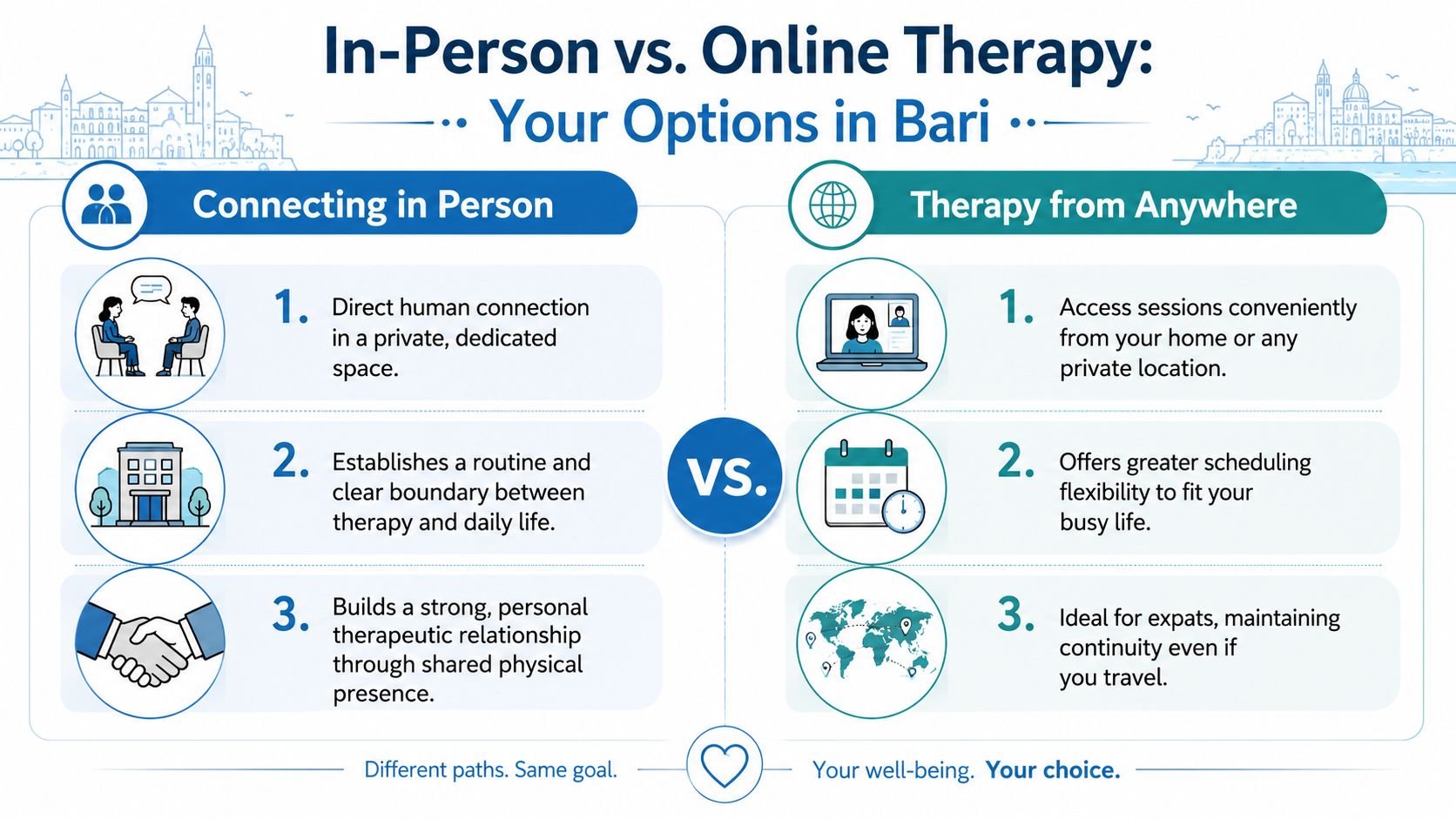
For therapy in Bari, individuals often assume they have to choose between convenience and quality. In practice, the better question is more specific: What format will make it easiest for you to show up consistently and share authentically?
Both in-person and online therapy can work well. The trade-offs are real. The right choice depends on privacy, schedule, travel patterns, therapeutic needs, and whether local specialist availability matters for your situation.
What in-person therapy tends to offer
For some people, walking into a therapy room changes everything. The physical setting creates a boundary. You leave your apartment, your dishes, your laptop, and your distractions outside.
In-person sessions often help when:
- You need a clearer emotional container: A separate space can make it easier to focus.
- Home doesn't feel private enough: Shared flats and thin walls can make online openness difficult.
- Routine helps you stay committed: Leaving the house for a standing appointment can strengthen consistency.
The limitation in a smaller city is choice. You may find fewer English-speaking therapists, fewer specializations, or fewer appointment times that fit your week.
What online therapy tends to solve
Online therapy removes geography from the equation. That matters more than people expect. If you need a therapist who understands trauma, intercultural relationships, or a specific evidence-based method such as EMDR or Schema Therapy, online care can widen your options substantially.
Online sessions are often best when:
- Your schedule changes often: Work, commuting, study, and travel make flexibility important.
- You want continuity: You can keep the same therapist even if you leave Bari temporarily.
- Specialization matters: You don't have to rely only on who happens to practice nearby.
Practical rule: The best therapy format is the one you can maintain when life gets messy, not the one that sounds ideal on a calm day.
In-Person vs. Online Therapy for Expats in Bari
| Feature | In-Person Therapy | Online Therapy |
|---|---|---|
| Setting | Dedicated private office | Home or another private space |
| Travel | Requires commuting in Bari | No travel required |
| Therapist choice | More limited locally | Wider access across Italy |
| Routine | Strong physical ritual | Easier to fit into busy weeks |
| Privacy | Strong if you prefer office space | Depends on your home setup |
| Continuity while traveling | Harder to maintain | Easier to continue |
A hybrid approach is often the most realistic. Some people start online because they want faster access and more choice, then move to in-person later if they prefer. Others do the reverse. If you want a fuller breakdown of the decision, online vs in-person therapy in Italy for expats covers the main considerations clearly.
How to Choose a Qualified English-Speaking Therapist
Fluent English matters. It is not enough on its own.
The safer question is this: Is this person legally qualified to provide psychotherapy in Italy, and do they have the right clinical approach for what you need? Many expats focus first on language and only later discover that titles, training, and legal registration matter just as much.
Start with the legal basics
In Bari, Italy, licensed English-speaking psychotherapists practicing within established clinical networks like Therapsy adhere to Italian National Law 56/1989, which requires practicing psychologists to hold a master's degree in Psychology, complete either a 5-year postgraduate specialization school or 2 years of supervised practice, and register with the local Ordine degli Psicologi to legally offer psychotherapy, as explained on Therapsy's Bari page.
That gives you a practical screening checklist.
- Check legal registration: Ask whether the therapist is registered with the relevant Ordine degli Psicologi.
- Confirm the professional title: In Italy, psychologist, psychotherapist, and psychiatrist are not interchangeable.
- Ask about session language: “Speaks English” can mean conversational fluency, not clinical fluency.
Then ask about therapeutic fit
Different approaches help with different problems. You don't need to become an expert, but you should know the basics.
- CBT: Useful when anxiety, panic, stress loops, avoidance, or self-critical thinking are prominent. It is structured and practical.
- EMDR: Often considered when trauma, distressing memories, or persistent nervous system activation are central concerns. It helps process overwhelming experiences.
- Schema Therapy: Helpful when the same painful patterns repeat across relationships, work, or self-esteem. It goes deeper than symptom management.
- Systemic-relational therapy: Often valuable for couples, family dynamics, and recurring interpersonal conflict.
A short interview helps
Before booking ongoing sessions, ask direct questions such as:
- What is your qualification in Italy?
- Are you registered with the Ordine degli Psicologi?
- What kinds of issues do you usually work with?
- How do you approach therapy with expats or intercultural clients?
- What happens if the fit doesn't feel right after the first session?
Credentials protect you. The relationship helps you heal. You need both.
The therapeutic alliance matters more than many people expect. That means the sense that you feel safe, understood, and able to be honest with the therapist. A highly trained professional who doesn't feel like a good fit may not be the right choice for you. If you're unsure how to evaluate that fit, this guide to finding the right therapist for expats in Italy is a useful next step.
Therapsy A Dedicated Resource for Expats in Bari
For expats in Bari, one challenge is simple visibility. Qualified support may exist, but it isn't always easy to identify who offers therapy in English, who is properly licensed, and who can also understand intercultural stress rather than treating it as a side issue.
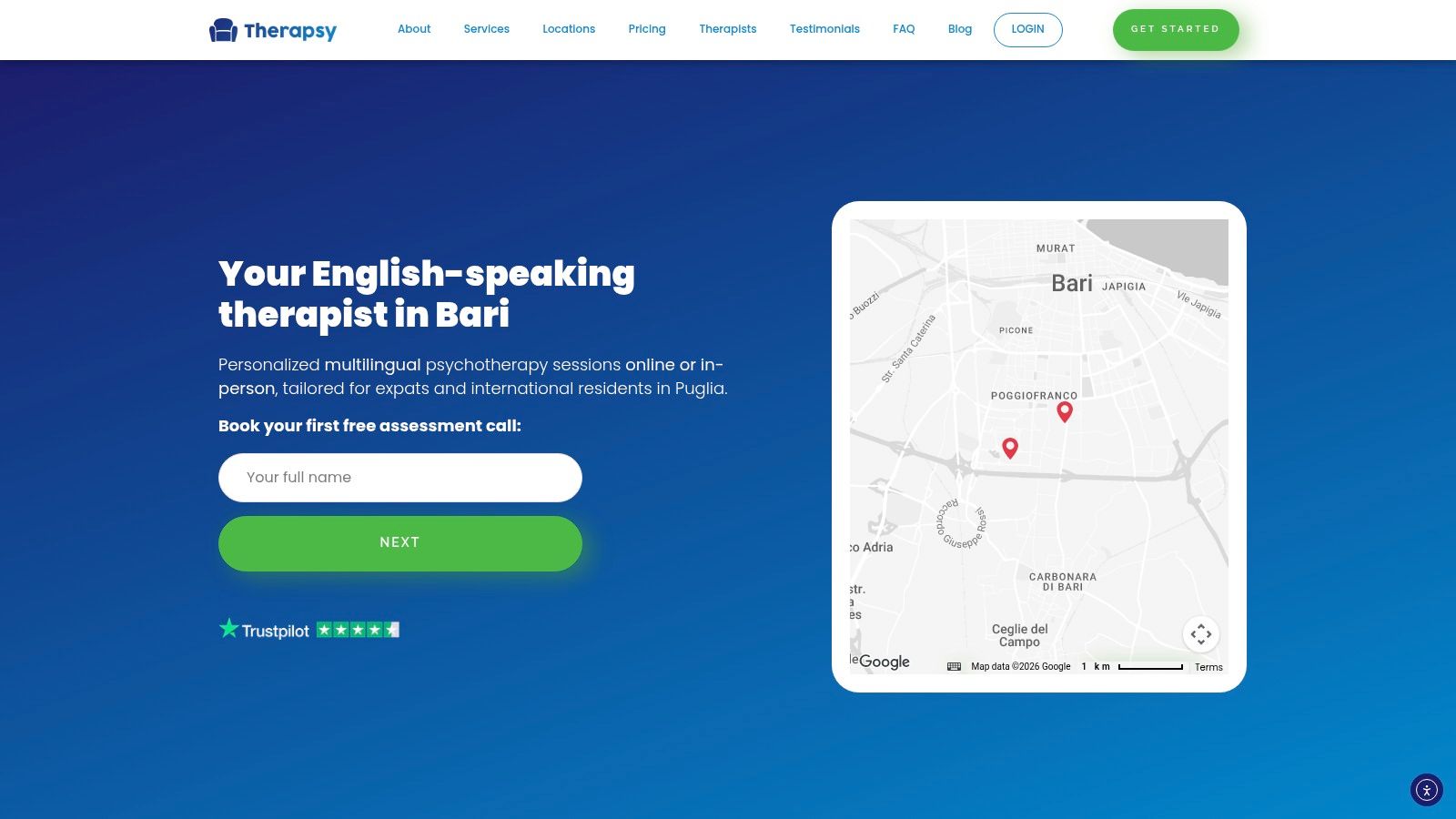
One option with a verified local presence is Therapsy, which serves Bari through two dedicated in-person locations at Via Michele Mitolo 17/A and Corso de Gasperi 413/C, as part of a network of 50+ physical sites across 20+ Italian cities. The service was founded in 2023 by Clinical Director Dr. Francesca Adriana Boccalari and has expanded to over 50 licensed therapists who have supported more than 1,000 international clients since inception, according to Therapsy's English-speaking therapist in Italy page.
That matters in Bari because the local market can feel narrower than in Milan or Rome. A service with both in-person and online access gives you more room to prioritize fit, language, and specialization rather than settling for whoever happens to be available nearby.
Why this model can work well for expats
Some practical advantages stand out:
- Multilingual access: Therapy is available in 14 languages, which helps when English isn't your only or first emotional language.
- Human matching: The process is guided by the Clinical Director rather than an automated quiz.
- Flexible format: You can choose online care, in-person sessions in Bari, or a mix of both.
- Institutional familiarity: The service works with international communities and organizations, which often matters for expats navigating unfamiliar systems.
There's also a trust signal that many people look for before making first contact. Therapsy has a 4.8/5 "Excellent" rating on Trustpilot, noted on the same English-speaking therapist in Italy page. For someone already feeling unsure, that can make the first outreach feel less risky.
What this does and doesn't solve
No service is a magic fix. Matching still matters. Timing matters. Your willingness to show up authentically matters. But a structured multilingual network can remove several barriers at once: uncertainty about qualifications, confusion about language, and the common expat fear of having to explain your entire life context before therapy even begins.
What tends not to work is choosing support based only on speed, or only on who answers first. What works better is a combination of verified credentials, language comfort, and a therapist who understands the pressure points of living between cultures.
What to Expect From Your First Therapy Session
Starting therapy can feel oddly vulnerable even when you know it's a good idea. Many people aren't afraid of therapy itself. They're afraid of getting it wrong. They worry they won't know what to say, that their problems won't sound serious enough, or that they'll be judged for being emotional, confused, or ambivalent.
The first contact is usually much simpler than people imagine.

The first step is a conversation, not a commitment
With a human-matched service, the process typically begins with a free first assessment call. This is not meant to pressure you into therapy or force you to tell your whole life story immediately. It is there to understand what you need, answer practical questions, and see whether the proposed therapist feels like a sensible fit.
You can use that first contact to say things plainly:
- I've never done therapy before.
- I'm not sure whether this is anxiety or burnout.
- I need someone who understands expat life.
- I want sessions in English because that's the language I can be honest in.
What happens in the first full session
The first therapy session is usually an orientation session. The therapist will likely ask what brought you there now, what has been difficult recently, and what you hope might change. They may ask about your move to Italy, your relationships, your work or studies, and any relevant mental health history.
Expect discussion around:
- Confidentiality: What is private and how therapy boundaries work.
- Goals: Not perfect goals, just a starting point.
- Patterns: Sleep, stress, relationships, avoidance, mood, and coping habits.
- Fit: Whether the conversation feels safe and useful enough to continue.
You do not need a polished explanation of your pain for therapy to begin. “I'm not doing well, and I don't fully understand why” is enough.
A good first session should leave you feeling more oriented, not more confused. You don't need instant relief or a breakthrough. You need a workable sense that this person can help you make sense of what's happening.
Understanding the Cost of Therapy in Bari
Cost matters because therapy works best when it is financially sustainable, not when it creates another source of stress.
For private care in Italy, a clear benchmark helps. At Therapsy, individual therapy starts from €70 per session, couple therapy from €100 per session, psychiatric consultation from €110 per session, and psychodiagnostic assessment from €255 for 3 sessions, as listed on therapy pricing in Italy.
A few practical points are worth keeping in mind:
- “From” matters: Price can vary based on the therapist's experience and specialization.
- Specialized care may cost more: This can apply when you need a particular modality or level of expertise.
- Consistency matters more than intensity: A rhythm you can maintain is usually more useful than overcommitting and stopping abruptly.
Therapy is an investment, but it's also a form of prevention. People often seek support only after months of strain. Starting earlier can help you address anxiety, isolation, conflict, or burnout before those patterns harden into your daily normal.
The English-speaking therapists we work with in Bari
Therapsy works with a therapist who receives in person in Bari and also sees patients online.
Dr. Mariateresa Volpe is a psychologist and CBT psychotherapist working in French, English and Italian, licensed in both Italy and Quebec, with over 15 years of clinical experience. Her expertise is in eating disorders, complex trauma and OCD, using third-wave approaches such as DBT, ACT and CBT-E. She has specific experience with LGBTQI+ patients and takes on complex clinical cases.
You tell Therapsy what you are looking for, a member of our clinical team reads your request, and they introduce you. The first call is free.
FAQ
Can I find an English-speaking therapist in Bari without speaking Italian?
Yes, you can find an English-speaking therapist in Bari without speaking Italian. The key is to focus on providers who clearly state that they work with expats and international residents, and who explain their language options and booking process in English. This reduces the usual friction of navigating local healthcare systems in a second language.
Is online therapy a good option if I live in Bari?
Yes, online therapy can be an excellent option if you live in Bari. It often gives you access to a wider range of therapists, languages, and specializations than local in-person searches alone. It is especially helpful if you travel often, have limited privacy for commuting, or want continuity even if your circumstances change.
How do I know if a therapist in Italy is properly qualified?
The most direct answer is to verify that the therapist is legally qualified and registered to practice in Italy. In practical terms, that means checking their professional title, confirming registration with the Ordine degli Psicologi when relevant, and asking about their psychotherapy training. A legitimate therapist should be able to answer these questions clearly.
What kind of issues do expats in Bari usually bring to therapy?
Expats in Bari often bring adjustment stress, loneliness, anxiety, relationship strain, burnout, and identity confusion to therapy. These difficulties can develop internally because the move may look successful on the outside while feeling emotionally costly on the inside. Therapy helps by giving those experiences language, context, and a place to work through them.
Should I choose in-person or online therapy?
Choose the format that you're most likely to attend consistently and engage with openly. In-person therapy can feel grounding if you want a dedicated space outside home, while online therapy can offer more flexibility and broader therapist choice. If you're unsure, starting with the more practical option usually works better than waiting for ideal circumstances.
What if I don't feel comfortable with the therapist after the first session?
That can happen, and it doesn't mean therapy isn't for you. The relationship with the therapist matters, so it is reasonable to reassess if you don't feel understood, safe, or able to speak freely. It is usually better to address the mismatch early than to continue with a poor fit out of politeness.
Is therapy in English really different from therapy in a second language?
Yes, for many people it is meaningfully different. Emotional nuance, humor, shame, grief, and personal history are often easier to express in the language that feels most natural. When you don't have to translate yourself, therapy can become more direct, less tiring, and more emotionally accurate.
How do I take the first step if I already feel overwhelmed?
Start with the smallest possible action. That might mean sending one inquiry, asking one question about availability, or booking a free assessment call rather than committing to ongoing sessions immediately. When someone feels stretched thin, reducing decision pressure is often what makes help finally feel possible.
Book your first free assessment call – no commitment, just a conversation with our Clinical Director who will listen and match you with the right therapist for you. Visit THERAPSY.