If you're searching for an english speaking therapist in Varese, you're probably dealing with more than a simple booking problem. You may be trying to hold down work, learn local routines, and stay emotionally steady while everything familiar feels slightly out of reach.
Varese can be a beautiful place to live, especially when daily life opens onto the lake, the mountains, and the quieter rhythm of Lombardy. But expat life often has a private cost, isolation, culture shock, and the hard work of explaining yourself in a second language when what you need most is to feel understood.

The Expat's Dilemma in Varese
A new arrival in Varese often starts with practical optimism. There's a flat to find, a commuter route to learn, a grocery list to translate, and the hope that once the basics are sorted, the emotional strain will ease on its own. Then the small losses begin to stack up, missed nuance in conversations, loneliness after work, and the feeling that even a simple cry for help would take too much effort in Italian.
That's where the search for an english speaking therapist Varese becomes more than a directory task. It becomes a search for a clinician who can hear the emotional content, not just the literal words. For expats, international students, and cross-cultural couples, the issue is rarely only stress. It's often stress layered with identity friction, homesickness, and the exhaustion of constant adaptation.
A practical place to start is with a service that keeps the process human and structured, like finding the right therapist for expats in Italy. The key question is not whether support exists in the city. The real question is whether the support fits your language, your schedule, and your situation.
Practical rule: If you feel calmer after reading a therapist's profile but still can't picture yourself speaking openly in session, the fit probably isn't strong enough yet.
Why Cultural Competence Matters More Than Just Language
Language fluency helps, but cultural competence changes the quality of therapy. A therapist who understands expat life can recognize that homesickness may look like irritability, that burnout can hide behind overfunctioning, and that a “minor” move can trigger a major identity shift. In cross-cultural psychology, those reactions are not overreactions, they're predictable responses to relocation, loss of reference points, and social dislocation.
That matters because therapy is not just about translating words. It's about translating meaning. A client who can describe symptoms in English may still struggle to explain shame, grief, family obligation, or relational tension if the therapist doesn't understand the cultural frame underneath those emotions.
For many people, the right benchmark is not “Does this therapist speak English?” but “Can this therapist work with my whole context?” That includes migration stress, bicultural family dynamics, and the strange loneliness of being visible as a foreigner while feeling invisible as a person. Therapy works the same way.
Direct insight: A therapist can be linguistically fluent and still miss the emotional logic of expat life.
Therapsy's own third culture adult therapy framing is relevant here because it recognizes that identity can become layered, not fixed, after living across countries. That's often what clients are really bringing into the room, not only anxiety or sadness, but a sense that no single culture fully contains them anymore.
Local Varese Practitioners vs Online Therapy Platforms
The right path depends on what you need most right now, not on a generic preference for local or digital care. Some people want the grounding of an in-person room, especially when they're managing grief, trauma, or a relationship rupture. Others need flexibility, broader choice, or continuity when work, travel, or relocation makes weekly in-person visits difficult.
The Varese area does include bilingual and multi-city coverage. An independent therapist directory lists a bilingual psychologist who works in Milan, Varese, and Como and offers sessions in English and Italian, which shows that the area isn't limited to a single therapist or a single office. That kind of coverage can be reassuring if you want someone within reasonable reach but still need English-language care.
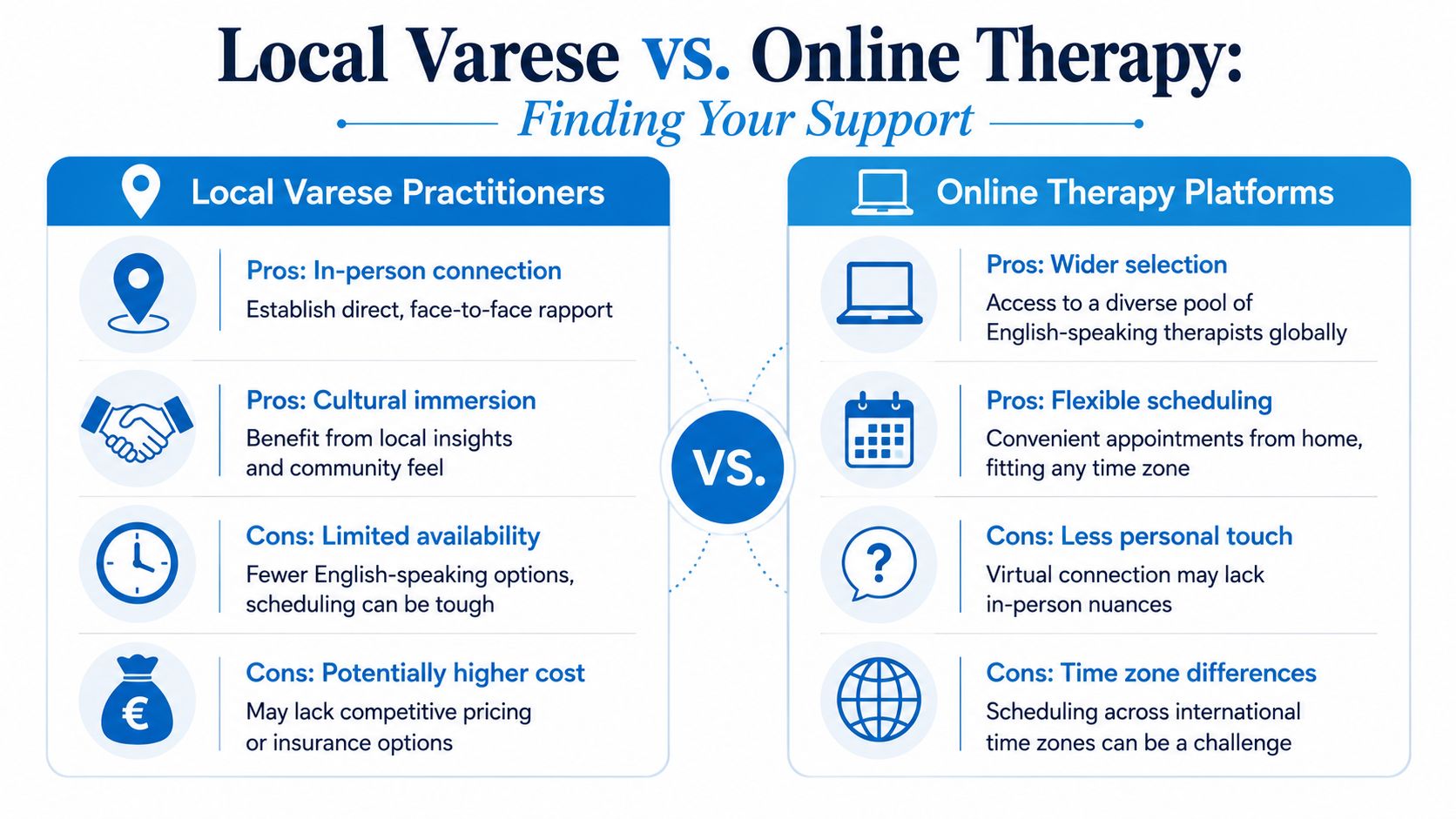
What local care does well
Local therapy can support rapport through face-to-face presence. It can also feel more rooted in the rhythms of the city, which matters if you want your therapist to understand the practical texture of living in the area.
Where online care often wins
Online platforms usually give you broader choice, easier scheduling, and better continuity if you move cities or split time between countries. A service designed for cross-city or online access can be especially useful when your work schedule changes or when you need to keep therapy stable across a relocation.
For a more detailed comparison of those trade-offs, online vs in-person therapy in Italy for expats is a useful next read. The main decision is simple. Choose the format that protects consistency, emotional comfort, and practical follow-through.
Your Vetting Checklist What to Ask a Potential Therapist
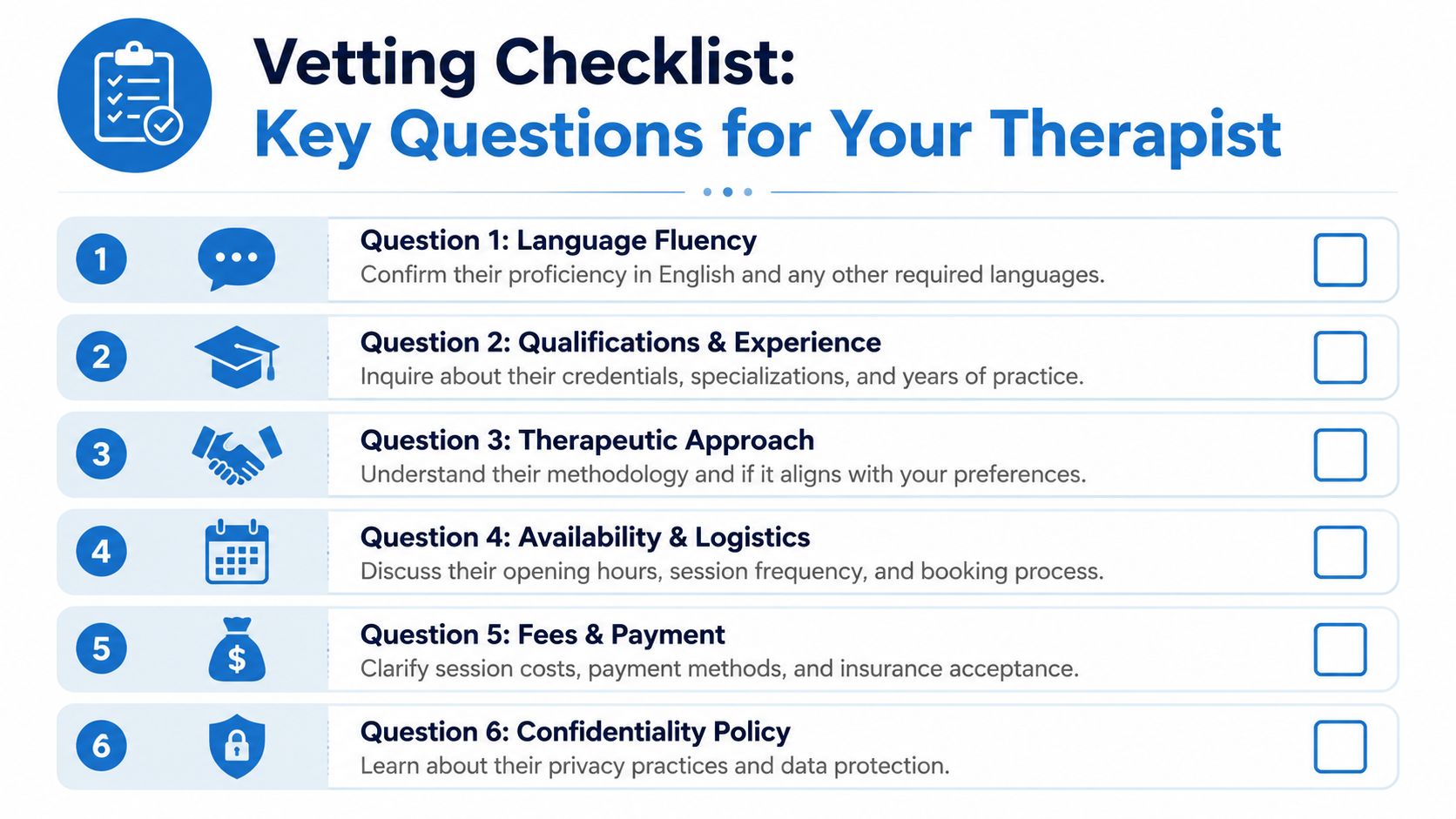
A good first call should feel focused, not performative. You're not trying to impress the therapist, you're trying to find out whether the therapist can do useful work with you. That means asking direct questions about training, method, availability, and the practical realities of care.
Credentials and clinical background
Ask whether the therapist is licensed to practice in Italy and what kind of clients they typically work with. That matters because expat needs are specific, and a general license doesn't automatically mean experience with relocation stress, intercultural couples, or third-culture identity issues.
You can also ask how they work with English-speaking clients. The point isn't to interrogate. It's to make sure the clinician can hold your language and your emotional complexity without forcing everything into a simplified script.
Therapeutic method and fit
Ask which approaches they use for anxiety, adjustment stress, trauma, or relationship issues. CBT, EMDR, Schema Therapy, and systemic-relational work all have different strengths, so you want to hear how the therapist thinks, not just which labels they know.
Useful filter: The best answer usually sounds specific, grounded, and human. If the response feels vague or overly generic, keep looking.
Logistics, privacy, and real-life follow-through
Ask about session frequency, scheduling flexibility, cancellation rules, and how the first contact works. A therapist may be excellent clinically and still be a poor fit if the booking process adds stress or the availability doesn't match your life.
For a practical conversation framework, how to talk to a therapist can help you prepare questions without overthinking the call.
A strong vetting checklist usually includes:
- Licensing and registration. Confirm the person can legally practice in Italy.
- Language fluency. Check whether they work comfortably in English, not only conversationally.
- Clinical focus. Ask whether they regularly see expats, students, couples, or trauma clients.
- Approach. Find out how they decide between methods like CBT or EMDR.
- Scheduling. Learn how fast appointments are available and whether online and in-person options exist.
- Privacy. Ask how they handle personal data, notes, and communication.
Understanding Therapy Costs and Access in Italy
Therapy in Italy can feel confusing at first because the system has two very different routes. Private care is simpler to access, while public care usually requires registration with the Italian healthcare system and booking through the local ASL. For newcomers, that registration step can be one more obstacle in an already overloaded week.
Private pricing also varies by professional type and language need. Expatica reports that fees in Italy start from €50 for a psychologist and €120 for a psychiatrist, while English-speaking therapists often charge €80 to €120 per session. Those figures are useful because they set a realistic budget frame for private care in English. Source context on therapy access and costs in Italy
That pricing structure is one reason many expats choose a private, English-language service rather than trying to manage a slower public pathway in a second language. It's not only about speed. It's about reducing friction at the exact moment when emotional energy is already low.
What to check before you book
- Session type. Ask whether the price changes for in-person versus online care.
- Billing clarity. Make sure you understand what's included in the session fee.
- Payment method. Confirm how the therapist collects payment and whether invoices are available.
- Insurance or deduction options. If relevant, ask whether your provider or tax situation supports reimbursement.
For a billing-focused resource, psychotherapy billing best practices can help you understand how professionals think about transparent documentation and session structure. That's useful background when you're comparing private options and trying to avoid surprises.
For local budgeting questions, how much does therapy cost in Italy is a good companion page. The main point is straightforward, affordable therapy is possible, but clarity matters more than finding the lowest number on a page.
How a Human-Matched Process Simplifies Your Search
A lot of expats waste energy on cold outreach. They message one therapist after another, wait for replies, and try to decode profile pages that all sound similar. A human-matched process removes some of that burden by making the first step a conversation, not a guessing game.
With Therapsy, the intake starts with a request form, and the Clinical Director matches clients with a suitable therapist within 12 hours. The service includes a physical Varese location at Via Benedetto Varchi 16 and also offers online options, which gives clients a concrete local point of contact without limiting them to one format. Therapsy Varese location and matching process
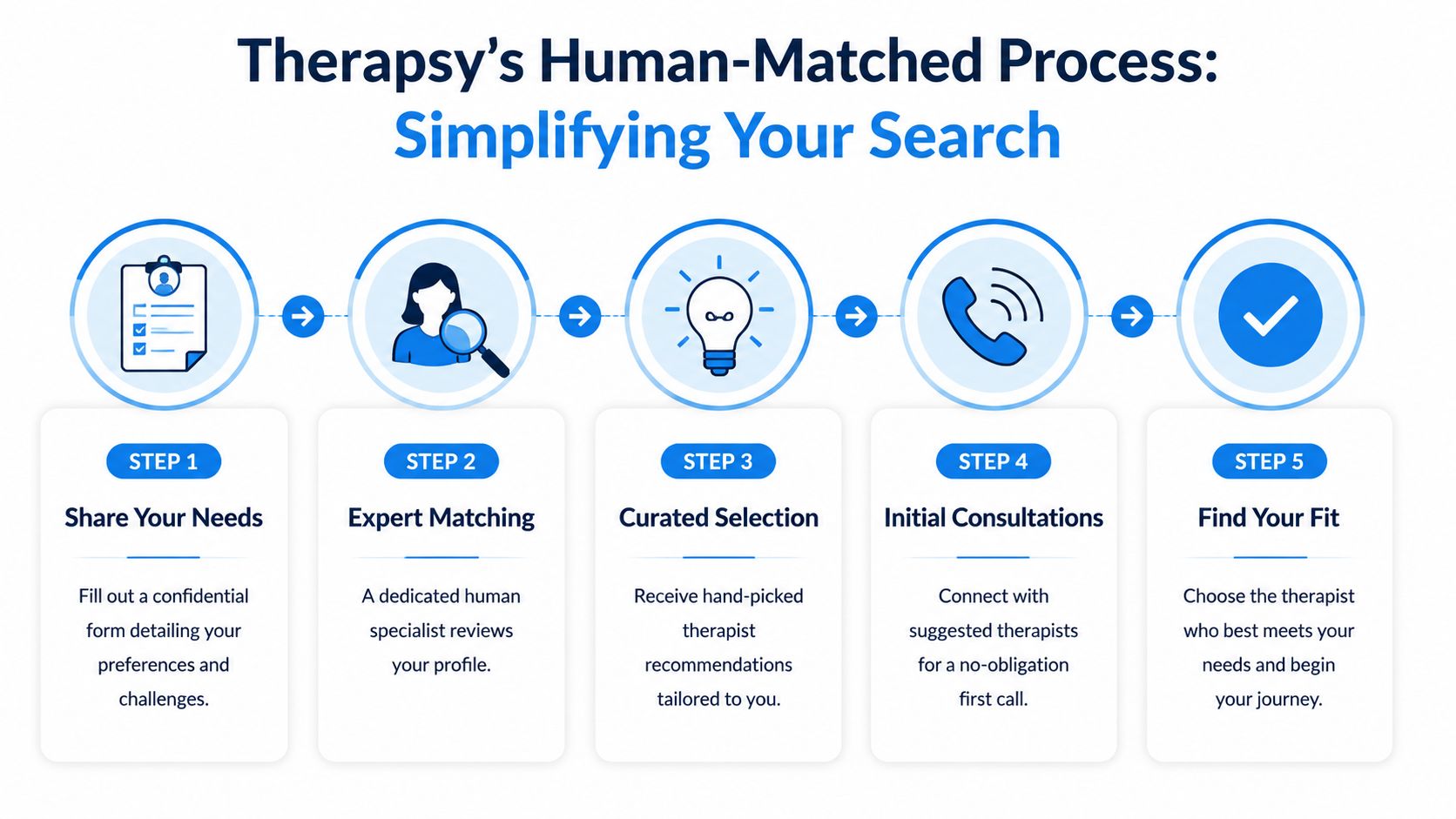
Why the human step matters
A real matcher can hear details that a form can't capture well, especially around cultural background, language preference, and therapy goals. That matters for expats because the most important fit issue is often not diagnosis, it's communication style, emotional pacing, and whether the therapist understands the social world you're living in.
The process also reduces the pressure to choose perfectly on the first try. A matched first call gives you a chance to assess whether the therapist feels steady, clear, and culturally literate before you commit.
What the first contact should feel like
You should come away with a sense that someone listened carefully and translated your needs into a thoughtful recommendation. You should also know whether the therapist can work in a way that fits your schedule, your language, and your comfort level.
That's the practical value of a human-led model. It turns a scattered search into a guided decision, which is often exactly what an overwhelmed expat needs.
The English-speaking therapists we work with in Varese
Therapsy works with a therapist who receives in person in Varese and also sees patients online.
Dr. Lorenza Celiberti is a clinical psychologist specialised in psychodiagnostic assessment, working in English and Italian with people from 11 years old, with couples and with families. She has specialised training in clinical sexology and in videogame therapy, which uses video games as a clinical medium for young people who do not want to sit and talk about themselves.
You tell Therapsy what you are looking for, a member of our clinical team reads your request, and they introduce you. The first call is free.
FAQ
How do I know if I need an English speaking therapist in Varese?
You probably do if you can describe your stress better in English than in Italian, or if you keep avoiding therapy because the language barrier feels too exhausting. The strongest sign is usually not crisis, it's sustained friction. If every important feeling gets harder to name, English-language support can make therapy more effective and less draining.
Is online therapy a good option if I live in Varese?
Yes, especially if your schedule is unstable or you want more choice in therapist specialization. Online care can also help if you travel often or may move again. For many expats, the best setup is the one that protects consistency.
What should I ask on a first therapy call?
Ask about licensing, language fluency, therapeutic approach, availability, fees, and privacy. Keep the questions direct and practical. A good therapist won't be offended by clarity.
Is private therapy in Italy expensive?
Private care can be a meaningful monthly expense, especially in English. Public care may be less direct to access because it typically requires registration with the Italian healthcare system and booking through the local ASL. If you want speed and language fit, private therapy is often the simpler route.
Can an English speaking therapist help with culture shock?
Yes, if they understand intercultural adjustment and not just general anxiety. Culture shock can show up as loneliness, irritability, identity confusion, or burnout. A therapist who works with expats will usually recognize those patterns faster.
What makes a therapist a good fit for expats?
A good fit combines language comfort, cultural competence, and a way of working that feels structured and respectful. You want someone who can understand your emotional world without asking you to overexplain your background every session. That combination usually matters more than a polished profile.
If you're ready to stop searching alone, book your first free assessment call with THERAPSY. It's a no-commitment conversation with our Clinical Director, who will listen to your situation and match you with the right therapist for you.