You might be sitting in a Pavia apartment, phone in hand, trying to find an English speaking therapist in Pavia while everything around you feels slightly out of sync. The city looks familiar enough, but the moment you start searching for mental health support, the practical problem appears fast, most listings are in Italian, some therapists list English as an extra skill, and you're left wondering whether therapy in a second language can really reach the parts that matter.
That confusion is normal. For expats, international students, and bilingual residents, the search is rarely just about convenience. It's about finding a therapist who can understand your words, your stress, and the cultural context behind both.
Finding an English Speaking Therapist in Pavia
A common first step is opening a local directory and filtering for English, then scanning profile after profile for someone who seems credible, available, and human. The hard part is not finding names, it's figuring out which therapist can work with the pressures of moving countries, losing your support network, and trying to explain complicated feelings in a language that isn't your own.
That's why the phrase english speaking therapist Pavia can mean two very different things. On one level, it means someone who can speak English. On a deeper level, it means someone who can hold migration stress, loneliness, identity shifts, and relationship strain without flattening them into generic advice.
Therapsy's Pavia page reflects that wider reality. It places the local service at Via Carlo Goldoni 7 and connects clients with therapists who speak their native language through online and in-person care across 20+ Italian cities. The service also uses real-person matching rather than an algorithm, which matters when the first question is not “Who is available?” but “Who will understand me?”
Practical rule: If a profile only proves English fluency, keep looking. You want language, yes, but also experience with the emotional reality of living between cultures.
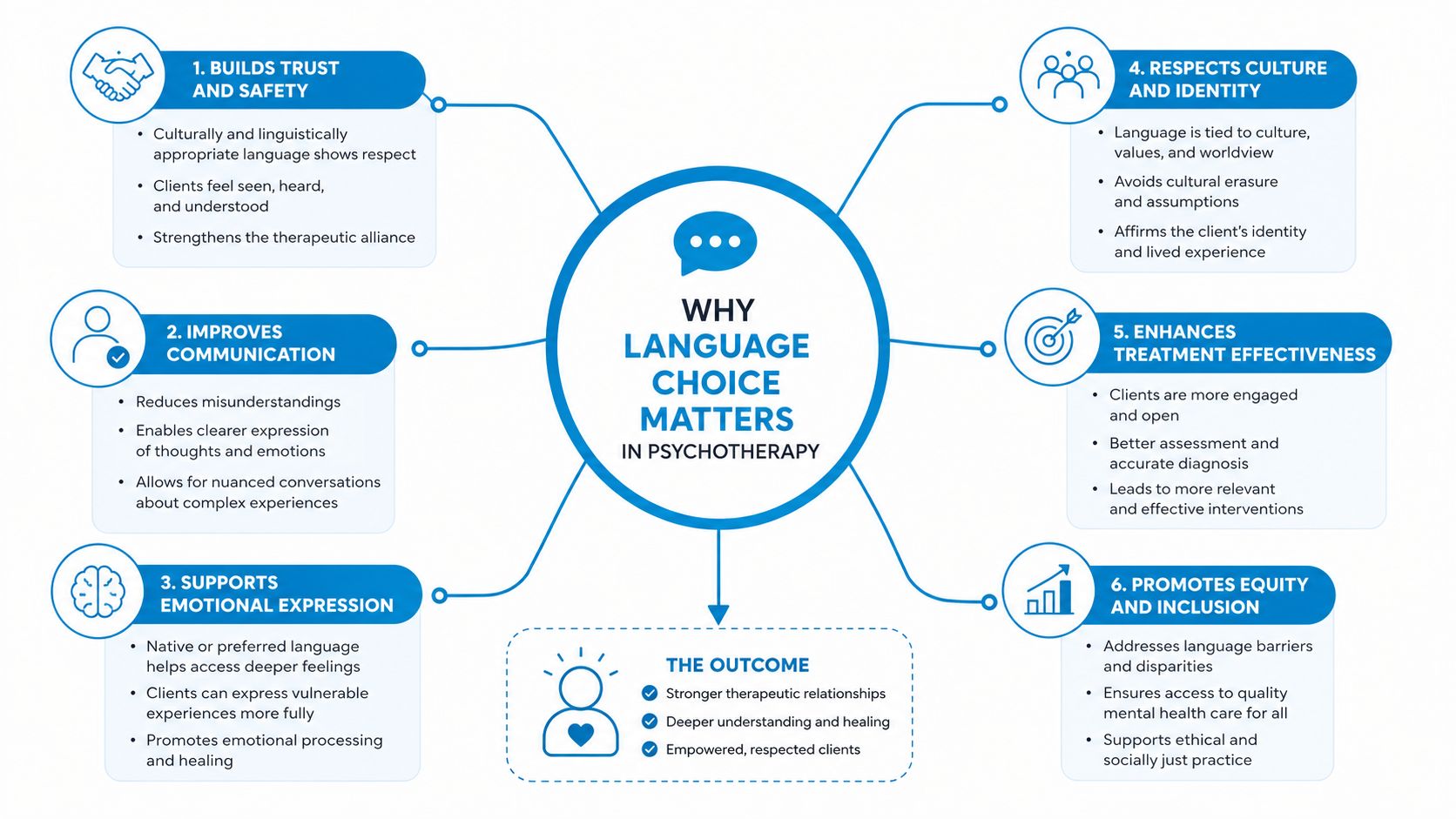
Why Language Choice Matters in Psychotherapy
A therapy session can feel like a narrow bridge. If the words do not carry your full meaning, the conversation gets shaky fast. Language in therapy is not cosmetic, because it shapes how quickly trust forms, how accurately emotion gets named, and how safely risk gets discussed. For expats searching for an English-speaking therapist in Italy, independent guidance recommends filtering by language first, then checking whether the clinician also understands the emotional realities that often come with living between cultures.
What changes when you speak in your preferred language
Bilingual clients often switch languages when a feeling becomes too sharp, too private, or too hard to translate. That is not a problem to correct. It is clinical information. A therapist who notices code-switching can hear where the emotion sits instead of forcing the session to stay polished and literal.
Language background also shapes what a therapist hears between the lines. Someone who learned English as an additional skill may speak fluently, but still miss idioms, emotional shading, or the social meaning behind a phrase. Someone trained in an Anglophone clinical setting is more likely to recognize how English speakers describe anxiety, boundaries, shame, or family conflict, and that can make the room feel more predictable for the client.
Why this matters for expats in Pavia
Pavia's international residents often carry culture shock, identity strain, relationship tension, and isolation at the same time. Cross-cultural psychology helps explain why those experiences can feel larger than they appear from the outside. Attachment theory adds another layer, because when you are far from home, safety can become tied to language, familiarity, and being understood without effort.
Key insight: The right therapeutic language can make hard material easier to say, and easier to hear.
That does not mean English is always the answer. It means the best fit is a therapist who can work with your real emotional language, not only your grammatical one. For clients who want support across languages and identities, multilingual psychotherapy for expats in Italy is often a better starting point than a simple language filter.
In-Person and Online Therapy Options in Pavia
Some people want a room, a chair, and a regular route across town. Others need flexibility because their schedule changes, their commute is unpredictable, or they want to keep therapy going while they travel. Both formats can work well, but they address different needs.
When in-person therapy helps
In-person sessions can feel grounding when life already feels scattered. A physical office can support focus, especially if you are dealing with anxiety, grief, or relational stress and want a clear boundary between daily life and therapy time. For some clients, showing up at a specific place also makes therapy feel more real and easier to protect in a busy week.
Pavia does have a local therapy market. Therapy search behavior in Italy often blends local and remote access, with directories showing both city-level contact details and options for remote sessions. That can be useful, but it can also make the search feel crowded when you are looking for an English-speaking clinician.
When online therapy makes more sense
Online sessions can widen your choices, especially if local English availability feels limited. They also reduce travel friction and can be a better fit if you live outside the city center, have irregular hours, or need continuity while moving between Italy and another country.
For many expats, the question is not just where the therapist sits, but how well the format fits daily life and the emotional work you need to do. online vs in-person therapy in Italy for expats gives a useful framework for comparing those trade-offs before you decide.
| Factor | In-Person in Pavia | Online from Anywhere |
|---|---|---|
| Privacy | A dedicated office space | Depends on your home setting |
| Convenience | Requires travel and scheduling | Easier to fit around work or study |
| Therapist pool | Limited to local availability | Wider choice across Italy |
| Emotional feel | More grounding for some people | Easier for those who travel or relocate often |
| Access | Best if you are near the practice | Best if language fit matters more than location |
If you are deciding between the two, the best match often depends on what you need therapy to hold. In-person care can help if you want a steady external setting. Online care can help if your priorities are consistency, flexibility, and access to the right language and cultural fit.
Types of Therapy and Specialties Available
An English speaking therapist in Pavia should be able to do more than basic supportive conversation if your situation is layered. Culture shock, burnout, trauma, relationship conflict, and identity loss often need a method, not just goodwill.
Match the method to the problem
CBT, or Cognitive Behavioral Therapy, is often used when thoughts, emotions, and habits are feeding anxiety or low mood. It helps people notice patterns, test assumptions, and build more workable routines.
EMDR is commonly used for trauma and PTSD. It gives clients a structured way to process distressing memories without needing to retell everything in detail every time.
Schema Therapy can be useful when the same painful patterns keep repeating in work, love, or self-worth. It looks at deeper emotional themes that started early and still shape present-day reactions.
Systemic-relational therapy is often a strong fit for couples and family dynamics. It pays attention to interaction patterns, not just individual feelings.
Ethnopsychotherapy can be especially relevant when culture, migration, family heritage, and belonging are part of the clinical picture. For international residents, that matters because the issue is often not only “stress”, it's stress plus displacement.
Clinical rule of thumb: If your struggle is tied to trauma, migration, or relationship dynamics, don't settle for a therapist who only offers generic talk therapy.
A simple way to narrow your choice
- Name the main problem. Anxiety, trauma, burnout, relationships, or adjustment.
- Ask what methods they use. A therapist should explain their approach in plain language.
- Check cross-cultural experience. Ask how they work with expats, mixed-language families, or identity change.
- Listen for specifics. Good answers sound concrete, not vague.
For readers looking for body-aware or trauma-sensitive support, somatic therapy in English in Italy can be a useful related route to explore when talk alone doesn't feel like enough.
How to Choose the Right Therapist for Your Needs
A good match is not just about credentials. It's about whether the therapist can hold your language, your story, and the social world you're living in without making you do all the translating.
What to check before you book
- Verify licensing and training. A legitimate therapist should be able to tell you what they studied and where they're registered.
- Ask about English fluency. You want to know whether they can do emotionally nuanced work in English, not just casual conversation.
- Test cultural competence. Ask how they've worked with international clients, mixed-nationality couples, or people adapting to life in Italy.
- Listen to their explanation of treatment. If they can't describe their method clearly, that's a warning sign.
- Notice your body during the first contact. Relief, safety, and clarity matter.
Red flags that deserve attention
Some therapists treat “English-speaking” like a checkbox. That can leave you doing the emotional labor of simplifying every sentence while also trying to be vulnerable. Another red flag is a therapist who seems unfamiliar with expat stress, as if homesickness, identity strain, and bureaucracy were side issues instead of central parts of your life.
Useful standard: The right therapist should make it easier to speak, not harder to explain.
Human matching can reduce that mismatch. Therapist matching is especially valuable when the choice needs to balance language, specialization, and personality fit, because the best clinical decision is not always the one that looks most convenient on a list.
Therapsy and Multilingual Therapy in Pavia
For an expat in Pavia, the hard part is often not finding a therapist at all, but finding one who can hold both the language and the meaning of what you want to say. Therapsy's Pavia service is set up for that kind of search. The local service is based at Via Carlo Goldoni 7, and it sits inside a wider network that serves expats and international students through online and in-person care across 20+ Italian cities (Therapsy Pavia).

What the service model changes
The matching process is handled by a real person, not an algorithm. That matters because therapy fit is not only about speaking English. It also depends on whether the therapist can keep pace with your way of speaking, understand your background, and work with the type of concern you are bringing in.
Therapsy states that it was founded in 2023, works with 50+ licensed therapists, has supported 1,000+ international clients, and offers therapy in 14 languages. It also highlights high client satisfaction ratings. For someone looking for an English-speaking therapist in Pavia, those details point to a multilingual model designed for international life in Italy (Therapsy's therapy in Italy for expats).
What to expect before the first session
You do not need a perfect explanation of your problem. A good first call is usually about clarifying what is happening, what language you are most comfortable using, and what kind of support would fit your situation. That is especially helpful if you are balancing work, study, a relationship, or a move between cities.
Therapsy's structure also helps clients compare options without pressure. The free first assessment call gives you a low-risk way to check fit before deciding on ongoing work, and pricing is presented transparently as from €70/session for individual therapy, from €100/session for couple therapy, from €110/session for psychiatric consultation, and from €255 for psychodiagnostic assessment across 3 sessions.
Preparing for Your First Therapy Appointment
The first appointment is not a test you have to pass. It's a starting point, and most therapists will expect some uncertainty, especially if you're speaking in a second language or talking about feelings you've been holding onto for a while.
What helps before you go
Bring a short list of what's been bothering you most. It can be a few phrases, not a polished summary. If the issue is partly practical, like sleep problems, homesickness, conflict with a partner, or difficulty concentrating, say that too, because therapy often starts with patterns you can notice.
What to expect in the room
The first sessions usually focus on understanding your history, your current stressors, and what you want to be different. That means you may not leave with a quick fix. What you should leave with is a sense that the therapist listened carefully and could describe a direction that makes sense.
If you're nervous about speaking English, say so at the beginning. A good therapist will adjust pace, check understanding, and notice when a word choice carries more feeling than the literal meaning alone.
How to judge the fit
- You feel heard. Not perfectly understood on day one, but respected.
- The therapist explains the process clearly. You know what the work might look like.
- Your stress becomes more speakable. Even small relief counts.
- You can imagine returning. That instinct matters more than people think.
If the fit feels off after a few sessions, ask about rematching. The point is not to force a connection. It's to find a therapist who can really work with your situation and language.
The English-speaking therapists we work with in Pavia
Therapsy works with a therapist who receives in person in Pavia and in Milan, and also sees patients online.
Dr. Chiara Trisotto is a clinical psychologist working in English and Italian. She graduated with honours from the Faculty of Clinical Psychology in Pavia and completed advanced training in the clinical assessment and treatment of ADHD in adults. She works with neurotypical and neurodivergent people alike, and with what she describes as existential and emotional distress: anxiety, low mood, confusion, the feeling of being lost.
You tell Therapsy what you are looking for, a member of our clinical team reads your request, and they introduce you. The first call is free.
FAQ
Is online therapy as effective as in-person therapy in Pavia?
Yes, online therapy can be a strong option when the therapist is a good fit and the setting is private and stable. It often works well for expats who need flexibility or want access to a wider pool of English-speaking clinicians. In-person therapy may feel more grounding for people who prefer a dedicated office and face-to-face contact.
How do I know if a therapist really speaks English well enough?
Ask how they work with emotionally complex conversations in English, not just casual language. You're listening for nuance, clarity, and comfort with difficult topics. If they can explain their approach in plain English and respond naturally to subtle feelings, that's a good sign.
What if I need therapy in a language other than English?
Look for multilingual services that match therapists to your preferred language. That can be especially helpful if you switch languages when you're emotional or if English doesn't feel like your safest inner language. A therapist who works across languages can often support more precise expression.
How long does therapy usually take?
It depends on the issue, the method, and your goals. Some people want short-term support for adjustment or stress, while others need longer work for trauma, relationships, or patterns that are firmly established. A good therapist should help you think in terms of goals rather than making vague promises.
Can I switch therapists if the first one is not the right fit?
Yes, and it's normal to do so. Fit matters, especially in cross-cultural therapy where language and personality both affect trust. If the match isn't right, asking for a rematch is a reasonable and professional step.
A CTA for THERAPSY.