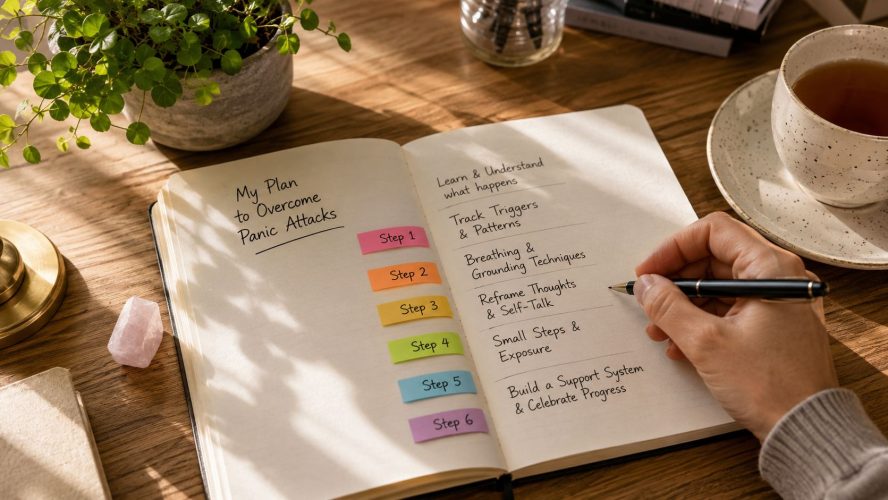
A panic attack treatment plan is a staged roadmap, not a single coping trick. If someone is sitting on a Tuesday evening convinced they're having a heart problem, the right plan starts by making the situation understandable, predictable, and treatable.
That structure matters because panic feeds on uncertainty. A written plan gives the brain a sequence to follow, from assessment to stabilization, then deeper CBT work, then relapse prevention, so the next step isn't guesswork.
What a Panic Attack Treatment Plan Actually Looks Like
What does the first version of the plan usually contain?
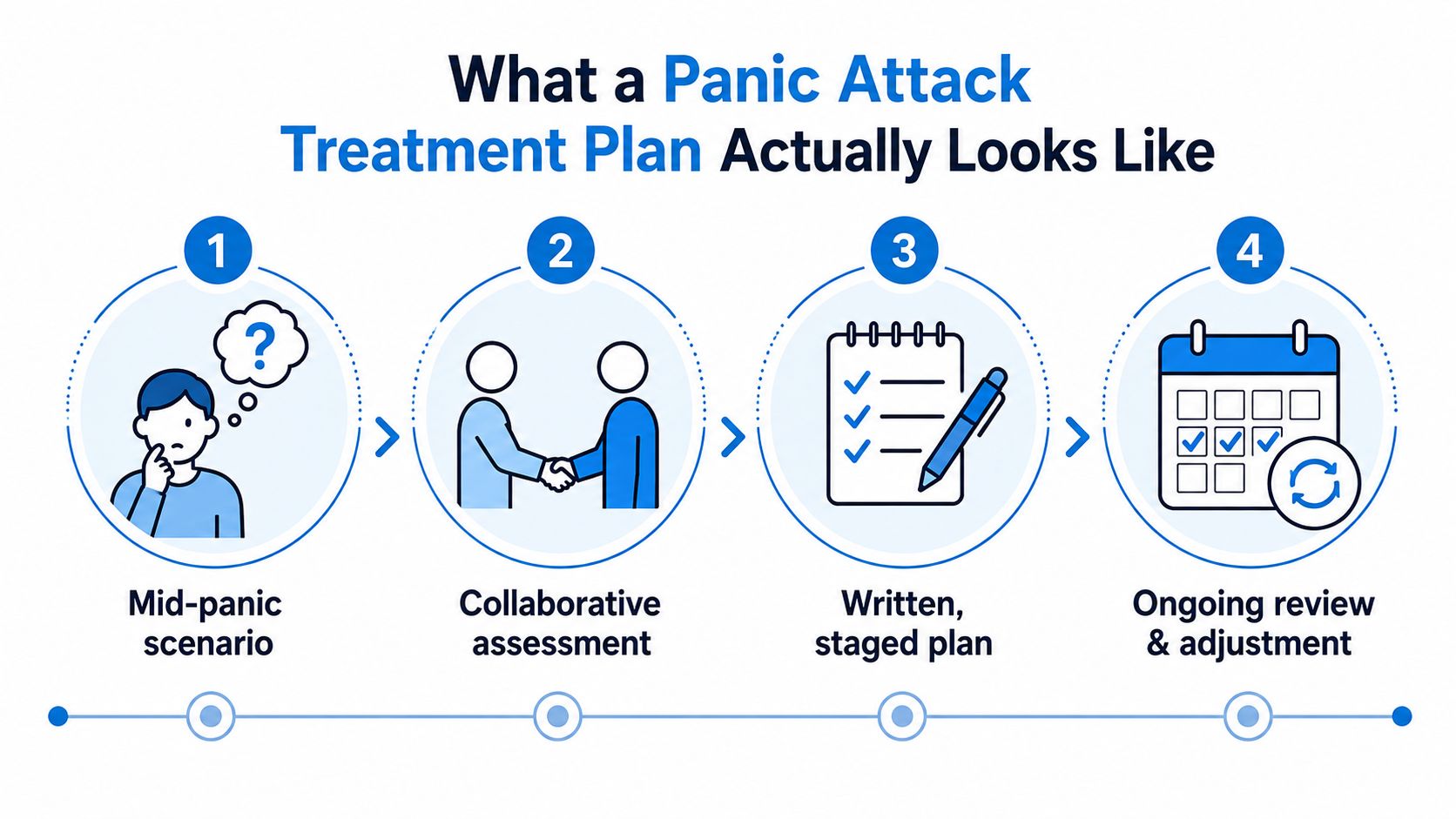
A real panic attack treatment plan starts with a shared map, not a pep talk. It usually moves through assessment, stabilization, core CBT and exposure work, then relapse prevention, and the order stays fairly stable even if the pace changes. That sequencing fits the way panic disorder is treated in modern guidance, which has long placed CBT at the center of care and describes structured plans as evidence-based interventions with measurable outcomes, not just supportive conversations (systematic guideline review).
In practice, a person from an expat or international background often benefits from this structure even more, because panic gets tangled with relocation stress, language strain, and unfamiliar medical systems. A good clinician doesn't just ask, “How do you calm down?” They ask what the panic looks like, what the person fears, what they avoid, and what life context is keeping the alarm system switched on.
A solid plan gives panic something it hates, a predictable sequence.
Why does the roadmap matter more than the panic episode?
Panic symptoms can feel sudden, but treatment can't be improvised. The plan gives a patient something concrete to return to after the first wave passes, which is especially important because panic disorder often involves fear of the next attack, not only the attack itself. That fear of fear is what treatment has to address.
The best way to think about the plan is as a working document. The timeline can flex, but the logic usually doesn't. First, the clinician understands the pattern. Then they help the nervous system settle enough for exposure-based change. After that, the focus shifts to maintaining gains when life gets busy again.
For people seeking care in Italy, a multilingual setting can make this roadmap easier to follow because the work happens in the person's own language. Therapsy offers that kind of matching with online and in-person sessions, and it can be useful for someone who wants a panic-focused plan without having to translate every fear and symptom in real time. See the dedicated overview on panic attack support.
How Clinicians Assess Panic Before Treatment Begins
Before any coping skill gets taught, a clinician needs to understand the pattern. That means looking at how often attacks happen, how intense they feel, what situations or thoughts set them off, and what the person does afterward. A panic plan isn't personalized by guesswork, it's personalized by mapping the episode and the avoidance that follows.
What gets assessed in a careful intake?
A clinician will usually ask whether the panic is tied to specific places, bodily sensations, or thoughts. They also look for agoraphobic avoidance, because many people stop taking trains, driving long distances, or entering crowded spaces after the first few attacks. That avoidance becomes part of the disorder, not just a side effect of fear.
They'll also screen for broader anxiety, low mood, trauma history, and substance-related factors, because panic can sit inside a larger emotional picture. If the body symptoms could point to a medical issue, a medical workup matters too. In other words, the plan starts with a broad enough view to avoid missing something important.
How does the data get turned into treatment choices?
Two simple tools often help make the pattern visible, a panic diary and a severity scale used in clinical assessment. The diary records what happened before, during, and after an attack, so the clinician can see whether the person is dealing with repeated triggers, fear of internal sensations, or a cycle of avoidance. That's also why the first psychological session matters, because it's where the pattern starts to become readable in a structured way (first psychological session).
| Common Assessment Components for Panic Disorder | What It Reveals |
|---|---|
| Attack timing and frequency | Whether panic is isolated or recurring |
| Intensity and body sensations | How strongly the alarm response is firing |
| Situational triggers | Where avoidance may be forming |
| Thoughts during the attack | Catastrophic interpretations that fuel panic |
| Post-attack behavior | Safety behaviors and avoidance patterns |
| Mood, trauma, substance, and medical history | What else may be shaping the picture |
The assessment phase is where panic stops looking random and starts looking patterned.
For expats and international students, this phase can also reveal cultural misunderstandings. Some people were taught to ignore distress, while others grew up in systems where emotional symptoms were discussed only after they became severe. A clinician who works cross-culturally can account for that difference instead of treating it like resistance.
First Steps for Short-Term Stabilization
What is stabilization meant to do?
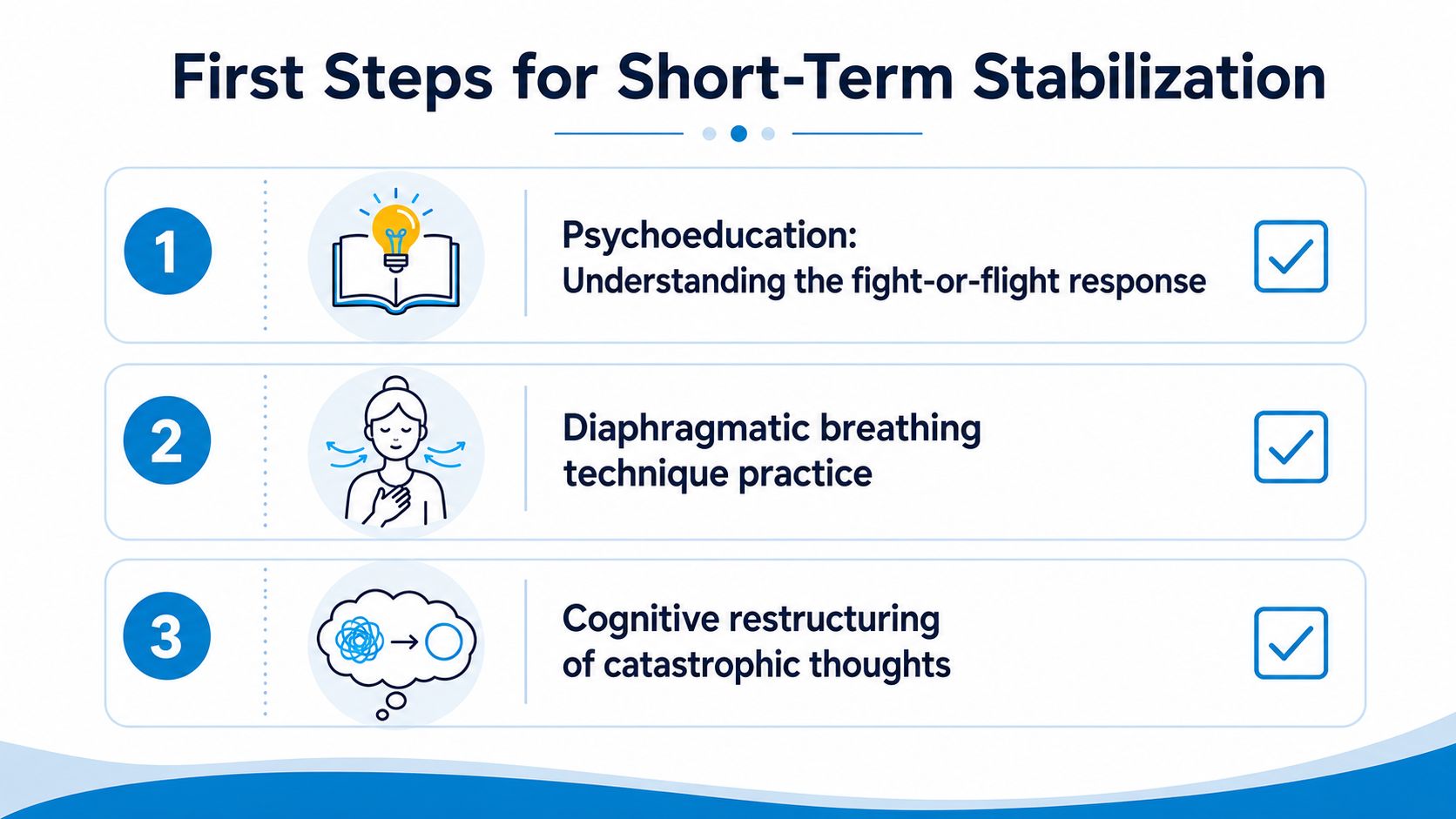
Stabilization doesn't cure panic. It lowers the floor so deeper work becomes possible. Early CBT usually begins by explaining the fight-or-flight cascade, because panic gets stronger when a person mistakes a body surge for proof of danger.
That explanation matters. If someone thinks, “My heart is racing, so I'm dying,” the nervous system gets a second burst of alarm from the interpretation itself. Reframing that moment as a stress response, not a catastrophe, reduces the spiral.
What do people usually practice first?
A therapist often teaches slow diaphragmatic breathing, grounding through the senses, and cognitive reframing of catastrophic thoughts. A simple sensory anchor, such as naming five things seen, four things felt, three things heard, two things smelled, and one thing tasted, helps shift attention out of threat scanning and back into the present.
The point isn't to force calm on command. It's to show the body that panic rises and falls without needing to be obeyed.
A few early weeks often look like this:
- Daily practice: Breathing and grounding are repeated outside sessions so they become familiar under stress.
- Panic diary review: The therapist and patient look for patterns rather than blaming the episode itself.
- Thought correction: Catastrophic interpretations get tested against what happened.
- Early success markers: Fear of panic starts shrinking, even if a full attack hasn't disappeared yet.
Why is this still part of the plan and not the whole plan?
Stabilization can help, but it shouldn't become avoidance in disguise. If someone uses breathing only to escape every sensation, the brain never learns that the sensation is tolerable. That's why structured support also includes nervous-system regulation work, which can be a helpful bridge for people who are highly activated at the start of care (nervous system regulation therapy).
The early phase is usually about practice, not perfection. People often expect symptoms to vanish quickly, but the more realistic goal is that panic feels less terrifying and less dominant in daily life. That shift is what makes the next stage workable.
The Core Work of CBT and Exposure Therapy
How does CBT change the panic loop?
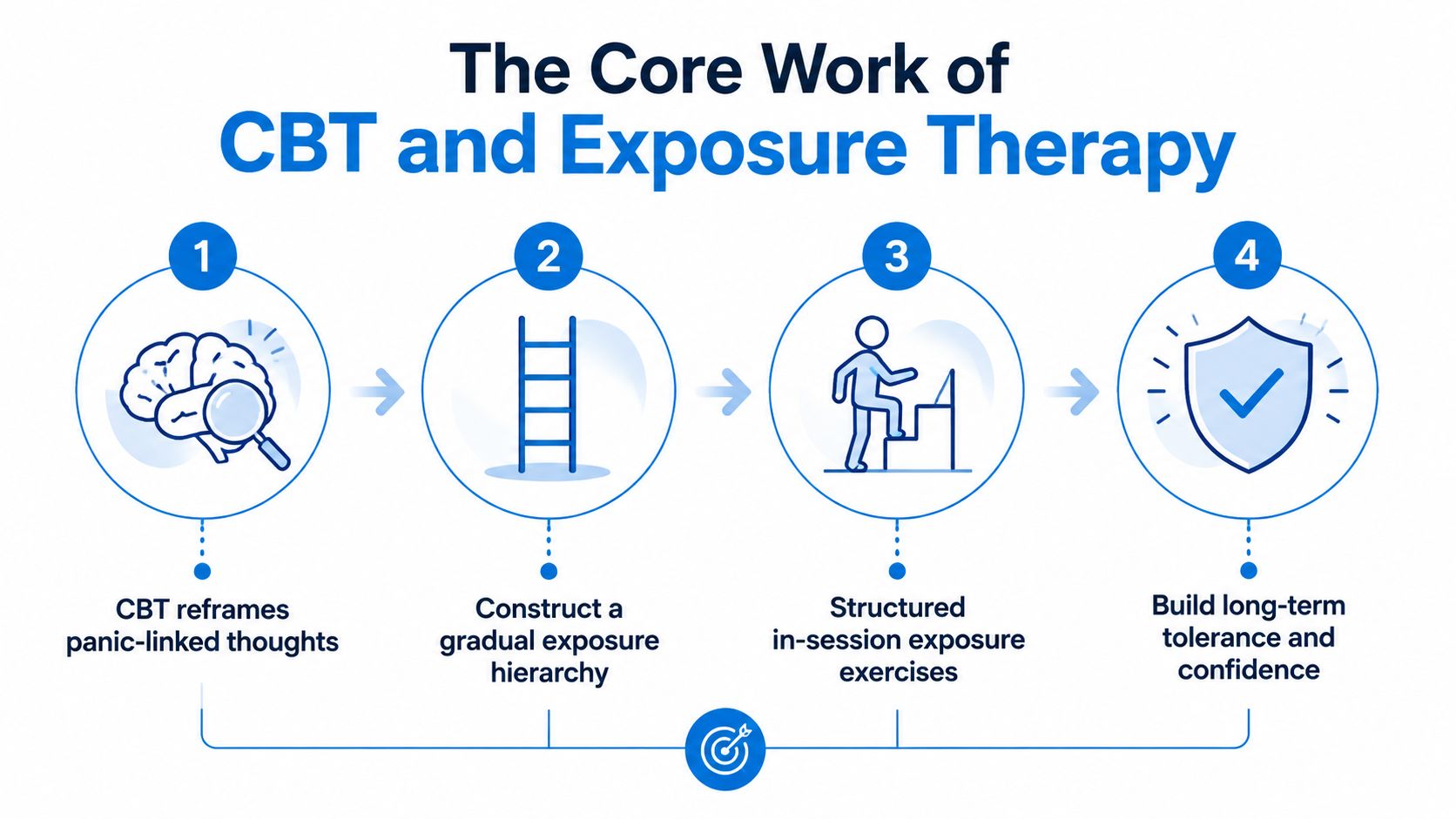
CBT targets the misfiring fear of fear. When the body sensation is treated as danger, the mind starts scanning for proof that catastrophe is near, and the cycle keeps feeding itself. CBT interrupts that loop by helping the person label the sensation, test the thought, and replace the automatic interpretation with something more accurate.
Structured repetition matters. A panic-focused CBT program isn't just one conversation about logic, it usually includes psychoeducation, cognitive restructuring, and homework between sessions so the new response gets rehearsed in real life. A guideline summary describes effective CBT as often delivered in roughly 7 to 14 total hours, commonly through weekly sessions over a few months, and standard programs can be delivered face-to-face or as guided digital CBT (practice guideline summary).
How does exposure retrain the alarm system?
Exposure works because the brain learns from contact, not from reassurance alone. When a person repeatedly faces feared sensations or situations without escaping, the alarm system gets new information: this feeling is intense, but it isn't dangerous. That is why interoceptive exposure and in-vivo exposure are central, one targets internal sensations, the other targets avoided situations.
Interoceptive exposure can include exercises such as hyperventilation, spinning, running in place, breath-holding, straw breathing, or body-tension exercises, all used to recreate the sensations that panic has taught the person to fear (interoceptive exposure mechanism). Specific protocols can be highly structured, which shows how concrete this work can be, rather than vague or purely reassuring (sample exposure dosing).
What does the middle phase feel like in real life?
A session block often feels like moving up a fear ladder. The person starts with a sensation or situation that's uncomfortable but manageable, then keeps practicing until the fear response weakens. Homework matters here, because progress usually comes from repeated contact, not from a single brave moment.
Exposure is not about forcing fear away. It's about teaching the brain that fear can rise, crest, and settle without catastrophe.
For readers looking for a more panic-specific version of CBT, CBT for panic disorder can help anchor the technique in a real-world treatment path. A useful expectation is that improvement is graded, not linear, and that smaller wins often show up before the big ones do.
Choosing Between Therapy, Medication and Digital Options
How do the main paths differ?
| Treatment Paths at a Glance | Best Fit For | Time to Relief | Key Trade-Off |
|---|---|---|---|
| Psychotherapy, especially CBT with exposure | People who want durable skill-building and a structured roadmap | Usually gradual | Requires practice and repeated sessions |
| Medication | People with severe symptoms, long-standing panic, or limited access to therapy | Often faster symptom reduction | Side effects, monitoring, and longer-term planning |
| Digital options | People on waitlists, in remote areas, or who need flexible access | Can start quickly | Quality and depth vary, and the work still needs engagement |
The strongest clinical plan is not always one path alone. It often depends on severity, co-occurring conditions, previous response, access, and personal preference. Some people start with CBT and add medication if symptoms stay severe, while others need medication support first so they can participate in therapy more fully.
What usually fits best in practice?
Therapy tends to be the foundation when someone can engage with it, because the change is more durable and skills carry forward after treatment ends. Medication can help reduce symptom intensity, especially when panic is overwhelming or when therapy access is delayed, but it doesn't teach the person how to respond differently to fear cues. Digital CBT can bridge access gaps and may be especially useful for people who need flexibility, although it still works best when the person practices the exercises.
The medication piece is often best handled with a psychiatric consultation, especially if the person is unsure about side effects, prior medication experiences, or whether panic is part of a larger anxiety picture. For that reason, a service that includes both psychological and psychiatric pathways can make the decision less fragmented, and Therapsy's psychiatrist network is one place where that kind of coordination can start.
A practical way to choose is to ask three questions. How intense are the attacks? What has already been tried? And what level of access is realistic over the next few months?
Relapse Prevention and Your Measurable Goals
Why does the maintenance phase matter?
Relapse prevention is where the plan becomes a living document. Panic disorder is common enough to require follow-up, with epidemiological work showing that many people first seek help in primary care, a substantial share remain untreated, and relapse after stopping medication is not rare (epidemiology review). That is exactly why the end of acute treatment should not be treated like the end of care.
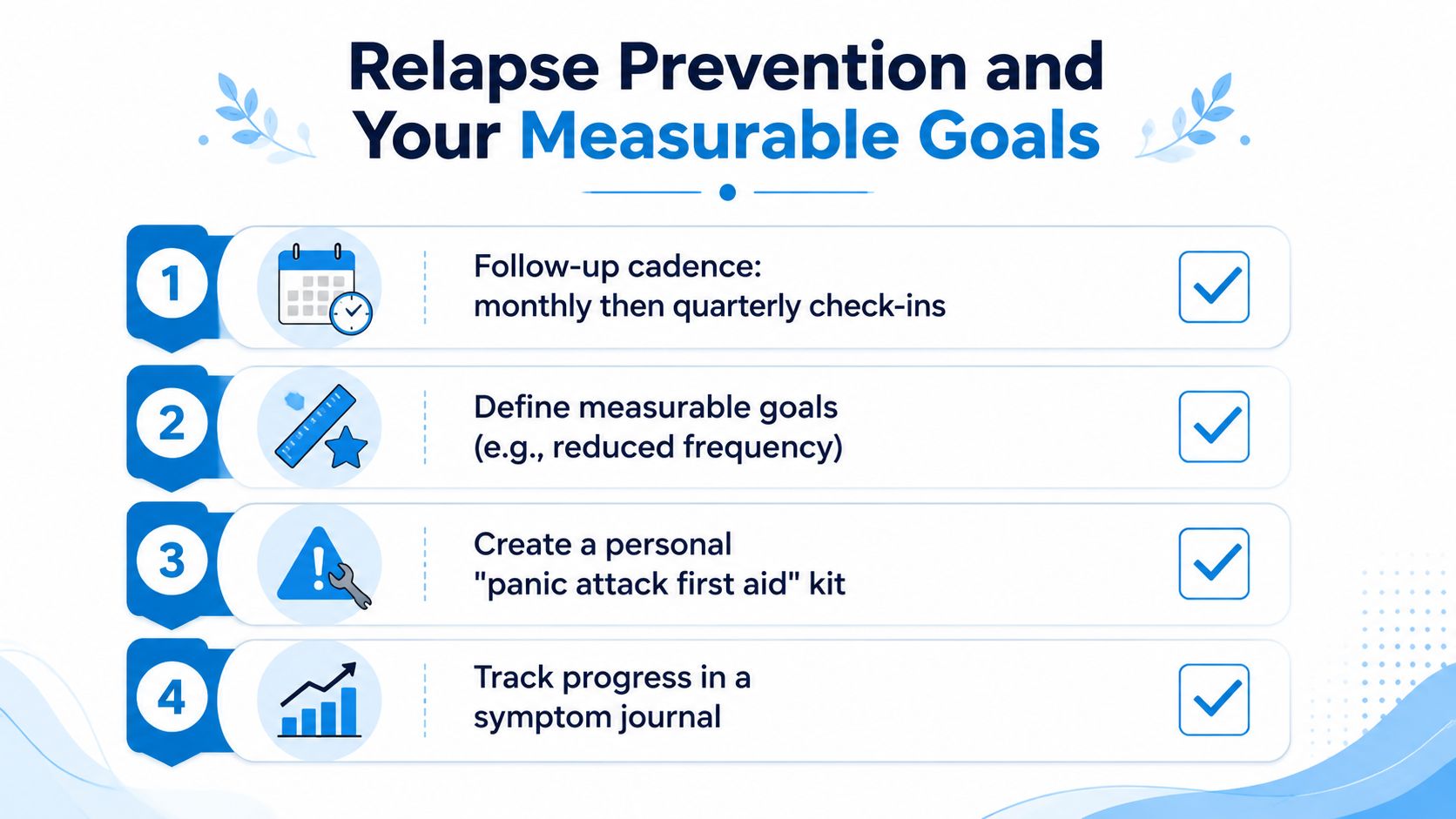
The maintenance phase usually includes check-ins after the acute work, booster sessions before predictable stressors, and a written description of early warning signs. Those warning signs can be cognitive, like “I'm starting to scan my body again,” or somatic, like subtle chest tightness or breath uncertainty.
What do measurable goals actually look like?
A good goal is concrete enough to track without turning the person into a spreadsheet. The plan might follow panic frequency, intensity, avoidance, sleep, and whether the person is re-entering places or activities they had been avoiding. That turns progress into something visible, which helps prevent the common mistake of assuming treatment has failed just because one stressful week brought symptoms back.
A useful maintenance toolkit often includes:
- Breathing practice: Kept fresh so it's available when stress rises.
- Thought records: Used when catastrophic thinking starts creeping back.
- Scheduled exposures: Repeated contact with feared situations so avoidance doesn't re-form.
- Crisis steps: Clear actions for when symptoms spike and the person feels stuck.
The goal isn't to promise that panic never returns. The goal is to make sure it doesn't take over the whole map again.
For expats, students, and young adults in Italy, that maintenance plan has to fit real life, including travel, exams, relocations, and work pressure. A plan that can survive those changes is more useful than a perfect plan that only works in ideal conditions.
Practical Questions About Access, Cost and Timing
How often should sessions happen at the start
Early treatment is usually weekly, because panic work depends on momentum and practice. Once the person is more stable, sessions may become less frequent, especially when exposures are going well and the maintenance plan is taking shape. The exact rhythm depends on symptom load, support needs, and whether medication is part of the picture.
Some people need help deciding whether the plan is moving slowly or moving at a normal pace. A reasonable checkpoint is whether the person has been engaging consistently and whether the therapist is adjusting the plan based on what's happening, not on habit.
When to think about a different level of care
If panic remains unchanged after steady engagement, the next step may be a medication consult, a change in therapy intensity, or a more structured service. The point isn't to label the plan a failure. It's to match the intensity of care to the intensity of the problem.
Access matters too. People in Italy often need multilingual support, online sessions, or in-person care that fits work and study schedules. That's one reason therapy coverage and practical access in Italy becomes part of the decision, not an afterthought.
A quick checklist for choosing a clinician:
- Licensing and training: The person should be properly qualified.
- CBT and exposure experience: Panic work should be specific, not generic.
- Language fit: The person should be able to speak in the client's own language.
- Follow-up style: The plan should include review, not just a first session and hope.
Therapsy offers human matching by the Clinical Director, therapy in 14 languages, and both online and in-person sessions across 24 Italian cities. It's built for people who want to be understood in their own language and want a first contact that doesn't feel like starting from zero.
If this roadmap feels clearer than the usual “just breathe” advice, that's exactly the point. THERAPSY offers a free first assessment call with the therapist chosen for that person, with no obligation to continue. For someone looking for a panic attack treatment plan that's structured, multilingual, and human, it can be a gentle place to start.