You may be reading this right after a frightening moment. Maybe you were in a crowded supermarket in Milan, standing in line, when your heart suddenly pounded, your chest tightened, and your mind told you something terrible was happening. Maybe you left your basket, rushed outside, and then felt embarrassed, confused, and alone because you couldn't easily explain it in Italian.
That experience can feel overwhelming. It can also make everyday life in Italy start to feel smaller. You may avoid buses, shops, trains, piazzas, lectures, restaurants, or anywhere that feels hard to escape.
CBT for panic disorder is a structured, practical therapy that helps you change the thoughts and behaviors that keep panic going. It doesn't require a mere 'calm down.' It teaches you how panic works, why your body reacts this way, and what to do differently so your nervous system stops treating normal sensations like emergencies.
For expats and international students in Italy, this matters even more. Panic often feels worse when you're far from home, unsure how to access local healthcare, and trying to manage intense symptoms in a second language. The good news is that panic disorder is treatable, and recovery is possible.
Understanding Panic Disorder and the Path to Recovery
A panic attack often seems to come out of nowhere. One minute you're choosing pasta sauce or waiting for the metro. The next, your body feels hijacked. Your heart races. You feel dizzy or unreal. Your mind jumps to the worst conclusion.
That doesn't mean you're weak, unstable, or "losing it." Panic disorder is best understood as a fear of the panic process itself. After one or more panic attacks, many people become highly alert to body sensations. A small change in breathing, warmth, or heartbeat can start to feel dangerous.
When panic becomes a pattern
Panic disorder usually isn't just about one attack. It's about what happens after. You start scanning for signs. You worry about the next episode. You avoid places where escape feels difficult or embarrassing.
For someone living abroad, the cycle can tighten quickly:
- Language stress – You worry you won't be able to ask for help clearly.
- Isolation – Family and trusted friends may be far away.
- Unfamiliar systems – Pharmacies, doctors, and emergency care may feel confusing.
- Loss of confidence – Places that once felt ordinary now feel risky.
Panic disorder is treatable, and CBT is the treatment most people mean when they talk about learning to stop fearing panic itself.
CBT is not vague advice. It's a skills-based therapy. You learn to notice catastrophic thoughts, test them, reduce avoidance, and face feared sensations safely and gradually.
That hopeful part is worth saying clearly.
If you're recognizing yourself in this pattern, it may help to read more about panic attacks and professional support. Naming the problem often brings the first sense of relief, because what feels chaotic usually follows a very understandable pattern.
Why CBT Is the Gold Standard for Panic Disorder
CBT became the gold standard for panic disorder because it targets the exact loop that keeps panic alive. Panic isn't random chaos. It's a cycle.
A physical sensation appears. You interpret it as dangerous. Fear surges. Your body reacts more strongly. Then you escape, avoid, or brace yourself. That avoidance teaches your brain that the sensation really was dangerous, so the cycle gets stronger next time.
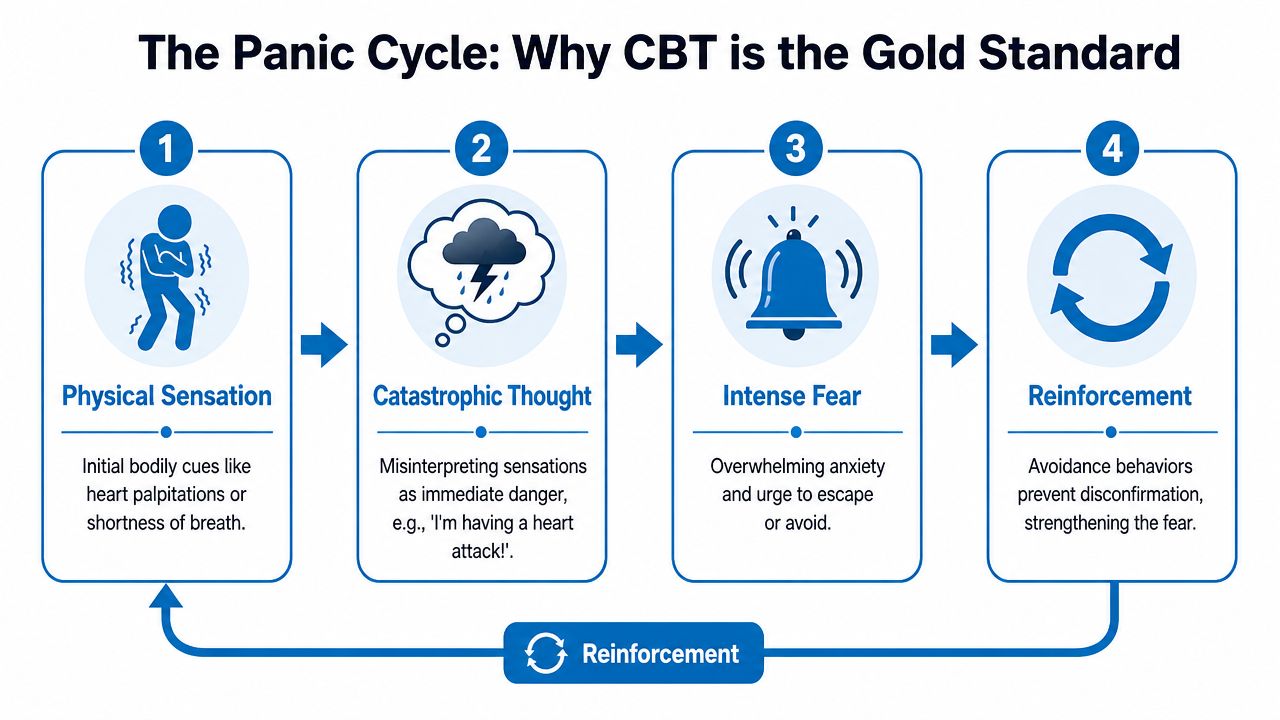
The panic cycle in plain language
CBT for panic disorder works by changing the meaning you give to bodily sensations and the actions you take in response to them.
A simple version of the cycle looks like this:
Physical sensation
Your heart beats faster after climbing stairs, drinking coffee, or feeling stressed.Catastrophic thought
You think, "I'm going to faint," "I'm having a heart problem," or "I'll lose control in public."Intense fear
Anxiety rises sharply. Your breathing changes. Your body prepares for danger.Avoidance or escape
You leave, sit down, call someone, carry "just in case" items, or stop going to similar places.
The short-term relief from escape is what keeps the problem going. Your brain never gets to learn that the sensation was frightening but not dangerous.
What makes CBT different
CBT doesn't only help you talk about panic. It helps you interrupt the cycle at multiple points. You learn to:
- Catch thoughts earlier – before they spiral into catastrophe
- Test beliefs – instead of automatically believing every alarm signal
- Reduce safety behaviors – so your brain can learn you're safer than you feel
- Face sensations and situations – with a plan, not by force
This is why CBT has such a strong evidence base. When properly delivered, CBT for panic disorder achieves success rates between 70% and 90% in randomized parallel trials, as reported in this trial on focused CBT for panic disorder.
For many readers, that phrase "properly delivered" matters. Panic treatment works best when it is structured, theory-based, and focused on the mechanisms that drive panic rather than only offering reassurance. If you'd like a clearer picture of how this method is used clinically, this page on cognitive behavioral therapy for anxiety gives a useful overview.
Why this matters in an expat context
Living in another country adds layers to the panic cycle. Ordinary uncertainty can become fuel for catastrophic interpretation. "What if I panic on the train?" quickly turns into "What if no one understands me?" or "What if I can't get help?"
That doesn't change the core treatment. It changes the context in which panic happens. CBT still works, but the examples, fears, and exposure exercises need to fit your real life in Italy.
The Core Techniques of CBT for Panic
The heart of CBT for panic disorder is not one single trick. It's a set of tools that work together. Each tool addresses a different part of the panic cycle.
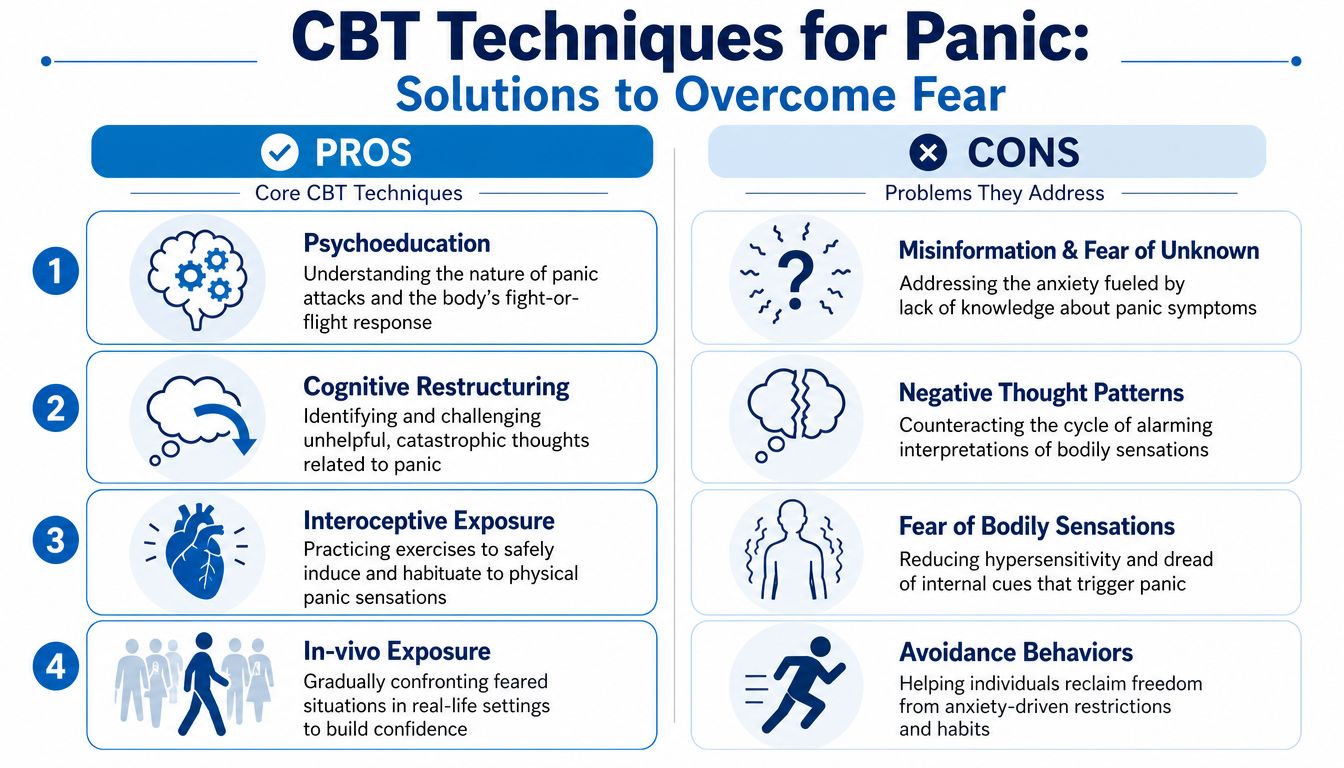
Cognitive restructuring
This is the part where you learn to challenge catastrophic thoughts instead of instantly obeying them.
Many people with panic don't realize how quickly their minds make extreme predictions. The thought may flash by so fast that it feels like a fact. CBT slows that down.
A therapist may help you examine thoughts like:
- "My racing heart means danger."
- "If I panic in public, I'll completely fall apart."
- "Dizziness means I'm about to collapse."
- "If I don't escape now, this will become unbearable."
The goal isn't forced positive thinking. It's accurate thinking. You ask questions such as:
- What's the evidence that this sensation is dangerous?
- Have I felt this before and survived it?
- Is there another explanation for what I'm feeling?
- What happens if I stay and observe instead of fleeing?
Over time, your mind becomes less dramatic and more grounded. Panic loses some of its power because the story attached to the sensation changes.
Interoceptive exposure
This is often the most important and most misunderstood part of CBT for panic disorder.
Interoceptive exposure means intentionally creating harmless body sensations that resemble panic symptoms, so your brain can learn they are uncomfortable but not dangerous. A therapist might guide exercises that create dizziness, breathlessness, warmth, or a faster heartbeat in a controlled way.
Many people with panic are not only afraid of situations. They're afraid of their own internal sensations.
Panic is often driven by the fear of sensations themselves; if your brain believes dizziness means catastrophe, it will keep sounding the alarm every time you feel dizzy.
Interoceptive exposure helps break that link. It is one of the most effective components of CBT for panic, yet it can be especially hard for expats to practice alone in an unfamiliar environment. Two-year follow-ups confirm that panic-free status depends on sustained self-exposure, as described in this discussion of interoceptive exposure and panic recovery.
For expats in Italy, confusion often arises. A person may understand the technique in theory but feel stuck in practice. It's one thing to say, "Practice the sensation." It's another to try it alone in a small apartment in Rome after a frightening week, with no nearby support system and lingering fear that something could go wrong.
That doesn't mean you can't learn it. It means guided practice matters.
If you want a broader explanation of how CBT tools fit together, this guide to cognitive behavioral therapy can help you place interoceptive exposure in context.
Situational exposure
Situational exposure is different. Instead of practicing body sensations, you gradually return to places and activities you've started to avoid.
For one person, that might mean:
- Standing in a short checkout line.
- Riding one metro stop.
- Sitting in the middle row at the cinema.
- Taking a train trip without rushing to the exit.
- Going to class or work without planning an escape route.
For someone else, the avoided situation may be crossing a piazza alone, attending a language course, or driving on the ring road. The details vary. The principle doesn't.
The purpose is not to prove that you'll feel calm every time. The purpose is to prove that you can handle fear without letting avoidance run your life.
Breathing and grounding
These tools help, but they need to be used wisely.
Breathing and grounding can reduce overwhelm and help you stay present long enough to practice new responses. They may include slowing the breath, noticing your feet on the floor, naming objects around you, or gently orienting yourself to the room.
But in CBT for panic disorder, these techniques are usually not taught as magic "make it stop" buttons. They're used to support learning, not to become another form of escape.
A practical difference looks like this:
| Useful use | Less useful use |
|---|---|
| Using grounding to stay present during exposure | Using grounding to immediately suppress every sensation |
| Slowing breathing after noticing panic thoughts | Forcing breath control because you believe sensations are dangerous |
| Orienting to the room while remaining in the situation | Escaping the situation as soon as symptoms rise |
That distinction can feel subtle. It's central. CBT isn't about winning a fight against panic. It's about teaching your brain that the sensations don't need emergency treatment.
What a Typical CBT Treatment Journey Looks Like
Many people delay therapy because the unknown feels intimidating. Knowing what usually happens can make the first step feel more manageable.
A CBT journey for panic disorder is structured, collaborative, and practical. You won't be expected to reveal everything at once or perform perfectly. You and the therapist build a plan together.
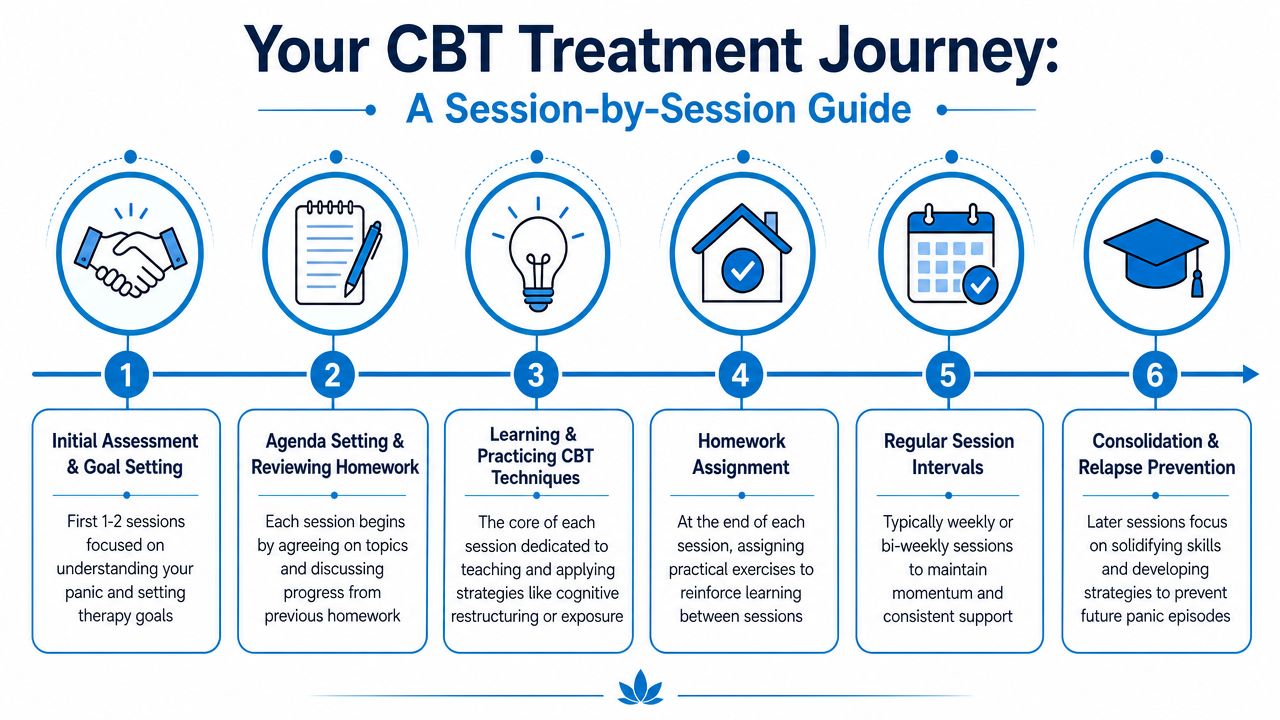
What a session often includes
A typical CBT session usually has a clear rhythm. That structure is reassuring for many people with panic because it reduces uncertainty.
A session often includes:
- Check-in – What happened since the last session, what felt difficult, and what changed.
- Agenda setting – You agree on the main focus for that meeting.
- Review of practice – You look at what you tried between sessions and what got in the way.
- Skill work – You learn or refine a CBT technique.
- Planning – You decide what to practice next in daily life.
Homework in CBT isn't busywork. It's where new learning becomes real life.
That "homework" may include tracking panic episodes, testing a feared belief, practicing an interoceptive exercise, or returning to an avoided situation in a graded way.
How long treatment may take
CBT for panic isn't always the same length for every person. Needs vary. Schedules vary. The presence of agoraphobic avoidance, burnout, trauma history, or relocation stress can also shape the pace.
Still, there are two common patterns worth knowing:
- Traditional CBT format – Often around 12 to 15 sessions, especially when treatment moves step by step through education, cognitive work, and exposure.
- Short intensive formats – These can be useful for people with limited time, limited funds, or a need for focused work.
While traditional CBT for panic involves 12 to 15 sessions, recent developments show that short, intensive cognitive behavioral therapy can reduce anxiety sensitivity faster than standard or psychodynamic approaches, according to this research summary on intensive CBT.
That matters in Italy for two groups in particular. International students may be balancing classes, exams, and budget pressure. Working professionals may want a focused plan that fits demanding schedules.
If you're anxious about what therapy feels like at the start, reading about the first psychological session can make the process less mysterious.
What clients often find surprising
People often expect therapy to be passive. CBT for panic disorder isn't passive, but it also isn't harsh. Good treatment feels active and supportive at the same time.
Three things commonly surprise new clients:
The structure feels calming
You know what you're working on and why.Practice between sessions matters a lot
Change doesn't happen only in the therapy room.Progress isn't measured only by fewer symptoms
It's also measured by less avoidance, less fear of fear, and more freedom in daily life.
Self-Help Strategies and Preventing Relapse
Self-help can support recovery when it's used in the right spirit. The goal isn't to manage every sensation perfectly. The goal is to keep building a different relationship with panic.
A few practical strategies can help you stay grounded between sessions and after treatment ends.
Daily tools that support recovery
These work best as complements to therapy, not substitutes for it.
- Keep a panic record – Write down the situation, body sensations, thoughts, actions, and what happened next. This often reveals patterns that feel invisible in the moment.
- Practice noticing without rushing to fix – If your heart speeds up, try naming the sensation before judging it. "My chest feels tight" is more useful than "Something is wrong."
- Reduce avoidance gently – Stay in contact with ordinary life. Small acts of approach matter.
- Review your learning – Many people benefit from keeping a short list of truths they want to remember when fear spikes.
A lapse is not the same as starting over. It's usually a signal to return to the skills that helped before.
Relapse prevention as a normal part of treatment
Relapse prevention doesn't mean expecting failure. It means planning wisely for stressful periods, travel, illness, transitions, sleep disruption, or major life changes.
This is especially relevant for expats. Returning home for a visit, changing jobs, moving cities, visa stress, or relationship strain can reactivate old panic patterns. That doesn't erase your progress.
A simple relapse-prevention plan often includes:
- Early warning signs – more checking, more avoidance, more reassurance-seeking
- A response plan – resume exposure practice, review thought records, seek support sooner
- Booster sessions – brief returns to therapy when needed
- Self-compassion – responding to setbacks with skill rather than shame
Long-term follow-up data supports the value of continued attention to maintenance. At 12 months post-intervention, the response rate for patients receiving CBT rises to 63%, compared with 38% for usual care. At the same time, at least 50% of patients still require room for improvement, which is why relapse-prevention strategies matter in real-world recovery, as summarized by the AAFP review of panic disorder treatment outcomes.
That is not discouraging news. It's realistic news. Panic recovery isn't about becoming a person who never feels anxiety again. It's about becoming someone who knows what panic is, knows how to respond, and doesn't let fear organize life.
Finding a CBT Therapist in Italy as an Expat
Finding a therapist is hard enough when you're in your home country. In Italy, it can feel even harder if you need support in English or another language and want someone who understands both panic treatment and intercultural stress.
A good CBT therapist for panic disorder should understand exposure work, catastrophic thinking, avoidance patterns, and the practical realities of living abroad. For expats, the fit matters. You may need someone who can hold both things at once: the universal psychology of panic and the specific challenges of navigating Italy far from home.

What to look for
These questions can help when you're choosing support:
Does the therapist really use CBT for panic disorder?
Not every therapist specializes in panic-specific treatment.Can they guide interoceptive exposure safely?
This is especially important if you're afraid to practice body-sensation exercises alone.Can you speak in your strongest language?
Panic is hard to describe. Nuance matters.Do they offer online sessions if travel across the city feels overwhelming at first?
Flexibility can make treatment more accessible.Do they understand expat stressors?
Panic can intertwine with homesickness, bureaucracy, loneliness, or identity strain.
You may also care about privacy and note-taking practices when working with a mental health professional.
Practical support for expats in Italy
For international residents, one common obstacle isn't motivation. It's access. You may need therapy in your own language, a clinician who understands evidence-based methods, and the option to meet online or in person depending on what panic currently allows.
In Italy, some people begin with online sessions because leaving home or taking transport feels too difficult at first. Others prefer in-person work once trust is established. Both paths can be valid.
If you're sorting through options, this guide on finding the right therapist for expats in Italy can help you clarify what fit looks like in practice.
FAQ
How quickly can CBT for panic disorder start helping
CBT for panic disorder can start helping relatively early for some people. Some individuals notice improvement within the first few weeks, especially once they understand the panic cycle and begin practicing new responses. The pace varies, but early progress often comes from reduced fear of the sensations rather than total symptom disappearance.
Is online CBT effective for panic disorder
Yes, online CBT can be effective for panic disorder. Meta-analytic evidence shows no significant efficacy differences between face-to-face individual, face-to-face group, and guided remote self-help formats for panic disorder, as described in this meta-analytic review of CBT delivery formats. For expats in Italy, online therapy can be especially helpful when language access, travel stress, or avoidance makes in-person care harder to start.
What if exposure therapy feels too scary
That's a very common fear, and good CBT doesn't throw you in unprepared. Exposure is planned gradually, explained clearly, and done with collaboration. The point isn't to overwhelm you. It's to help your brain learn, step by step, that feared sensations and situations can be tolerated safely.
Do I need medication for panic disorder
Not everyone with panic disorder needs medication. CBT is one of the most effective non-pharmacological treatments for panic, and many people choose to begin there. In some cases, medication can be part of a broader treatment plan, but that decision should be made with an appropriate medical professional.
Can CBT help if I've started avoiding parts of life in Italy
Yes, CBT is especially relevant when panic has started shrinking your world. Avoidance is one of the main processes that keeps panic going, whether you're avoiding trains, supermarkets, university classes, or crowded streets. CBT helps you return to those parts of life gradually and with more confidence.
Why is interoceptive exposure harder when I'm living abroad
It can be harder because panic feels more dangerous when you're already stressed, isolated, or unsure of your surroundings. Many expats feel less safe practicing feared sensations alone in an unfamiliar environment or in a second language. Guided therapy can make this core CBT technique feel more understandable, contained, and doable.
Book your first free assessment call – no commitment, just a conversation with our Clinical Director who will listen and match you with the right therapist for you. Visit THERAPSY.