Understanding Therapy Coverage for Expats in Italy
You may arrive in Italy with a clear assumption that your health plan will handle therapy the same way it handles a doctor visit. Then real life intervenes. Work pressure builds, the language gap slows every errand, and the idea of asking for help starts to feel harder than it should. At that point, the practical question is simple, does health insurance cover therapy in Italy, or are you expected to pay on your own?
The answer depends on which coverage layer you are using. Italy works through a three-layer coverage reality for mental health, the public Servizio Sanitario Nazionale (SSN), private health insurance, and government subsidy programs. Once you separate those layers, the system becomes easier to read. Until then, it can feel inconsistent, because each layer has its own rules, its own paperwork, and its own limits.
Practical rule: coverage only helps if you can actually use it, in your region, in your language, and through the right provider pathway.
For many expats, the issue is not whether therapy exists in Italy. It is whether they can reach it without repeated forms, upfront payment, or a provider who cannot communicate with them in English. A clear answer starts with structure, not guesswork.
Understanding Therapy Coverage for Expats in Italy
New arrivals often hear two opposite stories. One person says mental health care is part of the public system. Another says therapy is always private and expensive. Both stories can sound accurate because they are describing different parts of the same setup.
The key question for expats is usually status, not theory. Are you registered with the SSN, are you using private insurance, or are you relying on a subsidy route? If you are in the SSN, psychotherapy may be available through public channels such as local mental health departments. If you use private insurance, coverage depends on the wording of the policy, not on the label on the card.
Italy's national health system includes mental health care within its essential benefits package for eligible residents and EU citizens. That means therapy sits inside the public health structure rather than outside it. The practical problem is that having a benefit on paper does not automatically mean easy access.
In everyday life, many people move through a two-step or three-step choice, not a simple yes-or-no answer.
The three layers you need to separate
- SSN access: public mental health care, usually through local services and not unlimited everywhere.
- Private insurance: therapy may be reimbursed if your policy explicitly includes psychotherapy.
- Government subsidies: a separate route that can help pay for private sessions if you qualify.
That distinction matters because one person may fit all three layers, while another may only fit one. Confusion starts when “health insurance” is treated as if it means a single thing. In Italy, it often does not.
A useful way to understand the policy logic is mental health parity with Benely. The idea is straightforward. A mental health benefit may exist, but the path to using it can still involve referrals, service limits, or provider restrictions that make access harder than expected.
For expats deciding where to begin, the first question is practical. Are you dealing with SSN access, a private policy, or both? That answer usually tells you whether therapy will be free, partly reimbursed, or paid out of pocket.
How the Italian Public Health System Covers Mental Health
The SSN is the reason therapy can be covered at all for many residents in Italy. It is a tax-funded national system, and mental health care sits within its essential benefits package. That does not mean unlimited free psychotherapy for everyone. It means mental health is part of the public health structure, not an add-on you have to buy separately.
For an expat, that usually means access through local public mental health departments, often called CSM or linked to the ASL. The route is usually more bureaucratic than people expect. You do not choose any private therapist and send the bill to the state.
What public access usually looks like
The usual path starts with the local system, not with a private office. In many cases, a general practitioner can point you toward the public route, then the local mental health service decides how care is delivered. Public care may be low-cost or covered with only a small ticket, but access is not unlimited and it can vary by region.
What matters most: public coverage does not mean instant access. It means a formal route exists, and that route may be slower than private care.
That is where many English-speaking expats run into trouble. The system may cover mental health care, but the person at the front desk may not speak English. The nearest service may have a waiting list. A city with stronger public resources can feel very different from one with fewer specialists.
Why expats still struggle even when they're eligible
There are three common friction points.
- Language: the public pathway often isn't built around English-speaking patients.
- Region: availability and speed can differ depending on where you live.
- Referral: access is usually routed through public services, not a therapist you pick freely.
This is why a lot of newcomers feel stuck between “covered” and “usable.” They may technically qualify, yet still need a workaround if they want therapy in English, fewer delays, or a format that fits a demanding work schedule. Some expats combine the public route with private care, especially when they want continuity rather than a one-off appointment.
A helpful overview of how the local system fits into everyday life is Therapsy's guide to the medic of base for expats in Italy. The practical point is simple. The SSN can cover therapy, but the path is structured, local, and sometimes slow.
Private Health Insurance and Employer EAPs for Therapy
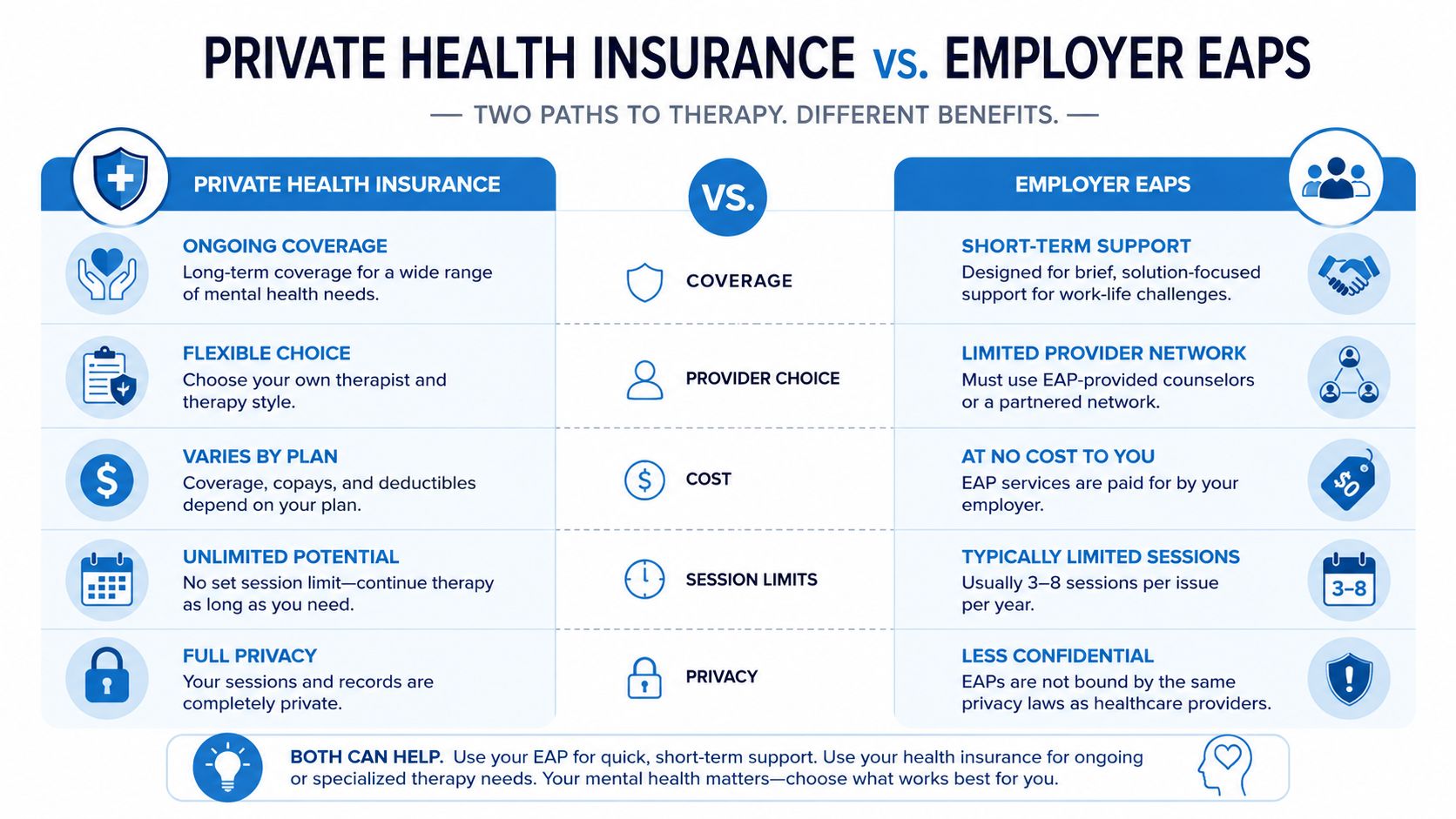
Private insurance is where many English-speaking expats look first, especially if they need quicker access or care in English. Coverage is not automatic. Psychotherapy is often a separate benefit, and the policy language matters more than the brand name on the card.
One expat insurance guide says that a standard therapy session in Italy usually costs €50–€100 without reimbursement, while many private plans that do include mental health reimburse only 50% to 80% of the fee and still impose annual limits or a fixed number of sessions. That is why the fine print matters so much. “Private insurance” does not automatically mean “therapy included.”
What private policies usually ask for
Private reimbursement often comes with conditions. You may need invoices, an approved provider, and a claim process that follows the insurer's rules. Some policies reimburse after you pay upfront. Others use networks or pre-approval systems.
That means the question is not only whether therapy is covered. It is whether your insurer accepts the therapist you want to see, whether the session type is eligible, and whether the annual cap is high enough to matter.
A separate practical issue for many newcomers is legal entry and residence. For non-EU nationals, health insurance is commonly required for visa or residence permit purposes, with coverage of at least €30,000 for medical expenses (Italian health insurance guide). In real life, that requirement often shapes the first policy people buy, even before they know whether therapy will be included.
Questions to ask before you rely on private coverage
- Is psychotherapy included? If the answer is vague, assume it may not be.
- Do I need an approved provider? That matters if you want reimbursement.
- Is there a yearly cap or session cap? Without this, your costs can surprise you.
- Do I need a diagnosis or referral? Some claims require more than receipts.
- Is English-language therapy reimbursable? Language alone doesn't guarantee eligibility.
Employer assistance programs can also help, especially for international staff, NGOs, and large companies. These programs are often lighter-weight than full insurance and can be useful for short-term support or early intervention. For a work-focused overview, Therapsy's employee mental health support page shows how workplace-based support fits into therapy access.
The main takeaway is this. Private coverage can be very helpful, but it is contractual, not universal. You have to verify the details before you book.
EHIC and Cross-Border Coverage for EU Visitors
If you are in Italy temporarily and hold a European Health Insurance Card, your situation is different from that of a registered resident. EHIC gives access to medically necessary treatment in the public system or an accredited provider, but it does not cover planned treatment or private care (Italian Ministry of Health urgent and necessary treatment page).
For therapy, that boundary matters a lot. Ongoing psychological support is rarely a simple emergency service, so relying on EHIC for regular sessions is usually not realistic. The card can help in a crisis if the treatment is medically necessary and delivered through the correct public pathway. It does not open the door to private psychotherapy just because you are in the country.
The Finnish EU healthcare guidance says EHIC access is tied to medically necessary care and does not reimburse fees charged for medical services in Italy (EU healthcare guidance for Italy). That is a narrow but important rule. If you pay a private therapist directly, the card does not work like a refund mechanism.
What EHIC can and can't do for therapy
EHIC can help in an urgent public-care situation. It cannot be treated as a general therapy plan.
That is the boundary many visitors miss. A person may be in Italy for work, study, or a short stay and assume the card will behave like a full insurance policy. It will not. It is a safety net for necessary public treatment, not a substitute for a private mental health plan.
For example, if someone has a mental health crisis and needs immediate public evaluation, EHIC may be relevant if the service is medically necessary and provided in the correct setting. But if someone wants weekly therapy for stress, grief, or culture shock, EHIC is usually the wrong tool.
The distinction sounds technical, but it changes everything. EHIC is for temporary cross-border access to public care. Therapy planning is usually a different category, especially when language, continuity, and choice of therapist matter.
The Bonus Psicologo and Government Subsidy Programs
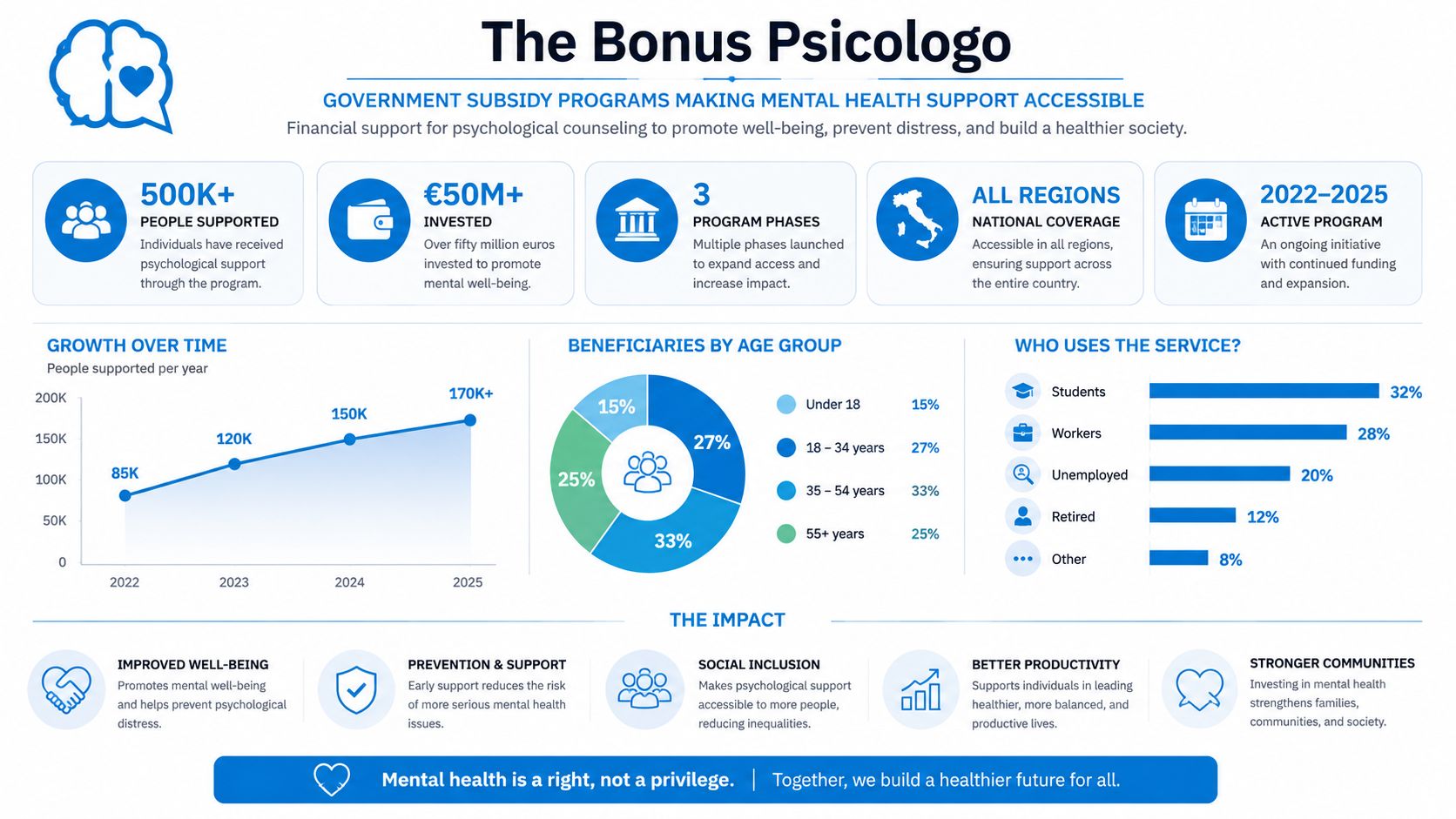
Italy has a rare extra funding route for mental health, the Bonus Psicologo. It can contribute up to €1,500 toward private psychotherapy, with tiers of €1,500, €1,000, or €500 depending on income bands, and reimbursement capped at €50 per session. That makes it different from ordinary insurance reimbursement because it is a public subsidy, not just a policy benefit.
Why this program matters for expats
The Bonus Psicologo sits between public access and private payment. That makes it useful for people who cannot find enough support in the public system but also do not want to carry the full private cost alone. If you qualify, it can reduce the pressure of paying every session out of pocket.
The catch is that subsidy programs still involve rules, timing, and eligibility checks. They are helpful, but they are not instant and they are not universal. Some expats qualify, some do not, and many never realize they should check.
A useful way to think about it is this. Public SSN access is one path. Private insurance is another. The Bonus Psicologo is a third route that can support private therapy when the other two are not enough.
Where extra support sometimes appears
- University counseling: international students may find short-term support through campus services.
- Regional initiatives: some areas add local resources or mental health projects.
- Private-pay therapy with subsidy: the Bonus Psicologo can soften the cost if you qualify.
For students, the main value is often speed and language access. For professionals, it may be the ability to begin therapy without waiting for a public opening. For couples, it can make it easier to start sessions sooner rather than postponing care until stress becomes a crisis.
The practical point is straightforward. If you are asking whether therapy is financially possible in Italy, do not stop at your insurance policy. Check whether you also qualify for a public subsidy.
The internal guide at Therapsy's Bonus Psicologo 2026 page for expats is a useful next stop if you want to understand how the program fits into expat mental health planning.
Costs, Documentation, and Reimbursement Procedures
The money question is usually the one people ask last, after they have already tried to book something and discovered the system is more complicated than expected. In Italy, the cost of therapy depends on the route you take, and the paperwork depends on who is supposed to pay it back.
The public system can involve a capped out-of-pocket charge for some specialist consultations, with one expat insurance guide citing a maximum of €38 for some specialist consultations under the SSN. Private therapy, by contrast, may cost €50–€100 per session without reimbursement, while some plans pay back only part of the fee. Subsidies can reduce costs further, but only if you qualify and use the approved process.
A simple cost map
| Pathway | What you may pay |
|---|---|
| SSN route | Low or no direct cost in public channels, with possible ticket charges |
| Private insurance | Upfront session fee, then partial reimbursement if the policy allows it |
| Bonus Psicologo | Private session cost reduced by subsidy if eligible |
The important detail is that reimbursement is not automatic. You usually need invoices that clearly show the provider, the date, and the service. Some insurers also want the therapist to be in their approved network, or they will reject the claim even if the therapy itself was legitimate.
Documents people are commonly asked for
- Invoices: clear proof of what was paid and for whom.
- Provider details: the therapist's identity and professional status.
- Policy confirmation: evidence that psychotherapy is included.
- Claim forms: the insurer's own paperwork, submitted correctly and on time.
Keep every receipt the moment you pay. Reimbursement problems usually start when documentation is incomplete, not when the therapy itself is in doubt.
Private plans can also vary in whether they ask for a diagnosis, a referral, or prior approval. That is why two people with similar coverage can still have completely different experiences at claim time. One gets reimbursed quickly. The other learns that the provider was not approved, or that the annual cap was already used up.
If you want a broader budgeting perspective, Therapsy's cost guide for therapy in Italy is a useful reference when you are comparing public, private, and subsidized routes.
How English-Speaking Expats Can Access Therapy in Italy
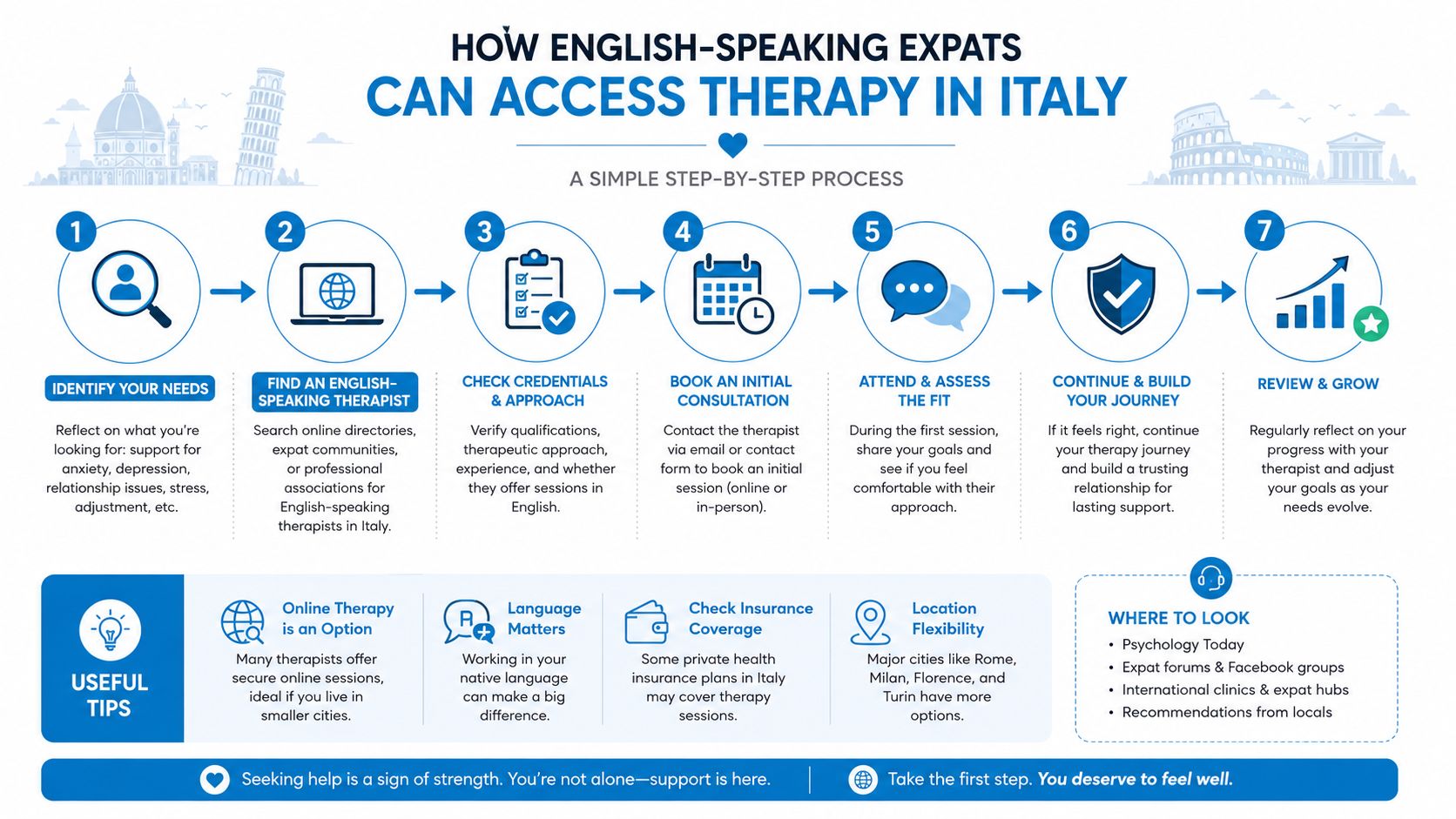
For English-speaking expats, the decision is usually less about philosophy and more about feasibility. You want a therapist you can understand, a system you can work with, and a path that does not break down when your paperwork changes.
A practical decision framework
Start with your status. If you are registered with the SSN, public mental health care may be available, but the service may not be built around English-speaking convenience. If you have private insurance, check whether psychotherapy is explicitly covered, not implied. If you are eligible for the Bonus Psicologo, use that as a cost-reduction path rather than assuming you have to pay everything alone.
Then match the pathway to your actual life.
- International students: campus support may help short term, but language and wait times can still matter.
- Young professionals: private or employer-based options often fit better if work hours are tight.
- Cross-cultural couples: continuity, shared language, and coordinated scheduling often matter more than the cheapest route.
A multilingual service can remove the two biggest barriers at once, language and access. THERAPSY works as a private psychotherapy resource for people who need support in multiple languages, with human matching, online and in-person sessions, and therapists available across several Italian cities. For many expats, that combination helps make care easier to start and maintain.
The internal page online therapy in English in Italy is especially relevant if you want to understand how English-language care fits into everyday life in Italy. Online therapy can be especially practical when you are juggling work, visas, classes, or a move between cities.
A decision sequence you can actually use
- Check SSN eligibility. If you are covered, see how local mental health access works.
- Read your private policy. Look for psychotherapy, reimbursement limits, and approved providers.
- See whether you qualify for the Bonus Psicologo.
- Choose the route that fits your language and schedule.
That sequence sounds basic, but it saves people a lot of time. Most coverage confusion starts when someone searches for a therapist before checking which system pays. Once you reverse that order, the picture gets much clearer.
FAQ Health Insurance and Therapy Coverage in Italy
Is therapy covered by the Italian public health system?
Yes, mental health care is part of the SSN's essential benefits package. Access usually runs through public mental health departments or SSN-affiliated services, so it is not the same as choosing any private therapist you want. The practical issue is availability, language, and region.
Does EHIC cover ongoing therapy in Italy?
No, EHIC is for medically necessary care in the public system, not planned private psychotherapy. It can help in a crisis if the treatment fits the public-care rules, but it is not a reliable plan for ongoing support. If you need regular therapy, you usually need SSN access, private insurance, or both.
Can private insurance reimburse therapy sessions in Italy?
Yes, but only if psychotherapy is explicitly included in the policy. Many plans require invoices, approved providers, and sometimes annual limits or a fixed number of sessions. Always confirm the details before you book.
What if my insurance excludes psychotherapy?
Then you will usually need to pay out of pocket or check whether you qualify for a public subsidy such as the Bonus Psicologo. Some people also use SSN pathways if they are eligible as residents. The right answer depends on your status, not just your policy.
Is the Bonus Psicologo hard to use in practice?
It can be helpful, but it still depends on eligibility and the application process. If you qualify, it can reduce private therapy costs by covering part of the session fee up to the program limit. The key is to apply early and keep your paperwork organized.
If you are trying to sort out therapy access in Italy and want help in your own language, THERAPSY offers a human-matched first assessment call, then connects you with a therapist who fits your situation, language, and goals. That can be a practical next step if the SSN feels too slow, your insurer is unclear, or you want a clear conversation before choosing a therapist.