You might be reading this because your body doesn't feel like home right now.
You're living in Italy. On paper, life may look beautiful. Yet inside, you feel wired, flat, tearful, irritable, or strangely disconnected. You may wake up tired, tense through the shoulders, overly alert in crowds, or unable to switch off after small stresses. Many expats assume this means they're “not coping well enough”. Clinically, it often means something simpler and more compassionate. Your stress system has been working very hard for a long time.
Nervous system regulation therapy is a therapeutic approach focused on restoring balance to the autonomic nervous system, which controls involuntary stress responses such as heart rate, breathing, digestion, and physiological arousal. In clinical practice, the strongest framing isn't vague wellness language. It is the idea that people can learn to shift more flexibly between activation and calm, especially when chronic stress, trauma, burnout, or major life change has left the body stuck in high alert or shutdown.
For expats in Italy, that makes sense. Relocation can bring beauty, but it also brings repeated stressors: language fatigue, homesickness, isolation, bureaucracy, identity shifts, and the pressure to “make the move worth it”. When those pressures pile up, your body may start reacting as if everyday life is slightly unsafe, even when your rational mind knows you're fine.
Important distinction: Nervous system regulation isn't about being calm all the time. It's about being able to return to balance after stress.
Online, many people get confused. They search for “nervous system regulation” and find broad promises, wellness trends, or one-size-fits-all advice. But if someone is highly activated, telling them to relax may not help. If unresolved trauma, burnout, or ongoing stress is driving the reaction, the work needs to be careful, structured, and clinically informed.
I'm Dr. Francesca Adriana Boccalari, Clinical Director at Therapsy. In this guide, I'll explain nervous system regulation therapy in plain language, with a special focus on expats in Italy who want something clearer than internet buzzwords and gentler than self-blame.
Introduction to Nervous System Regulation Therapy
Why this matters for expats in Italy
Moving abroad asks a lot from the mind and body at once. You may be translating constantly, reading social cues in a new culture, missing your usual support system, and trying to function as if none of that is stressful. The body often notices before the mind does.
A person can look “fine” while their nervous system stays in a guarded state. They may keep going, keep smiling, keep performing, but feel internally braced. Over time, that can show up as anxiety, irritability, numbness, poor sleep, emotional swings, or a sense of being detached from yourself.
A clinical definition in plain language
Nervous system regulation therapy helps a person move out of chronic stress states and build a safer, more flexible relationship with their own body, emotions, and stress responses.
In therapy, this usually means learning how to notice activation earlier, understanding what triggers it, and practising safe ways to come back into a tolerable state. The focus is not only on thoughts. It also includes the body's signals, what clinicians call interoception, and the autonomic nervous system's response to stress and safety cues.
This is why regulation work is often part of trauma treatment, burnout recovery, anxiety care, and adjustment support. It can include body awareness, grounding, breathwork, EMDR preparation, mindfulness, and other evidence-based approaches used as part of a broader treatment plan.
The strongest scientific framing for nervous system regulation is the role of interoception and autonomic regulation in trauma treatment, not a vague wellness concept, as noted in this clinical overview of nervous system work.
What people often misunderstand
The internet often presents regulation as if there is one trick that “resets” the body. Real therapy is more nuanced.
- It's not just relaxation: A person can feel tense because of unresolved threat, not because they forgot to breathe.
- It's not a standalone cure: Regulation tools are often most helpful when integrated with psychotherapy.
- It's not about forcing calm: If a person feels flooded, some exercises may feel irritating or impossible at first.
That's not failure. It's useful information. It tells us the system needs support, pacing, and safety rather than pressure.
Your Body's Internal Blueprint The Autonomic Nervous System
The body's automatic stress system
Your autonomic nervous system works in the background all day. It regulates things you don't need to consciously manage, like heart rate, breathing, digestion, and general arousal. When life feels demanding, this system reacts before you've had time to “think your way through” what's happening.
A simple analogy helps. Think of your nervous system as having an accelerator and a brake.
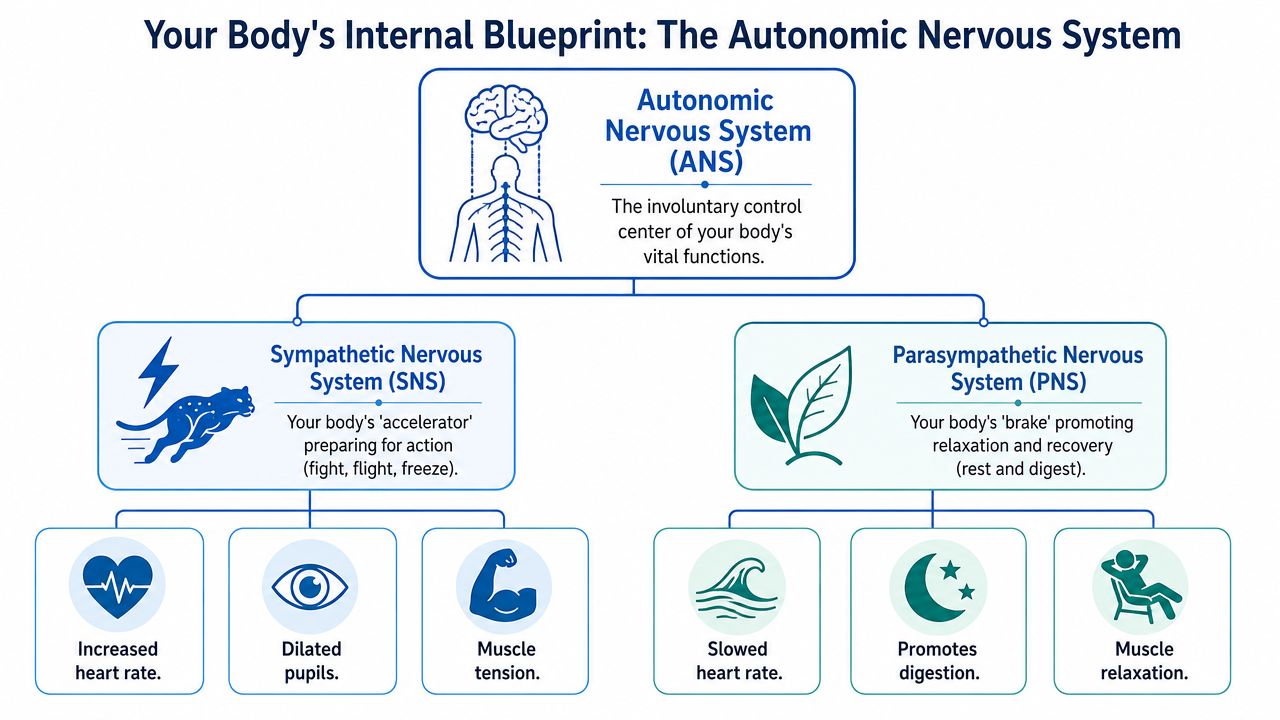
- The sympathetic system is the accelerator. It prepares you for action. You may feel alert, tense, fast, watchful, or reactive.
- The parasympathetic system is the brake. It supports rest, digestion, settling, and recovery.
Neither side is bad. You need both. Trouble starts when the accelerator keeps firing long after the stressor has passed, or when the system swings into collapse instead of recovery.
How this can feel in daily life
If you've spent a week dealing with paperwork, uncertainty, housing issues, or a language barrier, your accelerator may stay partly pressed down. You may notice:
- In the body: jaw tension, shallow breathing, stomach upset, racing heart
- In the mind: scanning for problems, overthinking, irritability
- In behaviour: snapping at people, avoiding messages, feeling unable to rest
At other times, the system doesn't speed up. It slows down too much. That can feel like numbness, heaviness, procrastination, or “I know what I need to do, but I can't move”.
For many expats, in these situations, self-judgement appears. They call themselves lazy, dramatic, weak, or difficult. A kinder and often more accurate frame is this: your body is trying to protect you with the tools it has.
What regulation therapy is trying to do
In clinical work, nervous system regulation therapy aims to help the autonomic nervous system shift out of chronic high alert and towards better parasympathetic balance. One practical method used in therapy is extending the exhale longer than the inhale for 2–5 minutes to support vagal engagement and lower activation, as described in this overview of nervous system regulation practices.
That won't solve every problem. But it gives the body a different signal.
If anxiety has been your main experience, it may also help to read more about anxiety symptoms in adults, especially because nervous system activation often gets mistaken for a personal weakness rather than a physiological stress pattern.
Signs Your Nervous System Needs Support
Some signs of dysregulation are dramatic. Many are quiet. They often look like ordinary stress until they start shaping your whole week.
Physical signs
The body is usually the first place I look with a client.
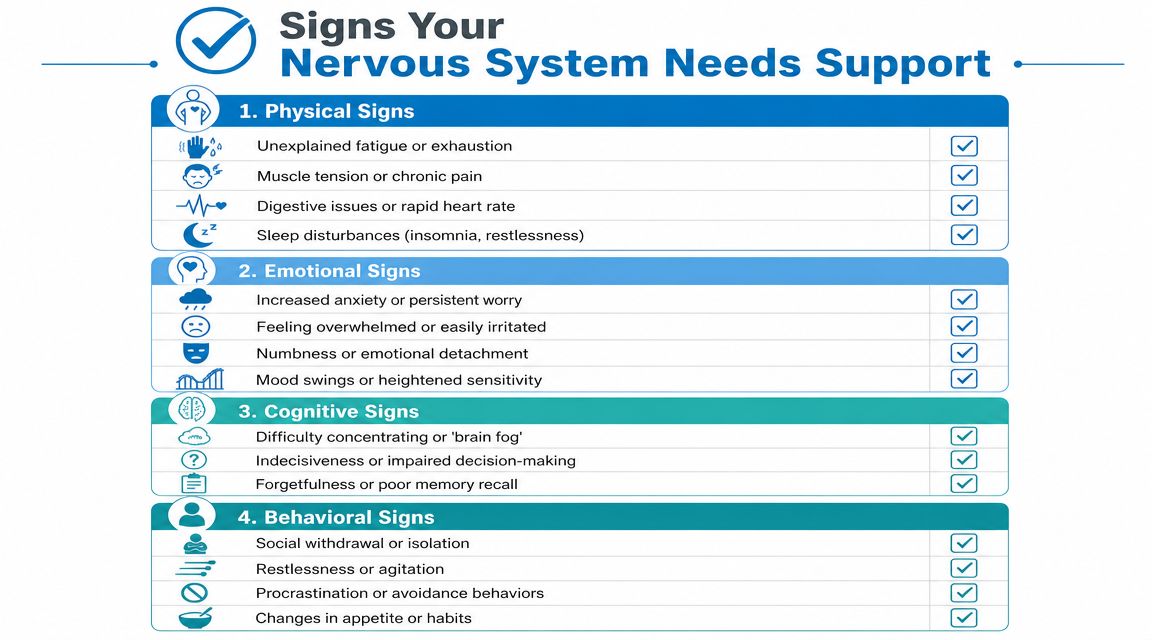
Common physical signs include:
- Persistent tension: shoulders up, jaw tight, fists clenched without noticing
- Sleep disruption: trouble falling asleep, waking early, light restless sleep
- Digestive changes: nausea, bloating, appetite changes, “stress stomach”
- Exhaustion: feeling tired even when you haven't done anything physically intense
- Startle responses: jumping easily at sound, touch, or interruption
Some people also experience chest tightness or pressure when stressed. That symptom can feel frightening, especially in a new country. For a grounded explanation of how stress can affect the chest, I Become on stress-related chest issues offers a useful overview. Of course, any new, severe, or concerning physical symptom should also be medically assessed.
Emotional and cognitive signs
Not all dysregulation feels like obvious anxiety. Sometimes it looks like emotional distance.
You might notice:
- Feeling overwhelmed fast: minor problems feel huge
- Irritability: you have less buffer than usual
- Numbness: you know you should feel something, but don't
- Worry loops: the mind keeps rehearsing worst-case scenarios
- Brain fog: concentration, decision-making, and memory feel harder
A useful clue: If your reactions feel bigger or flatter than the situation seems to warrant, your nervous system may be carrying more load than you realise.
This is common in expat life. Language fatigue alone can leave people mentally depleted by mid-afternoon. Social effort rises, recovery time shrinks, and the body starts staying defensive.
Behavioural signs
Behaviour often tells the story most clearly.
- Avoidance: putting off emails, appointments, phone calls, or social plans
- Withdrawal: staying home even though you feel lonely
- Restlessness: pacing, doom-scrolling, inability to settle
- Overworking: staying busy so you don't have to feel
- People-pleasing: staying hyper-attuned to others to avoid conflict or rejection
For some people, this pattern escalates into episodes that feel like a wave of physical terror. If that sounds familiar, learning more about panic attacks can help you distinguish panic from other forms of nervous system activation.
Core Therapeutic Approaches for Regulation
A helpful way to think about treatment is as a toolkit, not a single method. Different therapies support regulation in different ways. A skilled clinician chooses the right pace and combination based on what's driving the dysregulation.

EMDR
EMDR stands for Eye Movement Desensitisation and Reprocessing. It is often used when distressing memories or past experiences continue to keep the system on alert in the present.
In regulation-focused work, EMDR doesn't begin by pushing straight into painful material. Preparation matters. Therapists often help the client build internal resources first, such as a sense of safety, containment, and steadiness, before deeper processing begins.
For someone who says, “I know I'm safe now, but my body doesn't believe it,” EMDR can be especially relevant.
Somatic approaches
Somatic work focuses on what is happening in the body right now. Instead of asking only, “What are you thinking?” it may ask, “What do you notice in your chest, your breathing, your posture, your hands?”
That matters because stress responses are not only cognitive. They are physiological. Some people understand their patterns very well but still feel hijacked by them. Somatic work helps reconnect insight with bodily experience.
This may include:
- Tracking sensation: noticing tension, heat, heaviness, pressure, movement
- Grounding: orienting to the room, the chair, the floor, the present moment
- Titration: working in small, manageable pieces rather than too much at once
Polyvagal-informed therapy and mindfulness-based work
In plain language, polyvagal-informed therapy helps people recognise different nervous system states and identify what supports safety, connection, and steadiness for them.
A therapist might help you map:
| State | Common experience | Helpful therapeutic focus |
|---|---|---|
| High activation | anxious, wired, hyper-alert | slowing, grounding, orienting |
| Shutdown | numb, flat, disconnected | gentle mobilisation, contact, pacing |
| More regulated | present, connected, able to think | reflection, processing, integration |
If you're interested in how thoughts, behaviours, and body states work together, this guide to cognitive behavioural therapy can help place regulation work inside a broader evidence-based framework.
Practical Techniques for Daily Self-Regulation
These practices can support daily stability. They are not a replacement for therapy, especially if symptoms are persistent, trauma-related, or severe. Still, they can give your system small moments of safety and orientation.
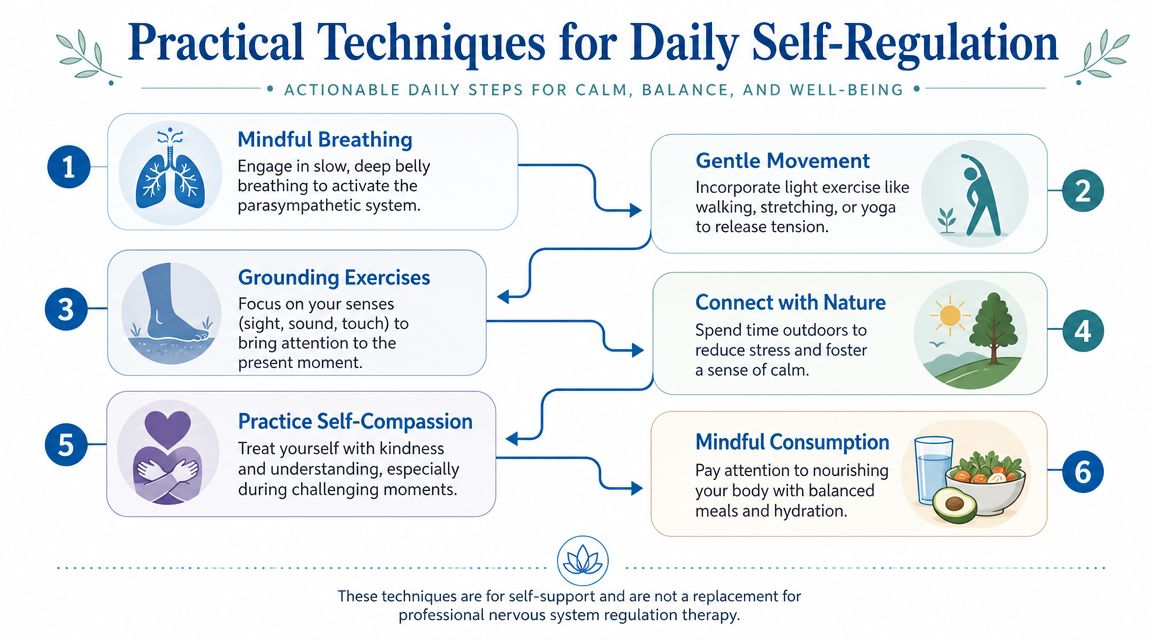
Start small and repeat often
Effective regulation is built through repeated state-shifts, not one perfect session. Practice-oriented guidance commonly recommends 5–10 minutes daily rather than occasional long efforts, as outlined in this overview of regulation techniques.
Three safe techniques to try
Paced breathing
Slow-breathing interventions are often defined as fewer than 10 breaths per minute, and breathing at fewer than 6 breaths per minute has been associated with increased heart-rate variability, a marker linked with stronger parasympathetic regulation, according to this review of nervous system regulation tools.
Keep it simple. Breathe gently and let the exhale run a little longer than the inhale. Don't force a huge breath. Forced breathing can make some anxious people feel worse.
Grounding through the senses
Look for five things you can see, four you can feel, three you can hear, two you can smell, and one you can taste. This helps interrupt spiralling and reminds the brain that you are here, now, in a real environment.
Brief body scan
Sit or stand and notice one region at a time. Jaw. Shoulders. Chest. Stomach. Hands. Legs. You're not trying to change everything. You're teaching your mind to notice the body without panic.
Practical rule: If a regulation exercise makes you feel more overwhelmed, stop. The right tool should feel tolerable, not punishing.
For readers who want a gentle introduction to diaphragmatic breathing, this piece on breathing for calm and focus can be a useful companion. You may also find this page on mindfulness helpful if you want to understand how present-moment attention supports regulation without becoming a performance task.
What to Expect in Therapy Sessions
Many people worry that therapy focused on nervous system regulation will be strange, intense, or overly body-based. In reality, good therapy usually feels measured, collaborative, and respectful of your pace.
The first sessions often focus on safety
A therapist won't usually begin by diving into the hardest parts of your history. The first phase often involves understanding your symptoms, your stressors, and what your body does under pressure. You may be asked when you feel most activated, what helps a little, what makes things worse, and whether certain sensations or situations feel especially loaded.
If trauma is part of the picture, preparation matters. Building resources first often makes later work feel safer and more manageable.
You don't have to “do it right”
A common fear is, “What if I can't relax in session?” That's okay. Therapy isn't a test of how calm you can become. It is a space where you and the therapist observe your system together and practise responding to it differently.
Sometimes the most important moment in a session is very small. Noticing your feet on the floor. Slowing down when your speech speeds up. Realising that your chest tightens before you say yes to something you don't want.
That is clinical progress.
Change usually comes through repetition
Regulation capacity is built gradually. Practice-oriented guidance often recommends 5–10 minutes daily of short, frequent exercises, using the therapy space to rehearse the shift between activation and calm, as described in this explanation of daily nervous system practice.
A therapist may suggest between-session practices such as:
- Very brief breathing work
- Grounding at predictable times of day
- Tracking one recurring body cue
- Reducing obvious overload where possible
Progress is rarely perfectly linear. Some weeks you feel steadier. Other weeks an unexpected stressor shakes the system again. That doesn't erase the work. It is part of how the nervous system learns.
Finding Multilingual Regulation Therapy in Italy
For expats, the question is often not only “What kind of therapy do I need?” but also “How do I access it in a language and cultural context that feels safe?”
Language is part of safety
When people discuss trauma, anxiety, shame, panic, or body sensations, their first language often holds more emotional accuracy than a second one. That doesn't mean therapy in English or Italian can't work if it isn't your native language. It means language choice matters clinically.
You may need words that come naturally when you're upset, not only when you're functioning well. You may also need a therapist who understands intercultural strain, homesickness, migration stress, bicultural identity, or the silent pressure many expats feel to stay grateful while struggling.
What to look for in a therapist
A good fit for nervous system regulation therapy in Italy often includes:
- Clinical training: especially in approaches such as EMDR, CBT, Schema Therapy, or somatic-informed work
- Cultural sensitivity: understanding relocation stress, identity shifts, and the practical realities of living abroad
- Language match: the ability to work in the language that gives you the most access to yourself
- Flexibility: online or in-person options that fit an expat schedule
If you're beginning your search, this page for an English-speaking therapist in Italy is a useful starting point.
A note on local evidence
There is an important evidence gap here. The available material does not provide Malta-specific or broader MT-region epidemiology, reimbursement, or outcome benchmarks for nervous system regulation therapy. In practical terms, that means any responsible article should avoid pretending there is local prevalence data when there isn't. What we can say clearly is that the clinical mechanisms and therapy approaches discussed here are used in practice-oriented guidance, but region-specific benchmarks would require additional local sources.
That kind of honesty matters. Good mental health information should reduce confusion, not add polished certainty where evidence is missing.
FAQ
Is nervous system regulation therapy the same as relaxation?
No. Nervous system regulation therapy is broader than relaxation because it focuses on helping the body shift more flexibly between stress and calm. Relaxation can be one tool within it, but therapy also addresses trauma patterns, chronic stress, body awareness, and how your system responds to safety cues.
Who can benefit from nervous system regulation therapy?
People dealing with anxiety, burnout, trauma-related symptoms, chronic stress, panic, or major life transitions can benefit from this kind of work. It can be especially helpful for expats in Italy whose bodies are carrying the strain of adaptation, isolation, or prolonged uncertainty.
Can I do nervous system regulation work on my own?
You can learn supportive self-regulation tools on your own, but self-help has limits. If your symptoms are persistent, intense, or connected to trauma, professional support is often the safer and more effective route because some techniques may feel frustrating or activating without guidance.
How long does it take to feel better?
It varies. Many people notice small shifts first, such as spotting activation earlier or recovering faster after stress, while deeper changes usually build gradually through repeated practice and a strong therapeutic relationship.
What if breathing exercises make me more anxious?
That can happen, and it doesn't mean you're doing anything wrong. A therapist can help you find alternatives such as grounding, movement, or sensory orientation, because not every nervous system responds well to the same tool at the same stage.
Is nervous system regulation therapy evidence-based?
Parts of it are grounded in established clinical approaches such as EMDR, mindfulness-based methods, somatic work, and trauma-focused psychotherapy. The strongest evidence-based framing is not a vague promise to “reset” the body, but helping people build the capacity to notice stress states and return to a more tolerable balance.
Do I need trauma to need regulation therapy?
No. Trauma is one reason people seek this work, but it isn't the only one. Burnout, relocation stress, chronic pressure, panic, grief, and long periods of overwhelm can all leave the nervous system struggling to return to balance.
What should I look for in a therapist in Italy?
Look for a licensed professional who understands both evidence-based therapy and intercultural stress. For expats, it also helps if the therapist can work in your preferred language and understands the practical emotional strain of building a life far from home.
If you're feeling constantly on edge, emotionally flat, or disconnected from yourself, you don't have to figure it out alone. Book your first free assessment call with THERAPSY for a no-commitment conversation with our Clinical Director, who will listen carefully and match you with the right therapist for you.