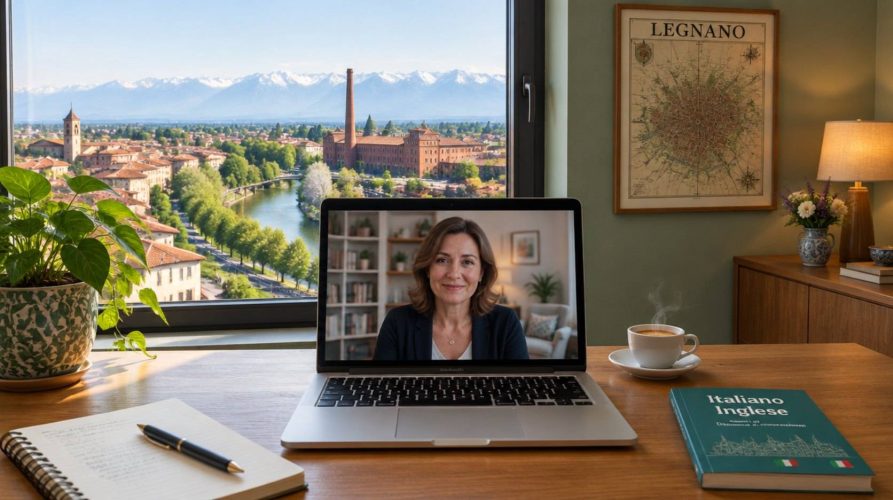
Looking for an English speaking therapist in Legnano puts you in a specific situation: you live in a place that has a real international population and almost no services that acknowledge it.
Legnano is not a destination people choose from abroad. It is a place people end up: because the company is here, because Malpensa is twenty minutes away, because the rent works and Milan is close enough. That difference matters more than it sounds, and it shapes what support actually looks like here.
The expat’s dilemma in Legnano
In a city that markets itself to foreigners, the English-speaking infrastructure comes built in. In the Alto Milanese it does not. There is a substantial international presence, tied to manufacturing, logistics and the airport corridor, but the services around it still assume you speak Italian.
Close to Milan, which is not the same as being in Milan
Milan is thirty-five minutes by train, and that proximity quietly costs people their therapy. A weekly session in the centre means the best part of three hours door to door. It holds for a month or two, then a deadline lands, and the session is the thing that gets dropped. Care that only works on easy weeks is not care you can rely on.
Arriving for work rather than for the place
Most people who move here are sent, not drawn. That produces a particular kind of difficulty: you did not choose this town, your partner may have followed you to it, and the life you are building has an unspecified end date written into the contract. It is hard to invest in a place you might leave, and equally hard to live somewhere provisionally for three years.
Why cultural competence matters more than language alone
Fluency is the floor, not the ceiling
An English-speaking therapist who has never worked with people living abroad will treat your situation as a series of practical complaints. Someone who has will recognise the pattern underneath: that the bureaucracy, the distance from family, the language fatigue and the sense of being a permanent guest are not five problems but one experience with five faces.
What it is like to work in your second language
In your own language you say the accurate thing. In your second you say the available thing. Over months that gap compounds, and you end up in therapy about a slightly simplified version of your life. Working in your first language is not a comfort: it is what makes the material precise enough to be useful.
The specific weight of a trailing partner
In an area like this one, one person is usually here for a job and the other is here because of it. The second person carries a distinct burden: no colleagues to meet, no structure to the day, and a difficulty that sounds ungrateful when said out loud. It is one of the most common reasons people in this area reach out, and one of the least often named.
Local practitioners versus online platforms
What a room in Legnano gives you
A short trip to a fixed place, at a fixed time, in the town where you live. It keeps the hour separate from the house and the laptop, and the journey home does part of the work of closing it.
When online is the honest choice
If you travel for work, if your shifts rotate, if you are at Malpensa more often than you are at home, online sessions are the format that will still be standing in three months. They also mean your therapist is chosen for fit rather than for postcode.
Mixing the two
Most people here end up alternating, and that is a sound arrangement rather than a compromise. What matters is continuity: the same therapist, whatever the format on a given week.
Your vetting checklist: what to ask
Registration and title
Italian psychologists are listed on the public register of the Ordine degli Psicologi, and you are entitled to ask for the registration number. “Psychotherapist” is a separately regulated title requiring a post-graduate specialisation: asking which qualification someone holds is a normal question, not a rude one.
What actually happens in a session
Ask them to describe a typical session rather than to name a school of thought. How much do they speak. Will there be anything to do between meetings. How do they handle it when something is not working.
The logistics that decide whether it lasts
Frequency, cancellation policy, invoicing for tax deduction, and what happens in August, when much of Italy closes. Arrangements usually fail on logistics, not on method.
What therapy costs in Italy
Expect roughly 60 to 120 euros per session privately, depending on the professional and the setting. Psychotherapy is deductible from Italian income tax at 19% as a healthcare expense, as long as you have an invoice and paid in a traceable way, so it is worth setting up the paperwork from the first session.
Public provision through the local health service is far cheaper but comes with waiting lists, and English-language sessions are not something you can count on. If you need to start now, private care is realistically the way.
How a human-matched process simplifies the search
The part that is genuinely hard
Choosing is the hard part, and it is asked of you at the worst possible moment: you are expected to evaluate strangers on the basis of a photo and a paragraph, about a problem you have not yet found the words for.
How it works at Therapsy
You do not choose from a list. You describe what is going on, and Dr. Francesca Boccalari, our Clinical Director, matches you with the therapist she thinks is right. You then have a free introductory call with that person before committing to anything. If it turns out not to fit, she finds you someone else at no charge, and without making you start the story over.
The English-speaking therapists we work with in Legnano
Therapsy works with a therapist who receives in person in Legnano and also sees patients online.
Dr. Chiara Gabelli is a clinical psychologist working in English and Italian with adolescents, adults and couples. She holds a master’s in Clinical Sexology and graduated with honours in Neuropsychology and Clinical Psychology from the University of Milan Bicocca. Her experience includes psychiatric care in hospital settings and extensive work in multicultural contexts, beginning with volunteer work with migrants, which is directly relevant if your difficulties are bound up with living between two countries.
You tell Therapsy what you are looking for, a member of our clinical team reads your request, and they introduce you. The first call is free.
FAQ
Is there really an English speaking therapist in Legnano?
Yes. Therapsy works with a clinical psychologist who receives in person in Legnano and also sees people online across Italy and abroad.
Would it be better to look in Milan instead?
Milan has more options, but the commute is what usually ends the treatment. A therapist you can reach in fifteen minutes, or online on a difficult week, is worth more than a wider choice you stop using by December.
My partner moved here for work and I did not. Is that something to bring?
It is one of the most frequent reasons people in this area get in touch. Being the person who followed has its own weight, and it is not made lighter by the fact that the move was reasonable.
Do I have to speak Italian?
No. From the first call onwards everything can be in English.
How much does it cost, and can I deduct it?
Private sessions are usually 60 to 120 euros, deductible at 19% as a healthcare expense with a proper invoice and traceable payment. The first assessment call with Therapsy is free.
What if I am only here for two years?
That is worth saying in the first call, because it shapes how the work is planned. A defined horizon is not a reason to postpone: it is a piece of information that makes the process more focused.
Next step
If you are looking for support in Legnano or the Alto Milanese, tell us what you need. The first call is free and commits you to nothing. You can also see the therapists available in Legnano.