Quick answer: Online therapy for expats in Italy means video sessions with a licensed therapist who works in your language, usually at the same fee as in person. It removes the two barriers that stop most people, travel and language, and it keeps the same therapist if you move city or leave the country for a while. Research comparing the two formats found that symptom reduction holds up, while the working relationship takes slightly more effort through a screen.
Therapsy is a multilingual psychotherapy service in Italy that connects expats, international students and Italians with licensed therapists in their own language, online across the country and in person in 24 Italian cities.
Key takeaways
- Language, not distance, is usually the real barrier: therapy in a second language makes shame, grief and identity harder to reach.
- Video sessions hold up on outcomes. A noninferiority meta-analysis of 12 studies found symptom reduction no worse than face-to-face delivery, while the working alliance came out somewhat lower.
- Online therapy in Italy costs the same as in person at Therapsy: from EUR 70 a session, with no surcharge for the format.
- Continuity is the practical advantage for expats: the same therapist follows you across cities, work travel and the months around a move.
- Therapsy works in 14 languages, online across Italy and in person in 24 Italian cities.
- Online is not right for every situation, and a serious service will tell you when it is not.
Why do expats in Italy look for therapy online first?
Is it about convenience or about language?
Convenience is what people say, language is usually what decides. You can find a good therapist in most Italian cities, but finding one who works fluently in your first language, near your home, with availability outside working hours, is a different problem. Online removes the geography from the equation so that the language and the clinical fit can come first.
What makes the first year abroad harder than expected?
The load is cumulative rather than dramatic: bureaucracy that consumes entire mornings, a social network that has to be rebuilt from zero, a professional identity that does not transfer cleanly, and family conversations that happen on a screen. None of it is a crisis. Together it produces the tiredness, irritability and low mood that bring people to a first session.
Why does therapy in a second language feel harder?
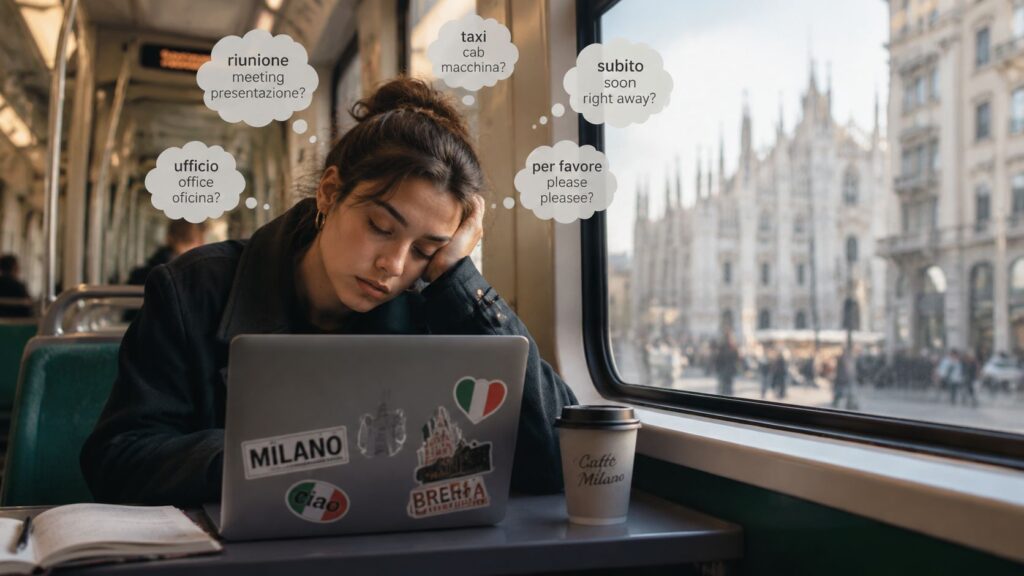
Because emotional vocabulary is learned early and is rarely complete in a language acquired as an adult. Describing shame, ambivalence or grief in a second language takes effort that is subtracted from the work itself, and many people simplify what they say without noticing. Working in your own language is not comfort, it is precision.
Does online therapy actually work?
What does the research say?
The question has been studied directly. A systematic review and noninferiority meta-analysis of videoconferencing psychotherapy examined 12 studies and found that target symptom reduction was noninferior to face-to-face delivery, while the working alliance came out somewhat lower than in the room. Specific treatments have been tested the same way: a randomised noninferiority trial of telehealth cognitive behavioural therapy for insomnia compared remote delivery with in-person care rather than with no treatment.
Where is online genuinely better?
When travel is the obstacle, when your schedule changes week to week, when you live in a town with no therapist who speaks your language, and when energy is the scarce resource. It also helps people who find a first session easier from their own room than in a waiting room.
When is online not the right choice?
When there is an acute risk to your safety, when you cannot find a private space where you will not be overheard, when the treatment needs in-person procedures, or when severe symptoms need coordinated medical care. In those cases a serious service says so and proposes another route. At Therapsy this is one of the things the first call is for.
How does online therapy work in Italy in practice?
Who is allowed to treat you?
In Italy psychotherapy is delivered by professionals registered with the Ordine degli Psicologi, and the register is public. Ask for the name and the registration number, and check it. This matters more online than in person, because the internet is full of services that describe themselves as therapy without a regulated profession behind them.
What does a session look like?
Fifty minutes on a secure video link, at a fixed weekly time in most cases. The therapist will ask you to sit somewhere private, to use headphones, and to agree what happens if the connection drops. It is a clinical setting, not a call: the frame is part of the treatment.
What about privacy?
Two layers matter. The platform, which must protect the connection and the data, and the room you are in, which is your responsibility. Practical measures work: headphones, a door that closes, a session time when the flat is empty, and no notes left open on a shared screen. If you live with people and there is no private hour, say it in the first call, because it changes the plan.
How much does online therapy cost in Italy?
At Therapsy individual sessions start from EUR 70, couple therapy from EUR 100, and a psychiatric consultation from EUR 110, with the same price online and in person; the full list is on the pricing page. Some international insurance policies reimburse sessions with a licensed psychologist: ask your insurer for the exact wording before you start, not after the third session.
What makes online therapy work better for expats?
The same therapist when you move
Expat life moves people. Online sessions mean a transfer to another city, a long work trip or a period back home does not force you to start again with a new clinician and retell your history. Continuity is the part of care that most often breaks when you live abroad.
A therapist who understands migration, not only your language
Language is the entry condition. What changes the work is a clinician who recognises acculturation stress, the guilt of the person who left, the pressure of the family who stayed, and the particular loneliness of being fluent in a place where you are still a foreigner. Our therapists work with those themes daily.
Human matching instead of a search filter
At Therapsy the match is proposed by the Clinical Director after a free conversation, not chosen from a directory. Language, clinical focus, schedule and what you have already tried are all part of the decision, and if the first match is not right you can change therapist without starting over.
Online, in person, or both?
Many people do both: video as the default, in person when they need it or when a specific phase of the work benefits from being in the room. Therapsy offers in-person sessions in 24 Italian cities, including Milan, Rome, Florence, Turin and Bologna, and online everywhere else in the country.
How do you start?
Step 1: the free first conversation
You describe what is happening, the language you want to work in, and your practical constraints. There is no charge and no commitment, and you get an answer within 12 hours.
Step 2: the match and the first session
The Clinical Director proposes a therapist and explains why. The first session is an assessment: history, current symptoms, what you want to change, and a first plan with a checkpoint.
Step 3: the checkpoint
After a handful of sessions, review with your therapist what has changed and what has not. If the fit is wrong, say so. A change of therapist inside the same service is not a failure and does not cost you the work you have already done.
Frequently asked questions
Is online therapy as effective as in-person therapy?
Research has tested equivalence rather than assuming it: a noninferiority meta-analysis of videoconferencing psychotherapy found symptom reduction no worse than face-to-face delivery, while the working alliance came out somewhat lower. For most common difficulties the format is a practical choice, and the relationship is worth a little extra attention in the first sessions.
Can I have therapy in English, or in my own language, while living in Italy?
Yes. Therapsy works in 14 languages, including English, and language is part of the match rather than an extra request.
How much does online therapy for expats in Italy cost?
At Therapsy sessions start from EUR 70 for individual therapy and EUR 100 for couples, with no difference in price between online and in person. Costs elsewhere vary widely, so ask for the fee and the session length together.
Can I keep the same therapist if I leave Italy?
In many cases yes, and it is worth asking in the first call, because the answer depends on where you are moving and on the rules that apply there. Continuity is one of the reasons expats choose online sessions.
Does insurance cover online therapy in Italy?
Some international policies do, usually when the professional is licensed and issues a proper invoice. Check the wording with your insurer before the first session, and ask your therapist what documentation they can provide.
What do I need for an online session?
A private room, headphones, a stable connection and fifty minutes when nobody will interrupt you. If none of that is available at home, tell the service: many people do sessions from an office room or a booked study space, and it is better to plan it than to improvise.
Is online therapy right if I am in crisis?
No, not on its own. If you are at immediate risk, contact emergency services on 112 in Italy. Online therapy is for planned care, and any responsible service will help you find the right level of support instead of starting sessions.
Related reading
- Online vs In-Person Therapy in Italy: Which Option Is Best for Expats
- Online Therapy for Expats: A Practical Guide
- Therapy in Italy for Expats
Written by Dr. Francesca Adriana Boccalari, Clinical Director at Therapsy and licensed psychologist (Ordine degli Psicologi della Lombardia n. 16241), and reviewed in September 2026.