
A Farsi-speaking therapist in Italy can provide therapy in Persian (Farsi), either online or in person, but language alone isn't enough. The right clinician should also understand migration stress, bicultural identity, Italian universities and workplaces, relationships across cultures, and the practical realities of accessing care in Italy. A structured human matching process can help an expat find that combination instead of choosing a profile at random.
Therapsy is a multilingual psychotherapy service in Italy that connects expats with therapists who speak their native language.
Why Does Therapy in Your Native Language Matter?
A person may speak Italian or English fluently and still find that grief, fear, shame, or family conflict feels more accessible in Persian. Therapy depends on emotional precision, not only conversational fluency. The language used for childhood memories, family expectations, migration experiences, and intimate relationships can shape what a client is able to notice and express.
A review summarized by Therapsy's explanation of therapy in a native language describes an American Psychological Association summary of a meta-analysis covering 76 quantitative studies. It reported that therapy delivered in a client's native language was, on average, twice as effective as therapy delivered in English for ethnic-minority clients. The same source explains that language barriers involving interpreters can contribute to misdiagnosis, restricted access to therapy, and low referral rates.
The mechanism is straightforward. A second language can encourage a person to describe events factually, while a native language may make emotional associations, cultural meanings, and unspoken family rules easier to reach. That distinction matters when a client is processing migration stress, homesickness, trauma, identity conflict, or the pressure of living between Iranian and Italian social expectations.
Can speaking Persian change the therapeutic relationship?
Native-language therapy can make emotional expression more precise, reduce misunderstandings, and give the client greater freedom to describe culturally specific experiences.
A client may need to explain concepts that don't translate neatly into Italian or English, such as obligations toward family abroad, changing expectations around marriage, or the tension between collective responsibility and personal independence. A Persian-speaking therapist can explore those meanings directly instead of relying on approximate translations.
Language concordance also affects trust. A client who has already spent months explaining their accent, family structure, migration history, or cultural references may feel relief when those explanations aren't necessary in every session. That relief doesn't guarantee a particular outcome, but it can create better conditions for honest participation.
Practical rule: The best language match is the language in which the client can discuss the most difficult memory, not simply the language used at work.
Italy's mental-health access rules are broad. European Union material states that services in Italy are open to everyone, regardless of legal status, with direct access available to migrants. That makes language-matched care relevant for students, newly arrived residents, undocumented migrants, and expats who may avoid support because the system feels unfamiliar.
A separate Italian study found that all 14 surveyed professionals had experienced language barriers while working with immigrants and refugees, and some reported being unable to provide therapy when those barriers couldn't be resolved. A peer-reviewed study on migrant mental-health access in Italy also describes how inadequate linguistic and cultural mediation can prevent patients from understanding care, making informed choices, and building a therapeutic relationship.
Therapsy addresses this need through human matching by the Clinical Director rather than an algorithm, access to therapy in the client's own language across 14 languages, and a choice between online and in-person sessions. Persian is included in that language network.
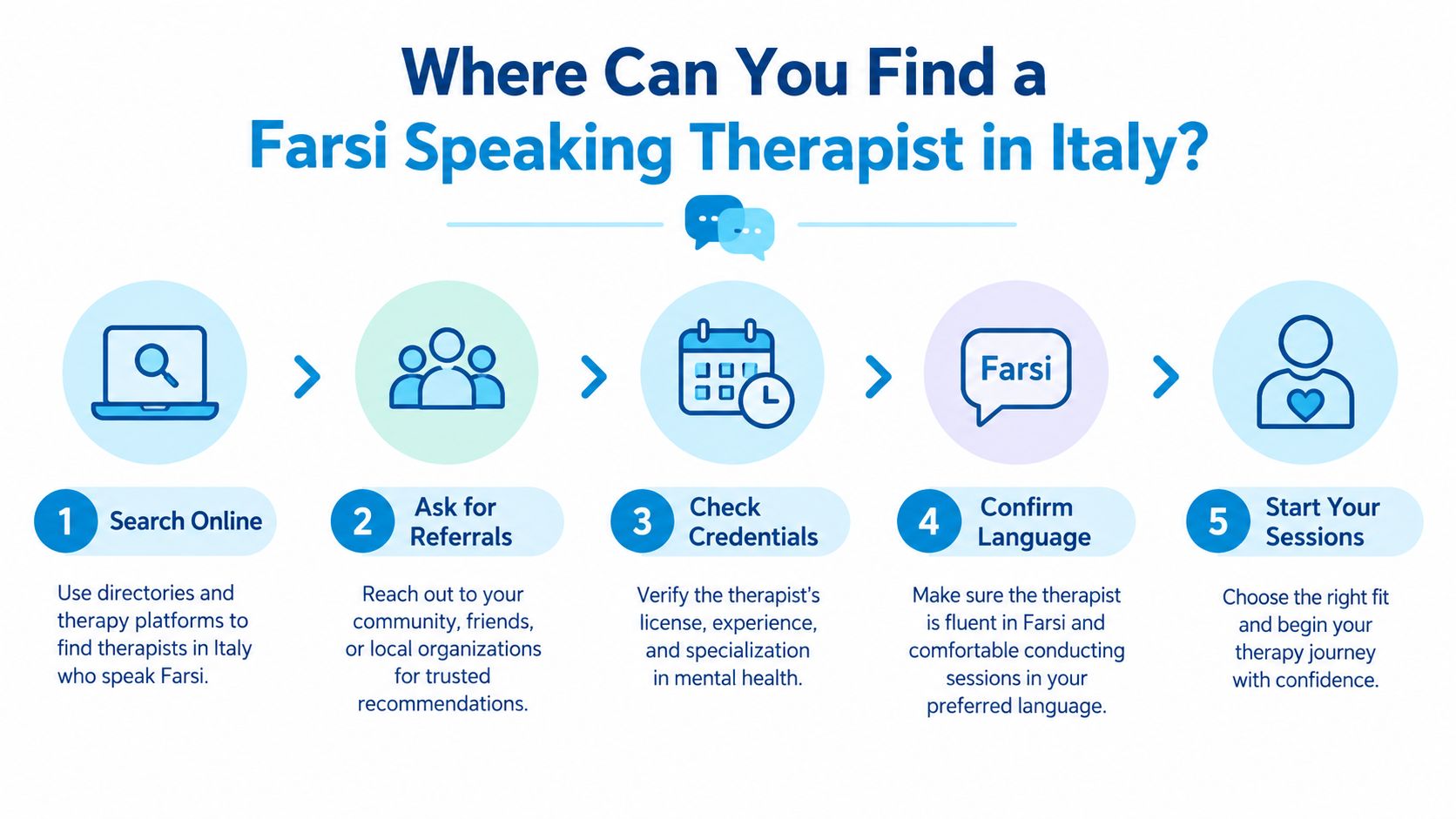
Where Can You Find a Farsi Speaking Therapist in Italy?
A person searching for Farsi therapy in Italy should check language, professional qualifications, clinical focus, location, session format, and familiarity with expat life before booking regular appointments.
The search is difficult because available care is geographically uneven. A news report cited about 10,000 Iranians in Italy in 2016, with larger concentrations in Lombardy, Lazio, Emilia-Romagna, and Piedmont, and listed Rome, Milan, Florence, and Bologna among the main cities. A separate language profile estimates about 16,000 Persian speakers in Italy, indicating a small but meaningful population for language-concordant care, particularly in major urban areas.
The figures point to a practical reality. A person outside a major city may find a Persian-speaking professional through a university, local community, or private referral, but the search may produce only scattered profiles. Multilingual therapy services are concentrated mainly in Milan, Rome, and Naples, while other locations are more often served online.
What should a person check before contacting a therapist?
The first check should be whether the clinician can provide therapy in Persian and whether the service is legally and practically available to someone living in Italy.
A useful search process includes:
Start with language. Confirm whether the therapist speaks Persian comfortably enough for complex emotional work, not only basic conversation.
Check the setting. Establish whether sessions are online, in person, or both, and whether the clinician can work with a client located in the client's Italian region.
Review the clinical focus. Look for relevant experience with trauma, anxiety, relationship difficulties, migration stress, grief, adjustment, or bicultural identity.
Ask about cultural context. The therapist should understand that the client may be navigating Italian bureaucracy, university expectations, employment pressures, family obligations, and changing social roles at the same time.
Use the first conversation to assess fit. The client should be able to ask how the therapist works, which approaches are used, and what happens if the match doesn't feel right.
Therapsy offers a more structured route for people who don't want to assemble those checks from disconnected listings. Its Clinical Director makes the match personally, rather than delegating the decision to an automated questionnaire. The first assessment call is with the therapist selected for that person, which allows language, clinical needs, and personal preferences to be discussed directly.
The network includes 50+ therapists, and less than 1 applicant in 100 is accepted. That selection process doesn't remove the need for a client to evaluate fit, but it provides a clearer starting point for someone seeking specialized multilingual care.
University counseling services, international student offices, community groups, and trusted personal referrals can still be useful. They may help a person identify local needs or understand regional services. However, a referral should be treated as a lead, not as proof that the therapist is the right match.
Should You Choose Online or In-Person Sessions?
Online therapy is usually the practical default when a Persian-speaking therapist isn't available in the client's city, while in-person care may suit clients who value a dedicated physical setting.
The central trade-off is continuity versus physical presence. A local office can make sessions feel separate from study, work, or home life. Online therapy can make it possible to continue with a suitable Persian-speaking clinician when local options are limited, schedules change, or the client moves between Italian cities.
A multilingual therapy service in Italy reports that languages such as Persian are mainly available in Milan, Rome, and Naples, while other cities are often served online. This means a person in a smaller university town shouldn't assume that the absence of a local profile means the absence of appropriate care.
Therapsy provides online and in-person sessions across 24 Italian cities with 85 physical locations. Its online therapy option for expats can be especially relevant for students, researchers, remote workers, and clients living outside the main urban centers.
Which format fits a Farsi-speaking expat?
The right format depends on location, privacy, mobility, preference, and whether the client can create a stable environment for online sessions.
| Format | Best For | Key Advantage | Potential Drawback |
|---|---|---|---|
| Online therapy | Clients outside major cities, frequent movers, students, and people with demanding schedules | Access to a Persian-speaking clinician without commuting or relocating | A private, reliable space and stable connection are necessary |
| In-person therapy | Clients who prefer a physical office or find home unsuitable for sessions | Clear separation between therapy and daily routines | Local Persian-language availability may be limited |
| Flexible combination | Clients whose location or schedule changes | Preserves continuity when circumstances shift | The client and therapist need to agree on a consistent format |
Online therapy works best when the client can protect privacy. A bedroom shared with roommates, a workplace, or a public location may make it harder to speak openly. The therapist should also confirm the client's location and the practical rules governing care before regular sessions begin.
In-person sessions can help a client who feels disconnected from the new country and wants a predictable place within the local environment. Traveling to an office may also create a useful transition before and after a difficult conversation. Still, physical proximity shouldn't outweigh clinical suitability.
A person living in Bologna, Florence, Turin, or a smaller city may find that online therapy offers a wider choice of Persian-speaking clinicians. A person in Milan or Rome may have both options, but should still compare cultural competence and clinical approach rather than choosing solely because an office is nearby.
Is Language Fluency Enough for Effective Therapy?
Language fluency is necessary for many Persian-speaking clients, but effective therapy also requires cultural competence, clinical training, and familiarity with the client's life in Italy.
A therapist may speak Persian fluently and still misunderstand the pressures affecting an Iranian student, professional, parent, or mixed-culture couple. The relevant question isn't only whether the therapist can speak the language. It is whether the therapist can understand how migration, family expectations, Italian institutions, legal uncertainty, gender roles, and bicultural relationships interact.
What should cultural competence look like in practice?
Cultural competence means the therapist can explore cultural meaning without stereotyping the client or treating culture as an explanation for everything.
A culturally responsive clinician should be able to ask whether a problem comes from anxiety, isolation, discrimination, family conflict, workplace strain, or a combination of pressures. The therapist should also recognize that Iranian identity isn't uniform. Age, region, religion, class, gender, sexuality, education, political history, and time spent abroad can all shape the client's experience.
Evidence-based approaches can be adapted to that context:
- CBT can help a client examine thoughts and behaviors linked to social anxiety, academic pressure, or fear of failure while considering the cultural and migration experiences behind those thoughts.
- EMDR may be considered by an appropriately trained clinician when trauma symptoms are present, with careful attention to safety, stabilization, and the client's personal history.
- Schema Therapy can help explore long-standing patterns involving duty, abandonment, shame, emotional inhibition, or unrelenting standards without assuming that a family value is automatically unhealthy.
- Attachment theory and cross-cultural psychology can clarify how separation from family, changing relationships, and different expectations around closeness affect emotional security.
A client can learn more about the difference between language matching and broader culturally responsive therapy before arranging regular sessions. The purpose isn't to find a therapist who shares every aspect of the client's background. The purpose is to find someone who can remain curious, respectful, clinically grounded, and informed about intercultural life.
Therapsy's clinical team uses human matching by the Clinical Director to consider more than language. The match can account for the client's concerns, preferred format, cultural context, and the type of therapeutic work that may be appropriate. This is more useful than treating Persian as the only selection criterion.
A shared language can open the door to therapy. Cultural competence and clinical skill determine whether the conversation can develop once the door is open.
A therapist who understands the Italian system may also help the client formulate practical questions about local care, referrals, psychiatric support, or coordination with other professionals. Therapy doesn't replace medical care or emergency services, and a clinician should be clear about when additional support is needed.
What Are the Costs and How Do You Get Started?
Private therapy costs vary by clinician and service, so a person should confirm the fee before regular sessions begin and ask what the first conversation includes.
Therapsy lists the following starting prices:
| Service | Starting price |
|---|---|
| Individual therapy | EUR 70 |
| Couple therapy | EUR 100 |
| Psychodiagnostic assessment | EUR 255 for 3 sessions |
| Psychiatric consultation | EUR 110 |
| First assessment call | Free |
The Therapsy pricing page provides the current starting structure. The final price can depend on the therapist's experience, specialization, and the type of support required. A person should also clarify cancellation terms, session length, payment arrangements, and whether a couple or family session has a different fee.
What happens after the first contact?
The first contact identifies the client's language, location, concerns, preferred format, and practical availability before a therapist is selected.
The process works in clear stages:
Initial request. The person submits the relevant details through Therapsy.
Human matching. The Clinical Director reviews the information and selects a therapist instead of relying on an algorithm.
Direct assessment call. The first call is free and takes place with the therapist chosen for that person. It is not just an administrative intake with a receptionist.
Fit review. The client and therapist discuss language, goals, clinical approach, format, and any concerns about continuing.
Regular sessions. If the match feels appropriate, sessions can continue online or in person. If the fit isn't right, the client can discuss another match.
Therapsy states that the first contact takes place within 12 hours. The network offers therapy in 14 languages, including Italian, English, French, Spanish, German, Portuguese, Ukrainian, Russian, Greek, Arabic, Urdu, Hebrew, Hindi, and Persian (Farsi).
A person without permanent residency or with uncertainty about legal status shouldn't assume that mental-health support is unavailable. European Union guidance states that Italian services are open to all regardless of legal status. Practical eligibility, confidentiality, and referral questions should still be discussed directly with the relevant service.
The free assessment call isn't a promise that therapy will solve a particular problem. Its value is more practical. It lets the client hear the therapist's communication style, explain the language preference, ask about cultural understanding, and decide whether continuing feels appropriate.
What Questions Do Expats Ask About Farsi Therapy?
Farsi therapy in Italy is appropriate to explore when a client wants emotional precision, cultural understanding, and practical access without having to manage the search alone.
Can a Farsi-speaking therapist provide therapy online across Italy?
An online therapist may be able to work with clients living in different Italian cities, subject to professional and service requirements. Online care can be a realistic option when local Persian-speaking provision is limited, but the client should confirm location, privacy, technology, and session arrangements before beginning.
Is therapy confidential for an expat in Italy?
Therapy should be conducted within the applicable professional and privacy rules, and confidentiality limits should be explained at the start. A client can ask how records are handled, when information may need to be shared for safety reasons, and how communication outside sessions is managed.
What is the difference between a psychologist and a psychotherapist in Italy?
A psychologist and a psychotherapist may have different training, professional roles, and areas of practice within the Italian system. A person seeking regular therapy should ask about the clinician's qualifications, registration, clinical approach, and experience with the issue being discussed rather than relying on the title alone.
Does a Persian-speaking therapist need to be Iranian?
No. A therapist doesn't need to share the client's nationality to provide culturally responsive care. What matters is Persian fluency, respect for the client's identity, evidence-based clinical training, and an ability to understand the realities of living in Italy.
Can therapy address mixed-culture relationships and family conflict?
Therapy can provide a structured space to explore communication, attachment, family expectations, bicultural identity, and conflict across languages. Couple or individual work may be appropriate depending on the situation, and the therapist should clarify the format and goals before sessions begin.
What should someone do during a mental-health crisis?
A person facing immediate danger, serious medical symptoms, or thoughts of imminent self-harm should contact local emergency services or go to the nearest emergency department rather than waiting for a routine therapy appointment. Language barriers should be explained clearly, and a trusted person can help communicate if the client cannot do so alone.
Therapsy reports a 4.8/5 “Excellent” Trustpilot rating, more than 13,000 sessions since 2023, and a network of 50+ therapists. Those figures describe the service's published activity and rating, not a guarantee of a particular therapeutic outcome.
A person can also use Therapsy's guide to finding the right therapist for expats to prepare questions about language, clinical focus, cultural competence, and session format before the first call.
Therapsy offers human matching by the Clinical Director, therapy in Persian (Farsi) and 13 other languages, and a choice between online and in-person sessions in Italy. The first assessment call is free, it takes place with the therapist chosen for that person, and there's no obligation to continue, so visiting Therapsy can be a low-pressure way to explore whether the match feels right.

