Acceptance and Commitment Therapy, or ACT, helps people stop wrestling with their thoughts long enough to build a life that fits their values. It does not try to erase anxiety, sadness, or stress, it changes the relationship a person has with them so there's more room for choice, steadiness, and action.
Therapsy is a multilingual psychotherapy service in Italy that connects expats with therapists who speak their native language.
For many expats, students, and young adults in Italy, that distinction matters. Feeling better is often the wish, but learning how to move through difficult feelings without letting them steer every decision is usually the practical starting point.
What Acceptance and Commitment Therapy Actually Is
ACT is a values-based therapy built to strengthen psychological flexibility. In plain language, it helps people notice difficult thoughts and emotions without getting pulled off course, so they can keep choosing actions that fit what matters most as defined in a clinical summary of ACT.
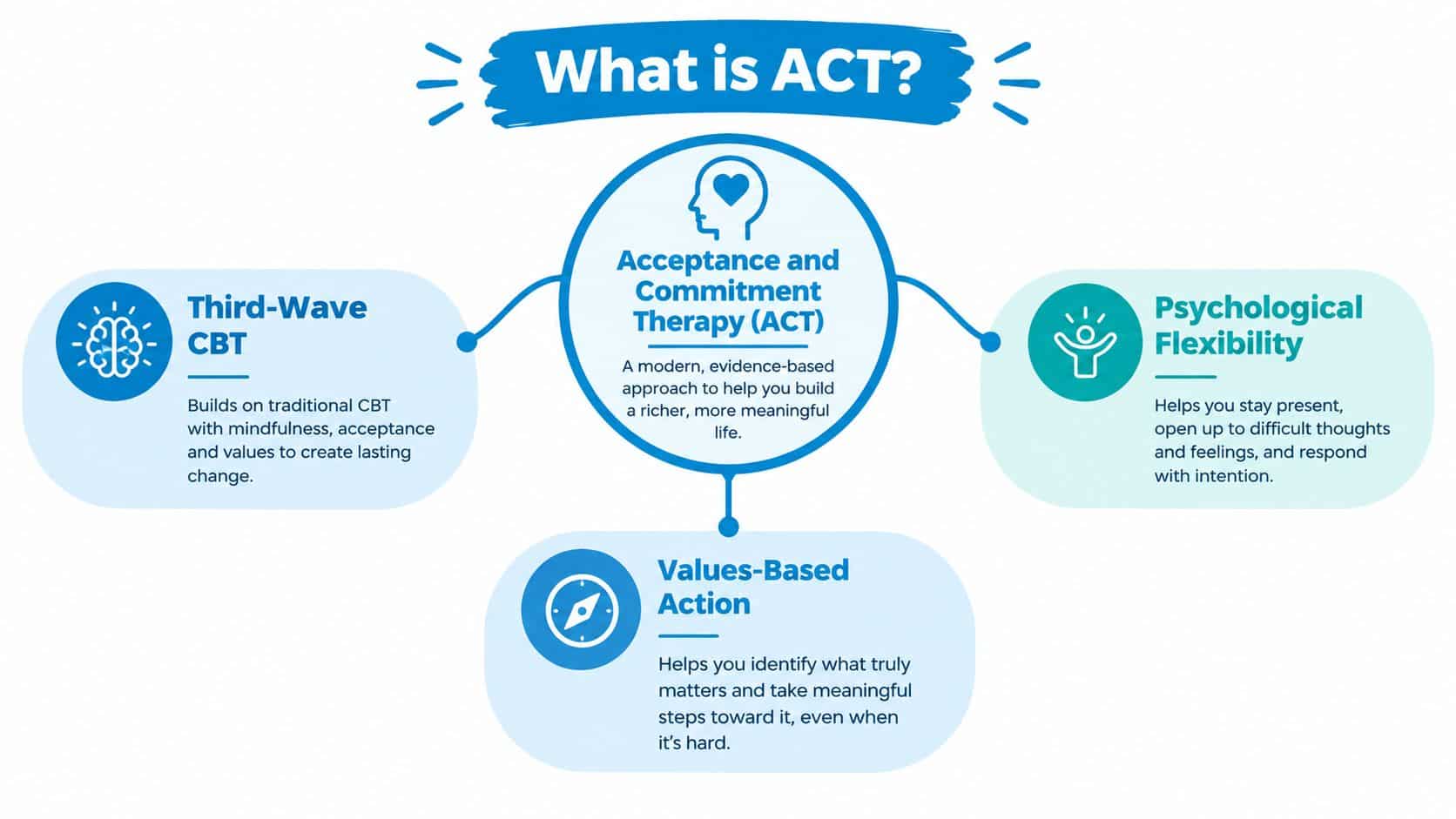
That idea matters for the person who feels stuck between understanding what is helpful and doing it. ACT does not aim to win an argument with the mind. It helps you notice the argument, make room for it, and choose the next step based on life direction rather than fear.
Practical rule: ACT does not ask a person to like painful feelings. It asks them to stop treating discomfort as a stop sign.
For an expat in Milan, a student in Florence, or an Italian living abroad, that can feel very concrete. The problem is often not only the feeling itself, but how the feeling shrinks behavior, until work, relationships, sleep, and confidence all start to get smaller too. ACT gives that pattern a structure, so there is more room to respond instead of react.
Therapsy can fit people who want therapy in their own language and want a therapist who understands the intercultural side of daily life. The approach works best when the therapist connects symptoms to values, rather than only naming distress.
The Hexaflex – Six Core Processes in Plain Language
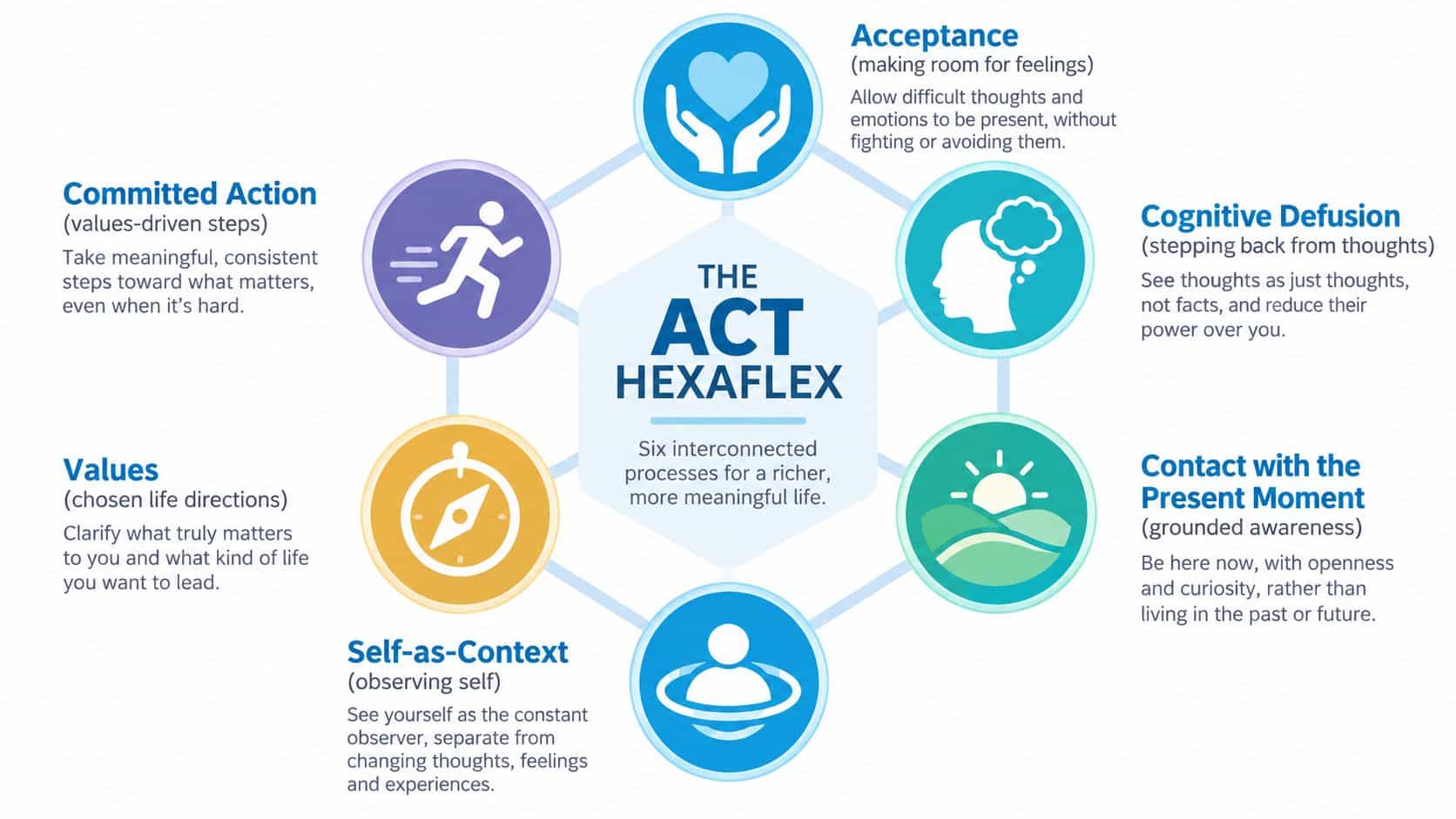
Psychological flexibility is the engine of ACT, and the hexaflex is the map. It shows six processes that work together, a bit like a car dashboard with several controls that help the driver stay on the road.
How do the six processes fit together?
Acceptance means making room for feelings instead of spending all your energy fighting them. Cognitive defusion means seeing thoughts as thoughts, not as commands or facts. Present-moment awareness means noticing what's happening right now, rather than living inside worry or replaying the past.
Self-as-context is the observing part of you, the one that can notice a thought without becoming that thought. Values are the directions you want your life to move in, like honesty, care, freedom, or connection. Committed action is the behavior that follows those directions, even when discomfort shows up.
A useful image is a passenger in the back seat of a car. The passenger can shout, complain, and predict danger, but they don't have to hold the steering wheel. In ACT, the goal is not to throw the passenger out, it's to keep driving toward the place you want to reach.
What usually keeps people stuck?
People often try to control thoughts as if control itself were the solution. That can work for brief practical problems, but it backfires when the mind starts arguing about anxiety, grief, shame, or uncertainty all day long. The struggle becomes its own burden.
When thoughts are treated like orders, life gets smaller. When they're treated like mental events, choice comes back into the room.
Therapsy's clinicians often see this pattern in clients who are functioning on the outside but exhausted on the inside. The point of ACT is not to become detached or passive, it's to become freer to respond.
For readers who want a related skill-building resource, mindfulness often supports the present-moment side of ACT because it helps people notice what's happening without getting pulled immediately into it.
What ACT Looks Like in a Real Session
ACT sessions often feel more experiential than people expect. Instead of spending the whole hour dissecting why a thought is irrational, the therapist may use a small exercise that changes the person's relationship to the thought in real time.

What is a defusion exercise actually doing?
A therapist might ask someone to repeat a word quickly, or say a worried thought out loud until it starts sounding like sound rather than truth. The point is to weaken the automatic grip of the thought, not to prove the thought false.
That matters because many clients already know their worry is exaggerated, yet they still feel trapped by it. Defusion gives them a lived experience of, “This is a thought, not a command.” Once that shift happens, there's usually more room for behavior.
How does values clarification work?
Values work usually starts with questions about what kind of person someone wants to be in key areas of life. A therapist may explore relationships, work, health, learning, and leisure, then help turn broad wishes into specific weekly actions.
So instead of “be less anxious,” the work becomes something like, “Send the message, attend the class, have the conversation, take the walk.” That translation from identity to action is what keeps ACT from becoming vague inspiration.
Homework in ACT is usually short and concrete. It may involve a brief defusion practice, a values check-in, or one small behavior that fits a chosen direction. For many people, that feels less like school and more like getting life back into motion.
For readers trying to understand the pace of therapy, how long therapy takes depends on goals, complexity, and consistency, not just on the method itself.
What the Research Actually Says About ACT Outcomes
A client can leave an ACT session feeling less “fixed” and more able to act, and that is closer to how the research frames outcomes. ACT has solid support as an evidence-based therapy, but it is not a magic answer. A meta-analytic review of controlled trials found a medium effect on primary outcomes compared with control conditions, with an effect size of 0.42 and a 95% confidence interval of 0.23 to 0.60; it also found a larger effect on secondary outcomes, 0.59 with a 95% confidence interval of 0.31 to 0.86 clinical review of ACT evidence.
A 2014 meta-analysis of 39 randomized controlled trials involving 1,821 patients found a moderate overall advantage for ACT over control conditions, with Hedges' g = 0.57 for primary outcomes meta-analysis of randomized trials. That review also found stronger effects versus wait-list, psychological placebo, and treatment as usual, and it reported gains in quality of life and psychological flexibility.
These numbers matter because they show ACT is doing real work, while also setting realistic expectations. ACT looks more like a useful tool than a universal cure. For many people, the value is not only symptom relief, it is getting unstuck enough to live in line with values.
A more recent depression-focused meta-analysis reported improved psychological flexibility after ACT, with a standardized mean difference of 0.50 in the included studies and maintenance at follow-up recent depression meta-analysis. Process evidence also links flexible processes such as acceptance and present-moment awareness with lower distress, while avoidance and fusion track with greater distress process meta-analysis.
The research supports ACT as a serious therapy option, not as a promise. A good fit still depends on the person, the problem, and the therapist.
For people in Italy deciding where to start, that means ACT can sit alongside CBT, EMDR, or other evidence-based work rather than replacing everything else by default. The better question is often whether the approach fits the client's language, culture, and goals.
If duration is part of the decision, what to expect from the first session and treatment planning is often more useful than looking for a universal timeline.
ACT vs CBT – What Is Actually Different
ACT and CBT overlap, but they're not the same in how they handle thoughts, symptoms, and progress. CBT tends to focus on identifying and changing unhelpful thought content, while ACT focuses on changing the person's relationship to thoughts and tying behavior to values.
| Dimension | ACT | CBT |
|---|---|---|
| Main goal | Build psychological flexibility and values-based action | Reduce distress by changing unhelpful thought patterns |
| Stance toward thoughts | Thoughts are events to notice, not commands to obey | Thoughts are evaluated, tested, and reframed |
| Role of symptoms | Symptoms matter, but they're not the only target | Symptom relief is often a primary goal |
| Typical style | Experiential exercises, metaphor, values work | Thought records, cognitive restructuring, behavioral practice |
| Best fit | People who want meaning, flexibility, and less struggle with inner experience | People who want structured tools for changing specific thought patterns |
In real life, the boundary is often softer than the table suggests. Many therapists blend both approaches, and many clients benefit from that blend because life doesn't come in neat categories. ACT is less about arguing with the mind and more about choosing direction even when the mind is noisy.
That difference matters for expats and multilingual clients. A therapy style that feels clear in one language can feel blunt, abstract, or culturally odd in another, so fit isn't a side issue. It's part of whether the method actually lands.
For readers who want a broader framework on structured, evidence-based work, a cognitive behavioral therapy guide can help place ACT in context without forcing an either-or choice.
Who ACT Helps and When to Be Cautious
ACT often helps people who feel stuck in loops of worry, rumination, burnout, perfectionism, adjustment stress, low mood, chronic pain, or the emotional strain of living between cultures. It can also fit clients who are tired of tracking symptoms all the time and want therapy to reconnect them with what life is for.
That makes it especially relevant for expats, international students, and young adults in Italy. A person might not be “broken,” but they may be carrying a constant load of transition, isolation, language strain, or identity confusion that keeps them tense and disconnected.
When should ACT be paired with something else?
ACT is not a substitute for psychiatric assessment, medication evaluation, or safety planning when those are needed. For more severe presentations, it may sit alongside EMDR for trauma, Schema Therapy for entrenched patterns, or CBT-informed work for stabilization and risk management.
Sleep also matters. Difficult sleep can amplify anxiety, irritability, and hopelessness, so a broader view of sleep and mental health can be useful when a person is trying to understand why therapy progress feels uneven.
Why does culture change the way ACT lands?
ACT uses values, metaphors, and acceptance language, and those ideas are never fully culture-free. A phrase that feels encouraging to one client can feel passive, strange, or morally loaded to another, especially across languages and family systems.
That's why a good therapist adapts the frame instead of just translating the words. In intercultural work, the question is not only “What does acceptance mean?” It's also “What does this person's life make possible right now?”
Therapsy often works from that perspective, with multilingual clinicians and a matching process that considers language, context, and therapeutic fit rather than treating all clients as if they need the same style.
What Your First ACT Sessions Will Feel Like
The first ACT sessions usually feel practical, not mysterious. A therapist starts by asking what brings you in, what you have already tried, and how the problem affects work, relationships, sleep, mood, or study life.
From there, the therapist listens for patterns of avoidance and fusion. That may sound technical, but in plain language it means noticing where you keep trying to get away from discomfort, even when that strategy is pulling you away from what matters.
What happens in the first few weeks?
Early ACT work often starts with values clarification and small exercises that show how the mind operates. A therapist might ask what matters most if the problem were less in the way, then help turn that into one or two behaviors for the week.
Later, sessions often become more experiential. You may practice defusion, brief mindfulness, or acceptance exercises, then notice what changes in body, attention, and behavior.
Progress is usually measured in two ways. Symptom measures matter, but ACT also tracks psychological flexibility, because the aim is not only to feel less bad, it is to function more freely and live more in line with values, as noted in ACT outcome research.
A real ACT therapist should talk about values early. If the work never reaches values, it probably is not ACT.
Pacing matters too. Some clients want direct structure, others need a gentler start, and good therapy respects that without losing direction. The first psychological session can feel easier when you know what is likely to happen before you book. In that sense, ACT stays collaborative rather than rigid.
How to Find a Multilingual ACT Therapist in Italy
A first session can feel easier when the therapist can explain ACT in plain language and adapt it to your cultural context. For expats and international students, that matters because values, metaphors, and even the word “acceptance” do not always carry the same meaning across languages.
The better question is not only whether the therapist knows ACT, but how they use it. Ask whether they can describe a recent ACT case where they used defusion or values work in your language, and how they adjusted the metaphor so it still made sense. That tells you more than a service menu ever will.
A useful shortlist starts with three checks. The therapist should speak your language well enough for emotion, not just logistics. They should work in a way that fits your situation. They should be able to explain why ACT fits your case rather than treating it like a generic option.
For people starting from scratch, see options for an English-speaking therapist in Italy before reviewing services.
It also helps when a therapist is clear about how ACT sits alongside CBT, EMDR, Schema Therapy, or other approaches when needed. ACT works best with clinical judgment, not as a label pasted onto every problem.
Therapsy is one option for people who want multilingual support in Italy. It offers therapy in the client's own language, with human matching by the Clinical Director, and the choice between online and in-person sessions across Italy. The network includes more than 50 therapists and physical locations in multiple Italian cities, which can matter when someone wants continuity rather than a one-off call.
For a starting point, review the service options at Therapsy services, browse therapists, learn how therapist matching works, compare pricing, check online therapy for expats in Italy, and see the local locations if in-person sessions matter.
If ACT sounds like a fit, THERAPSY can help match a person with a therapist who can work in their language and adapt the approach to life in Italy. The first assessment call is free, it is with the therapist chosen for that person, and there is no obligation to continue after it. Visit THERAPSY to explore the fit with no pressure.