Fifteen to 20 weekly sessions, which is about 4 to 5 months, is a widely cited starting point for therapy to help about 50% of patients recover. That gives you a real benchmark, but it isn't a universal clock.
How long therapy takes depends on the problem, the approach, and the person's life context. For an expat, that last part matters more than people expect, because language, culture, and distance from familiar support can shape the pace of change.
How Long Therapy Actually Takes and Why the Answer Varies
Therapy duration is best understood as a range, not a promise. The most useful first reference point is the American Psychological Association's benchmark, which says 15 to 20 sessions are needed for 50% of patients to recover on self-reported symptom measures, and that many evidence-based treatments show clinically significant improvement in 12 to 16 weekly sessions. The same guidance also notes that people with co-occurring conditions or certain personality difficulties may need 12 to 18 months for effective results. APA guidance on therapy length
That spread tells you something important. How long does therapy take depends on what you're treating, how structured the treatment is, and how much complexity sits underneath the visible symptom.
The three variables that change the timeline
The shortest version is this. Issue, modality, and personal context move the schedule.
- Issue: A focused fear, a breakup, or an adjustment problem usually moves faster than chronic depression, trauma, or longstanding relational patterns.
- Modality: Some therapies are built for brief symptom work, others are designed to revisit deeper patterns over longer periods.
- Personal context: Sleep, stress, support, cultural distance, and consistency all affect pace.
Practical rule: If a therapist gives you only a single number without asking what you want to change, the estimate is too blunt.
A good estimate sounds more like, “For this goal, I'd start by expecting a few months, then we'll review progress together.” That is a realistic clinical stance, and it fits the research better than any fixed promise.
For readers in Italy, this matters even more when you're navigating therapy across languages or after a move. A focused issue may settle in a short course, but the emotional load of relocation can extend the work. If you want a deeper look at why a therapist may ask about history, symptoms, and goals before giving a timeline, the process of psychodiagnosis in modern therapy is worth understanding.
Therapy Duration by Issue and Diagnosis
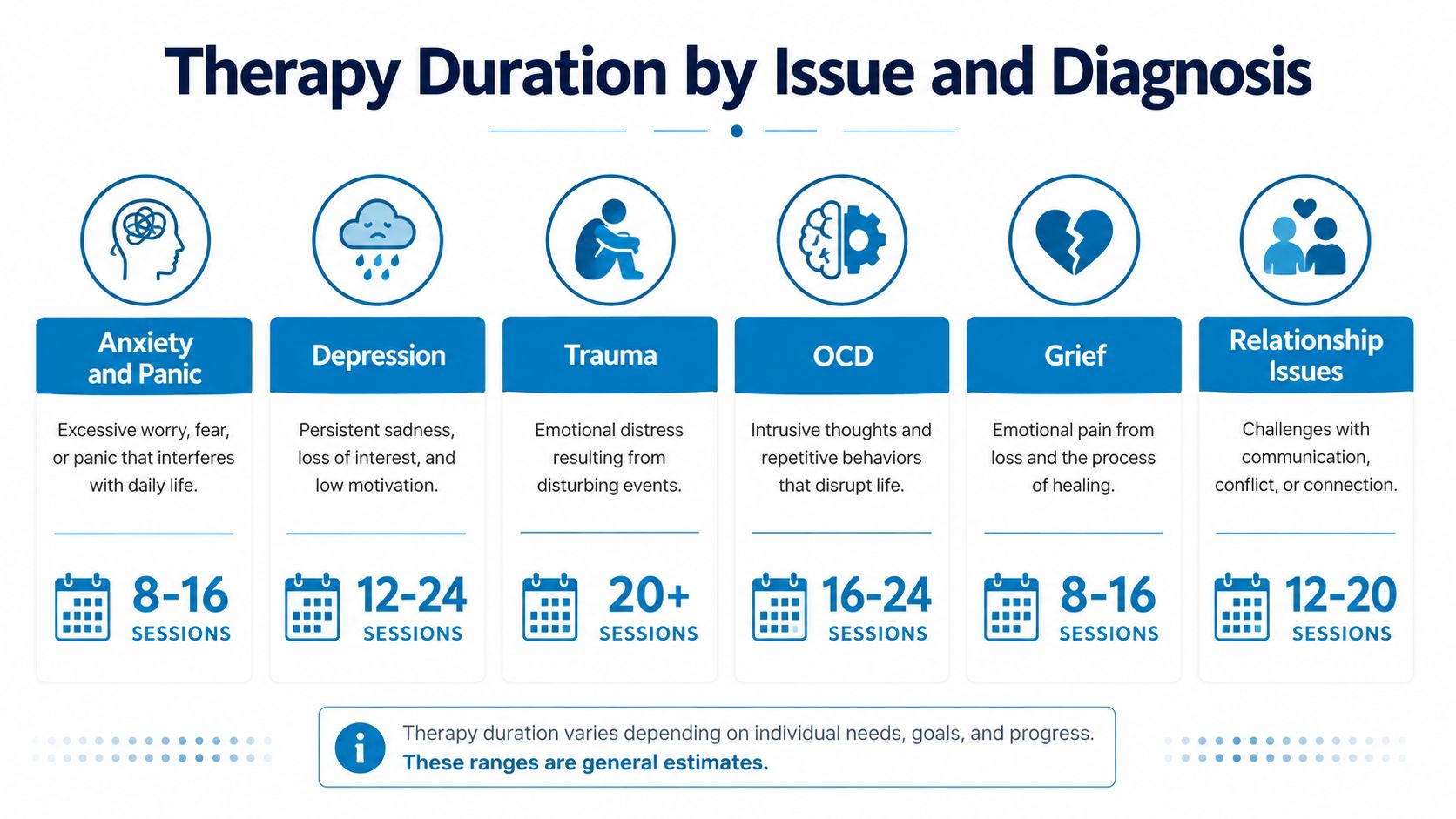
Some concerns usually move faster than others, and the difference is not random. A large UK routine-practice study in the British Journal of Psychiatry examined 26,430 patients and found an average of 8.3 sessions, with both the median and mode at 6 sessions. In that sample, 15,858 patients achieved reliable clinical improvement, and 60.0% left treatment with symptom scores below the clinical threshold after changing by at least 4.5 points on the CORE-OM measure. British Journal of Psychiatry routine-practice study
That's one reason session counts vary so much by diagnosis. Panic, depression, trauma, OCD, grief, and relationship strain don't ask for the same dose of treatment.
What the dose-response pattern usually means
A psychotherapy review reported median treatment lengths of 52 sessions for panic and 75 for depression, with successful CBT averaging 33 to 44 sessions. In the same dataset, 50% of clients reached clinically significant change by 21 sessions, and 75% by more than 40 sessions. Psychotherapy Networker review
That pattern helps explain why depression often takes longer than panic in raw session count, even when both are treatable. It also shows why some clients feel much better early, while others need sustained work before the gains become stable.
Key takeaway: Diagnosis shapes the timeline more than motivation alone.
A plain-language map of common concerns
- Anxiety and panic: Often improves earlier when the work is focused, structured, and practiced between sessions.
- Depression: Frequently needs a longer stretch, especially when low energy, hopelessness, or withdrawal reduce momentum.
- Trauma: Usually asks for more time because safety, memory, body responses, and trust all need room.
- OCD: Often needs repeated work on intrusive thoughts and response patterns, not just insight.
- Grief: Can move in waves, with some sessions feeling lighter and others reopening pain.
- Relationship issues: Pace depends on whether the goal is communication repair, conflict reduction, or deeper attachment work.
If you're trying to place your own concern on a timeline, start with the problem itself, not with a generic therapy number. For complex trauma and its layered effects, a longer frame is often more honest than a short one. For that reason, recovery therapy for complex PTSD usually needs a very different expectation than a brief stress-support plan.
How Different Therapy Modalities Shape the Timeline
The approach a therapist chooses is also a statement about pace. CBT and EMDR are often more structured and time-limited when the goal is focused symptom relief, while Schema Therapy and psychodynamic work usually stretch longer because they target underlying patterns, not just visible symptoms. If you're comparing options, that difference matters as much as the issue itself.
Structured therapies often move faster
CBT gives people tools for thoughts, behaviors, and coping habits. EMDR is commonly used when the work centers on trauma processing and the nervous system's response to memory. In a focused case, both can fit into a shorter frame because they have clear targets and review points.
That doesn't mean they're shallow. It means they're organized around a defined problem and a practical method.
Deeper pattern work usually takes longer
Schema Therapy and psychodynamic therapy often take more time because they look at repeated relationship patterns, early learning, and entrenched emotional habits. The aim is not only symptom relief, but also more durable change in how a person relates to themselves and to others.
A therapist's method is often a clue about the length of the journey, not just the style of conversation.
Short-term solution-focused work sits on the other end of the spectrum. It is often used when the goal is narrow, the problem is recent, or the client needs a rapid boost around one specific concern. For a person relocating, studying, or working on a deadline in Italy, that can be a useful fit.
If you want a practical example of a structured trauma method, the page on EMDR therapy is a helpful starting point.
How to use modality when planning your life
Think in terms of calendar fit. A student facing exams may need a time-limited plan. A professional managing burnout may want a steadier arc. A couple dealing with cross-cultural conflict may need space for both partners' histories, not just one symptom list.
That's why asking about modality early helps. It gives you a rough sense of whether the work is likely to feel brief, moderate, or extended before you commit your time and energy.
Factors That Shorten or Extend the Process
Not every timeline is driven by diagnosis. The pace can speed up or slow down because of human factors, and those matter just as much in an expat life.
What tends to accelerate therapy
Consistency is one of the clearest helpers. When someone attends regularly, speaks openly, and tries the work between sessions, therapy usually has more room to move. A strong therapeutic alliance matters too, because people change faster when they feel understood and safe enough to be direct.
What tends to stretch therapy
Co-occurring conditions, ongoing stress, and a low sense of readiness can slow things down. So can practical interruptions, like travel, work shifts, or irregular attendance. When life keeps changing outside the room, therapy has to keep reorienting itself.
A useful frame for understanding these layers is the biopsychosocial model in practice, because it shows how biology, psychology, and context interact instead of competing for blame.
Why expat life often adds sessions
Language fatigue can make emotional work harder. Cultural adjustment can also slow the process, because someone may need extra time to explain what a family role, a conflict style, or a social norm means in their home culture and in Italy.
Distance from family often matters too. When a client is already managing isolation, bureaucracy, and identity strain, therapy has more material to hold. In those situations, the timeline isn't “too slow”, it's often more realistic.
If the story around your symptoms includes relocation, culture shock, or grief for a life left behind, the work usually needs more context, not less.
That is where a careful therapist helps. They don't just treat a symptom in isolation. They pace the work so that insight, coping, and trust can grow at the same time.
Sample Timelines for Brief, Short-Term, and Long-Term Work
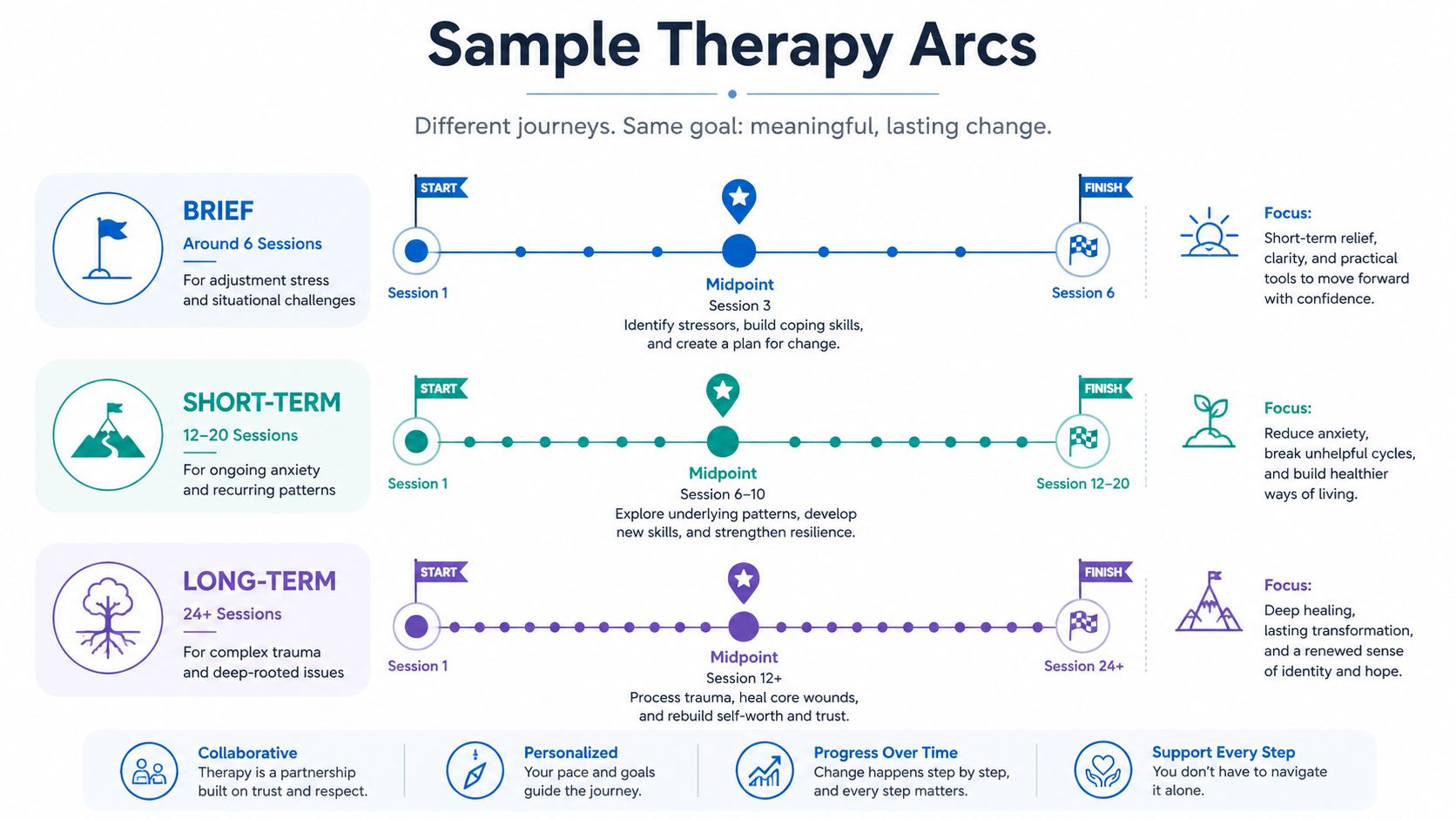
It helps to turn abstract ranges into a few realistic arcs. These aren't promises, they're reference points you can use to orient yourself.
Brief work around 6 sessions
This kind of course often fits a focused issue such as adjustment stress, a specific decision, or a recent setback. The first sessions are usually about clarifying the problem and choosing a target. Middle sessions focus on trying new responses, then the ending is about checking whether the issue feels lighter or more manageable.
A brief course works best when the problem is narrow and the person can apply tools quickly. If nothing is shifting by the middle, the therapist should revisit the goal rather than just continuing on autopilot.
Short-term work over 12 to 20 sessions
This is the range many people imagine when they ask how long does therapy take. It often suits ongoing anxiety, many depression presentations, and problems that need both insight and skill-building. The first part is assessment and stabilization, the middle is practice and pattern change, and the last part is consolidation.
A simple way to track progress is to ask three questions:
- Is the symptom intensity lower than when I started?
- Do I recover faster after triggers?
- Can I use the skills outside the session?
If the answer is yes more often than not, the work is probably moving in the right direction.
Long-term work over 12 to 18 months or more
Longer therapy is often the right fit for complex trauma, longstanding relational patterns, personality-level difficulties, or co-occurring conditions. This is usually not about endless talking. It's about giving change enough time to become stable.
A 12 to 18 month frame can be especially appropriate when trust itself is part of the work. If safety, attachment, shame, or repeated relational hurt are central, the process needs repetition and repair, not just insight. That is why long-term work can feel slower but still be the most efficient path overall.
Signs of Progress and What Ending Well Looks Like
Progress is not always dramatic. Many clients wait for a sudden breakthrough and miss the quieter signs that therapy is already working.
What progress often looks like
You may still have anxiety, grief, or low mood, but the intensity changes. Triggers don't knock you off course for as long. Sleep may settle, emotional range may widen, and you may notice that you can pause before reacting.
Another strong sign is that the skills show up outside the room. If you can name what you feel, ask for what you need, or recover after a hard moment more reliably, therapy is doing real work.
What a healthy ending usually includes
Ending well isn't just stopping because the calendar ran out. It usually involves reviewing gains, naming remaining vulnerabilities, and planning for setbacks. Some people reduce session frequency before ending completely, which gives the change a chance to hold without the same level of support.
Healthy closure means you leave with a clearer map, not just a final appointment.
If therapy ends abruptly, people can feel untethered. A thoughtful ending gives the work a shape, and that shape matters.
When clients want to understand this better, closure in therapy is a useful topic to discuss with a therapist before the final session is scheduled.
Questions to Ask During Your Free Assessment Call
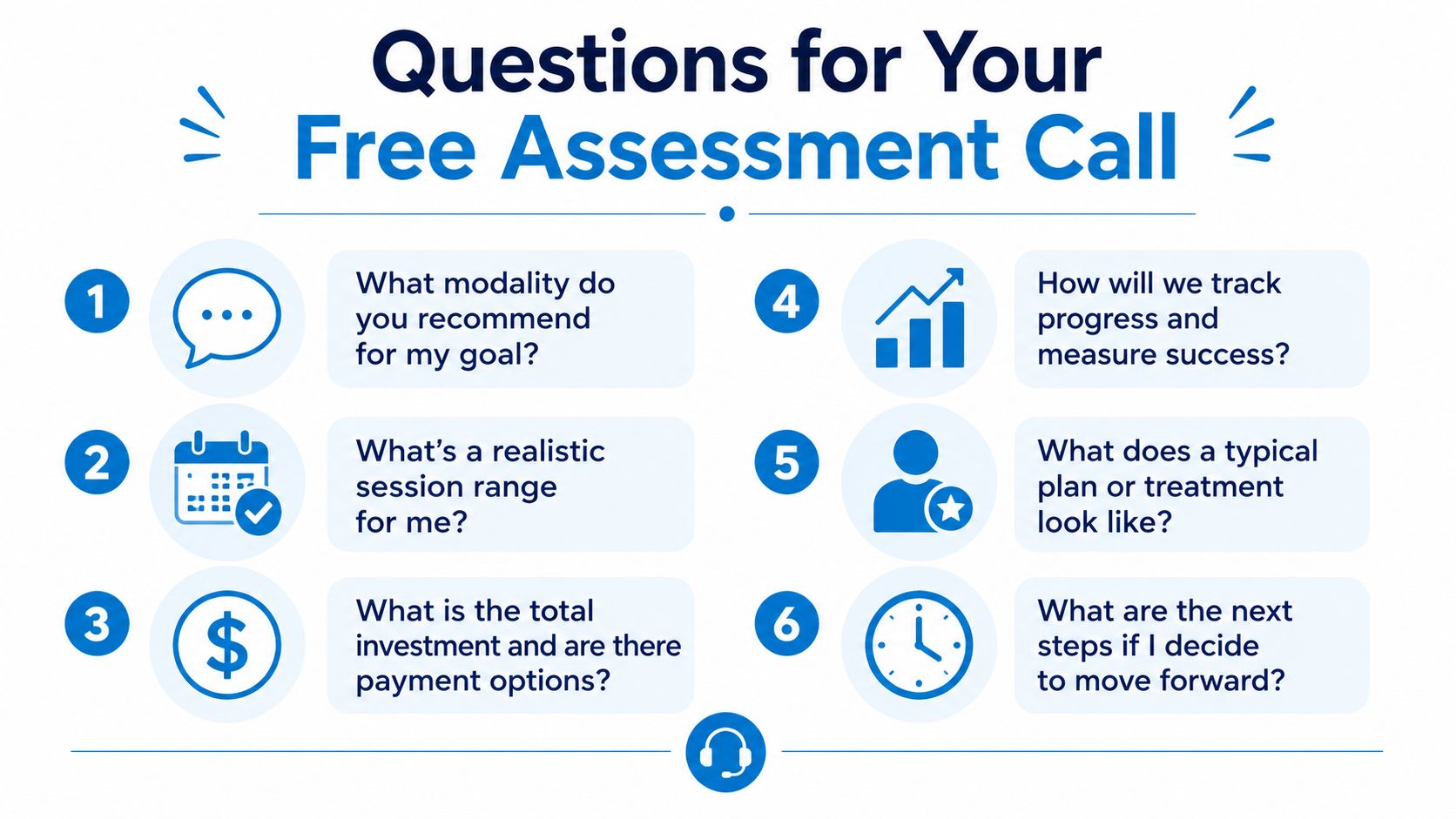
A good first call should lower uncertainty, not add to it. If you're trying to gauge how long does therapy take, these questions will help you get a more grounded answer.
What should I ask first
- What modality do you recommend for my goal?
- What's a realistic session range for my situation?
- How often would we meet at the start?
- How will we know the therapy is working?
- What happens if I don't feel the fit is right?
- Can I be rematched if needed?
What expats should add
If you're living in Italy, ask about language comfort, cultural familiarity, and whether online or in-person sessions make more sense for your schedule. If you move between cities or travel often, online continuity can protect the rhythm of the work.
A good assessment call should leave you with a clearer estimate, not a sales pitch. It should also help you decide whether the therapist can work with your pace, your language, and your goals.
Multilingual and Online Therapy Options for Expats in Italy
For expats, the timeline can change because therapy happens in a second language or across cultures. Nuance takes time. So does trust. If you're explaining family roles, migration stress, or identity loss in a language that isn't your first, the work may need extra sessions to reach the same depth.
That's why matching matters so much. If you need therapy in your own language, or with someone who understands intercultural life in Italy, a multilingual practice can reduce friction from the start. Therapsy offers sessions in 14 languages, including English, Italian, French, Spanish, German, Portuguese, Ukrainian, Russian, Greek, Arabic, Urdu, Hebrew, Hindi, and Persian (Farsi), with online and in-person options across 24 Italian cities and human matching by the Clinical Director.
If you're comparing options for remote continuity, the page on online therapy in English in Italy is a practical place to start. For someone juggling relocation, work, or study, that flexibility can keep therapy steady instead of interrupted.
The best fit is the one that lets you speak honestly, understand clearly, and keep showing up.
If you're also navigating a major life transition, even planning a move or a relationship milestone abroad can add emotional load. A resource like top Italy wedding venues may be useful for the practical side of that transition, while therapy helps with the relational and emotional side.
If you want a first conversation about pace, language, and fit, Therapsy offers a free assessment call with no commitment, just a chance to clarify what kind of support makes sense for your situation. That's often the simplest way to turn a vague question into a realistic plan.
If you're trying to understand your own timeline, THERAPSY can help you map the right pace, language, and therapy approach before you start. Book a free first assessment call at THERAPSY, and use that conversation to get a clearer sense of what support would fit your life in Italy.