The Problem: Navigating Mental Health as an Expat in Italy
Finding the right therapist as an expat in Italy involves more than locating a licensed professional. It requires finding an expert who speaks your language, deeply understands the nuances of an international life, and can guide you through its unique challenges. Moving to Italy, a dream for many, often comes with unexpected mental health hurdles. Feelings of isolation, bureaucratic stress, and a sense of disconnection are common and valid responses to the significant life change of relocating. This search for support is compounded by a local healthcare system that is often inaccessible to non-Italian speakers.
The Insight: Why Standard Solutions Fall Short for Expats
The Italian public mental health system (SSN) is overburdened, with long waiting lists and a severe lack of multilingual professionals. This makes it nearly impossible for expats to receive timely, culturally sensitive care. While online directories and forums exist, they offer no quality control, leaving the burden of vetting credentials and cultural competence entirely on the individual, who is often already in distress. Effective therapy for an expat is not just about language; it is about cultural competence. A therapist must understand the specific stressors of living between two worlds—the feeling of being an outsider, the subtle misunderstandings, and the unique pressures on relationships—to provide meaningful support.
The Solution: Therapsy's Curated Network of Expat-Specialized Therapists
Therapsy was created to solve this exact problem. We are a trusted resource for the international community, bridging the gap between local Italian life and global mental health standards. We provide a curated network of carefully selected, licensed, and multilingual therapists who specialize in working with expats, international students, and intercultural couples. Our professionals are not just fluent in your language; they are fluent in the expat experience. We offer both online and in-person sessions across Italy. The journey begins with a free first assessment call, a risk-free conversation designed to understand your needs and match you with the ideal therapist, ensuring your path to well-being starts with clarity and trust.
The Unique Mental Health Challenges of Expat Life in Italy

The Problem: The "La Dolce Vita" Dream vs. Reality
The dream of moving to Italy is often painted in romantic strokes—a sun-drenched journey into 'la dolce vita'. While the beauty and culture are real, so are the unexpected mental health hurdles that catch many expats off guard. If you feel isolated, tangled in bureaucracy, or disconnected from the life you imagined, you are not alone. These feelings are not a sign of failure; they are a normal part of the immense life change of moving to a new country.
The Insight: Common Emotional Pressures for Expats
Many expats in Italy face a specific set of emotional pressures that differ from those experienced back home. Recognizing these challenges is the first step toward seeking the right support.
- Culture Shock and Disorientation: The initial excitement can fade, replaced by confusion or frustration with unfamiliar social norms and communication styles.
- Loneliness and Social Isolation: Building a new support system from scratch is difficult. A language barrier can make it feel nearly impossible to form deep, meaningful connections.
- Bureaucratic Stress: Navigating Italy’s administrative maze, from the permesso di soggiorno to healthcare registration, is a significant source of anxiety and burnout.
- Identity and Belonging: Living between two worlds can be disorienting. You may not feel completely at home in Italy, yet feel a growing distance from your old life.
Certain groups, like digital nomads, often deal with a very specific mix of professional demands and personal adaptation struggles. You can read more about the challenges faced by digital nomads to get a better sense of that experience.
Key Insight: These feelings are a valid and common part of the expat journey. It is not a personal failing but a shared, understandable experience that can be managed with the right support.
The Overburdened Italian Mental Health System
Finding a therapist who understands the expat experience is made harder by the realities of Italy's public healthcare system. While 28% of the Italian population deals with mental health disorders, the country has only about 8.5 public sector psychologists per 100,000 people. For expats, this means long waiting lists and an almost impossible search for therapy in their native language through the public system. These systemic gaps are why private, multilingual services have become essential for timely and culturally aware care.
The Solution: Therapsy, Your Bridge to Quality Care
Therapsy exists to bridge that gap. We have built a network of carefully chosen, licensed therapists specifically to support the international community in Italy. We offer a safe, confidential space where you can speak your own language and be truly understood by a professional who knows what the expat life is really like. We delve deeper into the specific mental health challenges for expats in our dedicated guide. Your journey to well-being begins with our free first assessment call, the natural, risk-free next step to finding the right support.
Where to Begin Your Search for a Therapist in Italy
The Problem: An Overwhelming and Ineffective Search
Finding the right therapist in Italy can feel like another complicated item on your expat to-do list. The initial search often leads down frustrating paths. You are not just looking for a name; you are looking for a professional who speaks your language and truly understands the context of your life as an international resident.
The Insight: Why Traditional Search Methods Fail Expats
Expats typically explore two main avenues for finding a therapist, each with significant drawbacks.
Navigating the Italian Public Healthcare System (SSN)
Your first thought might be Italy’s public healthcare system, the Servizio Sanitario Nazionale (SSN). Registered residents are entitled to access mental health services through their local health authority (Azienda Sanitaria Locale or ASL). However, this route presents major roadblocks for expats:
- Long Waiting Lists: It is common to wait several months for an initial appointment.
- Language Barriers: Nearly all care through the SSN is in Italian. English-speaking therapists are extremely rare.
- Limited Choice: You are typically assigned a therapist, which may not be the right personal or clinical fit.
Using Online Directories and Expat Forums
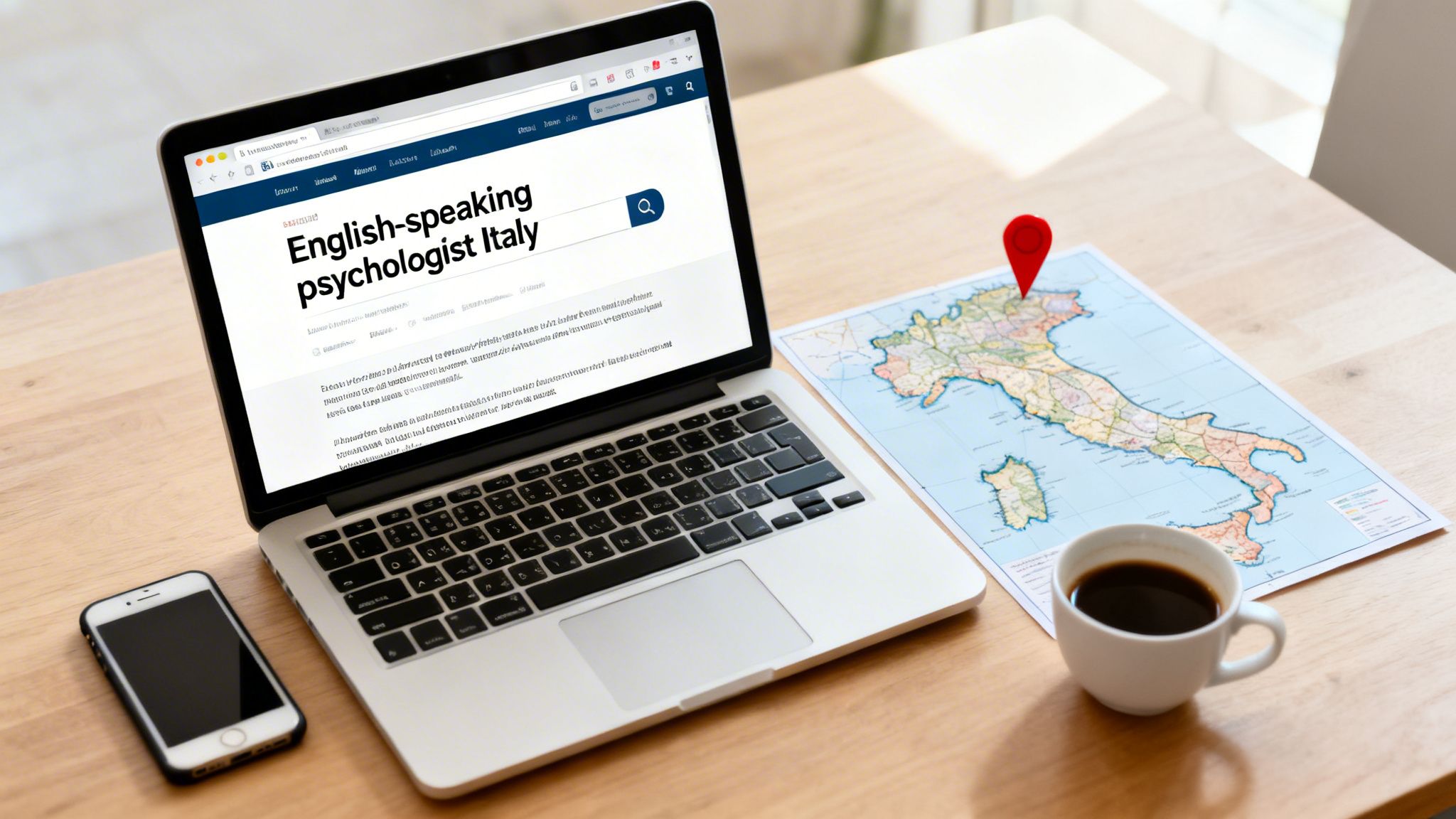
Another option is searching online directories or expat forums. While you might find individual therapists by searching for "English-speaking psychologist in Rome," this process is slow and lacks quality control. There is no vetting, leaving you to verify credentials and assess cultural competence on your own, which can be an overwhelming task.
Key Insight: Searching for a therapist is not about finding a name on a list; it is about finding a trusted partner for your mental well-being. The quality of the match is far more important than the quantity of options.
The Solution: The Advantage of Therapsy's Curated Professional Network
Therapsy was created to solve these exact problems. We take the guesswork and endless searching out of the equation by doing all the vetting for you. Our network is composed of carefully selected, licensed, and multilingual professionals who are experts at working with the international community. They are not just fluent in your language—they are fluent in the expat experience. This shared understanding is crucial for therapy to be effective.
With Therapsy, the process is built around you. It all starts with a free first assessment call where you speak with a clinical professional who listens to your story and needs. This conversation allows us to match you with the ideal therapist from our network—someone whose clinical style, personality, and expertise align with your goals. For those wondering about local options, our guide on finding a therapist near you in Italy offers more insight into what's available in your city. This approach transforms a daunting search into a simple, supportive, and collaborative first step toward feeling better.
How to Choose the Right Therapist for You
The Problem: Finding the Right "Fit" as an Expat
You’ve decided to find a therapist. That’s a huge first step. But finding the right one can feel like another challenge. For expats in Italy, this search has an extra layer of complexity. Language fluency is crucial, but true compatibility goes deeper. You need a professional who understands not just your words, but your world—the unique pressures and frustrations of building a life between cultures.
The Insight: Key Factors for a Successful Therapeutic Match
Finding the right therapist is about building a human connection that feels safe and supportive. The quality of this relationship, the "therapeutic alliance," is one of the strongest predictors of a positive outcome. Three key factors determine this match: clinical focus, therapeutic approach, and cultural competence.
Matching Their Clinical Focus to Your Needs
Therapists have specialties. Finding someone whose expertise aligns with your challenges is essential. Think about what brought you here. Are you dealing with:
- Anxiety and Depression: Persistent worry, a lingering low mood, or feelings of hopelessness.
- Stress and Burnout: Common for professionals and students in a high-pressure, unfamiliar environment.
- Relationship Issues: Navigating intercultural relationships or family friction from afar.
- Trauma and PTSD: Working through difficult past experiences with a trained professional.
- Life Transitions: Coping with the massive identity shifts that come with relocation or a career change.
This is especially critical for young adults. In Italy, 72.7% of individuals aged 18-24 report significant mood fluctuations, and 71% experience symptoms of depression. Relocation stress can amplify these issues, making specialized support non-negotiable.
Understanding Different Therapeutic Approaches
Therapists use different methods, or "modalities," to guide sessions. Finding an approach that clicks with your personality can make all the difference.
Key Insight: A therapist’s approach is their roadmap for helping you. Understanding the basic differences can empower you to choose a path that feels right for your personality and goals.
Here’s a quick look at some common therapeutic approaches and how they help with expat challenges.
Comparing Therapeutic Approaches for Common Expat Challenges
| Therapeutic Approach | Best For… | How It Works for Expats |
|---|---|---|
| Cognitive Behavioural Therapy (CBT) | Anxiety, depression, stress, burnout. | A practical, goal-oriented therapy. It provides expats with concrete tools to challenge negative thought patterns (e.g., “I’ll never fit in here”) and change unhelpful behaviours. |
| Psychodynamic Therapy | Deeper self-understanding, recurring relationship patterns, identity issues. | This approach explores how past experiences and unconscious thoughts shape your present. It’s ideal for expats trying to understand why they feel disconnected from their sense of self. |
| Systemic Therapy | Couple and family conflicts, relationship dynamics. | Focuses on the “system” (e.g., a couple or family). Invaluable for intercultural couples bridging communication gaps or families navigating the stress of a move. |
| Mindfulness-Based Therapies | Stress reduction, emotional regulation, being present. | Teaches you to observe thoughts and feelings without judgment. This can be a powerful way for overwhelmed expats to find calm and grounding in the here-and-now. |
The Make-or-Break Factor: Cultural Competence
For an expat, a therapist’s cultural competence is non-negotiable. It goes beyond being “expat-friendly.” A culturally competent therapist understands that your background, values, and the experience of living between two worlds profoundly impact your mental health. They create a space where you can unpack the feeling of being an outsider and the invisible stress of living abroad.
For example, while resources like couple counseling worksheets can be helpful, a culturally aware therapist adapts them to resonate with both partners’ backgrounds, rather than imposing a one-size-fits-all model. We explore this topic in our guide to multilingual psychotherapy for expats in Italy.
The Solution: Therapsy’s Multiculturally Competent Professionals
At Therapsy, we vet our therapists not only for their clinical excellence but also for their real-world experience with the nuances of international life. Our network includes professionals skilled in a wide range of evidence-based methods, ensuring we can match you with someone whose style genuinely works for you. They are more than just multilingual; they are multicultural, providing a safe space where your whole identity is finally seen and understood. The process begins with our free first assessment call, where we start this careful matching process.
The Logistics of Therapy in Italy for Expats
The Problem: Navigating the Practical Details of Therapy
You’ve researched and shortlisted potential therapists. Now, the focus shifts to the practical side. For an expat in Italy, figuring out the logistics—like session format, costs, and privacy—is just as important as finding the right person. These details can cause anxiety and become barriers to starting therapy.
The Insight: Key Logistical Considerations for Expats
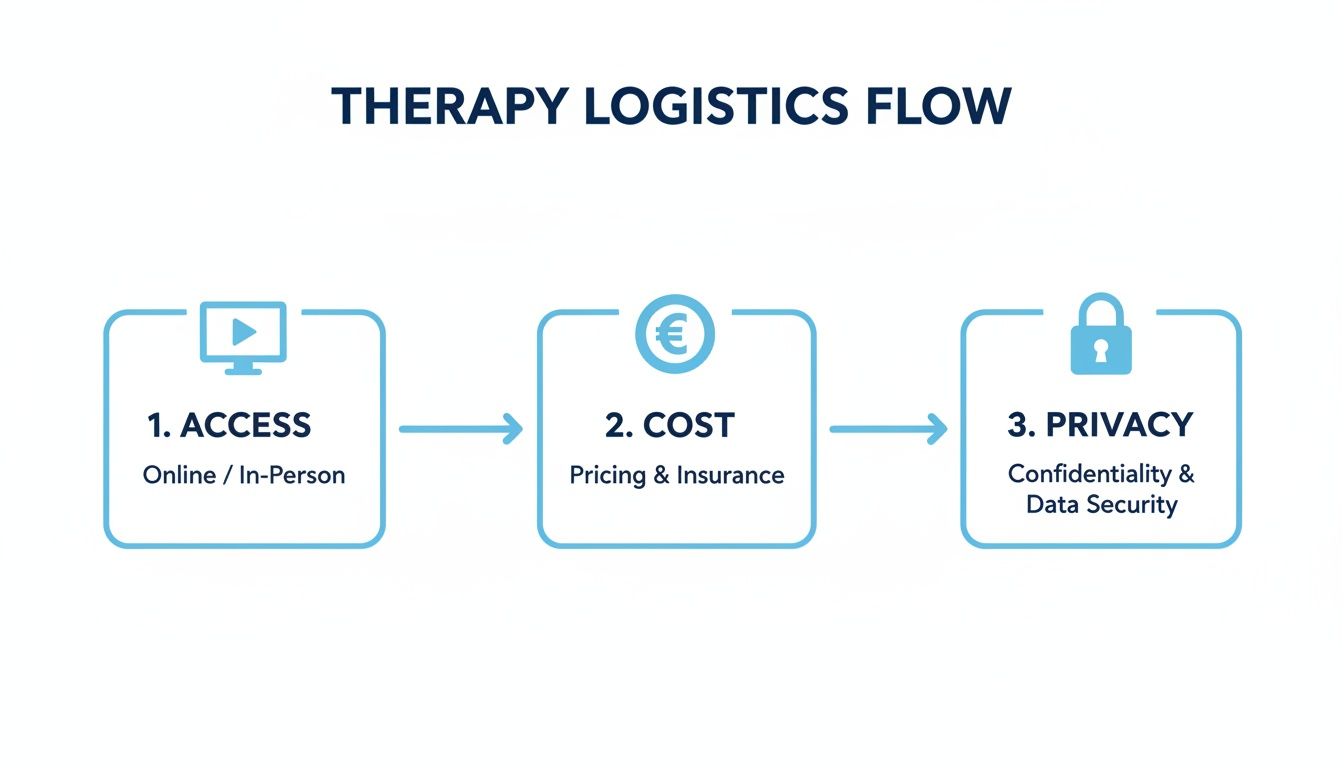
Making therapy a sustainable part of your life in Italy requires clarity on three main points: how you will meet, what it will cost, and how your privacy is protected.
Online vs. In-Person Sessions
One of the first practical decisions is how you want to meet your therapist.
- Online Therapy: Offers incredible flexibility, which is a lifesaver for expats with busy schedules, travel plans, or those living outside major cities. It breaks down geographical barriers, giving you access to a much wider range of multilingual specialists.
- In-Person Therapy: The traditional therapy room provides a dedicated, neutral space away from home and work. For some, being physically present helps build a different kind of connection.
Many people find a hybrid approach works best. If you’re weighing the options, our article on online vs. in-person therapy in Italy for expats breaks it down further.
Understanding the Costs of Private Therapy
Therapy is a fundamental investment in your long-term health and well-being. However, the financial aspect can be a source of anxiety. Mental health conditions cost the Italian economy over €20 billion a year, yet the sector receives only 3.3% of the total healthcare budget. This underfunding leads to long waits in the public system (SSN), forcing many to the private sector where sessions typically range from €80 to €150. These costs are often not covered by standard insurance, creating a financial challenge.
Key Insight: Transparent pricing is a cornerstone of trustworthy care. You should know exactly what to expect financially before you begin, without hidden fees or surprises.
Your Privacy and Confidentiality
When sharing your vulnerabilities, you must know your information is safe. In Italy and across the EU, your privacy is rigorously protected by the General Data Protection Regulation (GDPR). This law dictates how all personal data, especially sensitive health information, is secured.
- In-person sessions: Your therapist is bound by a legal and ethical code of confidentiality.
- Online sessions: Reputable services use GDPR-compliant, encrypted platforms to ensure your communications are secure.
This legal and ethical framework is your guarantee that what you say in therapy stays in therapy.
The Solution: Therapsy’s Transparent and Flexible Logistics
Therapsy is designed to manage these logistics for you, providing clarity and peace of mind.
- Flexible Sessions: We support you either way, with welcoming offices in major Italian cities for in-person sessions and a secure, simple-to-use platform for online therapy.
- Transparent Pricing: We believe this investment should be clear. Our sessions are transparently priced starting from €70, with no hidden costs. We use a secure payment system (Stripe) for your peace of mind.
- Guaranteed Privacy: As a professional service, we are fully GDPR-compliant, ensuring the highest standards of confidentiality for both online and in-person care.
All these details are discussed during your free first assessment call, so you can begin your journey with confidence.
Taking the First Step: How Professional Assessment Works
The Problem: The Fear of Making the “Wrong Choice”
The thought of finding a therapist in a new country can feel overwhelming. Many people get stuck, worried about committing to someone who is not the right fit. This “analysis paralysis” can prevent you from seeking the help you need. The search for support doesn’t have to be a stressful, solitary process.
The Insight: The Power of a Guided, Risk-Free Conversation
Finding help should not begin with an endless search. It should start with a simple, guided conversation that provides clarity without any long-term commitment. It is not about finding a therapist; it’s about finding your therapist, and that process starts with a human connection, not an algorithm. An initial consultation is a dedicated space to talk about what’s on your mind and what you hope to get from therapy. It helps:
- Clarify Your Needs: A professional can help you put words to your goals, whether you are wrestling with anxiety, relationship stress, or culture shock.
- Outline Your Preferences: You can be open about what you’re looking for in a therapist—their gender, their approach (like CBT), or their expertise.
- Demystify the Process: You can ask about session frequency, what to expect, and how to measure progress, removing the mystery from therapy.
After this conversation, a clinical expert takes everything you shared and carefully pairs you with the ideal therapist from a vetted network. This matching process considers clinical, linguistic, cultural, and personality fit.
Key Insight: A professional matching process removes the burden of endless searching. It replaces guesswork with expert guidance, ensuring your therapeutic relationship starts on the strongest possible foundation.
This initial meeting is a crucial part of the therapeutic journey, often called a psychodiagnosis. It’s a collaborative process that ensures the path forward is built specifically for you. We dive deeper into the importance of psychodiagnosis in modern therapy in our detailed article.
The Solution: Therapsy’s Free First Assessment Call
At Therapsy, we built our entire service around this human-first approach. Our free first assessment call is a conversation with our Clinical Director, a licensed professional whose only goal is to understand your unique situation. It’s not a sales pitch. It’s the first step in your care. This risk-free first step makes seeking help feel safe and manageable. It replaces the anxiety of “therapist shopping” with a supportive conversation that validates your experience and opens the door to effective, compassionate care.
Frequently Asked Questions: Finding a Therapist in Italy
Can I use my health insurance for therapy in Italy?
It depends on your specific insurance plan. The Italian public system (SSN) rarely covers English-speaking therapy due to long waits and language barriers. Private Italian plans often offer limited coverage. However, many international or expat health insurance plans do cover mental health services.
- Action: Contact your provider and ask about coverage for sessions with a licensed psicologo or psicoterapeuta in Italy and their requirements for reimbursement.
- Therapsy’s Role: We provide detailed, professional invoices that meet the requirements of most international insurance providers to simplify your reimbursement process.
Is online therapy as effective as in-person sessions?
Yes. Decades of research confirm that for most common issues like anxiety, depression, and stress, online therapy is just as effective as meeting in person. For expats, the flexibility and wider access to specialized, multilingual therapists often make it a superior choice.
Key Insight: The most crucial factor for successful therapy is the quality of the relationship you build with your therapist, which can be developed just as effectively online as in person.
How do I know if a therapist is properly qualified in Italy?
In Italy, the titles “psicologo” (psychologist) and “psicoterapeuta” (psychotherapist) are legally protected.
- A psicologo holds a master’s degree, has completed a supervised internship, and passed a state exam to register with the official board, the Ordine degli Psicologi.
- A psicoterapeuta is a licensed psychologist or medical doctor who has completed an additional four-year postgraduate specialization.
- Therapsy’s Guarantee: Every therapist in our network is a fully licensed professional whose credentials we have personally vetted, so you can be confident you are in safe, expert hands.
What if I don’t connect with my first therapist?
It’s a normal concern, and it’s okay if the first match doesn’t click. A good connection is the foundation of effective therapy. This is why our process at Therapsy starts with a free first assessment call to make the best possible match from the beginning. If the connection isn’t right, just let us know. We will listen to your feedback and work with you to find a different therapist in our network who feels like a better fit. Your comfort and progress are our top priorities.
Your journey to well-being in Italy starts with a single, supportive conversation. With Therapsy, you can connect with a professional who truly understands the expat experience.