A person can feel anxious, lonely, or stuck even when the immediate problem seems personal. Systemic relational therapy understands that distress can also reflect patterns within family, couple, friendship, workplace, cultural, and migration systems. It helps clients explore those connections and change the interactions, expectations, and stories that keep the difficulty going, whether loved ones attend sessions or not.
An expat in Italy may have a home, colleagues, and a social calendar, yet still feel emotionally unrooted. Conversations with a partner may become tense because one person is speaking a second language, while messages from family abroad carry expectations that are difficult to explain locally.
Therapsy is a multilingual psychotherapy service in Italy that connects expats with therapists who speak their native language.
Why Systemic Relational Therapy Matters for Expats
Can personal distress reflect the relationships and culture around someone?
Systemic relational therapy examines how personal distress develops within relationships, cultural expectations, and changing environments rather than treating it as an isolated flaw.
Consider an international student who starts missing deadlines after moving to Italy. At first, the problem may look like poor motivation or anxiety. A wider map might show disrupted routines, uncertainty about Italian bureaucracy, fewer conversations in the student's strongest language, pressure from family abroad, and a partner who interprets withdrawal as rejection.
The student isn't being blamed for these conditions. The therapist is asking a more useful question: what happens between people before, during, and after the distress appears? That question can reveal a cycle. The student feels overwhelmed, becomes quiet, the partner becomes more demanding, and the increased pressure leads to further withdrawal.
Living abroad changes more than geography. It can alter identity, independence, communication, family roles, friendships, work expectations, and the meaning of belonging. A person may also lose the small daily supports that once helped regulate stress, such as a familiar doctor, trusted relatives, or friends who understand cultural references without explanation.
Why can moving abroad intensify relational stress?
Migration can place ordinary relationships under unusual pressure because support networks become distant while new cultural rules remain unfamiliar.
An Italian partner may expect frequent family contact, while a foreign partner experiences that contact as intrusive. One person may see financial support for relatives as a duty, while the other sees it as a source of conflict. Neither reaction is automatically unhealthy, but the couple can become trapped when each person treats their own cultural assumption as self-evident.
Language adds another layer. A person who is articulate in English may sound hesitant in Italian, and a partner may mistake that hesitation for avoidance. Emotional conversations can become shorter, more practical, or more defensive when someone is searching for words.
A culturally responsive therapist helps distinguish individual vulnerability from relational and environmental pressure. This can include exploring family expectations, migration history, racism or exclusion, religious values, gender roles, financial stress, and the emotional meaning of staying connected across borders. Culturally responsive therapy for expats can provide a useful starting point for understanding this kind of support.
Practical rule: A symptom makes more sense when the conversation includes the relationships, language, culture, and setting in which it appears.
Systemic relational therapy doesn't mean that every problem is caused by a family or partner. It means that relationships can maintain distress, protect against it, or become a resource for recovery. The approach can therefore help an individual client even when no relative joins the session.
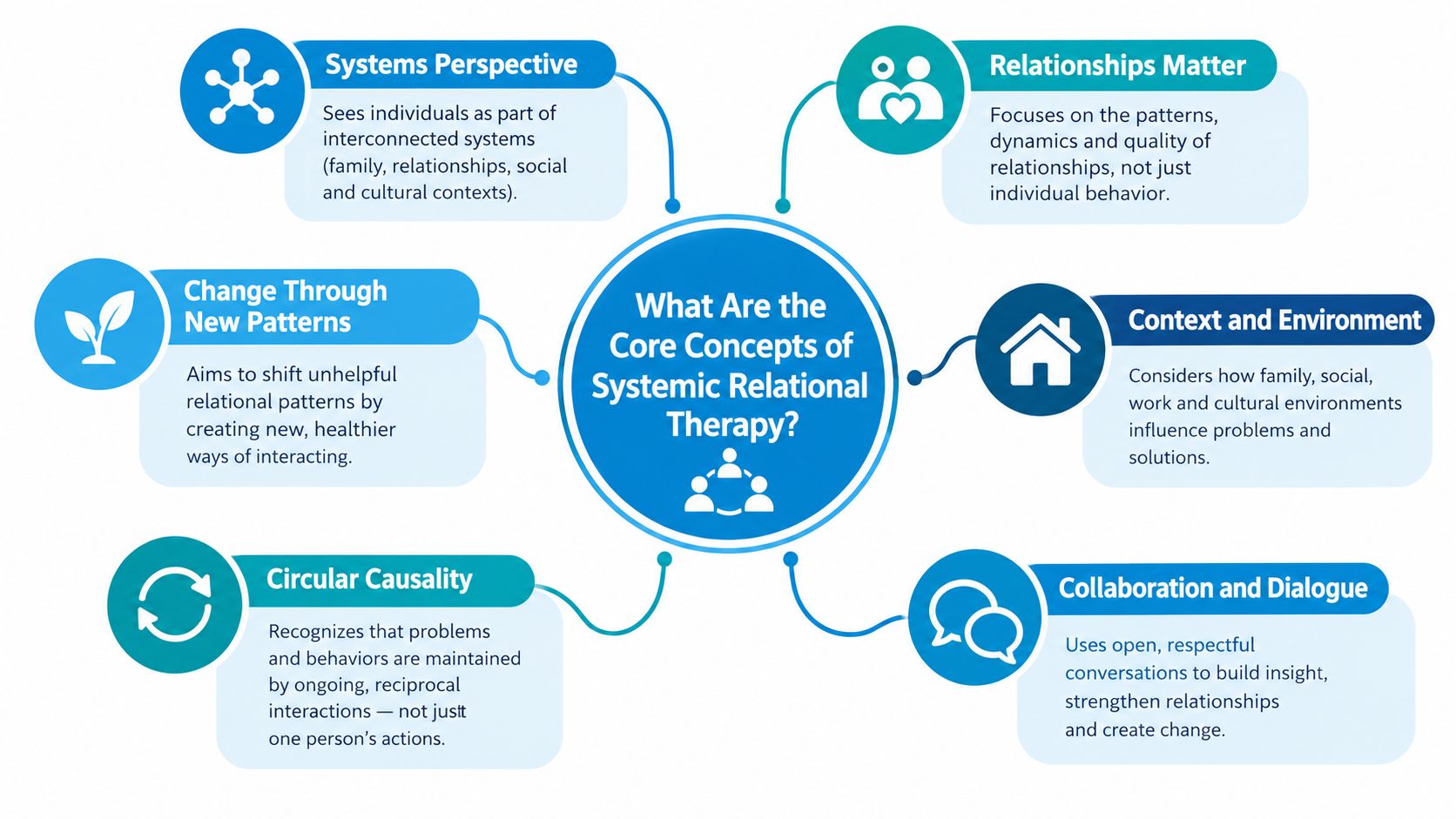
What Are the Core Concepts of Systemic Relational Therapy?
What does “systemic” mean in therapy?
“Systemic” means that the therapist studies the network of relationships and contexts influencing a person's experience, not only the person's internal symptoms.
A useful analogy is a hanging mobile. When one piece moves, the other pieces shift, even if nobody touches them directly. In a family, couple, friendship group, or workplace, one person's change can alter everyone else's expectations and reactions.
Suppose an expat begins setting firmer boundaries with relatives abroad. The relatives may increase calls, a partner may feel caught in the middle, and the expat may experience guilt. The new boundary isn't automatically wrong. It has changed the system, and the system is responding.
The family and other significant relationships are important settings where personality development and psychological functioning take shape. They're also places where people learn roles, interpret emotional signals, and decide what is safe to express. Research on systemic-relational therapy describes relationships as central both to understanding a problem and to creating change.
How does a therapist map a person's relational system?
A therapist maps the system by examining repeated interactions, roles, boundaries, loyalties, communication styles, and the meanings people attach to each other's behaviour.
The process may include questions such as:
- Sequence: What usually happens immediately before the anxiety, silence, criticism, or argument?
- Reciprocity: How does one person's response influence the next response?
- Roles: Who comforts, withdraws, mediates, decides, or carries responsibility?
- Context: How do language, migration, work, money, family history, or cultural expectations change the pattern?
- Exceptions: When does the cycle not happen, and what is different then?
This way of thinking replaces simple blame with circular understanding. A partner's criticism may increase withdrawal, while withdrawal may increase the partner's fear and criticism. Both people can contribute to a cycle without either person being reduced to a label.
An individual client can also draw a relational map without bringing anyone else into the room. The therapist may explore family members, former partners, friends, colleagues, host-country institutions, and communities. The map shows where the client feels supported, misunderstood, obligated, or alone.
People often confuse systemic work with taking sides. The therapist's role isn't to decide who is right. It's to identify the pattern that keeps producing the same painful outcome and create more choices within it.
Where did systemic relational therapy come from?
Systemic relational therapy emerged from the broader family therapy movement that took shape in the 1940s and early 1950s, including the founding of the American Association of Marriage Counselors in 1942 and postwar clinical work in the United Kingdom, the United States, and Hungary. The history of family therapy describes how the field moved from an individual view of distress toward a relational one.
By the late 1950s, systems theory, communications theory, and cybernetics had become major intellectual influences. In the 1960s and 1970s, distinct schools developed. Murray Bowen developed family systems theory in the late 1960s, Salvador Minuchin largely developed structural family therapy in the late 1950s and 1960s, strategic family therapy grew at the Mental Research Institute in Palo Alto during the late 1960s and 1970s, and the Milan school advanced systemic work in Italy during the 1970s and 1980s. A historical account of systemic psychotherapy documents these developments and notes the German Scientific Advisory Board for Psychotherapy's scientific recognition of systemic psychotherapy for all age groups in 2008.
The history matters because systemic therapy isn't just advice for couples. It developed into a broad framework for understanding how interaction, communication, development, and context affect psychological functioning. An expat experiencing anxiety may therefore explore both internal feelings and the relational conditions in which those feelings become stronger.
For readers who notice recurring patterns of distance and closeness, therapy for anxious attachment can offer another way to connect attachment experiences with present relationships.
How Does Systemic Relational Therapy Actually Create Change?
How does systemic therapy change a recurring problem?
Systemic therapy creates change by identifying the interaction cycle that maintains distress and helping people respond differently at key points in that cycle.
A common pattern looks like this: one partner asks for reassurance, the other feels pressured and withdraws, the first partner asks more urgently, and the withdrawal becomes stronger. Each response makes sense in isolation, but together they create a self-reinforcing loop.
The therapist slows the sequence down. Instead of asking only, “Who started the argument?”, the work may ask, “What does each person fear at that moment, what does each person do next, and how does that response shape the other person's behaviour?”
A core mechanism is changing symptom-promoting interaction patterns, not only discussing feelings. The treatment can address reciprocal interactions at family and social levels, along with the stories and internal patterns that keep distress going, as described in this clinical overview of systemic mechanisms.
What happens when the identified patient is one person?
The identified patient is the person whose distress has become most visible, but the treatment can still examine the relationship system around that person.
An expat may seek help for panic symptoms while living alone. The therapist might explore isolation, contact with family abroad, workplace expectations, friendships, language confidence, and the client's learned response to asking for support. The client remains the focus, but the problem is understood in context.
This approach doesn't imply that other people must attend or accept responsibility. The client can practise new boundaries, clearer requests, emotional regulation, and different interpretations of others' actions. When one person changes a repeated response, the wider system may begin to reorganise.
Therapy also examines the stories that shape interaction. A person may carry the belief, “If support is needed, independence has failed,” while a partner may carry, “If there's silence, the relationship is in danger.” These stories can make ordinary misunderstandings feel like evidence of abandonment or rejection.
What concerns can systemic interventions address?
Systemic interventions have documented clinical use across relationship distress, psychosexual problems, intimate partner violence, anxiety, mood disorders, alcohol problems, schizophrenia, and adjustment to chronic physical illness. A review of systemic therapy applications also describes use beyond couple and family concerns, including cases where the treatment target is the relationship system surrounding an individual.
That breadth doesn't mean systemic therapy is suitable for every person or every situation. Safety, consent, power differences, cultural context, and the client's goals must guide the treatment. In situations involving violence or coercive control, a therapist must assess whether joint relational work is appropriate and safe.
Evidence also needs careful interpretation. A 2024 review reported large effects for adult depressive symptoms compared with no-treatment controls, with g = 1.09 post-test and g = 1.23 at follow-up, while noting that comparisons with other therapies often relied on very small numbers of studies. A 2025 meta-analysis of systemic therapy for young people found a small but significant overall symptom effect of g = .16, with comparable effects on family functioning and caregiver psychopathology. These figures come from the review of systemic therapy for adult depression and the youth meta-analysis.
A realistic expectation is not a universal result or a promise of rapid transformation. Systemic therapy may help a client understand a cycle, interrupt a familiar response, communicate more clearly, develop boundaries, and build support. Progress should be discussed openly with the therapist and adjusted to the client's circumstances.
How Does Systemic Therapy Compare to CBT, EMDR, and Psychodynamic Approaches?
Which therapy approach fits an expat's concern?
An expat arrives at therapy after months of arguing with a partner, avoiding social contact, or feeling constantly alert in an unfamiliar country. The most suitable approach depends on the client's goals, history, safety, preferences, and the pattern keeping distress in place. No method is the best choice for everyone.
Cognitive Behavioral Therapy, or CBT, examines the links between thoughts, emotions, bodily reactions, and behaviour. It may suit an expat who wants structured support with anxiety, avoidance, rumination, or practical coping. Exercises between sessions are often part of this approach.
Eye Movement Desensitization and Reprocessing, or EMDR, centres on distressing memories and trauma-related responses. It may be considered when past events still produce strong emotional or physical reactions, after an appropriate clinical assessment. An introduction to EMDR therapy provides a further explanation of the approach.
Psychodynamic therapy explores emotional patterns, unconscious expectations, early relationships, and the influence of past experiences on present life. It can help clients who want to understand recurring inner conflicts, relationship themes, or questions about identity.
Systemic relational therapy examines interaction, communication, roles, boundaries, couple and family patterns, and the cultural setting around distress. It can support individuals, couples, and families. For an expat, this may include isolation, migration stress, changing identity, and tension between cultural expectations.
How do these approaches differ in practice?
The approaches can overlap. A systemic therapist may discuss thoughts and attachment, a CBT therapist may consider relationships, and an EMDR therapist may assess current support and safety. The table describes common areas of emphasis rather than strict boundaries.
| Approach | Primary focus | Best for |
|---|---|---|
| Systemic relational therapy | Interaction cycles, relationships, communication, roles, culture, and context | Relationship distress, migration stress, family tension, isolation, and individual symptoms maintained by relational patterns |
| CBT | Thoughts, emotions, behaviours, avoidance, and practical coping skills | Anxiety, rumination, low mood, and goals that benefit from structured exercises |
| EMDR | Distressing memories, trauma-related activation, and adaptive processing | Trauma-related difficulties when an appropriate assessment supports this direction |
| Psychodynamic therapy | Unconscious patterns, early relationships, emotional conflict, and meaning | Repeating relationship themes, identity questions, and a wish for deeper exploratory work |
For a bilingual or multicultural couple, systemic work may examine how each partner defines respect, independence, family loyalty, privacy, and commitment. Language can also shape what becomes possible in a session. One partner may express vulnerability more accurately in Italian, while the other may need another language to describe family expectations or grief.
An expat working alone can also benefit from this framework. Learning about nervous system regulation therapy can complement relational work when anxiety or physical activation affects communication and connection.
Is systemic therapy only for couples and families?
Systemic therapy can address the relational system around an individual client. A person may explore family-of-origin patterns, friendships, workplace relationships, migration stress, or the emotional effects of living far from home. Sessions can examine how the client's responses invite, avoid, or intensify particular interactions without placing blame.
The clearest starting point is the client's main concern. At Therapsy, matching by the Clinical Director, therapy in the client's own language across 14 languages, and online or in-person options can help align care with the client's circumstances.
A familiar-sounding method is not automatically the right one. The therapist should explain the reasoning, discuss alternatives, and review whether therapy is addressing the client's goals. If symptoms indicate a need for medical or psychiatric attention, psychological therapy should complement, not replace, appropriate medical care.
What Should You Expect When Starting Therapy in Italy?
What happens during the first therapy conversation?
The first conversation usually clarifies the client's main concern, current context, language preference, practical needs, and hopes for therapy.
An expat may describe loneliness, couple conflict, academic pressure, or anxiety without knowing which therapy model fits. The therapist can ask what has changed, which relationships are involved, what support is available, and whether online or in-person sessions feel more workable.
A systemic assessment may include a relational map. This isn't an interrogation of family members. It's a collaborative way to understand who matters to the client, where tensions appear, how communication unfolds, and how migration or cultural difference affects the pattern.
The client can also ask direct questions:
- Approach: Why might systemic therapy fit this concern?
- Language: Can difficult emotional topics be discussed comfortably in the chosen language?
- Format: Would online or in-person sessions offer better continuity?
- Participation: Would involving a partner or relative be useful, appropriate, and safe?
- Review: How will the client and therapist know whether the work is helping?
A good first conversation should leave room for uncertainty. The client doesn't need a finished explanation before seeking help.
How much does therapy cost in Italy?
At Therapsy, individual therapy starts from EUR 70, couple therapy from EUR 100, psychodiagnostic assessment from EUR 255 for three sessions, and psychiatric consultation from EUR 110. The Therapsy pricing page explains that the final fee can depend on the therapist's experience and specialisation.
The first assessment call is free. It gives the client an opportunity to discuss the concern, ask practical questions, and decide whether continuing feels appropriate, without an obligation to start ongoing therapy.
Costs should be considered alongside frequency, format, language, and clinical fit. A lower fee isn't automatically a better match, and a higher fee isn't a guarantee of better outcomes. The important question is whether the service is transparent and whether the therapist's approach fits the client's needs.
How does Therapsy match multilingual clients?
Therapsy uses human matching by the Clinical Director rather than an algorithm, offers therapy in the client's own language across 14 languages, and provides a choice between online and in-person sessions.
The available languages are Italian, English, French, Spanish, German, Portuguese, Ukrainian, Russian, Greek, Arabic, Urdu, Hebrew, Hindi, and Persian (Farsi). This can matter when clients need to describe family roles, cultural expectations, or emotionally precise experiences that feel difficult in a second language.
Therapsy offers sessions across 24 Italian cities with 90 physical locations, as well as online appointments. The network includes 50+ therapists, has supported 1,500+ clients and delivered 13,000+ sessions since 2023, according to the service's stated information. Its Trustpilot rating is 4.8/5, “Excellent,” and first contact is offered within 12 hours.
Less than 1 applicant in 100 is accepted into the network. This describes the network's selection process, not a promise about any individual client's outcome. The practical value of matching remains personal: the therapist needs to understand the client's concerns, language, cultural background, and preferred way of working.
For help with the practical steps, the guide to starting therapy in Italy explains how a client can begin the process. Therapsy's first call is free and takes place with the therapist chosen for that person.
Who works with systemic relational therapy at Therapsy
Dr. Svetlana Loginova, a Russian and English-speaking systemic psychotherapist in Milan and Bergamo, trained at the Centro Milanese di Terapia della Famiglia and works with international couples, eating disorders and body image. Dr. Stéphane Courtois, a native French-speaking psychotherapist in Rimini, brings over 25 years of practice and a specialisation in systemic-relational psychotherapy to work with families, depression and addiction. Dr. Giorgia Pro, a psychologist in Rome who works in Italian, English, Spanish and French, uses a systemic and relational approach with adults and families.
Frequently Asked Questions About Systemic Relational Therapy
Can systemic therapy help when the family isn't in the room?
Yes, an individual client can benefit from systemic therapy even when relatives or partners never attend a session.
The therapist can explore the client's current relationships, family history, friendships, workplace, cultural community, and migration experience. The aim isn't to analyse absent people from a distance. It's to understand interaction patterns and help the client change their own responses, boundaries, expectations, and communication.
This can be especially relevant for expats whose main support network lives abroad. The work may focus on loneliness, guilt about family obligations, conflict with a partner, or difficulty asking new acquaintances for support.
Is systemic relational therapy only for couples?
No, systemic relational therapy can support individuals, couples, and families because it focuses on relationship patterns rather than a single treatment format.
An individual may explore how family expectations influence anxiety or how workplace relationships affect confidence. A couple may examine repeated cycles around language, intimacy, money, family loyalty, or decisions about where to live.
The therapist decides with the client whether involving another person would be useful and safe. Participation is collaborative, not automatic.
Can systemic therapy help cross-cultural couples?
Systemic therapy can help cross-cultural couples examine how language, family traditions, identity, migration, and cultural expectations shape recurring disagreements.
A couple may argue about visits to relatives, but the deeper conflict may involve belonging, respect, independence, or fear of losing cultural identity. The therapist helps each partner explain the meaning behind their position and identify the interaction cycle that turns difference into distance.
Sessions can be arranged around the couple's strongest shared language, with attention to moments when one partner has more linguistic or cultural power. Therapsy connects clients with therapists across 14 languages and offers online or in-person formats, which can support couples living in different cities or managing demanding schedules.
What if CBT helped with symptoms but not relationship friction?
A different therapy focus may be useful when symptom-management skills have helped but a recurring relational pattern remains unchanged.
CBT can help a client identify unhelpful thoughts, reduce avoidance, and practise coping strategies. Yet a couple may continue to repeat the same cycle because the conflict also involves attachment expectations, family roles, communication habits, or cultural meanings that require relational exploration.
Systemic therapy doesn't invalidate earlier CBT work. It can build on the client's existing skills while examining what happens between people and how the broader context maintains the problem. The client can discuss this history openly during the first assessment call.
Does systemic therapy diagnose mental health conditions?
Systemic therapy doesn't rely on a blog article or a single conversation to diagnose anyone, and clients shouldn't self-diagnose from relationship patterns.
A qualified clinician considers the person's symptoms, history, functioning, safety, and context. Therapy may be appropriate alongside psychiatric or medical care, but it doesn't replace medical assessment, medication management, or emergency support when those are needed.
Clients can ask the therapist how assessment works and what additional support may be appropriate. Clear communication about scope and safety is part of responsible care.
How long does systemic relational therapy take?
There is no universal duration because the length of therapy depends on the concern, goals, relationships involved, safety, progress, and the client's preferences.
Some clients want focused support around a current transition, while others need more time to understand longstanding family or relational patterns. The therapist and client can review progress together rather than treating a fixed number of sessions as a guarantee.
For an expat, continuity may also be affected by travel, relocation, university schedules, or changing work commitments. Online and in-person options can help the client discuss a format that remains realistic.
What happens if the therapist doesn't feel like the right match?
A client can raise concerns about the therapeutic relationship, language, pace, or approach rather than assuming therapy has failed.
The first assessment call is free and carries no obligation to continue. If the fit doesn't feel appropriate, the client can explain what is missing and ask whether another therapist or format would be more suitable.
At Therapsy, the matching process is handled by the Clinical Director rather than an algorithm, and the client can choose between online and in-person sessions. A respectful match process should make room for questions, hesitation, and informed choice.
Therapsy connects expats and international clients in Italy with human-matched therapists who offer systemic relational therapy in the client's own language, online or in person. The first call is free, takes place with the therapist chosen for that person, and carries no obligation to continue, so interested readers can visit Therapsy and explore the next step at their own pace.