You arrive back in Italy with a suitcase to unpack, messages waiting, and a surprising heaviness in your chest. Post vacation depression is a short-term drop in mood after travel, often caused by the sharp contrast between freedom, novelty, and rest away from home and the demands of ordinary life. It can involve sadness, irritability, fatigue, low motivation, anxiety, sleep disruption, or difficulty concentrating. It usually improves as your routine returns, but persistent or worsening symptoms deserve professional attention.
Therapsy is a multilingual psychotherapy service in Italy that connects expats with therapists who speak their native language.
What Post Vacation Depression Really Is
You may have spent days enjoying long meals, different streets, spontaneous plans, and fewer obligations. Then you return to an apartment in Milan, Rome, Florence, or another Italian city and feel flat instead of grateful. The first work email feels unusually intrusive. Laundry, commuting, bureaucracy, and social effort suddenly seem heavier than they did before you left.
Post vacation depression, also called post-vacation blues or post-travel low mood, is a temporary emotional decline during the adjustment from a holiday back to everyday responsibilities. It isn't a formal psychiatric diagnosis, but the experience is real. The feelings often appear because the transition is abrupt, not because the trip failed.
Post vacation depression is a readjustment pattern, not a personal failure.
Historical survey data illustrates how widespread this kind of reaction can be. A 2011 Reuters report on a TripAdvisor survey found that 34% of American travelers who took a summer holiday struggled with melancholy after returning home, while 64% said the blues began before the holiday ended. The same survey reported that 12% called in sick within the first month after returning to work. This evidence comes from the United States and is historical, but it shows that the impact can involve both mood and productivity. (Verywell Mind summary of the survey)
A more recent U.S. consumer poll summarized by GoodRx reported that 1 in 5 people experience post-vacation depression after every trip, suggesting that the reaction isn't limited to unusually difficult journeys. (GoodRx source)
A real feeling with an important boundary
Post vacation depression usually remains connected to the return itself. You might miss the pace of the trip, feel tired from travel, or struggle to restart your schedule, while still being able to enjoy a conversation, complete essential tasks, or look forward to something small.
Clinical depression can look broader and more persistent. Low mood may spread across work, relationships, sleep, appetite, self-care, and the ability to feel pleasure. A therapist will consider the whole pattern, including what was happening before the holiday and whether symptoms are easing.
This distinction matters for expats. A trip home may temporarily restore familiar language, food, family roles, or cultural ease. Returning to Italy can then bring back adaptation demands that were quiet during the holiday. Feeling sad after that shift doesn't mean you chose the wrong country or aren't resilient enough to live abroad.
Therapsy offers a space where an expat can describe that experience in a familiar language and cultural frame. That can make it easier to distinguish ordinary readjustment from burnout, depression, homesickness, or anxiety that needs sustained support.
Why the Emotional Crash Happens After Travel
The crash often comes from several changes arriving together. During a holiday, your attention may move toward exploration, relationships, rest, and immediate sensory experiences. On return, your brain must manage schedules, decisions, deadlines, financial responsibilities, and cultural navigation again.
A contrast effect can make ordinary life feel worse than it objectively is because it follows a period of unusually high freedom or novelty. Cognitive behavioral therapy, or CBT, helps examine the thoughts created by that contrast. “My life is unbearable unless I'm away” may feel true in the first days home, but it may be an emotional conclusion rather than a complete assessment of your life.
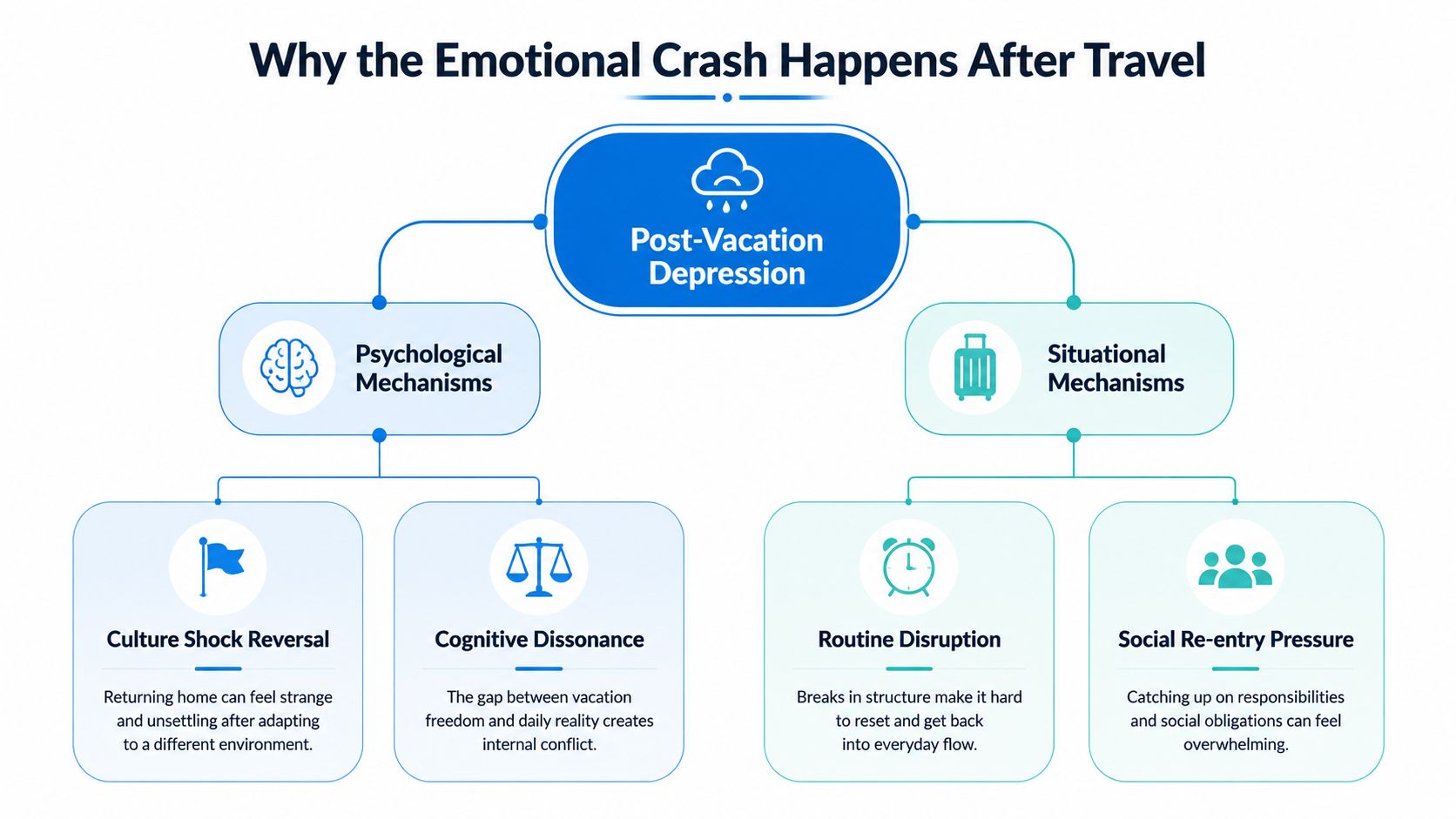
Psychological mechanisms
Novelty and anticipation can make the holiday feel emotionally concentrated. New places, plans, tastes, and conversations create repeated moments of interest. Once those stimuli disappear, familiar surroundings can feel dull by comparison.
Culture shock reversal can also play a role. An expat may relax while visiting family or spending time in a familiar cultural environment, then return to the effort of speaking another language, interpreting social expectations, and handling daily tasks in Italy. The emotional contrast may be stronger than the travel fatigue alone. Therapsy's guide to culture shock and reverse culture shock can help you identify that pattern.
Unmet expectations add another layer. A holiday may have been imagined as healing, perfectly restorative, or very refreshing. If there was conflict, illness, bad weather, loneliness, or financial worry, you may return grieving the trip you hoped to have rather than just missing the one you experienced.
Situational mechanisms
Travel can disrupt sleep, meals, movement, and substance use. Jet lag and late nights may leave your nervous system out of rhythm just as work or study requires concentration. Returning home can also reactivate unfinished responsibilities immediately, with no emotional buffer.
The first week back is particularly sensitive. The 2024 meta-analysis linked to vacation well-being found that gains fade after returning to work, with no significant difference from pre-vacation levels after the first post-vacation week and very small effect sizes at that point, d ≤ 0.12. Its practical implication is clear: smoothing the return may help more than making the next trip longer. (2024 meta-analysis)
The return can feel painful when rest ends suddenly and responsibility resumes all at once.
Burnout can make the contrast sharper. If you were already depleted before leaving, the holiday may provide temporary relief without changing the workload, relationship strain, or lack of recovery waiting at home. In that situation, post vacation depression may be useful information about the life you're returning to.
Common Symptoms and How Long They Last
Post vacation depression doesn't look identical for everyone. Some people feel tearful and withdrawn. Others become irritable, restless, anxious, or unusually critical of their home, job, partner, or daily routine.
Common experiences include:
- Sadness: You feel low, empty, or emotionally disappointed after returning.
- Irritability: Small demands, delays, or conversations trigger stronger reactions.
- Low motivation: Ordinary tasks feel disproportionately difficult to begin.
- Sleep disruption: You struggle to fall asleep, wake early, sleep late, or feel unrefreshed.
- Anxiety: Emails, work demands, finances, or re-entry responsibilities create tension.
- Difficulty concentrating: Reading, planning, and decision-making require more effort.
- Fatigue: Travel exhaustion continues after you've technically returned home.
- Loss of pleasure: Familiar activities feel less rewarding for a while.
A practical timeline
Improvement typically occurs within 3 to 14 days, and some sources describe recovery as closer to 3 to 7 days once routine and familiar surroundings begin to feel normal again.
A practical threshold is two weeks. One clinical explanation contrasts post-holiday blues, which generally last 3 to 14 days, with major depression, which lasts more than 2 weeks. Duration alone doesn't establish a diagnosis, but it helps indicate when a professional assessment is sensible.
| Symptom | Typical Duration | When to Seek Help |
|---|---|---|
| Sadness or emotional flatness | A few days to two weeks | Seek support if it persists beyond two weeks or keeps intensifying |
| Irritability | Several days while routine returns | Talk with a professional if conflict or anger disrupts relationships |
| Low motivation | Often improves as structure returns | Seek help if work, study, or self-care becomes difficult |
| Insomnia or disrupted sleep | Several days, especially after demanding travel | Get support if sleep problems continue or worsen |
| Anxiety and racing thoughts | Short-term during re-entry | Seek help if anxiety becomes pervasive, severe, or unsafe |
| Poor concentration | Usually settles with rest and routine | Discuss it with a clinician if it continues beyond the adjustment period |
For a more personal reflection, Therapsy's resource on whether you're depressed or just tired can help you organize what you're noticing. It can't diagnose you, but it may give you useful language for a first conversation.
Evidence-Based Strategies to Cope and Recover
The strongest practical lesson from the available evidence is that the transition matters more than extending the holiday. Plan for re-entry as a short recovery period rather than expecting yourself to perform at full capacity immediately.
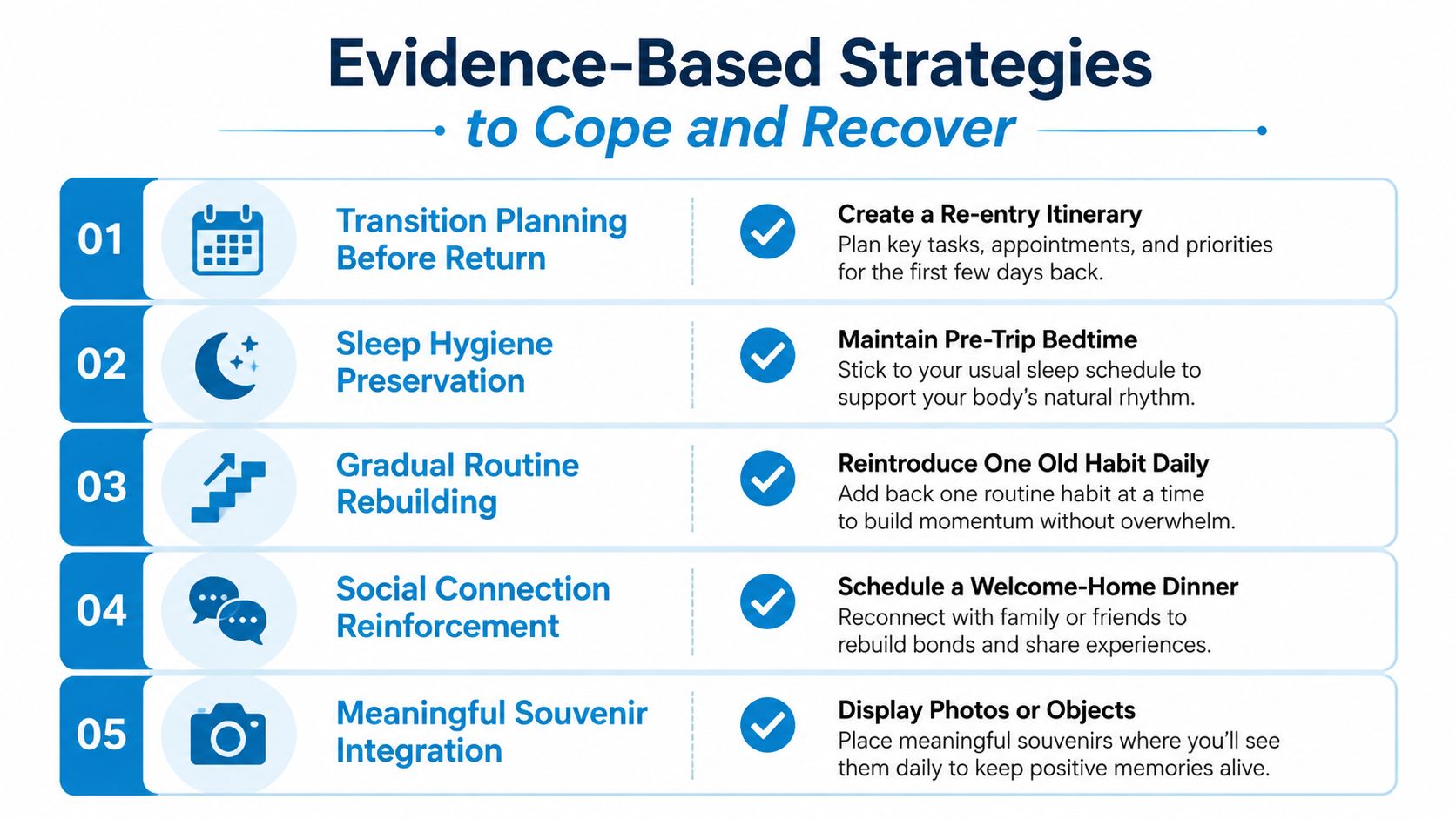
Plan the landing before you leave
If possible, create space between arriving home and resuming work or study. Avoid placing a high-stakes presentation, difficult meeting, or major decision on your first day back. Before the trip ends, write down the first small tasks you'll complete, rather than returning to an unstructured pile of obligations.
A re-entry plan might include:
- Protect a quiet arrival period. Unpack essentials, eat something simple, and reduce unnecessary decisions.
- Lower the first-week load. Begin with routine work before tackling complex or emotionally demanding tasks.
- Prepare your environment. Put away travel items, restock basic food, and make the next morning easier.
- Choose one near-term pleasure. Arrange a meal, walk, class, or conversation that gives ordinary life something to hold onto.
Restore sleep without fighting your body
Keep your sleep and wake times as consistent as you can for several days. Morning daylight, regular meals, and gentle movement can help your body recognize that the travel phase has ended.
Don't compensate for exhaustion by creating another unstable cycle of very late nights and irregular wake times. If you crossed time zones, give yourself patience. Sleep disruption can make ordinary sadness feel more intense.
Rebuild routine gradually
Return to one stabilizing habit at a time. You might begin with a morning coffee at home, a short walk, a regular lunch, or ten minutes of tidying. Small actions create visible evidence that daily life is becoming manageable again.
CBT can help you notice automatic thoughts and test them against experience. Therapsy's information about CBT for depression explains how this approach can address unhelpful thinking patterns alongside behavioral changes.
Reconnect with people
Isolation magnifies the emotional gap between holiday connection and home life. Contact one trusted person and describe the transition truthfully, without forcing yourself to say that everything was wonderful.
For remote workers, return stress can be especially difficult because work and home occupy the same space.
Bring home a value, not only a souvenir
Instead of trying to recreate the trip, identify what it gave you. Perhaps you walked more, ate slowly, spent time outdoors, spoke with family, or allowed your schedule to remain open. Choose one element that can fit into life in Italy.
A holiday can reveal a need. Recovery improves when you meet that need in a sustainable way at home.
When to Seek Professional Help for Post-Trip Low Mood
A holiday ends, your suitcase is unpacked, and ordinary responsibilities return. If the heaviness does not begin to ease after 2 weeks, continues getting worse, or interferes with daily life, arrange a conversation with a qualified mental health professional. The time frame is a guide, not a test you must pass. (GoodRx guidance)
Look for patterns rather than blaming yourself. A repeated crash after every trip can point to burnout, ongoing sleep loss, grief, pressure between work and personal life, or depression that the holiday temporarily concealed. The trip may have exposed the strain rather than caused it.
Signs that support would be useful
Professional help may be appropriate if you notice:
- Persistent low mood: Sadness or emptiness continues instead of slowly lifting.
- Marked loss of interest: Activities that usually matter feel flat or pointless.
- Functional decline: Work, study, hygiene, meals, or relationships become difficult to maintain.
- Severe anxiety: Worry, panic, or physical tension takes over much of the day.
- Repeated patterns: Returning from travel leads to the same prolonged collapse.
- Safety concerns: You have thoughts of self-harm, suicide, or not wanting to live.
If you or someone near you is in immediate danger, call 112, the emergency number in Italy and across the EU. Therapy is not an emergency service.
If you may act on thoughts of harming yourself, contact local emergency services or go to the nearest emergency department now. Safety concerns require immediate support, regardless of how long the low mood has lasted.
Therapy can clarify what the trip brought into focus
Therapy can separate ordinary readjustment from a deeper problem. CBT may help you question all-or-nothing conclusions and restore activities that provide pleasure or connection. Schema Therapy can examine longstanding beliefs such as “I only belong when I'm away” or “I must manage everything alone.” EMDR could be considered when travel, returning home, or separation from family activates traumatic memories, provided a trained clinician first assesses whether it fits your needs.
For expats in Italy, discussing these feelings in a familiar language can reduce the extra effort of explaining cultural context. Therapsy provides online and in-person psychotherapy in 14 languages, including Italian, English, French, Spanish, German, Portuguese, Ukrainian, Russian, Greek, Arabic, Urdu, Hebrew, Hindi, and Persian (Farsi). Its Clinical Director connects clients with selected licensed professionals through a human conversation rather than an automated questionnaire.
You can read about whether you need a psychologist before choosing support.
The first assessment call with Therapsy is free and carries no commitment or payment. You can describe what happens after your trips, ask practical questions, and consider whether a therapist and therapeutic approach fit your situation.
Why Expats in Italy Feel the Post-Vacation Crash More Intensely
You return to Italy after days of speaking freely with family, moving through familiar systems, and feeling understood without explanation. Then the first landlord message, work conversation, or bureaucratic task brings back the effort of building a life abroad. The emotional drop can feel sharper because the holiday did more than offer rest. It temporarily removed some of the work of adaptation.
For an expat, Italy may be home by choice while still demanding translation, observation, and flexibility. A visit to your country of origin can briefly restore automatic belonging. You may understand every joke immediately, know how services work, and speak without searching for words. Returning to Italian life restores the cultural and administrative effort that the trip held at a distance.

The hidden work of belonging
Language fatigue can make ordinary tasks feel expensive in attention. A conversation at work, a medical appointment, a landlord's message, or a bureaucratic form may require more concentration than it would in your first language. After a holiday, that effort becomes easier to notice because you have just experienced daily life with less friction.
International students may return to academic pressure and shared housing after feeling supported by family. Young professionals may come back to demanding work, limited local friendships, and the responsibility of creating a support network far from where they began.
The contrast can also expose the gap between an idealized Italy and ordinary Italian life. Beautiful memories do not remove rent, paperwork, commuting, loneliness, or uncertainty about belonging. Pleasure and strain can exist together, and recognizing both prevents the return from becoming a judgment about whether you chose the right country.
A gentler return to Italian life
Make re-entry specific. Small acts can reduce the sense that every part of expat life needs solving at once.
- Reconnect locally: Arrange a relaxed coffee or meal with someone who understands your life in Italy.
- Reduce administrative overload: Choose one practical task for the day rather than tackling everything immediately.
- Use familiar language support: Draft difficult messages in the language that helps you think clearly, then adapt them as needed.
- Restore place-based comfort: Return to a favorite walk, market, library, or café.
- Name what you miss: Homesickness points toward connection. It does not prove that you cannot adapt.
Therapsy supports expats through online and in-person sessions in 24 Italian cities, including Milan, Rome, Florence, Turin, Bologna, Bergamo, Padova, and Verona. Its multilingual care can help connect your inner experience with the language used in daily Italian life. If you are unsure whether you are experiencing homesickness or something deeper, read this guide to homesickness versus depression in expats in Italy.
Frequently Asked Questions About Post Vacation Depression
Is post vacation depression a real diagnosis?
Post vacation depression is a recognized short-term mood pattern, but it isn't a distinct formal psychiatric diagnosis. It usually describes sadness, fatigue, irritability, or low motivation during readjustment after travel. If symptoms persist, worsen, or impair daily functioning, a professional assessment can clarify whether depression or burnout is involved.
How long does post vacation depression last?
Post vacation depression commonly improves within 3 to 14 days. Some people feel better within several days as sleep and routine stabilize. If low mood continues beyond two weeks, consider contacting Therapsy or another qualified mental health professional.
Can post vacation depression be prevented?
You can reduce the risk by planning a gentler transition back to ordinary life. Protect sleep timing, avoid an overloaded first workday, rebuild routines gradually, reconnect socially, and schedule a small enjoyable activity after returning. The 2024 meta-analysis indicates that vacation well-being gains fade after returning to work, supporting the value of a smoother re-entry. (Meta-analysis source)
Why do expats in Italy feel depressed after visiting home?
Expats may feel a stronger crash because returning to Italy restores language, cultural, work, and social adaptation demands. A visit home can provide effortless familiarity and family connection, making the contrast with daily life abroad more noticeable. Multilingual therapy through Therapsy can help you explore belonging, homesickness, burnout, and adjustment together.
How can therapy help with post vacation depression?
Therapy can distinguish temporary readjustment from depression, burnout, anxiety, or unresolved emotional strain. CBT can address harsh interpretations and avoidance, while Schema Therapy or EMDR may be considered when deeper patterns or trauma are present. Therapsy offers a free first assessment call and human matching with therapists who work in 14 languages.
If returning from travel repeatedly leaves you sad, exhausted, or disconnected, Therapsy offers human-matched online and in-person psychotherapy across Italy in your preferred language. Book your free assessment call with Therapsy with no commitment, and speak with the Clinical Director about the support that fits your life.