You may be living in Italy, functioning on the surface, and still feeling overwhelmed.
Perhaps you are sleeping badly in Milan, crying more than usual in Turin, snapping at your partner in Rome, or losing motivation during your degree abroad. You finally decide to get help, then hit a basic but surprisingly stressful question: do I need a psychologist or a psychiatrist?
For many expats and international students, that question becomes the first barrier to care. The words sound similar. In some countries, people use them loosely. In Italy, the distinction matters. It affects what kind of support you receive, whether medication is part of the picture, how you enter the system, and what kind of first appointment you should expect.
The confusion is not a sign that you are uninformed. It is a normal response to understanding mental healthcare in another language, inside another health system, while already under strain.
A clear answer helps. Not a rigid rule, but a practical way to decide your next step with more confidence and less second-guessing.
Navigating Mental Health in Italy Your First Step
A common situation looks like this. An expat has been feeling anxious for months. Work feels heavier, small tasks take too much effort, and calling home leaves them more homesick than comforted. They search in English, find both “psychologist” and “psychiatrist”, and freeze because they do not know which one to book.
That pause can last weeks.
In Italy, many people delay support not because they do not want help, but because the first choice feels too technical. Add language barriers, insurance questions, and uncertainty about local qualifications, and the whole process can feel harder than it should.
Why this choice feels confusing abroad
In everyday conversation, people often mix up roles. Some assume a psychiatrist is “for serious problems” and a psychologist is “for talking”. Others believe seeing a psychiatrist means something has gone very wrong. Neither idea is a useful guide.
What matters is:
- A psychiatrist is a medical doctor who can prescribe medication.
- A psychologist focuses on psychological assessment and therapy.
- Sometimes you may need one.
- Sometimes you may benefit from both.
That sounds straightforward, but real life rarely feels that neat when you are distressed.
If you are asking for help, you do not need to be certain of the diagnosis first. You need a sensible starting point.
The Italian context matters
Italy’s system has its own language, pathways, and expectations. Public and private care work differently. Professional titles carry specific legal meaning. For expats, practical access often matters as much as clinical expertise. You may want someone who understands relocation stress, intercultural identity, mixed-language relationships, or the pressure of studying far from home.
If you want a broader overview of how care pathways work for internationals, this guide to https://therapsy.it/mental-health-services-in-italy-for-expats/ can help you understand the situation before choosing a provider.
The rest of this article will make the psychologist vs psychiatrist difference concrete. You will see who trains for what, what happens in each first appointment, which issues usually fit each professional, and when coordinated care makes the most sense.
The Fundamental Difference in Training and Philosophy
The simplest way to understand psychologist vs psychiatrist is this: one profession is trained through medicine, the other through psychology.
That difference shapes how each professional listens, assesses, and treats.
| Topic | Psychologist | Psychiatrist |
|---|---|---|
| Core training | Psychology and human behaviour | Medicine and psychiatry |
| Main focus | Thoughts, emotions, behaviour, relationships | Diagnosis, medical assessment, medication |
| Can prescribe medication in Italy | No | Yes |
| Typical role | Psychotherapy and psychological support | Medication management and psychiatric evaluation |
| Best fit for | Anxiety, stress, adjustment, relationship issues, burnout | Severe mood symptoms, psychosis, bipolar disorder, complex medication needs |
Two different educational paths
In Italy, psychiatrists are medical doctors. They complete around 12 years of training, including medical school and psychiatry residency, which is why they can prescribe medication. Psychologists complete 5 to 7 years for a doctoral degree plus clinical training, and they do not prescribe medication.
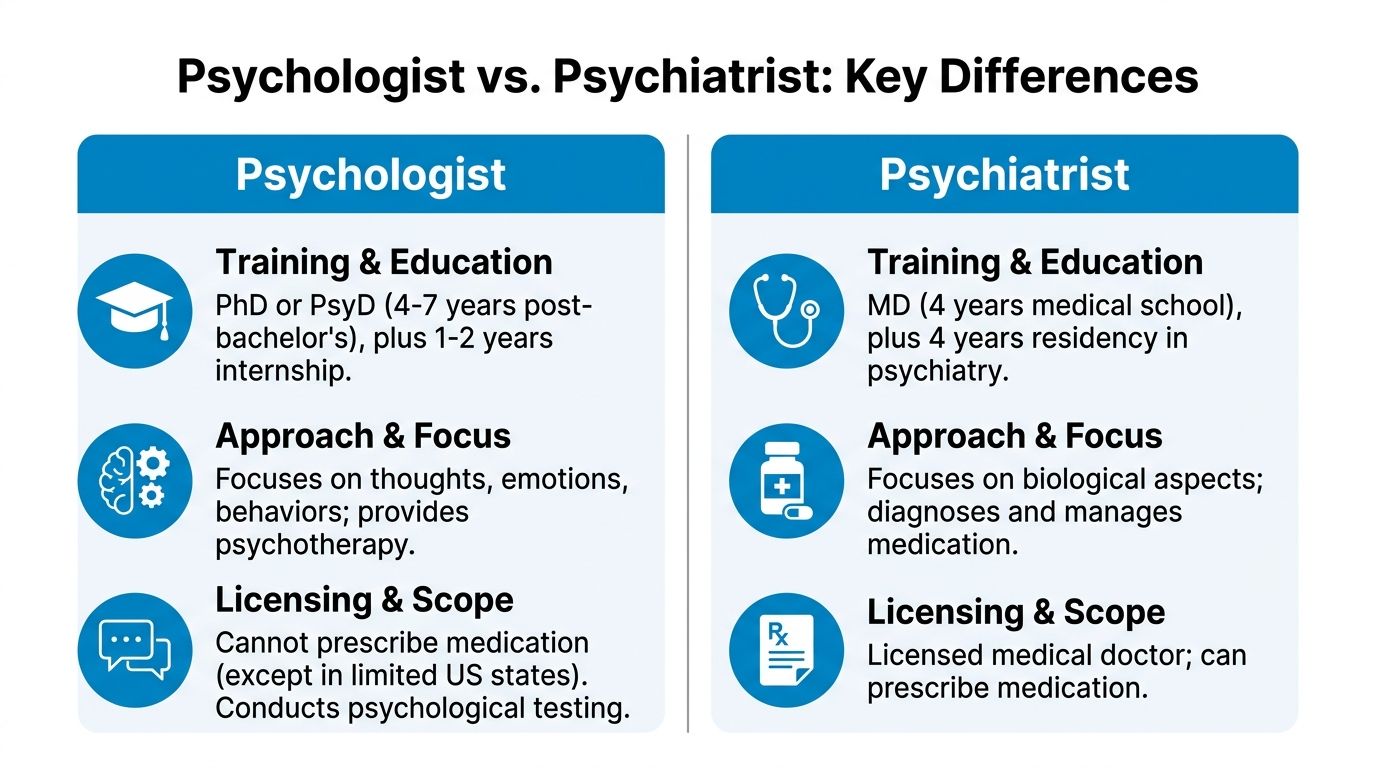
A useful analogy helps here.
Think of mental health care like a computer system.
- The psychiatrist is trained to assess the hardware and operating system. They look at medical factors, symptom severity, biological vulnerability, and whether medication might help stabilise the system.
- The psychologist works more on the software. They help you understand patterns, beliefs, emotional habits, relationship dynamics, coping styles, and the meaning of what you are experiencing.
Both are serious professionals. They just intervene from different starting points.
Different philosophy, not different value
A psychologist usually asks questions such as:
- When did this pattern begin?
- What happens in your thoughts just before the panic rises?
- What role do work, loneliness, or cultural adjustment play?
- How do you relate to yourself when you are under pressure?
A psychiatrist is more likely to explore:
- How severe are the symptoms?
- Is your sleep disrupted in a medically significant way?
- Have there been periods of extreme mood change?
- Is medication indicated, safe, and proportionate?
Neither lens is “better”. Each is suited to a different task.
Psychologist vs psychiatrist is not a status comparison. It is a role comparison.
Why psychologists are often the first stop for expats
Many expats do not begin with a medication question. They begin with a life question.
They may be struggling with homesickness, culture shock, anxiety, loneliness, identity shifts, work stress, or a relationship under pressure. Those concerns often respond well to psychotherapy because therapy gives space for reflection, coping tools, and emotional processing.
That is one reason psychologists are more numerous in Italy.
If you are comparing service models in digital care settings, some clinics explain how they organise psychotherapy services and triage people to the right professional. The principle matters more than the platform name. Good care starts with a good match.
One more title that matters in Italy
You may also come across the word psychotherapist. In Italy, that title has a specific meaning. A psychotherapist is a psychologist or doctor with additional specialised psychotherapy training. I will return to that in the FAQ, because it is one of the most common points of confusion for internationals.
What to Expect From Your First Appointment
The first appointment often creates more anxiety than the treatment itself.
People worry they will say the wrong thing, be judged, receive a label too quickly, or leave more confused than when they arrived. In practice, a good first session is not an exam. It is a structured conversation designed to understand what is happening and what kind of help fits best.

A first appointment with a psychiatrist
A psychiatric first appointment often feels closer to a specialist medical consultation.
The psychiatrist will usually ask about current symptoms in a direct, organised way. They may explore sleep, appetite, concentration, anxiety, mood changes, panic, substance use, past treatment, family history, physical health, and any medication you already take.
The aim is to build a diagnostic picture and assess risk, severity, and urgency.
A psychiatrist may also want to understand whether there are signs that point to conditions requiring medical management, such as severe depression, bipolar features, psychosis, or disabling anxiety. If medication is discussed, that conversation should include what the medicine is for, possible benefits, side effects, and follow-up.
The tone is often focused and efficient. That does not mean cold. It means the psychiatrist is trained to make clinical decisions that include medical responsibility.
A first appointment with a psychologist
A first meeting with a psychologist usually feels more relational.
You may be asked what brought you in now, what has been hardest recently, what you have already tried, and what patterns you have noticed in yourself. The conversation often includes your background, relationships, stressors, habits, and emotional history.
The purpose is not only to identify symptoms. It is also to understand context.
A psychologist listens for themes such as perfectionism, grief, people-pleasing, self-criticism, unresolved conflict, cultural displacement, or burnout. They are often assessing how your inner world works, not just which symptom list fits.
Your first therapy session does not require a polished explanation. “I do not feel like myself lately” is enough to begin.
How to prepare without overthinking it
You do not need a perfect summary, but a few notes can help:
- Write your main concerns: anxiety, low mood, panic, insomnia, relationship conflict, intrusive thoughts, burnout.
- Notice timing: when it started, whether it is getting worse, and what seems to trigger it.
- List current medication: include anything prescribed for sleep, mood, or anxiety.
- Mention previous help: therapy, counselling, psychiatric care, or hospital support.
- Say what you want: coping skills, clarity, diagnosis, medication review, better functioning.
If you are nervous about the therapy format itself, this guide to a first session can reduce uncertainty: https://therapsy.it/first-psychological-session/
A practical difference in feel
People often leave a psychologist’s first session feeling understood. They often leave a psychiatrist’s first session feeling clearer about clinical options. Neither reaction is superior.
One gives you a map of your emotional patterns. The other helps determine whether a medical intervention should be part of the plan.
Key Conditions and When to Choose One Over the Other
Many readers do not need a theoretical answer to psychologist vs psychiatrist. They need a practical one.
If you are living abroad and under pressure, your question is usually more direct: who should I book first for what I am dealing with?

When a psychologist is usually the better starting point
A psychologist is often the right first contact when the core problem involves stress, emotional patterns, adjustment, relationships, or coping.
Common examples include:
- Culture shock and homesickness: You may feel detached, irritable, lonely, or unsure where you belong.
- Anxiety: Worry, overthinking, panic, social anxiety, exam stress, or fear of failure.
- Burnout: Emotional exhaustion, dread before work, numbness, loss of motivation.
- Relationship strain: Conflict in intercultural couples, communication breakdown, jealousy, or emotional distance.
- Low mood linked to life circumstances: Isolation, transitions, grief, or identity stress.
- OCD-related thoughts or behaviours: Especially when you need structured psychotherapy as part of care.
- Personality patterns: Repeated relational difficulties, intense self-criticism, emotional instability, or boundary issues.
In these situations, therapy helps because it does more than reduce symptoms. It helps you understand why the symptom is there, what maintains it, and how to respond differently.
What Italian practice patterns show
In Lombardia in 2023, 42% of mental health consultations involved psychologists for mild-to-moderate issues, especially anxiety (40% of cases) and depression (35%). Psychiatrists handled 58% of cases, mainly more severe presentations such as psychosis (22%) and bipolar disorder (15%). This reflects the community-care model that expanded after Italy’s 1978 Mental Health Law, which increased psychologists’ role in everyday mental health support (historical review on PubMed).
This pattern mirrors what many expats experience in real life. If your distress is real but you are still able to reflect, talk, and function with effort, psychotherapy is often a strong first move.
When a psychiatrist should be considered sooner
A psychiatrist becomes especially important when symptoms suggest a stronger biological or safety-related component.
Consider psychiatric assessment sooner if there is:
- Severe depression: especially with marked slowing, inability to function, or hopelessness
- Possible bipolar symptoms: periods of unusually elevated mood, decreased need for sleep, impulsive behaviour, or racing thoughts
- Psychotic symptoms: hearing voices, fixed false beliefs, major confusion, or strong disconnection from reality
- Medication questions: past psychiatric medication, side effects, or concern that medication may now be needed
- Rapid deterioration: symptoms escalating quickly over days or weeks
- High risk: suicidal thoughts, inability to care for yourself, or major safety concerns
These are not signs of failure. They are signs that medical expertise may need to be part of care.
If your symptoms feel frightening, extreme, or difficult to control, start with safety and clinical assessment. Reflection can come after stability.
A few common expat examples
A student in Turin who cannot stop checking, washing, and mentally reviewing social interactions may benefit from a psychologist skilled in OCD treatment, with psychiatric input if symptoms are intense.
A young professional in Milan who feels detached, cries often, and cannot sleep after a painful relocation may do well starting with a psychologist.
A person whose mood swings suddenly include days of almost no sleep, racing ideas, and risky decisions should not rely on therapy alone at first. That picture needs psychiatric assessment.
For a simple, accessible explanation from a clinician-facing perspective, this short video can help clarify the two roles:
If you are still unsure
Book the professional who matches the most urgent part of the problem.
If the urgent part is understanding yourself, improving coping, or working through stress, start with a psychologist.
If the urgent part is severe symptoms, safety, or whether medication is needed, start with a psychiatrist.
If both feel true, coordinated care may be the best answer.
The Power of Integrated Care When You Need Both
Some mental health difficulties do not fit neatly into a single lane.
A person may need therapy to understand trauma, perfectionism, or relationship patterns, while also needing medication to reduce disabling panic, stabilise mood, or create enough mental space to function. In those cases, psychologist vs psychiatrist becomes the wrong question. The better question is whether both should be involved.
Why combined care can work so well
Therapy and medication do different jobs.
Medication can reduce the intensity of symptoms. That can mean fewer panic attacks, more stable sleep, less agitation, or a more manageable depressive state. Psychotherapy then uses that stability well. It helps the person process, reflect, practise new responses, and change longer-term patterns.
One approach creates room. The other uses that room.

Where integrated care is especially useful
A combined model often helps when someone is dealing with:
- OCD that is severe or consuming
- Burnout with marked collapse in functioning
- Depression that makes therapy hard to engage with
- Complex anxiety with sleep disruption and physical symptoms
- Mood instability that needs close monitoring
- A history of stopping therapy because symptoms felt overwhelming
Recent European research including Italian patients reported that a combined psychologist-psychiatrist team approach yielded significantly better outcomes for complex conditions such as OCD and severe burnout. The same verified data also notes that this integrated model is not yet standard, and psychiatrist shortages in major Italian cities make coordinated access more valuable.
The Italian access problem
Even when integrated care is clinically sensible, it can be logistically messy.
You may find a therapist who does not know a psychiatrist with availability. You may find a psychiatrist but struggle to arrange psychotherapy in your language. You may end up carrying updates between two separate providers while already exhausted.
That fragmentation is difficult for anyone. It is even harder when you are living abroad.
If you need psychiatric support in a more coordinated way, this page on https://therapsy.it/psychiatrists/ shows what an integrated route can look like in practice.
The best mental healthcare often feels less dramatic than people expect. It feels organised, connected, and easier to continue.
A mature way to think about treatment
Some people resist medication because they fear it means therapy has failed. Others want medication to solve everything because reflection feels tiring. Both reactions are understandable, but both can become limiting.
Good care is not ideological. It is responsive.
A skilled clinician asks what will help this person, at this moment, in this context. Sometimes that answer is weekly psychotherapy. Sometimes it is psychiatric review. Sometimes it is both, working together with clear roles.
Navigating Costs and Insurance for Mental Health in Italy
Once you understand psychologist vs psychiatrist, the next concern is usually financial.
Expats often ask three questions right away. Will the public system help? How much does private care cost? Will my insurance reimburse anything?
Public and private pathways
Italy has a public system, the Servizio Sanitario Nazionale (SSN), and a large private sector.
Public care can be valuable, especially if you qualify for access and can manage the local process. But for many internationals, it comes with practical obstacles such as waiting times, referral steps, language mismatch, and limited flexibility around provider choice.
Private care is usually faster and easier to arrange. It also gives you more control over language, therapeutic style, and appointment format.
What to expect on cost
Costs vary by city, provider background, and type of appointment.
One concrete benchmark from the publisher information is that therapy through Therapsy starts from €70 per session. Psychiatric consultations in private settings are generally structured differently from therapy and may involve an initial assessment followed by shorter medication reviews, but exact market-wide ranges should be checked directly with the provider because pricing varies.
If transparent pricing matters to you, this page offers a clear starting point: https://therapsy.it/pricing/
Insurance questions to ask before you book
International insurance can be helpful, but coverage rules differ widely. Some plans reimburse psychotherapy only if the therapist holds a specific licence type. Others cover psychiatry more easily because it is classified as specialist medical care. Some require a GP referral. Some only reimburse after you pay upfront.
Before booking, ask your insurer:
- Do you cover psychotherapy in Italy?
- Do you cover psychiatric consultations?
- Do I need a referral or prior authorisation?
- Is online therapy covered?
- What documents or invoices do you require for reimbursement?
- Do you reimburse only in-network providers, or also out-of-network care?
If you are comparing policies, this overview of what expat medical insurance covers is a useful starting point for understanding the kinds of benefits and exclusions people commonly need to check.
One practical reality for expats
The lowest-stress option is often not the cheapest option on paper. It is the option you can access, understand, and continue.
For many internationals, predictable private care in a familiar language is worth the clarity. Mental health support works best when the process itself does not become another source of stress.
Find Your Match with Multilingual Support from Therapsy
Choosing between a psychologist and a psychiatrist is hard enough in your home country. Doing it in Italy, possibly in your second or third language, while already anxious or low, is much harder.
That is where thoughtful matching matters.
Therapsy is built for people who do not want to decode the system alone. It offers multilingual support, carefully selected licensed psychologists and psychotherapists, and the option of online or in-person sessions across Italy. For clients who need medical input, integrated psychiatric consultations are also available, so care can stay connected rather than fragmented.
This matters for expats because symptoms do not happen in a vacuum. Anxiety may be tied to relocation. Relationship conflict may be shaped by culture and language. Burnout may be happening in a foreign workplace where you already feel under pressure. Being matched with a clinician who understands that wider context can change how safe and understood you feel from the first conversation.
A particularly valuable part of the process is that you do not have to solve the psychologist vs psychiatrist decision alone at the start. The service begins with a free first assessment call and a human conversation that helps identify what kind of support fits best.
If you want to see how multilingual psychotherapy works for internationals living in Italy, start here: https://therapsy.it/multilingual-psychotherapy-for-expats-in-italy/
The best first step is often not certainty. It is contact.
Frequently Asked Questions
Can a psychologist diagnose mental health conditions in Italy
Yes. A psychologist can assess and diagnose psychological conditions within their professional scope. A psychiatrist can also diagnose, with the added perspective of medical training and medication management.
Can a psychologist prescribe medication in Italy
No. In Italy, psychologists do not prescribe medication. If medication may be useful, you need a psychiatrist or another appropriately authorised medical professional.
Do I need a referral to see a psychologist or psychiatrist
It depends on whether you use the public or private route. In the private sector, you can often book directly. In the public system, referral steps may apply depending on the local service.
What is a psychotherapist in Italy
This is an important local distinction. In Italy, a psychotherapist is a psychologist or a medical doctor who has completed four additional years of specialised psychotherapy training. That means not every psychologist is automatically a psychotherapist, but every psychotherapist has extra postgraduate training in how to conduct therapy.
Should I choose a psychologist or psychiatrist for anxiety
If anxiety is mild to moderate and you want coping strategies, emotional insight, and structured therapy, a psychologist is often the best first step. If anxiety is severe, disabling, or raises questions about medication, psychiatric input may also be needed.
Can I see both at the same time
Yes, and for some people that is the most effective route. Therapy can address patterns, triggers, and coping, while psychiatry can help with medical assessment and medication when appropriate.
If you are living in Italy and still unsure where to start, THERAPSY offers a compassionate, multilingual way forward. You can speak with a real person, discuss what has been happening, and be matched with the right licensed professional for your needs, whether that is psychotherapy, psychiatric support, or coordinated care. Book your first free assessment call.
LinkedIn post in English:
Living in Italy and unsure whether you need a psychologist or a psychiatrist?
This guide explains the difference in plain language, with a specific focus on the Italian system for expats and international students.
Inside:
• what each professional is trained to do
• when therapy is the right first step
• when medication support may matter
• what first appointments feel like
• how costs and insurance usually work in Italy
• why integrated care can be the best option for more complex situations
If you have been delaying support because the system feels confusing, this article is for you.
Read it, save it, and share it with someone who may need clarity.
Book your first free assessment call at THERAPSY.