You say yes when you mean maybe. You smile through irritation at work, with in-laws, with new friends, with the school office, with the landlord, with the colleague who assumes you'll help. By evening, you're drained, slightly resentful, and confused by how hard it feels to ask for something simple.
For many American women living in Italy, this pattern becomes sharper after relocation. A new country can make everyday life feel higher stakes. Language gaps, unfamiliar social rules, bureaucracy, and distance from your usual support network can all push you towards over-accommodating. What looks from the outside like “being easy-going” often feels from the inside like constant self-abandonment.
People pleasing therapy for women is therapy that helps you understand why you automatically prioritise other people's comfort over your own needs, then build practical skills to respond differently. It isn't about becoming cold, selfish, or less caring. It's about becoming more honest, more boundaried, and more stable in yourself.
In my clinical work with expat women in Italy, I often see people-pleasing arrive wearing other labels first: anxiety, perfectionism, burnout, relationship stress, guilt, or the sense of “losing myself”. Sometimes the woman knows exactly what the problem is. Sometimes she only knows that she's exhausted from trying to be agreeable all the time.
Italy can be beautiful and demanding at once. People-pleasing often overlaps with perfectionistic coping, which is why many women recognise themselves in this guide to perfectionism in psychotherapy.
Introduction The Pressure to Be Perfect in Italy
When niceness stops feeling like a choice
Healthy kindness feels voluntary. People-pleasing doesn't.
When you're people-pleasing, your yes often comes from tension, not generosity. You may agree quickly to avoid disappointing someone, upsetting someone, or looking difficult. Afterwards, you pay for that “yes” with resentment, anxiety, overthinking, or emotional numbness.
A useful clinical distinction is this: kindness is offered freely, while people-pleasing is usually driven by fear.
For expat women, that fear often becomes intertwined with adaptation. You may want to be respectful of your partner's family, easy to work with in an international office, grateful for opportunities, and appreciative of life in Italy. Those are understandable wishes. But when they turn into a rule that says, “I must never inconvenience anyone,” your inner life starts shrinking.
Why this deserves real support
People-pleasing is often minimised because it can look socially acceptable. Reliable. Helpful. Pleasant. But the emotional cost is real.
Over time, women often describe:
- Chronic self-silencing when they want to disagree
- Difficulty identifying needs because they're scanning others first
- Guilt after setting limits even when the limit is reasonable
- A split between outer competence and inner exhaustion
This is exactly why people pleasing therapy for women matters. It names a pattern that many high-functioning women have normalised for years. It also offers a route out that is practical, respectful, and grounded in evidence-based work.
What People-Pleasing Really Means
People-pleasing is a learned pattern of prioritising approval, harmony, or other people's reactions over your own needs, limits, and authentic preferences.
That's different from being warm or cooperative. A woman can be generous, relational, and emotionally intelligent without automatically abandoning herself. The problem starts when pleasing becomes a strategy for safety, worth, or belonging.
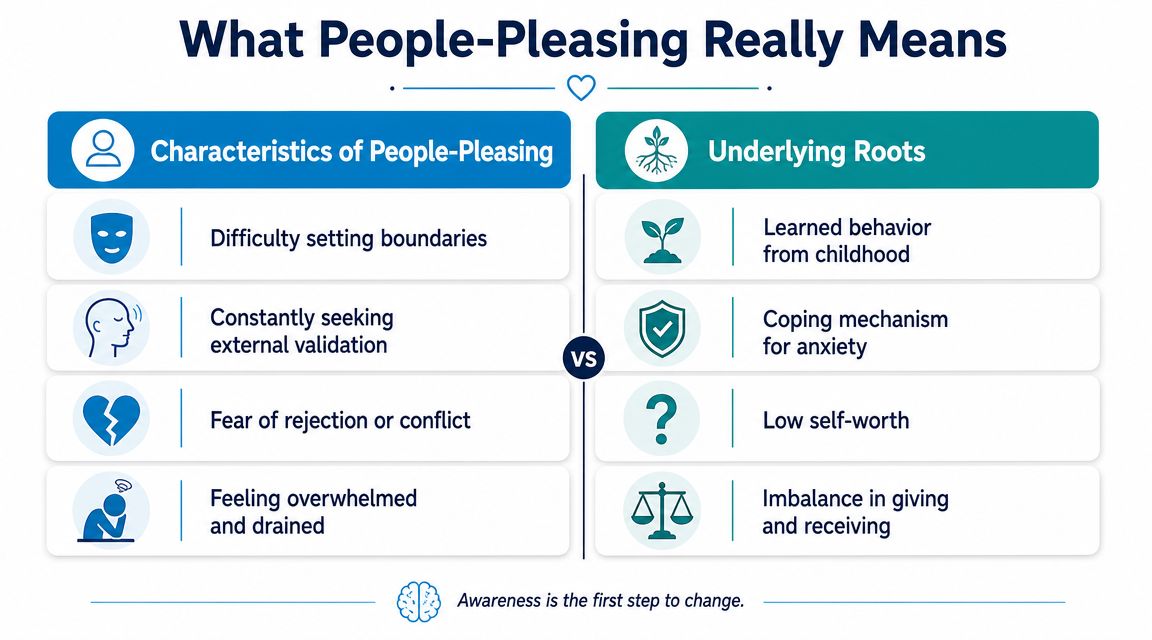
Kindness versus people-pleasing
This distinction helps many women immediately.
| Pattern | What it feels like inside |
|---|---|
| Genuine kindness | “I want to do this, and I can choose it freely.” |
| People-pleasing | “I feel like I have to do this, or something bad will happen.” |
A few common markers make the difference clearer:
- Kindness includes choice. You can help and still say no sometimes.
- People-pleasing includes fear. You anticipate rejection, criticism, tension, or withdrawal.
- Kindness respects limits. You don't have to betray your own body or schedule.
- People-pleasing erases limits.
Signs that the pattern is active
People-pleasing doesn't always look dramatic. Often it shows up in small, repeated moments.
You might notice:
- Over-apologising for normal needs, delays, or preferences
- Immediate yeses before you've checked what you want
- Over-explaining a boundary because a simple no feels too risky
- Feeling responsible for someone else's disappointment, mood, or anger
- Conflict avoidance even when something matters to you
- A strong need for reassurance that you're still liked
These patterns matter clinically because they affect mental health, not just social style. A PMC-hosted study on people-pleasing and mental well-being reported that higher people-pleasing tendencies were significantly associated with lower levels of mental well-being, with stronger thought patterns and emotional responses linked to greater psychological distress.
If your relationships look smooth from the outside but your nervous system is constantly braced on the inside, that isn't “just your personality”.
What people-pleasing is not
It isn't proof that you're weak. It isn't evidence that you're fake. It isn't a sign that you're “too nice”.
More often, it's a behavioural pattern with understandable roots. Therapy works best when it treats that pattern as something you can observe, understand, and gradually change. That shift alone tends to reduce shame.
Why People-Pleasing Affects Women and Expats in Italy
Why women often carry this pattern
Many women are taught early that being liked is important, and that being difficult is dangerous. Even in very modern environments, girls often receive strong messages about being accommodating, emotionally responsible, helpful, and self-controlled.
That conditioning doesn't affect every woman in the same way, but the pattern is widespread enough to show up clearly in survey data.
That gap matters in therapy. It tells us that many women aren't dealing with a rare personal flaw. They're dealing with a pattern that is socially reinforced, frequently rewarded, and often invisible until it becomes exhausting.
Why relocation can intensify it
Expat life adds another layer. When you move countries, you lose some of the cues that usually help you feel grounded and competent. You may not know the unwritten rules. You may depend more on your partner, employer, or local contacts. You may feel that making a mistake carries more social cost because you're already the outsider.
For American women in Italy, this can create a very specific pressure: be appreciative, adaptable, culturally sensitive, and pleasant at all times. If you're already prone to approval-seeking, relocation can amplify it.
Common expat triggers include:
- Language vulnerability when you can't express nuance quickly
- Bureaucratic dependence on others for translation or guidance
- Relationship imbalance if one partner knows the system better
- Identity disruption if your professional confidence has dropped
- Isolation when old friendships and family support are far away
Some women prepare carefully with practical resources such as a guide for relocating to a new country, which can reduce stress around logistics. But emotional adaptation is different from practical planning. You can be highly organised and still feel inwardly desperate to be accepted.
The expat version of people-pleasing
Expat people-pleasing often sounds like this:
- “I don't want to seem like the rude American.”
- “I should be grateful, so I shouldn't complain.”
- “My partner already does so much, so I shouldn't ask for more.”
- “If I set a boundary, people might think I'm unkind or difficult.”
This is one reason many women resonate with the experience of losing myself as an expat. The problem isn't only adjustment. It's the gradual habit of editing yourself to preserve connection.
The Hidden Link Between People-Pleasing and Trauma
Many women understand people-pleasing as anxiety or low self-esteem. Sometimes that's true. But in clinical work, another layer is often present. The pattern can be trauma-linked.
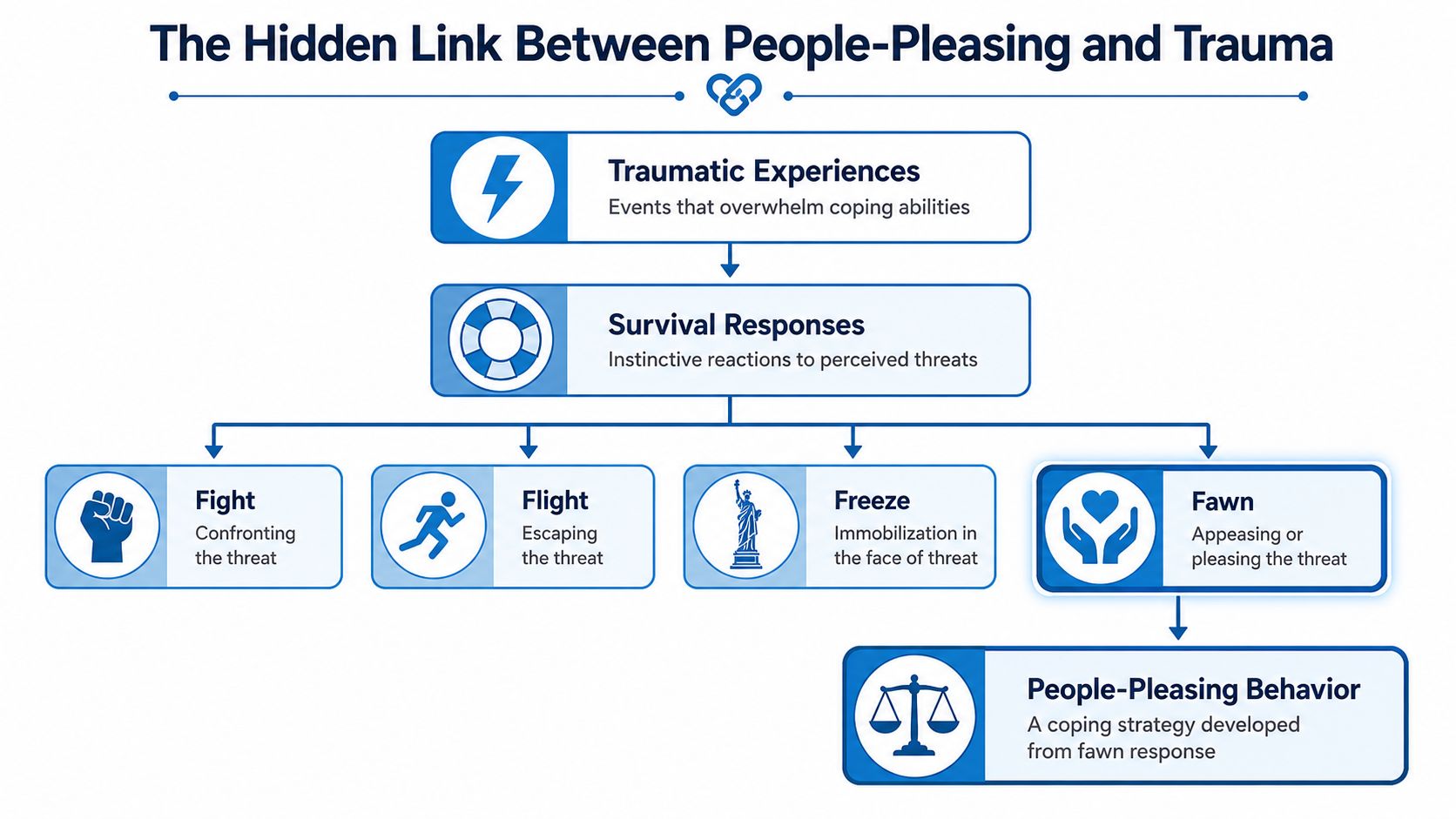
Understanding the fawn response
Many are familiar with fight, flight, and freeze. Fawn is less widely understood.
Fawn is a survival response in which a person tries to stay safe by appeasing, adapting to, or managing the other person. Instead of confronting danger, escaping it, or shutting down, the nervous system learns to reduce threat through compliance and connection.
A trauma-informed perspective changes the question completely. Instead of asking, “Why can't I just stop doing this?” a more compassionate question is, “What did I learn was necessary to stay safe in relationships?”
A clinical discussion of therapy for people-pleasers and the fawn response notes that many women seeking help for people-pleasing are dealing with trauma-linked fawn patterns. The guidance emphasises noticing automatic approval-seeking and building regulation skills, rather than only rehearsing assertive scripts.
People-pleasing can be a nervous system strategy before it becomes a conscious habit.
How this develops
The original environment doesn't have to look dramatic from the outside. Sometimes women with fawn patterns grew up in homes where anger felt unpredictable, love felt conditional, or conflict carried emotional risk. Sometimes the shaping experiences happened later, in controlling relationships, repeated invalidation, or prolonged stress.
The nervous system takes notes. It learns:
- Stay agreeable
- Don't need too much
- Keep the peace
- Scan quickly for mood changes
- Make yourself useful
Those strategies may once have helped. But what protects you in one chapter can trap you in the next.
Why this matters in therapy
If your people-pleasing is linked to a fawn response, insight alone usually isn't enough. You may understand perfectly well that you're allowed to say no, but your body still reacts as if a boundary is dangerous.
That's why treatment often needs to include both psychological and bodily work:
- noticing the trigger
- slowing the automatic yes
- naming the fear underneath
- learning to regulate the discomfort that follows self-assertion
Women looking for this kind of support often benefit from a therapist with trauma training, especially when the pattern is rigid, shame-based, or tied to earlier relational pain. That's the kind of work described in support for an English-speaking trauma therapist in Italy.
Therapeutic Approaches That Help You Reclaim Your Voice
Effective people pleasing therapy for women doesn't focus on becoming less caring. It focuses on becoming more grounded, more honest, and more able to tolerate other people's reactions.

A consistent theme across clinical guidance is that treatment is skill-based. A clinical overview of stopping people-pleasing behaviours describes effective treatment as building measurable skills such as assertiveness and boundary-setting, with structured approaches including CBT and Schema Therapy.
CBT for compliant thought patterns
Cognitive Behavioural Therapy helps identify the thoughts that rush in before you over-accommodate.
These often sound like:
- “If I say no, they'll think I'm selfish.”
- “If someone is upset, I must have done something wrong.”
- “It's easier if I just handle it.”
CBT helps you test those thoughts rather than obey them. That doesn't mean replacing them with fake positivity. It means developing more accurate, flexible thinking. If you want a clear overview of the method, this guide to Cognitive Behavioural Therapy explains the model well.
Schema Therapy for deeper life patterns
Schema Therapy becomes especially useful when people-pleasing feels old, intense, and automatic. A schema is a deep pattern about yourself, other people, and relationships.
Women with strong people-pleasing tendencies often carry schemas linked to self-sacrifice, approval-seeking, defectiveness, or subjugation. In plain language, that means they may feel responsible for others, overly dependent on praise, flawed, or unsafe when asserting themselves.
This work goes deeper than “just set boundaries”. It asks: what story does your mind tell about what will happen if you stop adapting?
Trauma-informed work and EMDR
When the fawn response is active, therapy often needs to help the body learn safety as well as the mind. Trauma-informed care pays attention to signs of activation, shutdown, and relational threat. EMDR can be helpful when present-day compliance is linked to earlier experiences that still carry emotional charge.
A woman may know, rationally, that her boss's disappointment isn't dangerous. But if her body reacts as though tension means danger, she'll keep abandoning herself under pressure. Trauma work helps reduce that mismatch.
Some women also notice this conflict symbolically. They dream of trying to speak and not being able to, or of needing to shout and feeling blocked.
Approaches that support action in daily life
Different therapies target different layers of the same problem:
| Approach | What it helps with |
|---|---|
| CBT | Unhelpful beliefs and automatic compliant thinking |
| Schema Therapy | Longstanding relational patterns and self-worth issues |
| Trauma-informed therapy | Nervous system safety and fawn responses |
| EMDR | Disturbing earlier experiences that still drive present reactions |
| Values-based work | Choosing actions based on who you are, not who you fear upsetting |
The best approach depends less on the label and more on the function of the pattern. If pleasing is mainly habit, skills work may help quickly. If pleasing is tied to trauma, therapy must move more carefully.
What to Expect From People-Pleasing Therapy Sessions
Many women feel relief when therapy becomes concrete. The process is usually less mysterious than they expect.
What the work is aiming for
The goal isn't to make you harder. The goal is to help you become clearer.
In practice, people pleasing therapy for women often aims to help you:
- recognise when fear, not choice, is driving your response
- separate empathy from over-responsibility
- tolerate guilt without treating guilt as proof you're wrong
- communicate wants and limits more directly
- build self-worth that doesn't depend entirely on approval
This is why a nuanced therapeutic approach treats people-pleasing as a context-dependent boundary difficulty. A clinical article on the psychology of people-pleasing recommends starting small, stalling before saying yes, and practising boundaries in low-stakes situations.
What happens in session
Sessions often begin by slowing down a recent moment.
For example:
- You agreed to host when you were already exhausted.
- You took on extra work because you feared looking uncooperative.
- You reassured your partner for an hour instead of saying you were hurt.
A therapist may help you unpack that moment in layers:
Trigger
What happened externally?Automatic meaning
What did your mind instantly tell you?Body response
Did you tense, go blank, speed up, smile automatically?Protective action
Did you appease, explain, withdraw, or overfunction?After-effect
Resentment, shame, fatigue, self-criticism, anxiety
That sequence matters. It turns a vague habit into something observable.
What practice between sessions can look like
Progress usually comes from repeated small experiments, not one brave confrontation. Between sessions, you might practise:
- Buying time by saying, “Let me check and get back to you.”
- Delaying the automatic yes for even a few minutes
- Naming preferences in low-risk situations, such as choosing the restaurant
- Letting someone feel mild disappointment without rushing to fix it
- Writing down resentments to identify where your boundaries are already being crossed
- Tracking body cues that signal fawn, such as smiling while tense or speaking too quickly
Practical rule: start where the nervous system can succeed. A tiny boundary you can hold is more useful than a dramatic boundary that leaves you flooded.
Therapy often includes role-play as well. This can feel awkward at first, but it's effective. Practising a sentence aloud helps your body experience a different ending. You're not only learning what to say. You're learning that saying it is survivable.
How to Find the Right Therapist in Italy as an Expat Woman
Finding a therapist in Italy involves more than checking whether someone speaks English. For many American women, the most helpful fit is a therapist who understands expat stress, intercultural relationships, and the emotional meaning of adaptation.
What to look for
A strong fit often includes these elements:
- Licensed professional background with clear therapeutic training
- Experience with anxiety, trauma, boundaries, and self-worth
- Sensitivity to cross-cultural dynamics rather than generic advice
- Ability to work in your preferred language when emotions become complex
- A style that feels both warm and structured
If people-pleasing is linked to deeper trauma, look for someone who can recognise nervous system responses, not only communication habits. If your pattern shows up mainly in work or relationships, a therapist with strong CBT or Schema Therapy skills may be especially useful.
Why language matters more than many people expect
You may function very well in Italian at work or in daily life and still need therapy in English. That's common.
Women often discover that anger, grief, shame, and childhood material are harder to access in a second language. Therapy works best when you don't have to translate your inner life before you can speak it.
This is also why many expats benefit from guidance on finding the right therapist for expats in Italy. The practical fit matters. The relational fit matters more.
A sensible next step
If you've recognised yourself in this article, you don't need to wait until the pattern becomes unbearable. Support is often most effective when you're still functional enough to notice the problem, even if you're tired of carrying it alone.
Dr. Francesca Adriana Boccalari is Clinical Director at Therapsy, a trusted multilingual psychotherapy service in Italy. She works from an expat mental health and intercultural psychology perspective, with training in CBT, Schema Therapy, and EMDR, and experience supporting international women navigating life in Italy. Therapsy offers therapy in 14 languages, with online and in-person sessions across 24 Italian cities and 90+ physical locations, delivered by carefully selected licensed professionals and matched through a human process led by the Clinical Director. The first assessment call is free, with individual therapy from €70/session.
Who works with self-criticism at Therapsy
A great many people arrive at therapy already excellent at criticising themselves. Standard techniques can quietly become one more measure to fail. These clinicians work differently.
Dr. Marianna De Simone integrates CBT with Compassion-Focused Therapy, which is built for exactly this: it treats the self-attack as the problem to be worked on, not as motivation to be harnessed. She also aims to be reachable between sessions, which matters when your support network is in another country.
Dr. Benedetta Cereda works with anxiety that comes with change and with couples, in Milan, in English and Italian, in a cognitive constructivist frame.
Dr. Marisa Gennari works with adolescents and adults in a relational and psychodynamic frame, on the personal meaning behind a difficulty rather than the label attached to it, in a space built to be non-judgemental.
You do not have to work out who fits on your own. You tell Therapsy what you are looking for, a member of our clinical team reads your request, and they introduce you. The first call is free.
FAQ
| Question | Answer |
|---|---|
| Will therapy make me selfish? | No. Therapy helps you become more honest and boundaried, not less caring. |
| Can self-help be enough? | Sometimes it helps, but persistent patterns usually change faster with structured support. |
| What if my people-pleasing is trauma-related? | Trauma-informed therapy can address the nervous system pattern beneath the behaviour. |
| Do I need therapy in English? | If English is your emotional language, it often allows deeper and clearer work. |
| Is online therapy effective for expats in Italy? | Yes, especially when geography, travel, or limited local options make consistency harder. |
Frequently Asked Questions
Can people pleasing therapy for women help if I'm high-functioning?
Yes. High-functioning women often hide this pattern well, which can make it harder to recognise and easier to minimise. Therapy helps even when you're outwardly competent, because the issue is usually the internal cost.
Will I become rude or uncaring if I stop people-pleasing?
No. The goal is not to remove empathy. The goal is to add self-respect, choice, and honesty so your care for others doesn't require abandoning yourself.
How long does it take to change this pattern?
It varies. Some women feel early relief once they understand the pattern and begin practising small boundaries, while deeper trauma-linked or schema-driven patterns usually need more sustained work.
Is people-pleasing always caused by trauma?
No. Sometimes it grows mainly from social conditioning, family roles, anxiety, or perfectionism. But for some women, trauma and the fawn response are a central part of the picture, and therapy should take that seriously.
Can I work on this if my partner or workplace is part of the problem?
Yes. Therapy can help you understand your part in the pattern without blaming you for difficult environments. It also helps you decide where to set limits, what to communicate directly, and what kind of support you need.
Is therapy in Italy available online and in person?
Yes. Many expat women choose online therapy for convenience, privacy, and continuity, while others prefer in-person sessions. The best format is the one that helps you stay consistent.
If you're tired of being the person who copes by over-accommodating, support is available. Book your first free assessment call with THERAPSY, no commitment, just a conversation with our Clinical Director who will listen carefully and match you with the right therapist for you.