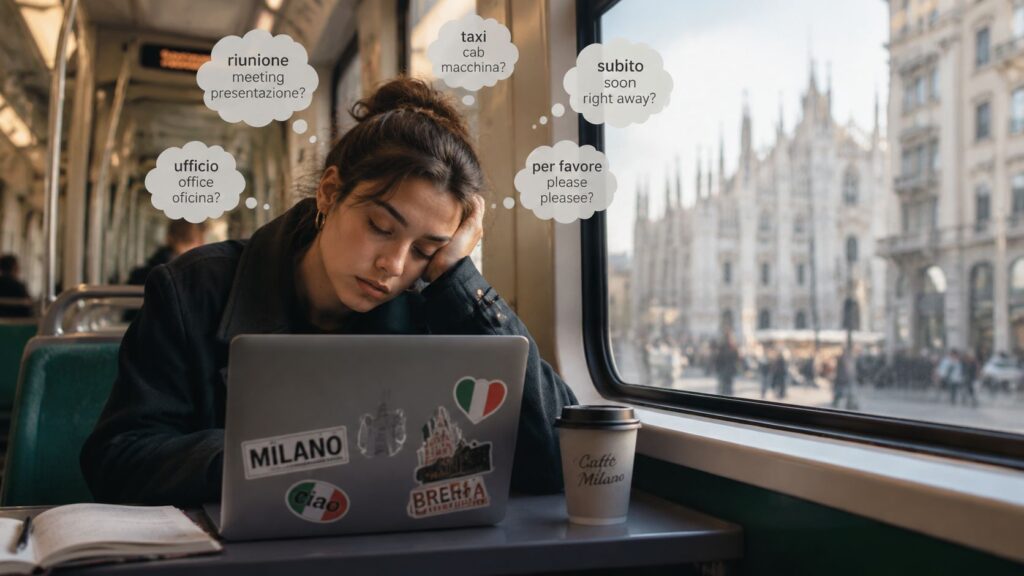
Quick answer: Multilingual psychotherapy means the language of the session is a clinical decision, not a convenience. For most bilingual people the first language carries the memory and the feeling while the second carries the composure, so what you can say changes with the language you say it in. A therapist who works across languages uses that difference deliberately instead of ignoring it.
Therapsy is a multilingual psychotherapy service in Italy that connects expats, international students and Italians with licensed therapists in their own language, online across the country and in person in 24 Italian cities.
Key takeaways
- Fluency is not the criterion. The question is which language your emotions are stored in, not which one you work in.
- Clinical literature has described “language independence” in bilingual patients: material can be accessible in one language and not in the other.
- Naming a feeling in a foreign language appears to work less well, which matters because naming is a large part of what therapy does.
- The second language is not always the wrong choice: its emotional distance is occasionally the reason someone can approach a memory at all.
- Switching language mid-session is a recognised technique, not a failure of the frame.
- Therapsy works in 14 languages, with a free first conversation and a reply within 12 hours.
Why does the language of the session matter clinically?
What is language independence?
The idea that a bilingual person can hold material in one language that is not equally reachable in the other. It is not new: the clinical literature described strategies and risks in psychotherapy with bilingual patients and the phenomenon of language independence decades ago. In practice it means a client can describe a childhood scene fluently in English and find that it carries nothing, then say three words of it in their first language and be unable to continue.
What does the research say about naming feelings?
That the second language dampens it. A study found that foreign language processing undermines affect labeling. Since putting a feeling into words is one of the basic operations of therapy, a session run in a language where that operation works less well is doing the same work with a handicap.
So is the second language always worse?
No, and this is the part that gets flattened. The distance a second language creates is sometimes exactly what allows someone to approach material they cannot touch in their own. Clinicians have written about psychiatric evaluation and psychotherapy in the patient’s second language as a situation with its own risks and uses, not simply a deficit.
How is the language used in the work?
Switching on purpose
Moving between languages inside a session is a described technique: language switching has been discussed as a treatment strategy with bilingual patients. A therapist might ask you to say the same sentence in your other language and notice what changes, or let you leave a phrase untranslated because the translation loses it.
The words that have no equivalent
Every language has emotional concepts the other does not carry cleanly. Forcing a translation converts a precise feeling into an approximate one, and the session then works on the approximation. A multilingual therapist lets the word stand and works with it.
What the therapist is listening for
Where the fluency drops. People slow down, simplify, or switch language exactly at the point that matters, and that shift is information. In a monolingual session that signal does not exist.
What if you and your partner have different first languages?
Then the working language of couple sessions is a decision with consequences, because the partner in their second language starts at a disadvantage in precisely the conversations that count. It should be chosen deliberately with the therapist rather than defaulting to whoever is more fluent, which is often already part of the pattern at home. Our guide to intercultural couples therapy covers that.
How do you choose the language for your own therapy?
The practical test
Which language do you count in, swear in, and think in when you are tired. That is usually the one that carries the feeling, regardless of which one your CV is written in.
What if your strongest language is not available?
Then a second language is better than no therapy, and it is worth naming the limitation at the start so the therapist can work around it: more time on the body, more tolerance for pauses, less pressure to produce a tidy account.
Can you change language later?
Yes, and people do. Some start in English because it feels safer and move into their own language when the work goes deeper. Saying so is not a complaint about the therapist; it is clinical material.
Does the therapist need to share your culture too?
It helps, but it is a different thing from language. What saves time is a clinician who has already heard about acculturation stress, guilt towards family left behind and a career that did not transfer, so you spend the session on your situation rather than explaining the category.
How it works at Therapsy
How is the match made?
At Therapsy the first conversation is free and happens with the Clinical Director, not with a search filter. Language, clinical focus, availability and what you have already tried all go into the proposal, and you get an answer within 12 hours. You can see the network on our therapists page.
Which languages, and where?
Fourteen languages, with sessions online across Italy and in person in 24 Italian cities. If the first match is not right you can change therapist without starting your history again.
What does it cost?
Individual sessions start from EUR 70, couples from EUR 100 and a psychiatric consultation from EUR 110, with the same fee online and in person; the full list is on the pricing page.
Frequently asked questions
What is multilingual psychotherapy?
Therapy in which the language of the session is treated as a clinical variable rather than a practical detail, so the choice of language, and any switching between languages, is made deliberately with the therapist.
Should I have therapy in my first language or in English?
Usually in the language you think in when you are tired, because that is where emotional vocabulary is deepest. English is a reasonable choice when nothing better is available, and the limitation is worth naming at the start.
Is it a problem if I mix languages during a session?
No. Switching between languages has been described in the clinical literature as a treatment strategy with bilingual patients, and where you switch is often the most informative moment in the hour.
Can the second language ever be the better choice?
Sometimes. The distance it creates can make it possible to approach material that feels unbearable in the first language. It is a trade-off between reach and precision, and the therapist decides it with you.
How many languages does Therapsy work in?
Fourteen, online across Italy and in person in 24 Italian cities. Language is part of the match rather than an extra request.
Can I change the language of my therapy later?
Yes, and people often do as the work goes deeper. Telling your therapist that you want to switch is clinical information, not a complaint.
Related reading
- The power of emotional awareness
- How to find an English-speaking psychologist in Italy
- Why expats in Italy come to therapy
Written by Dr. Francesca Adriana Boccalari, Clinical Director at Therapsy and licensed psychologist (Ordine degli Psicologi della Lombardia n. 16241), and reviewed in September 2026.