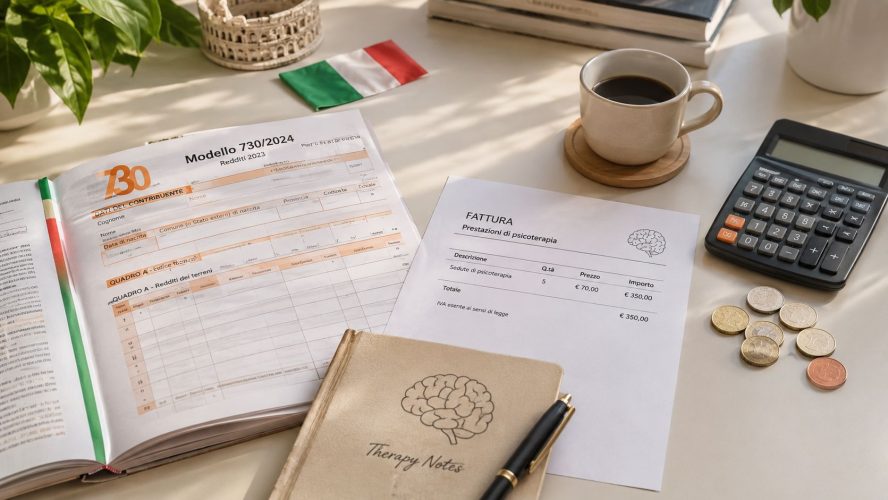
Yes, therapy and psychotherapy expenses in Italy are tax-deductible as healthcare spending. You can claim an IRPEF tax credit of 19% on eligible costs above the €129.11 annual threshold, as long as the payment is traceable and the invoice identifies the professional and the service.
If you're sitting in front of your Italian tax papers in Milan, Rome, or anywhere else in Italy, that's usually the moment the question gets real. You may have invoices in English, a card statement from another country, and therapy sessions that helped you more than any bureaucratic form ever could. The good news is that the Italian system does recognize psychotherapy as a medical expense, but it rewards the people who keep their paperwork tidy and file in the right year.

For expats, the challenge is usually not the principle itself. It's the mismatch between a clear mental-health need and a confusing tax trail, especially when therapy is online, the card is foreign, or the invoice is bilingual. A simple rule helps: if the session is clinically eligible, the deduction still depends on the administrative proof that shows who provided the service, when you paid, and how you paid. For a broader mental-health context for newcomers, Therapsy also publishes a guide to the bonus psicologo 2026 for expats, which many people compare with ordinary medical deductions.
Whether Therapy Is Tax Deductible in Italy
If you are sorting through Italian tax papers in Milan, Rome, or anywhere else in the country, the answer usually becomes clear once you separate the clinical side from the paperwork side. Therapy and psychotherapy are generally treated as healthcare expenses in Italy, so they can fall under the ordinary medical deduction rules when the provider is a properly registered psychologist or psychotherapist and the documentation is complete. That is the practical starting point for a tax deduction for therapy in Italy.
What that means in real life
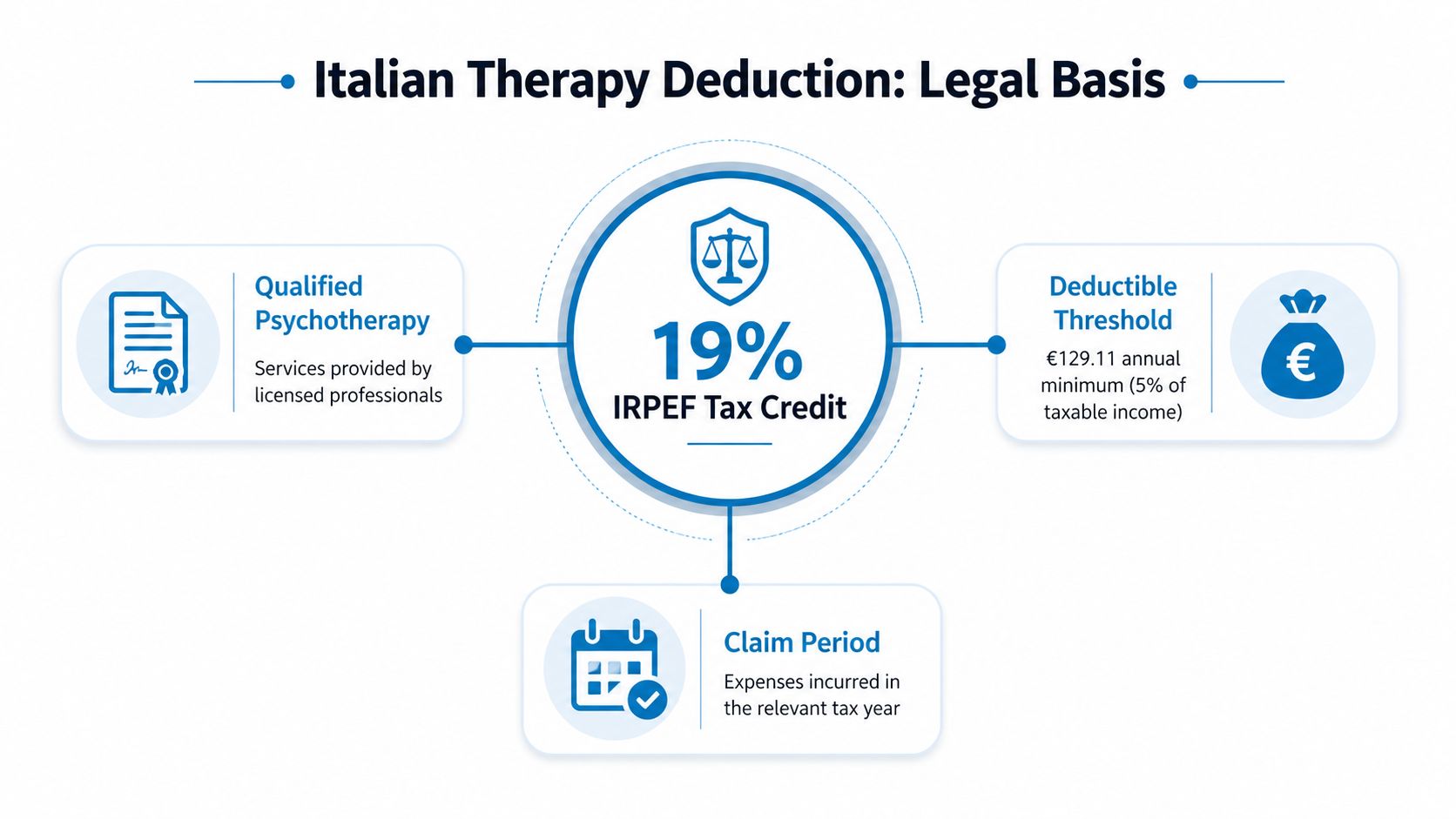
The deduction is not a separate “therapy bonus.” It sits inside the broader Italian healthcare expense system, so the tax office reads it the same way it reads other eligible medical spending. You do not recover the full amount either. The standard relief is a 19% IRPEF tax credit on the eligible portion of spending above the €129.11 annual deductible threshold.
A simple way to check the rule is to ask two questions. Was the session a qualifying medical expense, and can you prove the payment trail? If the answer to both is yes, the claim usually fits the ordinary framework.
The most confusing part for expats is timing. Italian medical expenses are claimed under the cash principle, so the expense belongs to the year in which you pay it, not the year the invoice was issued. That matters when you start therapy in December, pay in January, or receive a delayed invoice from a therapist working online with international clients.
Therapy is also one of those expenses where people often overthink the diagnosis question. For psychotherapy specifically, guidance says no preventive medical prescription is required, but the invoice still has to identify the professional and the service, and the payment has to be traceable. If one of those elements is missing, the tax relief can disappear even when the treatment itself was entirely legitimate.
For expats, the paperwork details matter even more than the therapy language. An invoice in English, a foreign card statement, or an online session can all be workable, as long as the file still shows who provided the service, what was paid, and when. If you want a practical starting point on service types and access to multilingual support, see Therapsy therapists and matching.
A useful comparison is this: the therapy itself is the health event, but the deductible claim is the tax event. The first is about care, the second is about proof.
The Legal Basis Behind the Italian Therapy Deduction
A therapy invoice in Italy is not treated as a separate tax category. It sits inside the ordinary medical-expense rules, which means the claim follows the same basic logic as other eligible healthcare costs, with 19% tax credit relief applying after the €129.11 annual deductible threshold is crossed. For expats, that matters because the filing often involves foreign bank cards, bilingual invoices, or sessions booked from abroad, but the tax rule still looks first at proof, payment, and timing.
The three moving parts that decide the claim
The first part is the nature of the expense. Therapy counts only if it is a qualifying medical expense and is provided for a therapeutic purpose by an appropriate professional.
The second part is the threshold. Only the amount above the annual franchise of €129.11 can generate the relief.
The third part is the tax year. Italy uses the cash principle for these claims, so the relevant year is the one in which payment is made, not the year the invoice is issued. That distinction matters if a session is booked late in the year, paid in the following year, or billed after an online appointment.
The payment rule changed the practical side of the deduction. Since 1 January 2020, under Law No. 160 of 2019, most deductible medical expenses must be paid with traceable payment methods, such as a card or bank transfer, and cash is generally not deductible. A claim can fail even when the therapy itself was legitimate if the payment trail is missing.
Why the invoice matters as much as the session
Psychotherapy does not require a preventive medical prescription, but it does require an invoice or receipt that clearly identifies the professional and the service. That is the point where many files become fragile. A tax office does not read a receipt as “I needed help,” it reads it as evidence that a qualified provider delivered a described service and that the payment can be tied to that service.
For expats, the practical problem is usually not the therapy itself. It is the paperwork around it. An invoice in English can still be workable if it shows the essential details, a foreign card statement can still support the payment if it is traceable, and online sessions can still fit the rule if the documentation is complete. For a calmer overview of how therapy support fits into daily life in Italy, see mental health support for expats in Italy.
Bottom line: the Italian rule is generous, but the tax trail has to be complete.
Who Can Claim the Deduction and What Types of Therapy Qualify
A therapy receipt can look straightforward and still raise different tax outcomes depending on who paid, who received the care, and whose return includes the expense. That matters for expats, because in many households the payer, the patient, and the taxpayer are not the same person.
Resident, non-resident, and dependent claims
A resident taxpayer in Italy is usually in the clearest position to claim the deduction. A non-resident with Italian-source income may still have filing duties, but the availability of a medical deduction depends on the overall tax position, the type of return filed, and the income profile involved. Mixed-status households often need to check carefully which return should carry the expense, especially if a spouse, child, or dependent relative is involved.
For dependents, the rule is practical. If the therapy expense belongs to a dependent family member, the deduction is generally claimed by the taxpayer who is entitled to include that dependent on the return. The problem appears when two adults try to use the same receipt. At that point, the issue is no longer the therapy itself, it is a filing error.
What qualifies and what doesn't
Therapy with a clinical purpose is the starting point. That includes services provided by licensed psychologists and psychotherapists, and psychiatric consultations also fit within the healthcare deduction logic because they are medical in nature. Online and in-person sessions can both qualify when the provider is properly registered and the invoice is in order.
Coaching, life mentoring, and general wellness apps sit in a different category. They may be useful, but they are not automatically the same as deductible healthcare. If there is no therapeutic service from a properly registered professional, the tax treatment is usually weaker. For readers comparing the practical cost of care before they collect receipts, therapy pricing in Italy gives a useful baseline.
A quick check helps before you rely on the document. Is the provider a licensed psychologist, psychotherapist, or other qualified medical professional? Does the invoice clearly describe psychotherapy, counseling, or another therapeutic service? Can you trace the payment, and does the receipt match the person who will claim it, or the dependent they support?
Save the invoice, keep the payment evidence, and make sure the names line up before tax season starts.
Invoice and Payment Requirements for a Valid Claim
A therapy expense usually fails at the paperwork stage, not at the treatment stage. The tax office needs a record that is easy to read and easy to trace, so the invoice and the payment proof have to work together like two parts of the same file. For expats, the usual sticking points are language, cross-border banking, missing digital copies, and invoices that look correct to the patient but not to the tax office.
What the invoice should clearly show
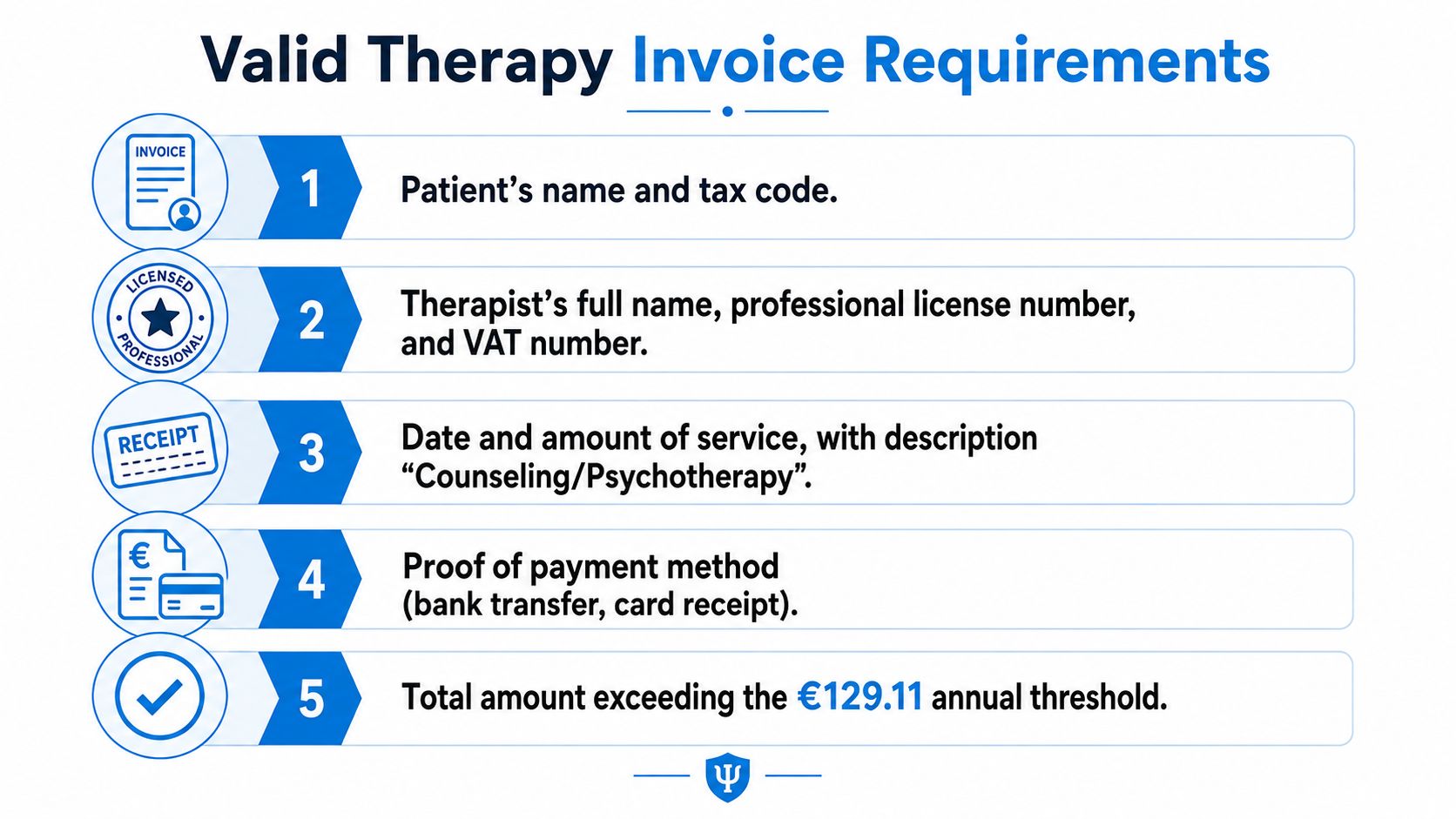
A valid therapy invoice should identify the therapist's full name, their professional registration number, and their VAT or fiscal code, along with the date of service, the amount paid, and a service description that leaves no doubt that the session was therapeutic. If the wording is too general, the taxpayer may need to show extra proof of what was purchased.
The payment also has to be traceable. The rule in practice is simple, a card payment, bank transfer, or another recordable method creates a paper trail, while cash usually does not. That is why a correct invoice can still fail if the payment cannot be connected to it. For a quick sense of the expense side before you gather documents, how much therapy costs in Italy helps set expectations.
If the payment cannot be followed from your account to the therapist's receipt, the deduction is vulnerable.
Expat edge cases that create trouble
Foreign-issued cards are usually fine. The test is whether the bank record clearly links the payment to the invoice, so the tax office can follow the trail without guessing. The same logic applies to online therapy across borders. A receipt that names the provider and the service is stronger evidence than a chat screenshot or a subscription email with no invoice detail.
Bilingual invoices are acceptable when they stay precise. If the wording is vague, ask for a corrected invoice before filing. Keep digital copies with the payment proof in one folder, because paper versions are easy to misplace when you need them most.
A simple pre-filing routine
- Match names carefully. The invoice, payment record, and taxpayer should connect cleanly.
- Check the service description. It should read as a therapeutic service, not a vague appointment note.
- Verify traceability. Card, bank transfer, or another method that leaves a clear record.
- Store both files. Keep the invoice and the payment proof together.
- Review the tax year. Make sure the payment belongs to the year you are claiming.
A quick check before filing usually saves a correction later. If the invoice is clear and the payment trail is complete, the claim is much easier to support.
How to File the Deduction on Mod 730 and Redditi PF
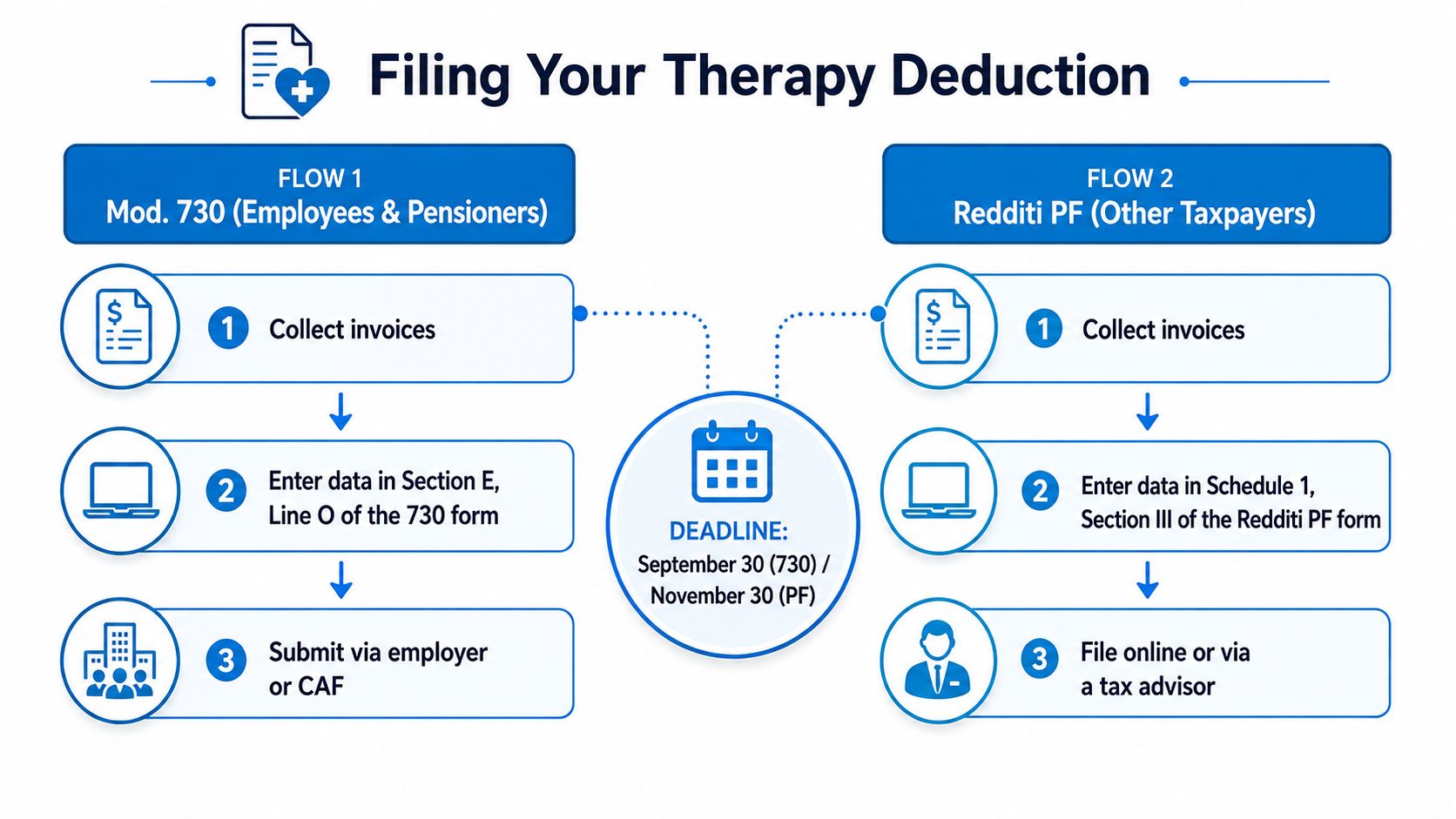
A therapy expense only helps your tax return if it is entered in the right form. In Italy, employees and pensioners usually file with Mod. 730, while the self-employed and taxpayers with more complex income situations often use Redditi PF. For many expats, the deciding factor is not nationality, but how income is reported in Italy and whether the return needs a simpler or fuller structure.
Choosing the right filing route
A salary earner with a straightforward position usually finds Mod. 730 easier to handle. A person who works for themselves, has mixed income, or needs to file a fuller return usually ends up in Redditi PF. Both forms can include medical expenses, therapy included, as long as the expense meets the ordinary healthcare deduction rules.
The filing calendar still matters. Check the current year's calendar before submitting, because the form is not the place for guesswork.
Where the expense goes
For Mod. 730, medical expenses are entered in Section E (Quadro E), starting from line E1. For Redditi PF, the corresponding area is Section RP (Quadro RP), starting from line RP1. You do not need to memorize the tax code, only the part that asks for healthcare expenses and the amount paid.
Before opening the return, keep three things close at hand. Your invoices, your payment proof, and the personal details that tie the expense to the taxpayer. If the expense is for a dependent, the supporting papers should also show that relationship clearly.
The same filing logic applies whether the session was in person or online, including cross-border therapy. A clear invoice that names the provider and the service carries more weight than a generic booking email or a message thread with no invoice detail. For therapists who use a sliding scale therapy model, the invoice still needs to state the service clearly, because the tax office reads the documentation, not the pricing philosophy.
Common filing mistakes to avoid
- Wrong year: claiming the payment in the year the invoice was issued instead of the year it was paid.
- Double counting: entering the same dependent's therapy expense on two different returns.
- Missing traceability: filing the expense without proof of card or bank payment.
- Loose paperwork: uploading a receipt that does not identify the professional or the service.
Bilingual invoices are acceptable if the wording stays precise. If the description is vague, ask for a corrected invoice before filing. Keep digital copies and payment proof in the same folder, because paper versions are easy to misplace when you need them later.
Practical Calculation Examples for Therapy Expenses
A therapy bill can feel straightforward, yet the tax result often looks abstract until you run the numbers. The deduction starts after the €129.11 threshold, and only the amount above that floor is used for the 19% tax credit. Once you see the sequence, the calculation becomes much easier to check on your own.
Three simple examples
| Therapy Tax Deduction Examples by Annual Spending Level | Annual Therapy Spending | Deductible Portion Above €129.11 | 19% Tax Credit |
|---|---|---|---|
| Example 1 | €200 | €70.89 | €13.47 |
| Example 2 | €1,000 | €870.89 | €165.47 |
| Example 3 | €3,000 | €2,870.89 | €545.47 |
The formula is the same in every row. Start with the annual amount paid, subtract €129.11, then apply 19% to what remains. A small yearly total produces a small tax benefit, which is normal. A longer course of therapy creates a larger claim because more of the annual spending sits above the deductible floor.
For expats who collect invoices from different providers, a simple yearly spreadsheet helps keep the figures tidy. It also helps if the sessions are split between in-person and online appointments, since the tax calculation still depends on the same payment total and the same deductible threshold.
When larger spending is split over several years
There is also an installment rule for larger medical expenses. When eligible annual medical costs exceed €15,493.71, the deduction can be split into four equal annual installments. In practice, that rule matters when psychotherapy is part of a broader medical pattern, not only when therapy stands alone.
For the average reader, the point is simple. You are not trying to force the biggest possible claim, you are trying to match the return to the payments made during the year. That helps when you are balancing treatment continuity with monthly budgeting, especially if you are considering a sliding scale therapy arrangement to keep costs predictable.
Useful habit: keep a running yearly total instead of waiting until tax season. It makes the final calculation much less stressful.
Special Cases for Expats, Non Residents, and Therapists
The details get more interesting when life in Italy isn't neatly local. Expats move mid-year, switch jobs, receive therapy online across borders, and sometimes file from a household where one partner is Italian and the other isn't. Those situations don't cancel the deduction, but they do make documentation more important.
Non-residents and mixed-status households
A non-resident taxpayer who has Italian-source income may still need to file in Italy, but the ability to claim therapy costs depends on the structure of the return and the taxpayer's overall status. If the expense belongs to a dependent spouse or child, the family should decide in advance which return will carry the claim. That avoids duplication and keeps the paperwork coherent.
If you moved to Italy partway through the year, the same principle applies. Claim only the expenses that belong to the relevant tax period, and make sure the payment date is the anchor point, not the invoice date. That's especially important for expats who start therapy in one country and continue it after a move.
Online therapy across borders
Online therapy usually raises more questions than in-person sessions. The core issue isn't the screen, it's the paper trail. If the therapist is properly registered, the service is therapeutic, the invoice is specific, and the payment is traceable, online delivery does not automatically block the deduction.
Therapists and practice managers can make life easier by being precise on invoices. Use a service description that clearly identifies psychotherapy or counseling, include the professional registration details, and avoid vague wording that looks like general wellbeing support. Clients who receive digital invoices should save them in a stable folder together with payment proof, because tax requests tend to arrive after people have deleted the original email.
If you're a therapist working with international clients, the right administrative structure protects both sides. A multilingual practice can reduce confusion by keeping invoicing language clear and payment methods traceable from the start. For readers looking for that kind of support, an expat therapist in Italy is often the most relevant service page to review.
A final practical note for expats
What the Italian system really asks for is consistency. The professional should be qualified, the service should be therapeutic, the payment should be traceable, and the tax return should match the date and the person who paid. If those four things line up, the deduction is far easier to defend.
For people who want a therapist that understands expat life in Italy, multilingual care, and how these documents intersect with real-world stress, Therapsy offers online and in-person psychotherapy in multiple languages, with a free first assessment call and human matching by the Clinical Director. If you're unsure how your therapy receipts fit your own filing situation, start there, then confirm the tax side with your accountant or CAF.
If you're an expat in Italy and you want therapy that fits both your language and your life here, Therapsy can help you take the next step with less friction. You can book a free first assessment call, speak with the Clinical Director, and get matched with a therapist who understands the human side of moving, working, and living in Italy. Visit THERAPSY to start with a conversation, not a commitment.
FAQ
Is therapy deductible in Italy without a prescription?
Yes. Psychotherapy can be deductible without a preventive medical prescription if the invoice identifies the professional and the service, and the payment is traceable. The missing prescription doesn't automatically block the claim, but the administrative details still have to be correct.
Do I need to pay by card or bank transfer?
Yes, in most cases you do. Since 1 January 2020, most medical deductions require a traceable payment method, and cash is generally not deductible. Keep the payment record with the invoice so the trail is easy to follow.
Can I claim online therapy sessions?
Yes, if the provider is properly qualified and the paperwork is complete. The format of the session is less important than the professional status, the service description, and the traceable payment.
What happens if the invoice is in English?
That can still be fine if it clearly identifies the therapist, the service, and the payment details. What matters is clarity, not the language alone. If the wording is too generic, ask for a corrected invoice before filing.
Can I claim therapy for my child or spouse?
Yes, if they count as dependents on your tax return and the expense is claimed on the correct return. The key is to avoid double claiming and to keep the family relationship and payment trail clear.
Which tax form should I use for therapy expenses?
Employees and pensioners usually use Mod. 730, while self-employed taxpayers and people with mixed income often use Redditi PF. The right form depends on your tax profile, not just on the fact that you paid for therapy.