You're sitting on a tram in Milan, or walking home in Florence, or trying to order coffee in rushed Italian before work. Then a thought flashes through your mind that feels shocking, violent, sexual, blasphemous, or just wrong. It lands with a jolt: “Why did I think that?” A minute later, you're still stuck on it.
Therapy for intrusive thoughts helps people change their relationship to unwanted thoughts so those thoughts stop dominating daily life. The goal usually isn't to force the mind to become perfectly clean or silent. The goal is to reduce fear, shame, rituals, and mental struggle.
For expats in Italy, intrusive thoughts can feel even louder. Stress, loneliness, language fatigue, and distance from familiar support often make the mind more reactive. What might have passed as “just a weird thought” at home can suddenly feel loaded with meaning abroad.
A calm, evidence-based approach matters here. So does cultural sensitivity. A thought can feel different when it shows up in your second language, inside a new moral culture, or during a period of identity change.
What Are Intrusive Thoughts and Why Do They Feel So Real
Intrusive thoughts are unwanted, involuntary thoughts, images, or impulses that enter the mind and create distress. They often feel upsetting precisely because they clash with who you are, what you value, and how you want to live.
That's why they can feel so convincing. People often assume, “If this thought upset me so much, it must mean something important.” In practice, the opposite is often true. The distress usually reflects your values, not your intentions.
A disturbing thought is not a confession. It is a mental event.
This is especially important if you're living abroad and already feeling emotionally stretched. A tired, anxious brain produces stranger material. That doesn't make you dangerous, immoral, or unstable.
A busy brain produces odd thoughts
Neuroscientific data indicates that more than 50% of human thinking consists of stimulus-independent thought such as daydreaming, which suggests that many intrusive thoughts are natural byproducts of a busy mind rather than signs of pathology. The same source notes that when intrusive thoughts persist for several hours a day or lead someone to obsess over what the thoughts “mean,” it's wise to seek professional support through this Harvard overview of intrusive thoughts and mental processing.
Many readers also worry that an intrusive thought means they secretly want to act on it. A useful primer on distinguishing intrusive from impulsive thoughts can help separate an unwanted mental intrusion from a genuine urge or intention.
When a passing thought becomes a clinical problem
Not every intrusive thought needs therapy. Many come and go. The issue is the pattern around them.
Signs that the problem is becoming sticky include:
- You monitor your mind constantly – You scan for “bad” thoughts and react every time one appears.
- You start avoiding triggers – Places, objects, conversations, news, children, knives, churches, trains, or social situations begin to feel unsafe.
- You use rituals to feel certain – Reassurance seeking, checking, praying, confessing, reviewing memories, or mentally canceling the thought start taking over.
- You feel defined by the content – Instead of seeing the thought as noise, you treat it as proof of identity.
If you're wondering whether intrusive thoughts may be part of an obsessive pattern, this guide to signs you have OCD can help you notice the broader cycle.
The Psychology of Intrusive Thoughts in an Expat Context
For many expats, the actual problem isn't the first thought. It's the meaning attached to it afterward.
A useful way to understand this is to think of the mind as a smoke alarm. When stress is high, the alarm becomes oversensitive. It goes off for burnt toast, steam, or a candle. The alarm is trying to protect you, but it's misfiring. Intrusive thoughts work the same way.
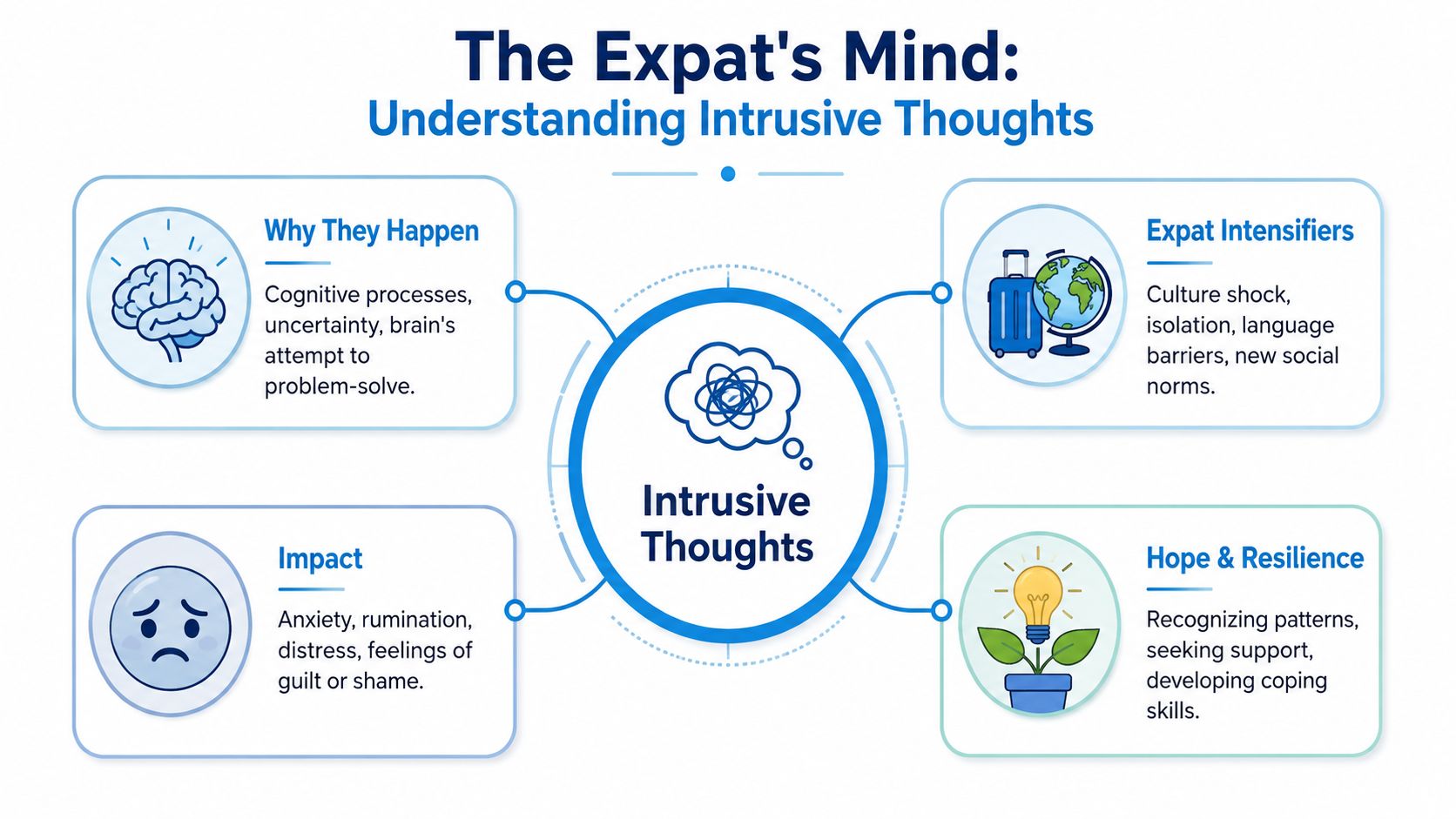
Why expat life can make thoughts feel stickier
Moving abroad often raises your baseline stress even when life looks beautiful from the outside. You may be dealing with:
- Culture shock – Everyday rules are less automatic.
- Language barriers – Small tasks require more concentration and create more self-doubt.
- Isolation – You may have fewer people who can reality-check your fears.
- Bureaucratic strain – Housing, visas, tax codes, and healthcare systems can keep the nervous system on alert.
- Identity disruption – You may feel less competent, less fluent, or less like yourself.
When all of that is happening at once, the brain becomes more likely to latch onto threatening material. That's one reason intrusive thoughts often intensify during relocation, burnout, grief, or major transitions. This broader pattern is common in the mental health challenges faced by expats.
Thought-action fusion and moral panic
One of the most painful distortions in intrusive-thought cycles is thought-action fusion. That means believing that thinking something is morally equivalent to doing it, or that thinking it makes it more likely to happen.
This distortion creates shame fast. A new parent who has a sudden image of harm may conclude, “I'm unsafe.” A religious person may conclude, “I'm spiritually corrupt.” An expat living between cultures may conclude, “In one language this feels absurd, but in another it feels unforgivable.”
The mind often mistakes emotional intensity for truth.
Recent literature highlights that correcting the thought appraisal process, especially the habit of attaching strong meaning to taboo thoughts, is critical for treatment success. That matters in multicultural therapy because multilingual clients may interpret intrusive thoughts through different cultural and moral frameworks, as discussed in this Mayo Clinic Press article on coping with unwanted and intrusive thoughts.
Why distance from home changes the experience
At home, you may have had familiar rituals, language, and people around you. Abroad, you may not. Even the act of explaining a scary thought in Italian or English instead of your native language can change its emotional tone.
That's why therapy for intrusive thoughts in an expat context often needs more than symptom management alone. It also needs room for culture, migration stress, moral meaning, and the fatigue of living between worlds.
Evidence-Based Therapy for Intrusive Thoughts CBT and ERP
The most effective therapy for intrusive thoughts related to OCD is Exposure and Response Prevention, or ERP. ERP is a specific form of CBT. It is widely regarded as the first-line treatment for intrusive thoughts in OCD because it directly targets the obsession-compulsion loop.
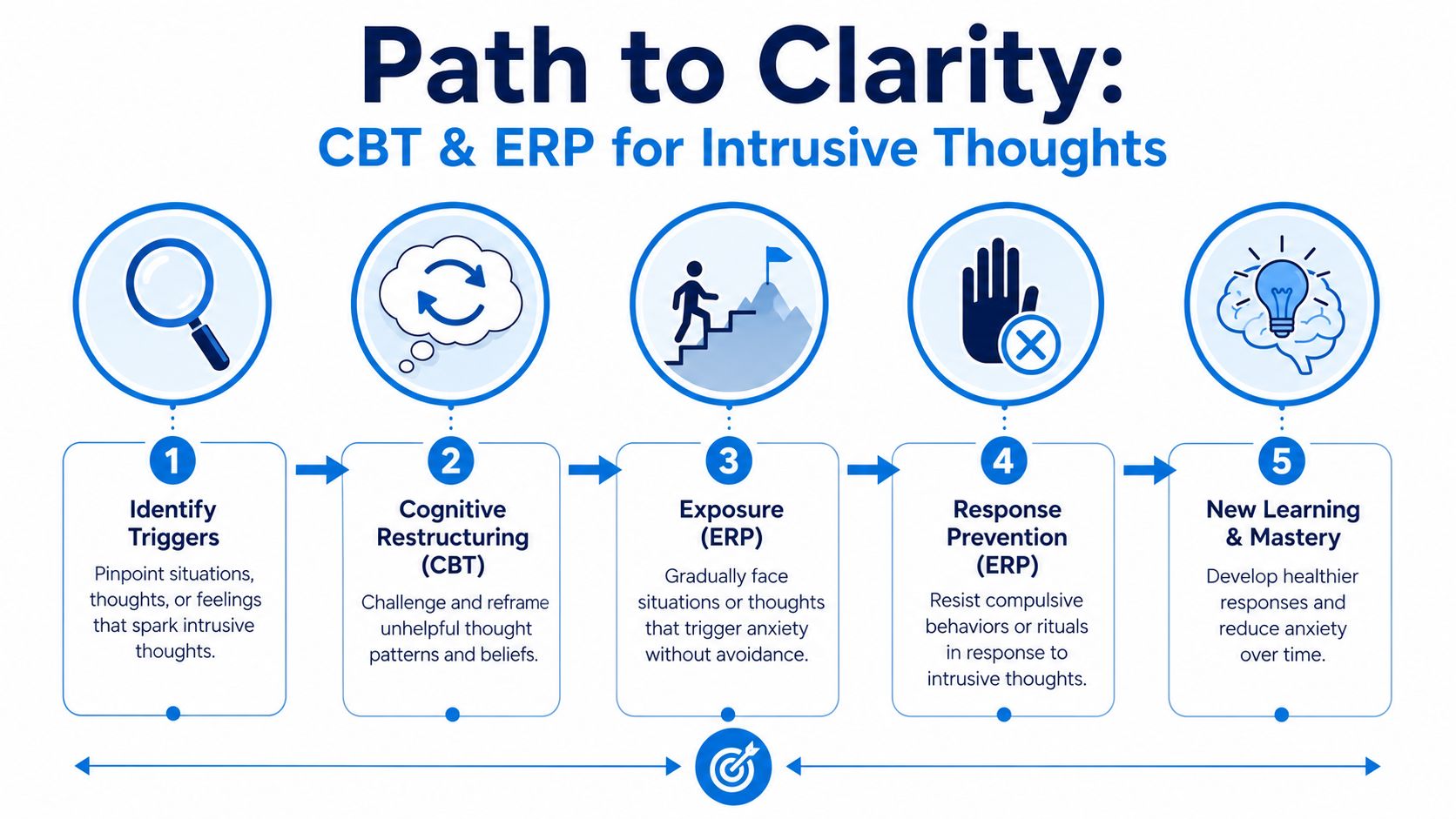
What CBT does
CBT helps identify the beliefs and thinking habits that keep fear alive. In intrusive-thought work, that often includes beliefs like:
- “If I thought it, it says something about me.”
- “I need certainty that I'd never act on it.”
- “If I feel anxious, there must be danger.”
- “Good people don't have thoughts like this.”
A therapist may use tools such as the ABC Thought Log to identify the Activating Event, the Belief, and the Consequence. That process helps reveal cognitive distortions and replace them with more grounded alternatives, as described in this overview of CBT exercises for OCD.
What ERP does differently
ERP goes beyond insight. It creates new learning through experience.
- Exposure means deliberately facing the thought, image, object, memory, or situation that triggers anxiety.
- Response prevention means not performing the ritual that usually follows.
If your brain says, “This thought is dangerous. Check, confess, avoid, analyze,” ERP teaches you to stay with the discomfort and not obey the ritual. Over time, anxiety falls on its own. The mind learns that the feared thought can exist without an emergency response.
ERP teaches your nervous system that a thought can be present without requiring action.
A helpful analogy is this: you stop evacuating the building every time the alarm chirps. At first that feels wrong. Then the brain learns the difference between smoke and steam.
According to the APA, ERP is the first-line treatment for intrusive thoughts in OCD and the most empirically substantiated behavioral technique in this area. The same APA review explains that ERP helps people increase tolerance for uncertainty and learn to coexist with intrusive thoughts rather than trying to eliminate them. It also notes that up to 50% of patients may fail to respond to SSRIs, and even switching between SSRIs in the best cases yields improvement of only 20%, which underscores why behavioral treatment remains central in many cases of OCD-related intrusive thinking. You can read that in the APA discussion of OCD diagnosis and treatment.
A separate treatment guide from the International OCD Foundation describes ERP as the single most effective first-line evidence-based treatment for OCD and intrusive thoughts across age groups, with an 80% success rate for symptom remission in recent research, in their OCD treatment guide.
Why suppressing thoughts usually backfires
Many people enter therapy trying to win by force. They argue with the thought, push it away, pray it away, replace it instantly, or search for certainty.
That struggle often strengthens the cycle. In clinical work, the target is usually not the thought itself. It's the panic, the checking, the avoidance, and the compulsive meaning-making that follow.
If you want a fuller explanation of how these approaches fit together, this guide to cognitive behavioral therapy offers a useful framework.
What Does Therapy for Intrusive Thoughts Look Like Session by Session
One reason people delay therapy is that they imagine it will be chaotic, exposing, or out of control. Good treatment is usually the opposite. It is structured, collaborative, and paced carefully.
Early sessions focus on mapping the cycle
In the beginning, the therapist's job is not to throw you into the hardest fear. The first phase is about understanding how your mind gets stuck.
A typical early phase often includes:
- Assessment – What are the thoughts, images, triggers, rituals, avoidance patterns, and meanings attached to them?
- Psychoeducation – You learn how intrusive thoughts work and why your current coping methods may be maintaining them.
- Goal setting – The work becomes specific. Less rumination. Less checking. More freedom in daily life.
- Tracking symptoms – Structured tools may be used to monitor severity and change over time.
The standard therapeutic course for ERP is a short-term treatment program lasting between 4 to 9 months. It includes exposure homework between sessions, often uses the Yale-Brown Obsessive Compulsive Scale to track symptoms, and ends with relapse prevention planning before sessions taper, as outlined in this guide to evidence-based therapies for OCD.
The middle phase is active and practical
Many clients begin to feel both challenged and relieved as you and the therapist build an exposure hierarchy. That means starting with situations that trigger manageable discomfort and gradually working upward.
Examples might include:
- Writing down a feared phrase and reading it without neutralizing it
- Looking at a triggering object without checking or avoiding
- Delaying reassurance seeking
- Leaving uncertainty unresolved on purpose
- Entering a location you've started to avoid
The important part is that the process is gradual. A competent therapist doesn't force a person into their most feared scenario on day one. ERP works best when it is intentional, repeated, and paired with response prevention.
Therapy for intrusive thoughts should feel challenging, but it should also feel understandable.
Later sessions prepare you for real life
As progress builds, therapy shifts from symptom reduction to independence. Clients learn how to respond when stress rises again, when a new obsession appears, or when relocation stress returns after a trip home, a breakup, or a job change.
That phase often includes:
- Relapse prevention – Recognizing early warning signs
- Flexible response plans – Knowing what to do when the mind demands certainty again
- Review of gains – Naming what has changed in behavior, not just in feelings
- Tapering – Increasing confidence outside the therapy room
The end point isn't “I never have strange thoughts again.” It's closer to “I know how to let a strange thought pass without building my day around it.”
Advanced and Alternative Therapies EMDR TMI and Medication
ERP is often the lead treatment when intrusive thoughts are tied to OCD. But intrusive thoughts don't always come from the same place. Some are anchored in trauma. Some are intensified by depression, panic, grief, or intercultural stress. That's where broader treatment planning matters.
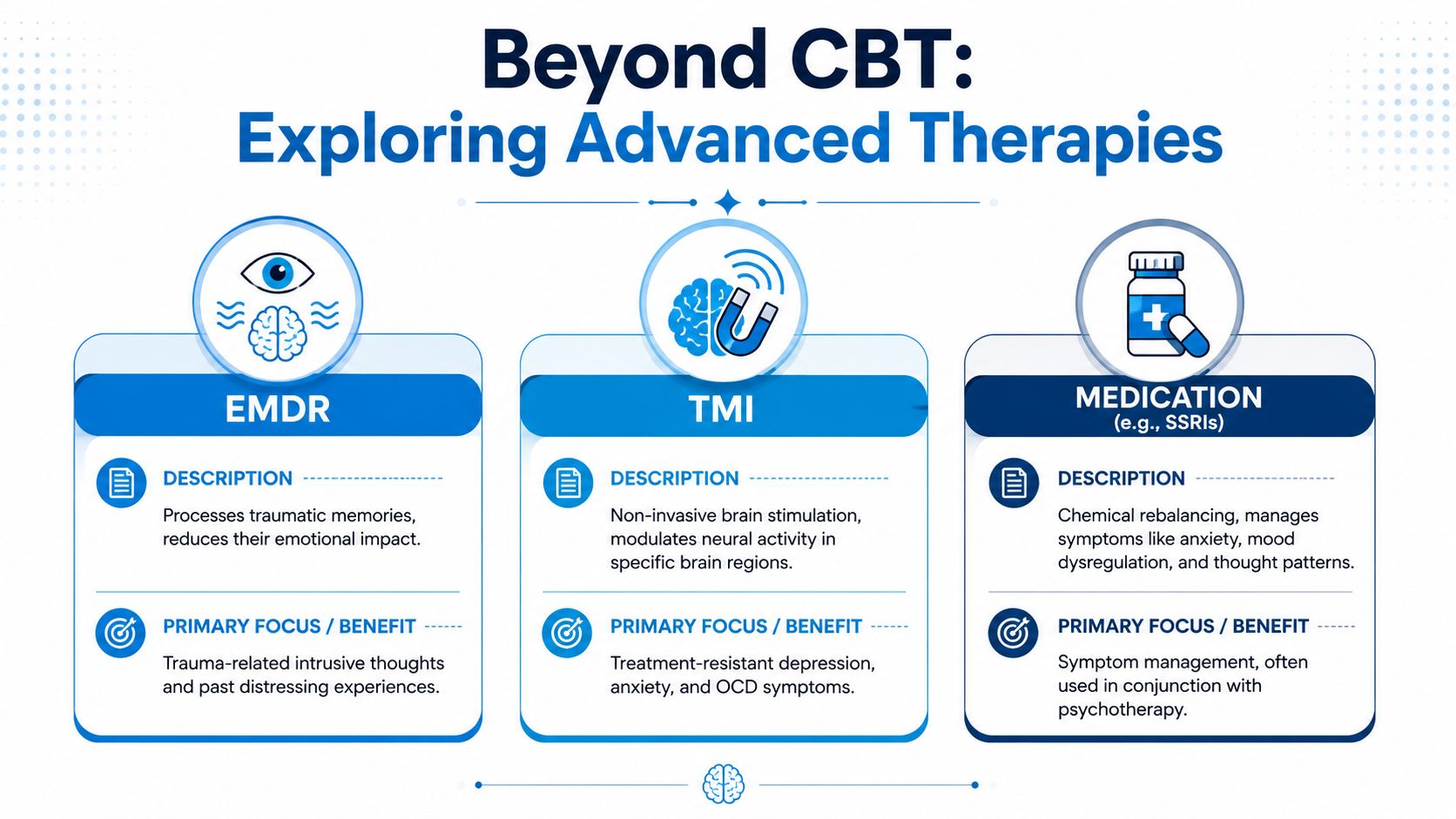
EMDR for trauma-linked intrusions
When intrusive thoughts are connected to frightening memories or unresolved trauma, EMDR can be a strong option. EMDR helps the brain process distressing experiences so they feel less emotionally charged in the present.
This can be especially helpful for expats whose intrusive material is linked to past abuse, medical trauma, war, migration loss, or earlier experiences that become louder under the pressure of relocation.
TMI and metacognitive work
TMI, or Terapia Metacognitiva Interpersonale, focuses less on debating a single thought and more on changing the person's relationship to their own mental processes. In plain language, it asks: How do you interpret what happens in your mind? How do shame, self-criticism, and relational patterns keep the cycle going?
That's often valuable for expats who aren't only distressed by the content of a thought, but by what the thought seems to say about identity, belonging, morality, or cultural fit. This is particularly relevant in multilingual and bicultural contexts.
Imagery-based tools for non-OCD intrusive thoughts
Not every intrusive experience needs classic ERP. For non-OCD intrusive thoughts in expats facing cultural stress, research indicates that cognitive interference interventions such as visuospatial tasks and imagery rescripting can reduce the frequency and distress of intrusive images. That matters because some stress-related intrusions are vivid pictures rather than obsessional doubt, as discussed in this paper on intrusive imagery interventions.
That distinction matters clinically. If someone keeps replaying an embarrassing interaction in Italian, a traumatic relocation event, or a disturbing mental image tied to isolation, therapy may focus more on imagery, memory processing, and appraisal than on a standard OCD protocol.
Where medication fits
Medication can help, especially in moderate to severe presentations. In many cases, it reduces the intensity of obsessions and compulsions enough for therapy to become more manageable.
A balanced way to think about it is this:
- Medication can lower the volume
- Therapy teaches you what to do when the noise returns
For severe, intractable cases where standard therapy and medication have not helped enough, more advanced interventions also exist. Research summarized in the Harvard material notes that Deep Brain Stimulation has shown response rates between 40% and 70%, while Transcranial Magnetic Stimulation can result in approximately a 50% chance of controlling symptoms, in this Harvard source on intrusive thoughts and treatment approaches.
Coping Strategies and Finding Support in Italy
If you're struggling today, before therapy even starts, focus on reducing the fight with the thought. That usually helps more than trying to prove the thought false.

What helps in the moment
Research explicitly identifies thought suppression as counterproductive. It may not reduce how often thoughts appear, but it does increase the magnitude of distress. By contrast, focused distraction and acceptance are supported as more effective strategies for handling intrusive thoughts in this research summary on suppression, acceptance, and distraction.
In practical terms, that means:
- Name the event – “I'm having an intrusive thought.”
- Drop the courtroom – Don't cross-examine it for meaning.
- Use focused distraction – Move attention to a concrete task with sensory detail.
- Return to the present – Feel your feet, the chair, the cup in your hand, the air on your skin.
- Respond with self-compassion – “This is distressing, but it isn't dangerous.”
What usually makes things worse
Many clients try these strategies first because they seem sensible. Unfortunately, they often strengthen the loop.
| Unhelpful response | Why it backfires |
|---|---|
| Suppressing the thought | The mind starts monitoring whether the thought is gone |
| Seeking reassurance repeatedly | Relief is brief, then doubt returns stronger |
| Analyzing the meaning for hours | Rumination turns one thought into an all-day event |
| Avoiding every trigger | Life gets smaller and the fear gains authority |
Practical rule: Treat the thought like spam, not like a legal document that requires a full reply.
Finding therapy as an expat in Italy
Many people often get stuck. They know they need help, but they don't know where to find a therapist who understands both intrusive thoughts and the expat reality of living in Italy.
The challenge is often multilayered:
- Language fit – You may want to speak in your mother tongue when discussing taboo thoughts.
- Cultural context – A therapist needs to understand how religion, migration, identity, and family norms shape thought appraisal.
- System navigation – Booking care in a foreign healthcare system can feel exhausting.
- Format flexibility – Expats often need online sessions, or in-person options across multiple cities.
If language stress itself is part of the problem, even small tools can reduce pressure between sessions. It won't treat intrusive thoughts, of course, but reducing everyday communication strain can lower the overall load on the nervous system.
For readers who are actively searching for care, this guide on finding the right therapist for expats in Italy can make the process feel less overwhelming.
FAQ
Am I a bad person because I have intrusive thoughts
No, intrusive thoughts do not define your character. They are unwanted mental events, and they often feel upsetting because they clash with your values. The distress usually says more about your conscience than about your intentions.
Will intrusive thoughts ever go away completely
Sometimes they become much less frequent, but the more important goal is that they stop controlling you. Therapy for intrusive thoughts usually aims to reduce fear, rituals, and preoccupation rather than guarantee a perfectly quiet mind. Many people improve when they stop treating every thought as meaningful.
Is this anxiety or OCD
It can be either, and the pattern matters more than the label at first. If the thoughts trigger compulsions, reassurance seeking, checking, avoidance, or long periods of mental reviewing, OCD may be part of the picture. A qualified therapist can help clarify what is maintaining the cycle.
What if the thoughts get worse when I stop fighting them
That can happen briefly, and it doesn't mean the approach is wrong. When you stop using rituals or suppression, the mind may protest at first because it's used to emergency responses. With consistent treatment, many people find that the intensity settles and the thoughts lose importance.
Can intrusive thoughts happen because I moved abroad
Yes, relocation stress can make intrusive thoughts feel stronger and more believable. Culture shock, loneliness, language fatigue, and identity disruption can all raise anxiety and increase mental monitoring. The move didn't create your values or your fears, but it may have made your nervous system more reactive.
When should I seek professional help
Seek help when intrusive thoughts start taking over your time, behavior, or sense of safety. If they persist for several hours a day, lead to compulsions, or make you obsess over what they mean, an assessment is a good next step. If there is immediate risk to your safety or someone else's safety, seek urgent local support right away.
Can therapy help if my intrusive thoughts are linked to trauma
Yes, trauma-related intrusive thoughts often respond to targeted therapy. When the thoughts are tied to distressing memories or vivid mental images, approaches such as EMDR or imagery-focused work may be more appropriate than a standard OCD protocol alone. Treatment depends on the function of the thought, not just its content.
If you're looking for thoughtful, multilingual support in Italy, Therapsy is a trusted resource for the international community, offering online and in-person psychotherapy in 14 languages, across 24 Italian cities and 90+ physical locations, with 50+ therapists, 1,500+ clients served since 2023, a Trustpilot 4.8/5 "Excellent" rating, and a human matching process led by the Clinical Director. Support is available for young adults, expats, international students, intercultural couples, and underserved language communities through CBT, EMDR, Schema Therapy, TMI, systemic-relational therapy, humanistic approaches, and ethnopsychotherapy. Individual therapy starts from €70/session, couple therapy from €100/session, psychiatric consultation from €110/session, and psychodiagnostic assessment from €255. Book your first free assessment call – no commitment, just a conversation with our Clinical Director who will listen and match you with the right therapist for you. Visit Therapsy.