You moved to Italy with a real life behind you. You had skills, routines, social confidence, professional credibility. Then, suddenly, you're hesitating before ordering coffee, second-guessing emails, replaying conversations, and wondering why everyday tasks now make you feel small.
That drop in confidence is one of the most common and least discussed parts of expat life. Advice on how to improve self-esteem often consists of generic suggestions about thinking positively or listing strengths. That can help a little. But for expats in Italy, low self-esteem often grows from something more specific: repeated moments of friction between who you know yourself to be and how life currently makes you feel.
Self-esteem is your overall sense of worth and capability. It influences how you speak to yourself, what you expect from others, what risks you take, and how quickly you recover from setbacks. It isn't fixed. It changes with context, stress, relationships, and the stories you tell yourself about difficulty.
For expats, that context matters. A competent person can start to feel incompetent in a new country. A warm, articulate adult can feel awkward and dependent. A successful professional can feel invisible. Those are not signs that you've become less valuable. They're signs that your environment is asking more of your nervous system than is readily apparent.
Introduction What Is Self-Esteem and Why Does It Matter for Expats
Self-esteem is more than confidence
Confidence is often task-specific. You can feel confident in your work and unsure in relationships, or socially comfortable but professionally doubtful.
Self-esteem runs deeper. It shapes whether you believe you're capable of handling life and worthy of respect, care, and belonging. When self-esteem drops, people often become harsher with themselves, more avoidant, more perfectionistic, or more dependent on external approval.
In expat life, that drop can be easy to miss at first. It often sounds like:
- “I used to be so much more competent.”
- “Why is everything so hard for me here?”
- “Maybe I was never that capable to begin with.”
- “Everyone else seems to be thriving except me.”
Those thoughts feel personal. Often, they're contextual.
Low self-esteem abroad often develops as a response to repeated mismatch between effort and reward.
Why it matters so much when you live abroad
When you're far from home, self-esteem doesn't just affect mood. It affects adaptation. It shapes whether you ask for help, try the language, apply for work, leave a relationship, set boundaries, make friends, or stay hidden.
For many expats in Italy, the hardest part isn't one dramatic crisis. It's the daily drip of small humiliations, misunderstandings, and dependency. Over time, these experiences can create shame. Shame then starts masquerading as truth.
That's why generic advice often misses the point. “Just prove yourself” can backfire when your environment keeps blocking progress. For expats facing chronic cultural challenges, self-compassion can be more stable than self-esteem, especially when life includes repeated social rejection or exclusion. Mainstream advice often pushes performance. Compassion-Focused Therapy offers another route: rebuilding self-worth without depending on external validation that may not be available in a new culture, as discussed in this overview of self-esteem and self-compassion.
Self-esteem can be rebuilt
The good news is that self-esteem responds to practice. It grows through accurate thinking, compassionate self-correction, meaningful action, and repeated experiences of competence.
That means the question isn't whether you should “feel good about yourself” all the time. The question is: what helps you build a steadier sense of worth in a setting that often shakes it?
That's what the rest of this guide addresses.
Why Moving to Italy Can Challenge Your Self-Esteem

Language fatigue changes how you see yourself
One of the fastest ways self-esteem erodes abroad is through language. Even if you're learning quickly, there's a painful difference between having thoughts and being able to express them with nuance.
In your home country, you may have sounded intelligent, funny, persuasive, and warm. In Italy, especially early on, you may sound abrupt, hesitant, simplistic, or younger than you are. That gap can become emotionally loaded.
People often start making distorted conclusions from normal language struggle:
- “I sound stupid.”
- “They think I'm incompetent.”
- “I can't be myself here.”
The practical problem is communication. The psychological problem is identity threat.
Professional demotion can feel like personal failure
Many expats experience some form of professional shrinking. Qualifications may not transfer smoothly. Networking norms may be unfamiliar. Your previous experience may carry less weight. You may find yourself underemployed, dependent on a partner, or doing work below your level while trying to “break in.”
That can create a specific wound: professional invisibility. You know what you can do, but your environment doesn't reflect it back.
This often leads to a harmful internal equation:
| Experience | Common interpretation | More accurate reading |
|---|---|---|
| Slow career progress | I'm falling behind | I'm adapting inside a different system |
| Limited recognition | I have nothing to offer | My value isn't yet legible in this context |
| Repeated rejection | I'm not good enough | Access barriers are real and exhausting |
When this combines with isolation, it can deepen into the kind of loneliness many expats describe in this guide on expat loneliness in Italy.
Comparison gets harsher abroad
Social comparison is rarely neutral when you've relocated. You may compare yourself with:
- Locals who understand the rules you're still learning
- Other expats who seem more settled, social, fluent, or successful
- Friends back home whose careers and routines look stable
- Your former self before the move
This comparison trap becomes even more intense when your real life feels messy and everyone else's life looks curated.
A strength-based review highlighted a related pitfall: 68% of adults report diminished self-worth from social media comparisons, and redirecting comparison toward “whole lives” rather than polished fragments reduced this effect by 40% in the source summary presented in this strength-based self-esteem article. The useful takeaway isn't just the number. It's the mechanism. Self-esteem falls when you compare your private struggle to someone else's edited outcome.
You are not failing because adaptation looks less glamorous from the inside than it does online.
Bureaucracy and daily friction wear people down
Italian life can be beautiful and enriching. It can also be administratively exhausting. Residence permits, tax codes, healthcare registration, housing, banking, and paperwork can make capable adults feel helpless.
This matters psychologically because self-esteem often drops when effort doesn't produce predictable results. You do everything “right,” and the process still stalls. Over time, repeated friction can train your mind to expect defeat before you begin.
That's one reason many expats don't just need advice on confidence. They need methods that account for chronic stress, shame, and uncertainty.
Recognizing the Signs of Low Self-Esteem
Cognitive signs
Low self-esteem often begins in the mind as a pattern, not a single thought. You may notice a harsh inner voice that interprets small setbacks as proof of larger inadequacy.
Common cognitive signs include:
- Mind reading – assuming others see you as awkward, needy, or incompetent
- Black-and-white thinking – deciding a conversation was either perfect or terrible
- Personalizing – taking neutral reactions as evidence that you've done something wrong
- Discounting positives – brushing off praise because it “doesn't count”
- Overgeneralizing – turning one difficult interaction into “I always mess this up”
A simple example: a barista looks rushed, and you spend the day thinking your Italian was embarrassing. That's not just social worry. It may be low self-esteem filtering neutral events through self-criticism.
Emotional signs
Emotionally, low self-esteem doesn't always feel like “low self-esteem.” It often shows up as constant tension, shame, irritability, or a low-grade sadness that follows you through the day.
You might notice:
- Shame after ordinary mistakes
- Anxiety before simple tasks
- Hopelessness about improving
- Jealousy mixed with self-blame
- A lingering sense of being less than other people
These emotions are especially common when you're living in a setting where you don't fully understand the rules yet.
Practical rule: If a small mistake creates a large collapse in how you see yourself, self-esteem may be part of the problem.
Behavioral signs
Behavior is often where low self-esteem becomes most visible. People start shrinking their lives to avoid confirming their worst beliefs about themselves.
Look for patterns like these:
Avoidance
You delay phone calls, appointments, applications, or social invitations because they feel exposing.People-pleasing
You say yes when you mean no because disapproval feels unbearable.Overpreparing
You spend excessive time rehearsing conversations or checking messages because any imperfection feels risky.Withdrawal
You stop reaching out because being unseen feels safer than possible rejection.Neglecting yourself
You stop doing the basic things that help you feel grounded, such as eating well, resting, moving, or maintaining routines.
A helpful question is this: What am I doing less of because I no longer trust myself? Your answer usually points directly toward the places where self-esteem needs attention.
Building Your Foundation with CBT-Based Techniques
Why CBT works for self-esteem
Cognitive Behavioral Therapy, or CBT, helps people identify the thoughts, feelings, and behaviors that keep distress going. For self-esteem, that matters because low self-worth is rarely just a feeling. It becomes a system.
A difficult event happens. You interpret it harshly. Your mood drops. You avoid or overcompensate. Then your behavior seems to “prove” the original negative belief.
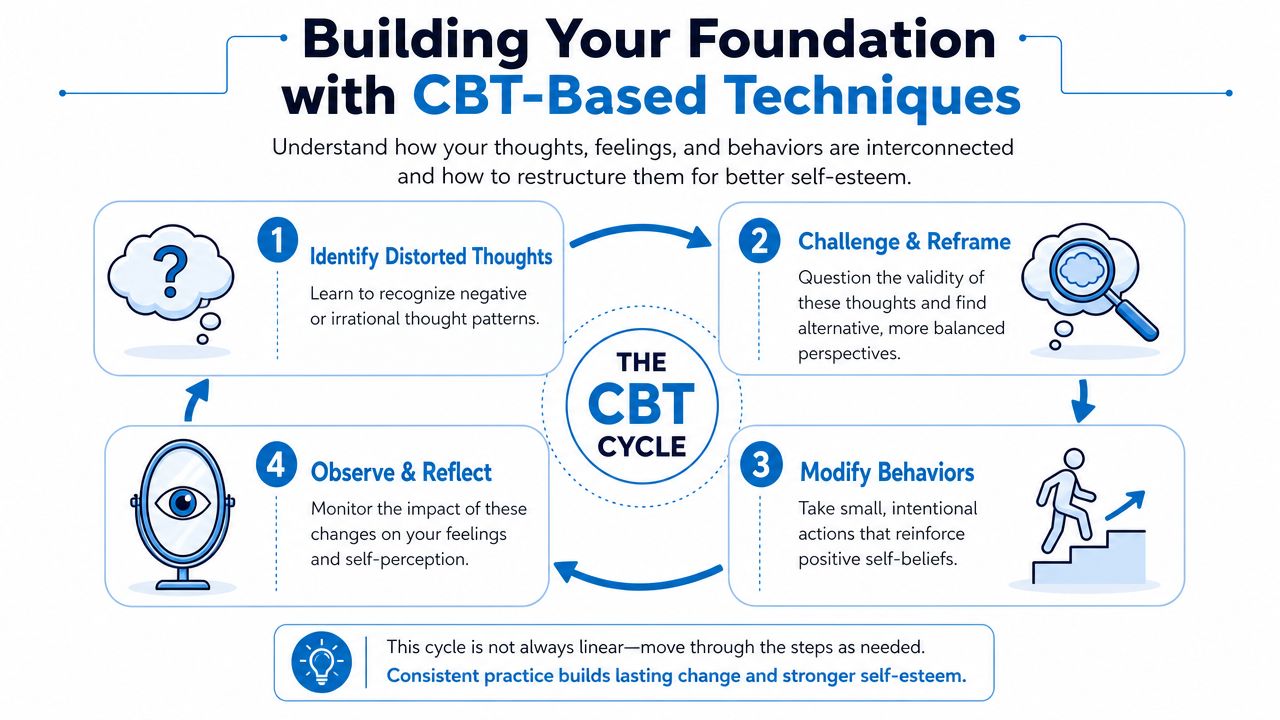
This is why CBT is one of the strongest evidence-based approaches for how to improve self-esteem. A major 2021 meta-analysis found that CBT had a weighted mean effect size of 0.74 compared with 0.41 for non-CBT approaches, and interventions lasting 8 to 12 weeks produced 27% greater improvement in self-esteem scores than shorter programs, according to the 2021 meta-analysis in the Journal of Abnormal Psychology.
If low self-esteem overlaps with low mood, the same logic often appears in structured work like CBT for depression.
Exercise one thought record
A thought record helps you slow down a painful moment and examine what your mind added to it.
Use this format:
| Situation | Automatic thought | Emotion | Evidence for | Evidence against | Balanced thought |
|---|---|---|---|---|---|
| What happened | What did I tell myself | What did I feel | Facts that support it | Facts that don't | A fairer conclusion |
Example:
- Situation – I made a grammar mistake during a work call.
- Automatic thought – They think I'm unprofessional.
- Emotion – Shame, anxiety.
- Evidence for – I stumbled and had to repeat myself.
- Evidence against – Nobody mocked me, the meeting continued, my points were still understood.
- Balanced thought – I sounded less fluent than I wanted, but that's different from being unprofessional.
The goal isn't fake positivity. It's accuracy.
Exercise two behavioral experiment
Low self-esteem survives by avoiding tests. A behavioral experiment is a small, planned action that checks whether your belief is true.
Start with one belief:
- “If I speak Italian in a shop, people will react badly.”
- “If I ask a question at work, they'll see I don't belong.”
- “If I go alone to an event, everyone will ignore me.”
Then test it:
Write the prediction
Be specific about what you think will happen.Take one manageable action
Ask one question. Start one conversation. Make one phone call.Record the result
What happened, not what you feared might happen.Update the belief
Did reality fully confirm the fear, partly confirm it, or contradict it?
People are often surprised that reality is less brutal than their inner critic predicted.
Exercise three build evidence of competence
Self-esteem improves when your brain has real evidence to work with. Create a brief daily log with three entries:
- One thing I handled
- One effort I made
- One quality I showed
Keep it concrete. “Booked the medical appointment” counts. “Asked for clarification instead of pretending to understand” counts. “Stayed calm when embarrassed” counts.
CBT helps you stop treating every hard moment as a verdict on your worth.
This matters in expat life because so many stressors are ambiguous. Without structure, the mind fills in the gaps with self-blame. CBT gives you a way to interrupt that process.
Cultivating Self-Compassion as an Expat
Why self-compassion matters when life keeps humbling you
Self-esteem asks, “How am I doing?” Self-compassion asks, “How do I treat myself when things are hard?”
That difference matters enormously for expats. If your worth depends on performing well, adapting fast, and getting approval from a new environment, your sense of self will stay fragile. There will be too many variables you can't control.
Self-compassion offers a steadier base. It doesn't ask you to deny pain or lower standards. It asks you not to turn pain into self-attack.
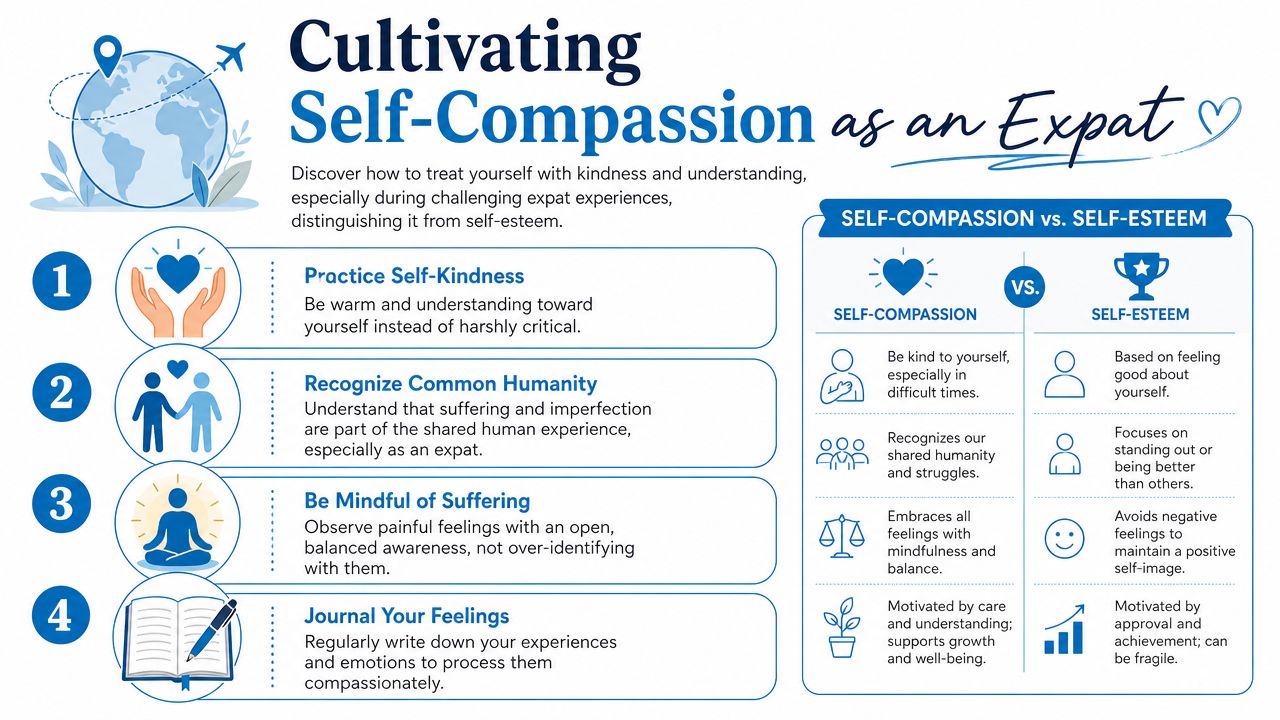
A 2023 meta-analysis found that self-compassion interventions increased self-esteem scores by 0.58 standard deviations, and a trial within that analysis showed that a simple daily exercise for two weeks led to a 41% reduction in negative self-talk and a 29% increase in positive self-affirmations, as reported in this Clinical Psychology Review article.
This is especially relevant in a culture shaped by appearance, presentation, and social perception. For some expats, body image and self-worth become tightly linked.
The self-compassion break
Use this in the moment. Not later when you feel better. Right when the shame spike hits.
Try these three steps:
Name the moment
“This is a painful moment.”
“I'm feeling embarrassed.”
“This really stings.”Normalize the struggle
“A lot of expats feel this way.”
“Learning a new system is hard.”
“I'm not the only person who struggles with this.”Offer kindness, not punishment
“May I be kind to myself right now.”
“I can be disappointed without attacking myself.”
“I'm allowed to be human in a difficult place.”
This can sound simple. It is simple. It's also powerful because it interrupts shame before shame turns into identity.
A supportive complement to this practice is mindfulness for emotional regulation, especially if you tend to get flooded before you can think clearly.
What self-compassion is not
People often resist self-compassion because they think it means self-pity, passivity, or making excuses. It doesn't.
Self-compassion is:
- Honest about pain
- Grounded in shared humanity
- Motivating because it lowers shame and defensiveness
It is not:
- pretending everything is fine
- avoiding responsibility
- telling yourself comforting lies
When you're building a life abroad, kindness toward yourself is not indulgence. It is psychological stamina.
Actionable Habits for Sustaining Self-Esteem

Set boundaries that protect self-respect
Low self-esteem often makes people overly accommodating. You don't want to seem difficult, especially in a foreign culture, so you say yes too quickly, stay silent too long, and absorb more than you should.
That may keep things smooth in the short term. It usually creates resentment and self-abandonment in the long term.
Assertiveness is one of the most practical self-esteem skills because it teaches your nervous system that your needs can be stated clearly and safely. A meta-analysis cited in this article on assertiveness training reported a stress reduction effect size of d = 0.52 among students. The core lesson is straightforward: when people communicate needs and boundaries more clearly, the stress that erodes self-worth often drops too.
Useful boundary scripts:
- At work – “I can do that, but not by today. I can have it ready tomorrow.”
- With friends – “I'd love to see you, but I need a quiet evening tonight.”
- With family back home – “I know you care. I'm not always able to update everyone right away.”
Use a success journal instead of waiting to feel better
Waiting to feel confident before acting rarely works. Action usually comes first.
A practical tool is a Success Journal. Each evening, write down three accomplishments from the day. Keep them specific and small enough to be real.
Examples:
- Administrative win – “I finally called the office instead of avoiding it.”
- Social win – “I introduced myself first.”
- Emotional win – “I noticed my shame spiral and paused before reacting.”
A strength-based approach reported that interventions like a Success Journal showed 60% higher self-awareness gains over four weeks compared with only challenging negative thoughts in the source summary available in this strength-based self-esteem review.
This kind of habit works because it gives the mind fresh data. You are no longer relying on mood to tell you who you are.
Build a community that reflects you back accurately
Self-esteem struggles get louder in isolation. When you have no witnesses to your effort, your inner critic becomes the loudest voice in the room.
Community doesn't have to start with deep friendship. It can begin with repeated contact and small belonging cues.
Try one of these:
- Join a recurring activity – language exchange, sports group, class, book circle
- Choose low-stakes repetition – go to the same café, market, or coworking space
- Initiate one step sooner – send the message, suggest the coffee, ask the follow-up question
- Let people know you're new – many warm connections begin with simple honesty
If daily stress is already high, support skills for regulation can make these efforts easier, especially strategies like those in this guide on coping with stress.
A strong self-esteem routine usually includes all three of these habits: boundaries, evidence of strength, and steady contact with other people.
When Self-Help Is Not Enough How Therapy Can Help
Signs you may need more support
Self-help can do a lot. It can help you name patterns, test beliefs, and reduce self-criticism. But there's a point where trying harder on your own starts to feel like more proof that you're failing.
That's usually the moment to stop treating support as a last resort.
Consider professional help if:
- Low self-esteem is affecting work, study, or relationships
- You avoid basic tasks because shame feels overwhelming
- You're stuck in persistent anxiety, sadness, or self-criticism
- Past experiences of rejection, trauma, or bullying keep getting activated
- You understand the advice but can't apply it consistently in real life
Therapy is useful here because low self-esteem is rarely just a set of wrong thoughts. Often, it's tied to older patterns: attachment wounds, perfectionism, chronic shame, trauma, or identity disruption after relocation.
What therapy can offer that self-help can't
A good therapist does more than give advice. They help you notice patterns you can't see when you're inside them.
Depending on your needs, therapy may include:
| Approach | What it helps with |
|---|---|
| CBT | Negative beliefs, avoidance, perfectionism, self-criticism |
| Schema Therapy | Deep-rooted patterns such as defectiveness, abandonment, or failure |
| EMDR | Painful memories and experiences that still trigger shame or fear |
| Cross-cultural work | Identity strain, belonging issues, and adaptation stress |
For expats, language also matters. The words available to you shape what you can process. Many people can function in Italian or English but only access vulnerable emotional material in their native language.
That's one reason therapy for internationals works best when it's culturally aware and easy to access. If you're looking for that kind of support, online therapy in English in Italy can make help feel much more reachable, especially when location, schedule, or language are barriers.
Therapy is not about becoming more impressive
It's about becoming less divided against yourself.
You do not need to earn support by getting worse. You do not need to wait until a confidence problem becomes a crisis. If you've been carrying the feeling that life in Italy has made you smaller, therapy can help you rebuild a sense of self that is more stable, more compassionate, and less dependent on constant proof.
FAQ
How can I improve self-esteem when living abroad in Italy?
Start by working on both your thoughts and your daily behavior. Low self-esteem abroad usually improves when you challenge harsh beliefs, practice self-compassion, and take small actions that rebuild competence. The key is using strategies that fit expat stress rather than relying only on generic positive thinking.
Why has moving to Italy affected my confidence so much?
Relocation can disrupt identity as much as routine. Language barriers, bureaucracy, isolation, and career disruption can make capable adults feel dependent or invisible. That often creates shame, even when the problem is the environment and not your worth.
Is self-compassion better than self-esteem?
For many expats, self-compassion is more stable than self-esteem. Self-esteem can rise and fall with success, approval, and performance, while self-compassion helps you stay grounded during setbacks. That makes it especially useful when you're adapting to a country where progress can be slow and inconsistent.
What is the fastest practical exercise for low self-esteem?
A thought record is one of the fastest useful tools. Write down the situation, your automatic thought, the emotion, the evidence for and against, and a more balanced conclusion. This helps you stop treating every awkward or painful moment as proof that something is wrong with you.
Can therapy help with low self-esteem caused by expat life?
Yes, therapy can help when low self-esteem is tied to relocation stress, shame, or repeated rejection. A therapist can help you work on distorted thinking, deeper patterns, and the emotional impact of cultural adaptation. This is often especially helpful when self-help tools make sense intellectually but don't shift how you feel.
When should I seek professional support for self-esteem problems?
Seek support when low self-esteem starts limiting your life. If you're avoiding relationships, work opportunities, everyday tasks, or feeling persistently anxious or depressed, it's a good time to talk to a professional. You don't need to wait until things become unbearable.
Is online therapy a good option for expats in Italy?
Yes, online therapy is often one of the most practical options for expats. It can make support easier to access across cities, work schedules, and language needs. Many people also find it easier to open up when they can speak from their own space.
Book your first free assessment call – no commitment, just a conversation with our Clinical Director who will listen and match you with the right therapist for you. Visit Therapsy.