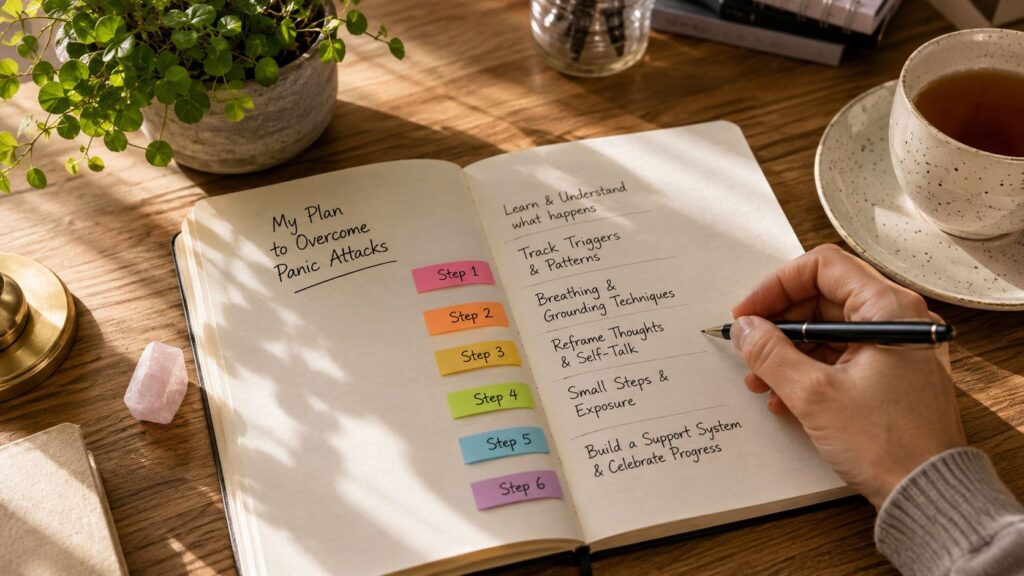
You open your laptop in Milan, skim the agenda for a meeting, and feel your chest tighten before anyone has spoken. You're not only thinking about the presentation. You're also translating tone, wondering whether your Italian colleague's brief email sounded irritated or efficient, and trying to decide if asking for clarification will make you look unprepared. That's often what managing anxiety at work looks like for expats in Italy. It isn't just pressure. It's pressure filtered through language, culture, identity, and the fear of getting it wrong in a place that still doesn't fully feel like yours.
For many professionals abroad, workplace anxiety is not a sign of weakness. It's a human response to sustained uncertainty, high expectations, and limited psychological safety. The dream of life in Italy can be real and beautiful. So can the loneliness, overcompensation, and quiet self-doubt that come with building a career far from home.
As a clinical psychologist, I often see that expat anxiety at work becomes more intense when people interpret every misunderstanding as a personal failure. They don't just ask, “Can I do this job?” They ask, “Do I belong here at all?” That's a heavier question.
The Hidden Weight of Working Abroad in Italy
The workplace can become the place where every part of expat life converges. Your performance matters. Your visa or financial stability may depend on it. Your support system may be elsewhere. And if you're working in a second language, even small tasks can require more mental effort than they used to.
Workplace anxiety is often a reasonable response to an environment that feels high-stakes, unfamiliar, or hard to read.
The broader public health picture matters too. This is a major health and work issue. It is not a personal flaw.
Why expats often miss what is happening
Many foreign professionals in Italy minimise their distress at first. They tell themselves:
- “I should be grateful.” You worked hard to get here, so you push down legitimate strain.
- “It's just adjustment.” Sometimes it is. Sometimes it has moved into a persistent anxiety cycle.
- “Everyone else seems fine.” They may not be. They may know the local codes better.
- “I need to prove myself.” This is one of the fastest ways to slide into chronic over-functioning.
Anxiety also blends easily with culture shock. If you're adapting to different work rhythms, more relational communication, or less explicit feedback, it can be hard to tell whether you're struggling emotionally or adjusting socially. Often, it's both. If that overlap feels familiar, it may help to read more about culture shock in Italy and how to cope.
What actually helps
The most useful approach combines two realities. First, you need practical tools for the nervous system and for your thoughts. Second, you need a culturally aware lens. If your anxiety is being triggered by unclear expectations, after-hours messaging, or fear of making mistakes in a foreign setting, generic advice like “just breathe” won't be enough.
That's where a more grounded approach helps. Name what's happening. Separate personal anxiety from structural pressure. Then respond to both.
Is It Stress or Is It Anxiety Recognizing the Signs at Work
Some stress at work is normal. It can sharpen focus, help you prepare, and fade once the situation passes. Anxiety is different. Anxiety lingers, generalises, and often starts affecting how you think, feel, and behave long before the actual task begins.
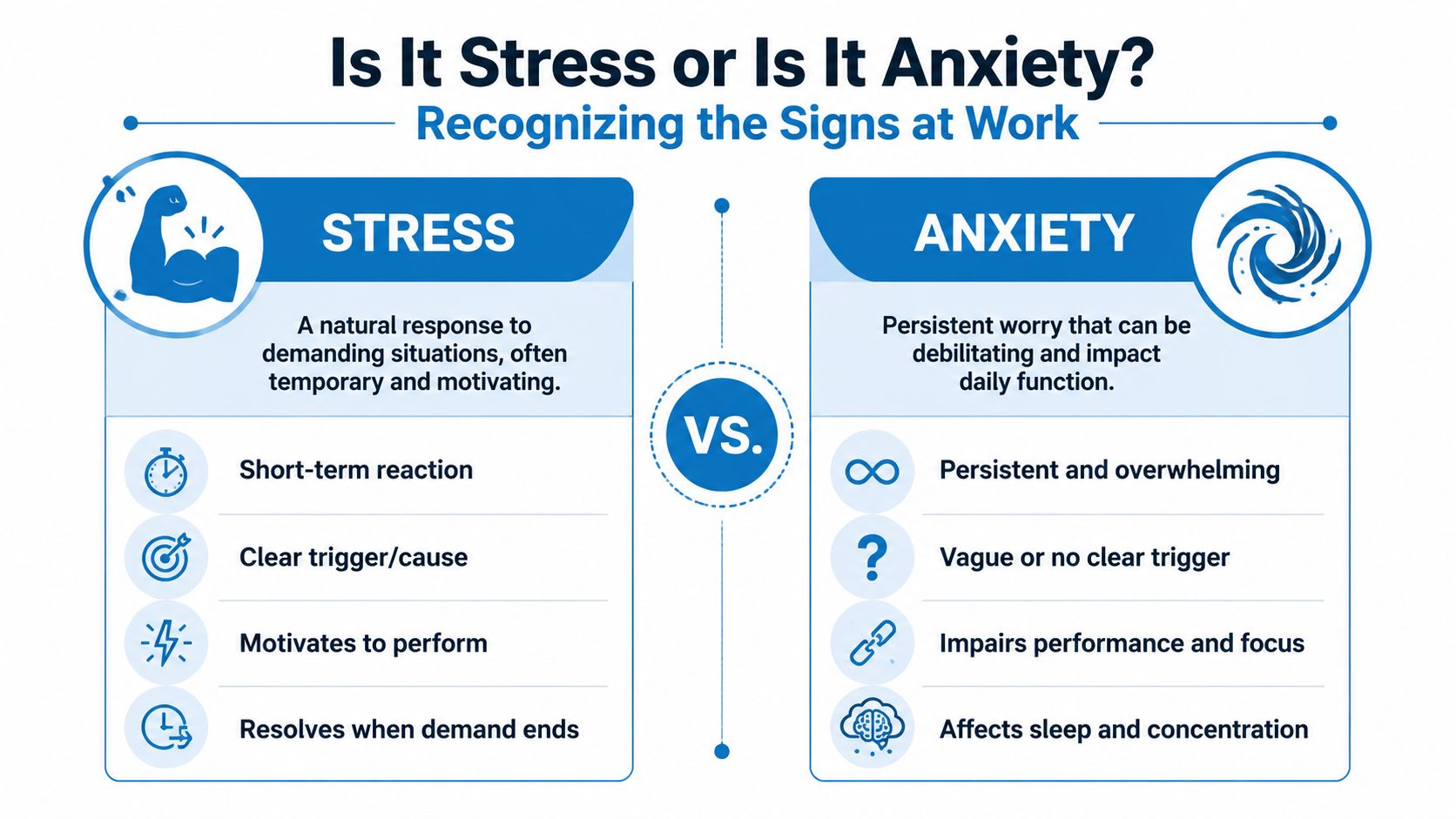
Workplace anxiety is persistent fear or worry linked to work demands, performance, communication, or evaluation, and it starts to interfere with concentration, confidence, decision-making, or daily functioning.
That difference matters because anxiety often disguises itself as conscientiousness. People praise you for being thorough, responsive, and committed. Meanwhile, you're checking emails compulsively, replaying conversations, and avoiding tasks that feel emotionally loaded.
According to ComPsych, employee leaves of absence for mental health issues were up 300% from 2017 to 2023, and anxiety became the No. This isn't a niche problem. It's showing up across modern workplaces.
How anxiety tends to show up on the job
A useful way to recognise anxiety is to sort symptoms into three groups.
Physical signs
- Body tension. Tight shoulders, jaw clenching, or a stomach that knots before meetings.
- Sleep disruption. You're tired but your mind keeps rehearsing tomorrow's tasks.
- Stress reactivity. Your heart races when your manager messages, even before you read it.
Cognitive signs
- Catastrophic thinking. A small correction becomes “I'm failing.”
- Analysis paralysis. You keep preparing, but can't send the email or start the project.
- Attention problems. You read the same paragraph several times and still don't absorb it.
Behavioural signs
- Avoidance. You postpone calls, delay feedback, or stay quiet when you need clarification.
- Excessive reassurance-seeking. You ask colleagues if your message sounded okay, then ask again.
- Overcompensation. You work late, over-explain, or try to be perfect to prevent criticism.
If you want a broader symptom overview, this page on anxiety symptoms in adults may help you put words to what you're feeling.
A quick distinction that helps in practice
Stress usually sounds like, “I've got a lot on this week.”
Anxiety often sounds like:
- “If I make one mistake, they'll lose confidence in me.”
- “I need to get this exactly right before I reply.”
- “If I ask for help, I'll look incompetent.”
- “If my boss is brief, something is wrong.”
When those thoughts become repetitive, believable, and behaviour-shaping, you're likely dealing with more than ordinary stress.
Your In-the-Moment Anxiety First-Aid Kit
When anxiety spikes at work, you don't need a perfect routine. You need a small set of tools you can use quickly, discreetly, and consistently. The goal isn't to erase anxiety on command. The goal is to bring your system down from alarm mode so you can think again.

Use grounding before you use logic
If your body feels flooded, start with sensation. One simple option is the 5-4-3-2-1 method. Mentally name:
- Five things you can see
- Four things you can feel
- Three things you can hear
- Two things you can smell
- One thing you can taste
This works because attention shifts from imagined threat to present sensory input. In practical terms, it gives your mind a task that competes with spiralling thoughts.
Slow breathing helps when your body is leading the panic
Try box breathing:
- Inhale for a count of four
- Hold for four
- Exhale for four
- Hold for four
Repeat for a few rounds. Keep your shoulders relaxed. Breathe lower into the torso rather than lifting the chest.
A calm body doesn't solve every work problem, but it makes better decisions possible.
Take a micro-break that actually interrupts the cycle
A useful micro-break isn't scrolling your phone while continuing to worry. It's a short, deliberate state change. Stand up. Walk to get water. Look outside. Loosen your jaw. Write one sentence on paper: “What is the next concrete task?”
For many office workers, movement is especially helpful because anxiety builds energy in the body. If you want practical ways to add more movement into a desk-heavy day, this guide on how to burn calories while working offers realistic ideas that can also support regulation through brief physical activation.
You can also explore simple mindfulness practices if your mind tends to race during transitions between calls, emails, and deadlines.
Don't make the common mistake
People often try six techniques at once, then conclude that none of them work. That usually backfires. Pick one breathing tool and one grounding tool. Use them repeatedly in the same kind of moments. Anxiety responds better to repetition than novelty.
Reshaping Your Mindset with Cognitive and Behavioral Tools
If first-aid tools help you get through the moment, CBT helps you change the pattern that keeps anxiety alive. In simple terms, Cognitive Behavioral Therapy looks at the relationship between thoughts, feelings, body responses, and behaviour. At work, that matters because anxiety is rarely driven only by what happens. It's driven by what your mind predicts, assumes, and rehearses.
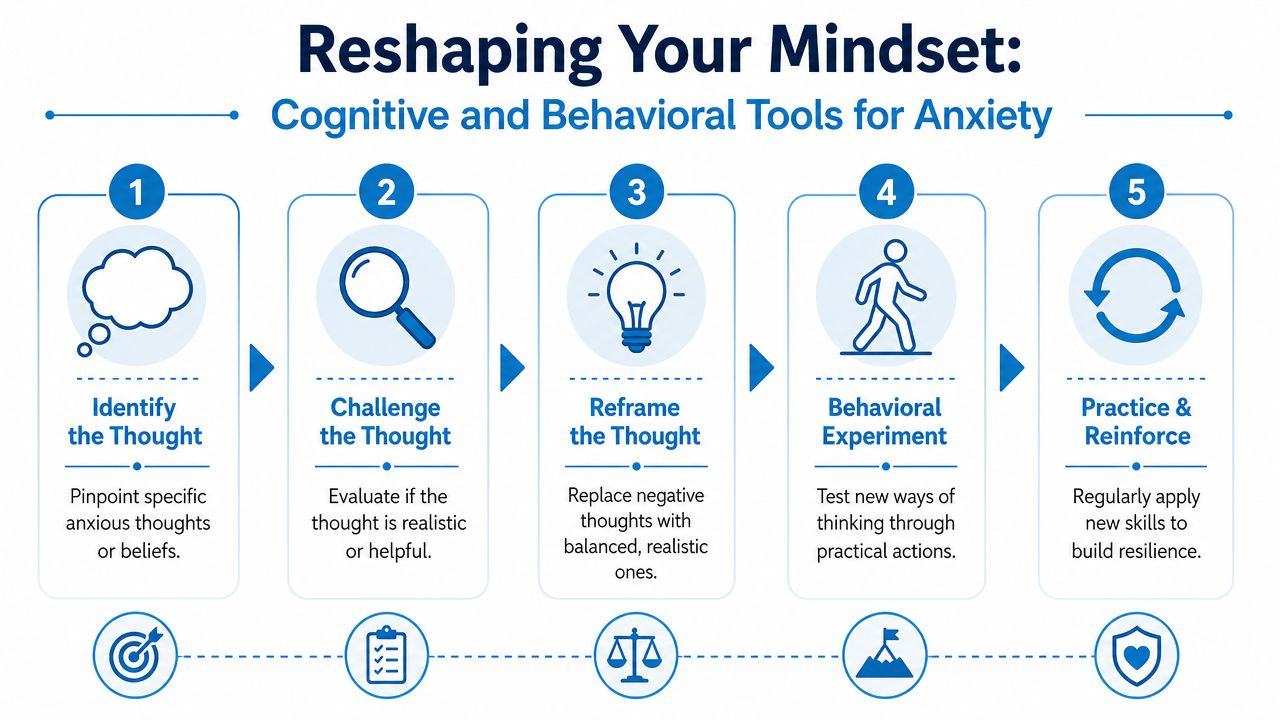
A practical strategy is to identify the trigger, write the automatic thought, test it against evidence, and replace it with a more realistic statement.
A simple reframing sequence
Try this four-part structure when work anxiety flares.
| Situation | Automatic thought | Evidence check | Balanced replacement |
|---|---|---|---|
| Manager asks to talk later | “I'm in trouble” | Has this happened before for neutral reasons? Do I actually know the topic? | “I don't have enough information yet. I can prepare, but I don't need to assume the worst.” |
| I need to ask a colleague to repeat something in Italian | “They'll think I'm incapable” | Have people usually responded badly, or am I predicting embarrassment? | “Clarifying improves accuracy. It is a professional behaviour, not a failure.” |
| I made a small mistake in an email | “I've damaged my credibility” | Is there evidence this one mistake defines my performance? | “I made an error and can correct it. That is uncomfortable, not catastrophic.” |
This is the core of cognitive reframing. You're not replacing thoughts with forced positivity. You're replacing distortion with proportion.
Behavioural experiments are where change becomes real
Anxious thoughts feel convincing because they are rarely tested. A behavioural experiment is a small action that checks whether your feared prediction is true.
Examples:
- Prediction: “If I ask for clarification, my boss will think I'm weak.”
Experiment: Ask one concise clarifying question in writing. - Prediction: “If I don't answer tonight, they'll see me as unreliable.”
Experiment: Reply the next morning with a clear, professional response. - Prediction: “If I speak up in the meeting, I'll say something foolish.”
Experiment: Prepare one short contribution and deliver only that.
The aim is not to feel fearless first. The aim is to gather better evidence.
For some people, a more structured CBT process is useful, especially when work anxiety has become repetitive or closely tied to self-worth. This overview of cognitive behavioral therapy for anxiety explains how that work is typically approached.
Graded exposure works better than avoidance
Regional guidance also recommends a graded exposure hierarchy for anxiety. List work triggers from least to most distressing, start with the easiest, stay in the situation until anxiety drops naturally, and repeat before moving up (Better Health Victoria anxiety treatment options). This can be very effective for tasks like speaking in meetings, making phone calls, or sending messages without over-editing.
The key mistake is moving too fast or escaping too soon. Anxiety learns safety through repetition, not through perfect performance.
Communicating Your Needs and Setting Boundaries in Italy
Many expats assume that if they were stronger, they wouldn't need to say anything. Clinically, that's rarely true. Managing anxiety at work often requires communication, not just coping. If your environment is unclear, overloaded, or constantly intruding into personal time, silence tends to increase anxiety rather than reduce it.
In Italy, workplace communication can feel more relational and context-based than what many Americans or northern Europeans expect. That doesn't mean you should become vague. It means your message may land better if it is both clear and socially attuned.
Direct does not have to mean harsh
A useful formula is:
- Name the work goal
- Describe the obstacle neutrally
- Propose a concrete adjustment
For example:
“I want to deliver this well. To do that, I need clarity on which part takes priority today.”
That tends to work better than apologising excessively or waiting until you're already overwhelmed.
Boundary scripts that sound professional
If after-hours availability is increasing your anxiety, try language that is firm but cooperative.
On evening messages
“I saw your message. I'll respond properly first thing tomorrow morning.”On competing deadlines
“I can complete this today, but then the other task would move. Which is the priority?”On vague requests
“To make sure I've understood, could you confirm the expected outcome and timing in writing?”On recurring overload
“I've noticed the volume has become difficult to sustain at the current pace. I'd like to discuss what can be adjusted so I can keep the quality high.”
These are not defensive statements. They're organisational statements.
Cultural nuance matters
An American professional might be used to naming a problem quickly and moving straight to solutions. In some Italian workplaces, rapport, tone, and timing carry more weight. A request may be better received if you begin with shared purpose rather than immediate objection.
That doesn't mean abandoning your needs. It means packaging them in a way that fits the local social rhythm. In practice:
- Lead with collaboration rather than confrontation.
- Keep your tone warm, but your request specific.
- If spoken conversation feels too fluid or ambiguous, follow up in writing.
- Don't confuse indirect communication with rejection. Sometimes it is style.
If your anxiety rises after every ambiguous exchange, the answer may be more clarification, not more self-criticism.
One boundary that expats especially need
Global teams often create a hidden trap. You may be working in Italy while your colleagues are in other time zones, using email, Slack, WhatsApp, and calls that never fully stop. In that kind of system, “being available” can subtly become part of your identity.
That's risky. A better standard is predictable responsiveness, not permanent openness. You don't need to be reachable at all times to be professional. You do need to communicate your response windows clearly and follow them consistently.
Navigating Workplace Accommodations as an Expat
Sometimes the problem is not that your coping skills are weak. The problem is that the work setup is driving the anxiety. That distinction matters. If your workload is excessive, expectations are unclear, or manager support is poor, no breathing exercise will fully solve it.
A major gap in typical advice is exactly this point. Many articles focus on personal coping, but a more effective response may involve requesting accommodations when the trigger is structural, especially for expats trying to handle these conversations in a foreign culture (FEEA discussion of structural workplace anxiety).
What counts as a useful accommodation
In practice, workplace support often looks less dramatic than people fear. You may not need a sweeping change. You may need one or two targeted adjustments that reduce friction.
Examples include:
- Clearer written instructions when verbal communication is too fast or ambiguous
- Temporary workload changes during acute periods of anxiety
- Flexible scheduling if sleep disruption or therapy appointments affect early hours
- Protected focus time for tasks that become harder under interruption
- More structured check-ins so you're not left guessing priorities
The best request is usually specific, work-linked, and framed around performance.
How to ask without over-disclosing
You do not need to share every detail of your mental health history to ask for support. In many professional contexts, less is better. Focus on function.
A practical script:
State the issue neutrally
“I've noticed that the current workflow is affecting my concentration and ability to prioritise effectively.”Link it to work quality
“I want to make sure I can continue delivering strong work consistently.”Request one concrete adjustment
“It would help if priorities could be confirmed in writing after meetings.”Suggest review
“Could we try that for the next few weeks and then reassess?”
This keeps the conversation grounded and collaborative.
The expat-specific challenge
For foreign professionals, the accommodation process can feel harder for reasons that have nothing to do with motivation. You may not know local HR norms. You may worry about your contract, probation, or reputation. You may struggle to find the right wording in Italian, or to read whether a manager is being receptive.
That uncertainty often leads people to ask for nothing until they're near burnout.
A better rule is this:
Ask for support while you still have enough energy to use it.
If HR feels intimidating, prepare in writing first. If language is a barrier, draft the request in your strongest language and then translate it carefully. If the workplace is informal, follow a spoken conversation with a concise written summary so expectations are documented.
When self-accommodation is still useful
Even if formal accommodations aren't possible, you can still build structure around your day:
- batch similar tasks
- create written follow-ups after verbal instructions
- block transition time before difficult meetings
- reduce caffeine or alcohol if they amplify symptoms
- protect sleep as part of your work functioning, not as an afterthought
These steps don't replace organisational change, but they can reduce preventable strain.
When Self-Help Is Not Enough How to Find Professional Support
Self-help has a place. It can steady you, reduce reactivity, and help you understand your patterns. But if anxiety keeps returning, spreads beyond work, or starts shaping your identity, professional support becomes important. Therapy is not a last resort. It is often the most efficient way to stop a problem from becoming your normal.
Signs it is time to get support
Consider speaking to a therapist if:
- Work anxiety is persistent. It doesn't switch off after the workday ends.
- Your performance is suffering. You're avoiding, freezing, second-guessing, or overworking to compensate.
- Your body is paying the price. Sleep, digestion, headaches, or constant tension are becoming part of daily life.
- Your world is getting smaller. You're declining social plans, feeling emotionally flat, or losing confidence outside work too.
- The issue feels bigger than one role. Similar fears show up with authority, belonging, perfectionism, or self-worth across settings.
In those cases, short-term coping strategies usually help only partially. The work needs to go deeper.
What therapy for workplace anxiety often includes
A therapist may help you:
- identify the specific triggers that set off your anxiety at work
- understand the thoughts and assumptions underneath them
- map the behaviours that maintain the cycle
- practise more effective communication and boundaries
- process the intercultural stress that sits underneath the work problem
- decide whether the issue is manageable, or whether the environment itself is not healthy for you
For expats, this matters because work anxiety is often tied to migration stress, isolation, identity shifts, and the fatigue of constantly adapting. A culturally aware therapist doesn't treat that as background noise. They treat it as clinically relevant.
If you're trying to understand what a good clinical fit looks like, this guide on finding the right therapist for expats in Italy can help you assess what you need.
A practical treatment direction
In my clinical work, I often use CBT for workplace anxiety because it is concrete and effective for identifying triggers, challenging distorted thoughts, and reducing avoidance. EMDR can also be helpful when current work situations activate older experiences of criticism, humiliation, instability, or trauma. Schema Therapy becomes useful when anxiety is tied to deeper patterns such as perfectionism, defectiveness, or relentless standards.
One option in Italy is Therapsy, a multilingual psychotherapy service that offers online and in-person sessions across many Italian cities, with therapists working in Italian, English, French, Spanish, German, Portuguese, Ukrainian, Russian, Greek, Arabic, Urdu, Hebrew, Hindi, and Persian (Farsi). The service includes a free first assessment call, and sessions are available from €70 for individual therapy, €100 for couple therapy, €110 for psychiatric consultation, and €255 for psychodiagnostic assessment.
A simple action plan if you're overwhelmed
This week's plan
- Identify one repeating trigger at work.
- Use one breathing or grounding tool during that moment.
- Write down the automatic thought that appears.
- Test it with one small behavioural experiment.
- If the pattern keeps disrupting work or sleep, book professional support rather than waiting for a crisis.
You don't need to wait until you're falling apart to deserve help. Anxiety at work often improves when support is timely, practical, and culturally informed.
FAQ
Is managing anxiety at work mostly about learning to calm down?
No. Calming down is useful, but it is only one part of the process. Effective support usually combines nervous system regulation, clearer thinking, behavioural change, and, when needed, changes to workload, communication, or boundaries.
How do I know if my job is causing the anxiety or just revealing it?
Usually it's both. A demanding or unclear environment can trigger anxiety, and existing patterns such as perfectionism or fear of criticism can then intensify it. Therapy helps separate what belongs to the workplace from what belongs to your history and coping style.
Can I ask for support at work without sharing a diagnosis?
Yes. In many situations, it's better to focus on what helps you function well rather than disclosing every personal detail. You can describe the work impact, request one practical adjustment, and frame it around maintaining quality and consistency.
Is workplace anxiety common for expats in Italy?
Yes, it is common. Working abroad often adds language pressure, cultural ambiguity, isolation from familiar support, and uncertainty about professional norms. Those factors can intensify ordinary work stress and make anxiety harder to recognise.
What if I feel anxious only with my manager, not with the job itself?
That still matters. Anxiety linked to one authority figure can reflect communication style, unclear expectations, or an older relational pattern that gets activated in the workplace. It is worth exploring rather than dismissing.
Will therapy focus only on coping techniques?
No. Good therapy should include coping tools, but it should also help you understand the pattern, improve communication, and evaluate whether the workplace setup itself needs to change. For expats, it should also take intercultural stress seriously.
Do I need therapy if I'm still functioning at work?
Possibly, yes. Many high-functioning professionals are coping at a very high internal cost. If your work gets done but your sleep, confidence, or personal life is suffering, that is still a meaningful problem.
Book your first free assessment call with THERAPSY if you'd like support that is warm, evidence-based, and sensitive to the circumstances of building a life and career abroad. There's no commitment, just a conversation with our Clinical Director who will listen carefully and match you with the right therapist for you.