If you're in Milan, Rome, Florence, or anywhere else in Italy and you've realised your old therapy setup doesn't fit your new life, you're not overreacting. Talkspace alternatives matter most when the problem isn't “therapy online or not”, it's finding care in your language, with your cultural context, and in a format that works in Italy.
For expats, that usually means a therapist who understands relocation stress, loneliness, bureaucracy, identity shift, relationship strain, and the weird in-between feeling of living between countries. It also means knowing when a subscription platform is enough, and when you need a human-matched practice with online and in-person access.
Why Expats in Italy Look Beyond Talkspace
A client in Milan often comes to this conclusion the hard way. They signed up for a therapy app, expected convenience, and then discovered the therapist had never lived abroad, didn't understand Italian bureaucracy, and couldn't offer anything beyond a virtual format that felt disconnected from daily life. That's when Talkspace alternatives stop being a pricing comparison and become a fit question.
For expats, the issue is rarely just access. It's language, cultural context, and continuity. If you're trying to hold down a job, manage residence permits, or manage a relationship across cultures, the therapist has to understand the environment you're living in, not just the symptoms you're reporting.
Practical rule: if your stress is tied to life in Italy, your therapy should be able to deal with Italy too.
That's why the phrase Talkspace alternatives means something different here. In an expat context, alternatives are not only other digital apps. They include multilingual psychotherapy, clinics with local presence, and care that can move with you between online sessions and appointments in Italian cities.
The market itself reflects that shift. Similarweb's August 2025 data shows that Talkspace's closest comparable site was Talkiatry, with 1.7 million monthly visits, while Psych Central reached 2.2 million visits and BetterHelp reached 7 million visits. That pattern shows people aren't shopping one brand against another anymore, they're moving among therapy platforms, psychiatric services, and mental-health content hubs while they decide what kind of help they need. Similarweb competitor data
For expats, the smartest question is simple. Do you need a chat-based subscription, or do you need a therapist who can work with your relocation reality in Italy?
What Makes a Therapy Platform Work for Expats
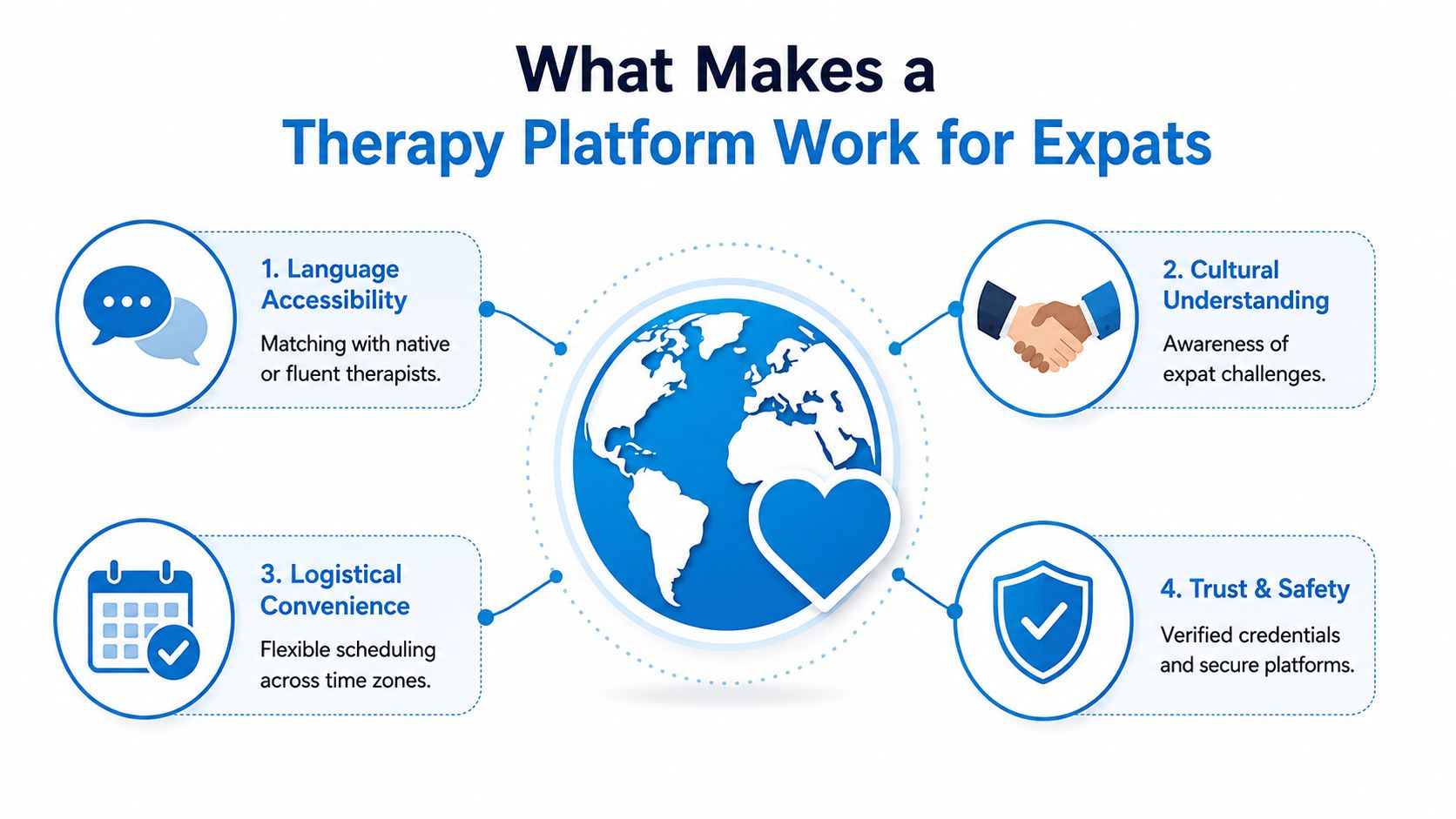
A therapy platform works for expats when it solves four problems at once. It must match language, culture, logistics, and trust. If it only solves one of those, it usually feels convenient for a week and frustrating after that.
Language and cultural fit
Language match is not a luxury. If you're an expat or international student, you need to say difficult things without translating your pain in your head first. That matters even more for multilingual communities such as Ukrainian, Russian, Arabic, French, Spanish, Portuguese, Greek, Hebrew, Hindi, and Persian (Farsi) speakers, where emotional nuance can disappear fast if the therapist only works in English.
Cultural fit matters for the same reason. Relocation stress can look like anxiety, numbness, irritability, or shutdown, but underneath it is often grief, identity disruption, or a loss of belonging. CBT, EMDR, and Schema Therapy can all help, but only if the therapist understands the context the symptoms grew out of.
Logistics and continuity
Expats need flexibility. Sometimes online care is the only realistic option. Sometimes the work goes deeper when you can also meet in person, especially if you're dealing with trauma, couples conflict, or long-running adjustment issues.
That's why hybrid access matters. A platform that can move between online sessions and physical locations across Italy gives you continuity when your schedule changes, your city changes, or your needs change.
Human matching and safety
A good platform doesn't hide the therapist behind automation. Human matching matters because people don't fit neatly into forms. If you're choosing care for trauma, burnout, relationship strain, or psychiatric support, you want a clinician, not a chatbot.
Clinical point: the right match is often more important than the fanciest interface.
If you want a straightforward English-language entry point for therapy in Italy, you can read more on online therapy in English in Italy.
Comparing the Main Types of Talkspace Alternatives
The mistake many individuals make is comparing therapy options as if they're all the same product. They're not. Some are subscription apps, some are local multilingual practices, some are public services, and some are campus-based support desks. Each one solves a different problem.
Here's the cleanest way to think about the subject.
| Category | Languages | Access | Pricing Model | Best For |
|---|---|---|---|---|
| Global teletherapy platforms | Mostly English, sometimes limited matching in other languages | Virtual only | Subscription or per-session | People who want fast digital access and don't need local presence |
| Multilingual practices in Italy | Multiple languages, including expat-relevant languages | Online and in-person | Session-based, often transparent | Expats, international students, couples, and people who want continuity in Italy |
| Public Italian services | Primarily Italian | In-person, system-dependent | Public-sector access | Residents who can navigate the local system and wait times |
| University counseling desks | Often limited, sometimes bilingual | Campus-based | Usually low-cost or included | Students who need basic support and a first point of contact |
The big difference is not “which one is cheaper”. It's which one matches the level of support you need.
If you're still sorting out broader platform comparisons, this internal guide on BetterHelp alternatives is useful context, but for expats in Italy the key filter is simpler. Does the service fit your language, your city, and your clinical need?
How Therapsy Works as a Multilingual Alternative
A good expat therapy service should feel personal from the start. Not decorative. Personal. That means a real person reads your situation, asks what language you need, and helps decide whether you should start with individual therapy, couples work, psychiatric consultation, or assessment.

Human matching first
Therapsy uses human matching, not automated questionnaires. You fill out the form on therapsy.it, and the Clinical Director gets in touch within 12 hours, usually via WhatsApp. That first contact is a real conversation, not a funnel.
The point is simple. People living abroad often don't know whether they need support for adjustment, trauma, burnout, panic, or relationship conflict. A human intake process is better than making them guess.
Languages, methods, and clinical depth
Therapsy offers therapy in 14 languages, including Italian, English, French, Spanish, German, Portuguese, Ukrainian, Russian, Greek, Arabic, Urdu, Hebrew, Hindi, and Persian (Farsi). That matters because most expats do not need a translated symptom checklist. They need a therapist who can follow emotional nuance in their own language.
The practice works with evidence-based approaches like CBT, EMDR, Schema Therapy, TMI, systemic-relational therapy, humanistic and bioenergetic psychotherapy, and ethnopsychotherapy. That mix is useful because expat distress is rarely one-dimensional. Anxiety, identity loss, grief, and relationship strain often overlap.
A Ukrainian professional in Milan, for example, may need language safety first, then trauma-informed care, then practical support around work stress and belonging. An American student in Florence may need help with homesickness, panic, and academic pressure. Different stories, different pacing, different treatment paths.
In-person and online access across Italy
Therapsy offers both online sessions and in-person therapy across 20+ Italian cities and 80+ physical locations, including Milan, Rome, Florence, Turin, Bologna, Bergamo, Padova, Verona, and more. That matters because many clients start online, then move in person once trust is built.
The structure is clear. First assessment call is free, individual therapy starts from €70/session, couple therapy from €100/session, psychiatric consultation from €110/session, and psychodiagnostic assessment from €255 for 3 sessions. Those are real entry points, not vague promises. Multilingual psychotherapy for expats in Italy
Therapsy also carries institutional trust signals through organisations such as Cigna, World Food Programme, FAO, MUR, InterNations, IED, and Istituto Marangoni. For people living abroad, that kind of credibility matters because therapy has to feel culturally open and professionally grounded at the same time.
Choosing the Right Alternative for Your Situation
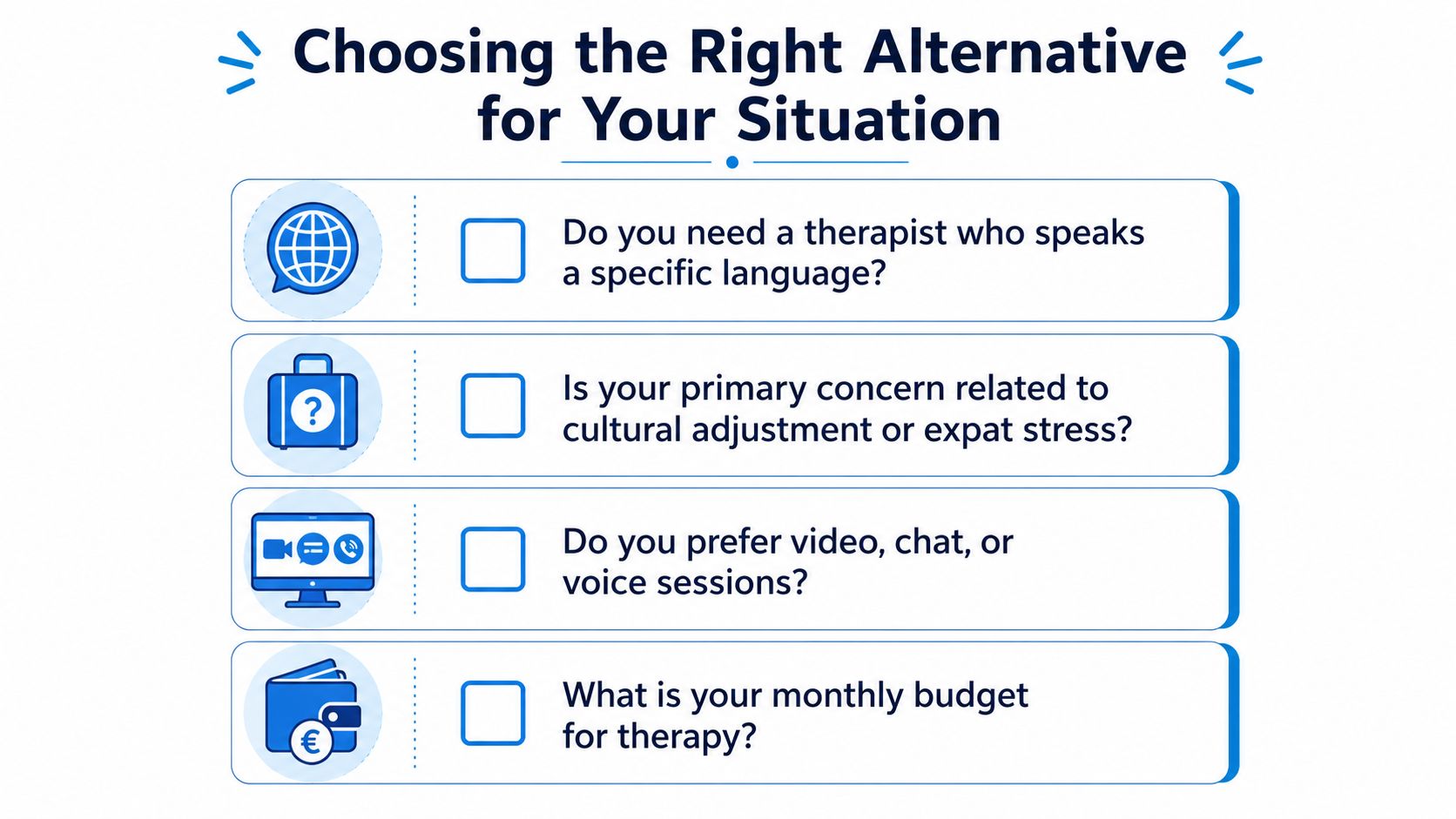
You don't need every kind of therapy platform. You need the right one for your problem. That starts with being honest about what you need right now.
Use these questions before you book
- Do you need a therapist who speaks a specific language? If yes, language match should come before brand familiarity.
- Is your stress mostly about relocation or culture shock? If yes, you need someone who understands expat adjustment, not just generic anxiety.
- Do you prefer video, chat, voice, or in-person sessions? If you know you need physical presence, rule out virtual-only care.
- Do you need psychiatry, diagnosis, or medication support? If yes, a therapy-only subscription may be too narrow.
- Are you dealing with a couple issue across cultures? If yes, you need a therapist who can hold two realities at once.
That last point gets ignored too often. Cross-cultural couples usually need more than communication tips. They need help with family systems, conflict styles, and cultural assumptions that keep colliding in the same conversation.
For students, the right path can be different. Campus support may be enough for short-term strain, but if the issue is deeper, a multilingual external therapist gives better continuity. For burned-out professionals, the main question is whether care can fit around work without losing quality.
If budget is the deciding factor, this guide on how much therapy costs in Italy helps you compare realistic options without guessing.
If you need diagnosis, psychiatric care, or trauma treatment, don't choose based on convenience alone. Choose based on clinical fit.
That's the dividing line. Convenience helps you start. Fit helps you stay in treatment long enough for it to matter.
Booking Your First Session Step by Step
Booking therapy abroad shouldn't feel like paperwork with feelings attached. The process should be simple, human, and clear. If it isn't, people delay it, and delay is usually the most expensive option emotionally.
A clean booking path
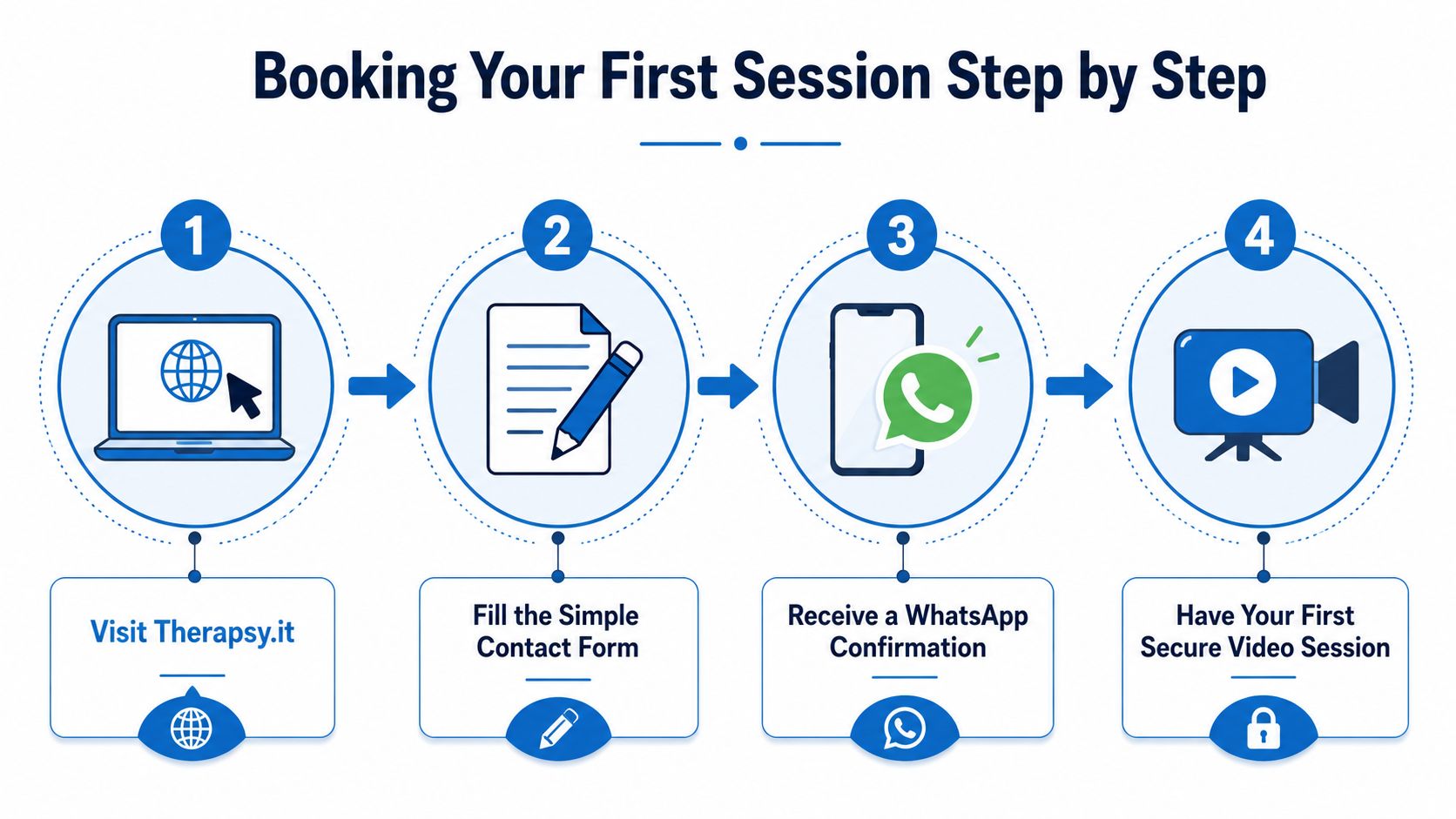
- Visit therapsy.it. Start with the contact form, not a long search spiral.
- Fill in your details. The form gives enough context for the Clinical Director to understand your needs.
- Get a WhatsApp confirmation. You're contacted within 12 hours, which reduces the usual waiting-room uncertainty.
- Have the free assessment call. Language, preferences, and clinical needs are discussed during this call before matching.
That assessment call matters more than people think. It lowers the risk of getting paired badly, and for expats that's huge. If you've already had the experience of trying to explain your life twice, you know why.
What the first session usually feels like
The first session isn't meant to solve everything. It's meant to clarify what's going on, what you want help with, and what pace feels safe. You'll usually talk about your background, your current stressors, and what you need from therapy in practical terms.
If the first match doesn't feel right, rematching is possible. That's not a failure, it's part of good care. Therapy only works when the relationship is usable.
For readers who want a broader orientation to starting therapy in Italy, this internal guide on how to start therapy in Italy is a good companion resource.
What to prepare before you book
- Your main concern: one or two sentences about what's been hardest lately.
- Your language preference: the language you can think and feel in most easily.
- Your format preference: online, in-person, or hybrid.
- Your care needs: therapy alone, couple work, psychiatry, or assessment.
That's enough to begin. You don't need a perfect explanation of your life before reaching out.
Key Takeaways and Your Next Step
Talkspace alternatives for expats in Italy are not just about price or app design. They're about whether the care actually fits your life here, in this language, in this city, with this level of complexity. If the platform can't handle language, culture, and continuity, it's not really built for expats.
The clearest decision rule is this. If your problem is light and purely digital, a subscription model may be enough. If your problem involves relocation stress, identity loss, trauma, couples conflict, or the need for psychiatry, you need something more grounded and more human.
For many international clients in Italy, the most practical solution is a multilingual practice that offers both online and in-person care. That gives you flexibility when life is busy and stability when therapy gets deeper. It also means you're not forced to choose between local presence and global standards.
Therapsy is one option that fits that model in Italy. It offers multilingual psychotherapy, human matching, online and in-person sessions, and a free first assessment call, which is the lowest-risk way to see if it's a fit.
Book your first free assessment call, no commitment, just a conversation with our Clinical Director who will listen and match you with the right therapist for you. Visit therapsy.it.