You may be living in Italy, studying, working, and managing daily life in another language, yet still feel like you're failing at all of it. A difficult conversation, a mistake at work, or another evening alone can quickly become evidence for the thought, “I'm not good enough.” Therapy for low self-esteem helps by changing the cycle behind that conclusion, not by teaching temporary confidence tricks.
Why Low Self Esteem Feels Different When You Live Abroad
An international student in Milan might understand a lecture but freeze when speaking in a seminar. A professional in Rome might perform well at work yet feel unintelligent after searching for the right Italian phrase at a pharmacy. Someone who moved for a relationship may look settled from the outside while privately wondering whether losing familiar work, friendships, and routines means losing part of their identity.
Living abroad can make ordinary uncertainty feel personal. Language fatigue can resemble incompetence, cultural differences can feel like rejection, and comparing daily life with an idealised vision of Italy can create a painful sense of falling short. Social situations may also demand more effort because humour, tone, bureaucracy, and unspoken rules aren't always easy to read.
That doesn't mean the problem is “just culture shock.” A person may begin interpreting specific difficulties as proof of a global belief: “I don't belong here,” “I'm behind everyone else,” or “I'm a burden.” Once those beliefs become familiar, low self-esteem can affect decisions, relationships, work, study, and the willingness to ask for help. Readers who recognise a broader loss of identity may find it useful to explore the experience of an expat identity crisis.
What makes the expat experience especially vulnerable?
An expat often loses several sources of feedback that previously supported a stable sense of self. Friends and relatives may no longer see daily achievements, professional status may change after relocation, and the person may not yet have a local community that reflects their abilities back to them.
The result can be a mismatch between external reality and internal evaluation. Someone may be coping with a demanding transition while judging themselves as though they should already feel confident, fluent, socially connected, and professionally established.
A difficult adjustment is evidence that the transition is demanding, not proof that the person is inadequate.
Therapy doesn't erase the practical challenges of living abroad. It helps identify where those challenges have become linked to harsh self-judgement, avoidance, shame, or withdrawal. The clinical aim is to make self-evaluation more accurate and flexible, so a mistake remains a mistake rather than becoming a verdict on personal worth.
The Hidden Cycle That Keeps Low Self Esteem Going
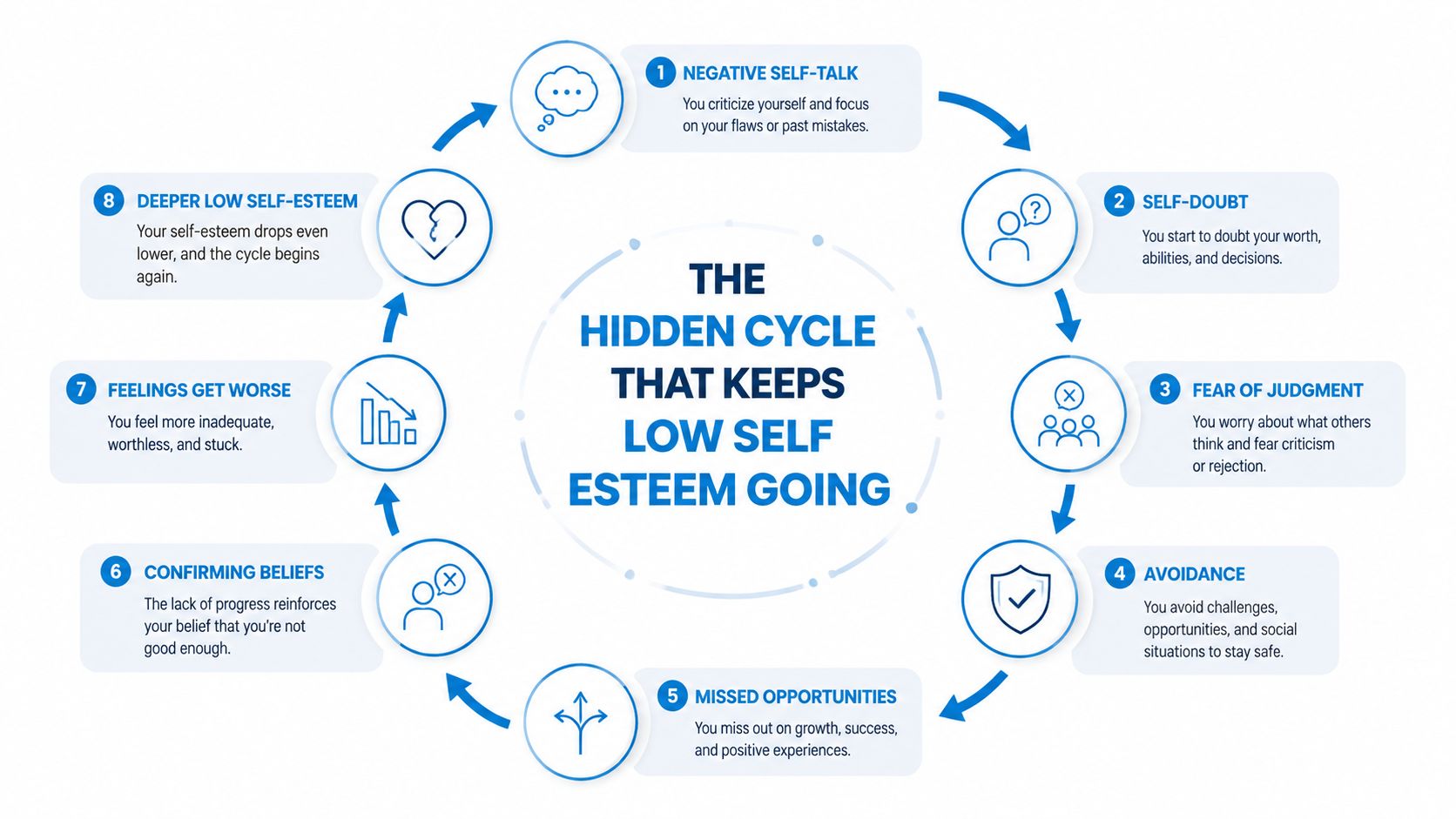
The Fennell model, used in CBT for low self-esteem, describes a maintenance cycle involving negative automatic thoughts, avoidance, safety behaviours, and rigid core beliefs such as “I am worthless.” Research on CBT interventions based on this model found a post-treatment effect size of 1.12 for weekly sessions and 0.34 for one-day workshops, with low heterogeneity, supporting the importance of structured, repeated work rather than very brief formats (systematic review of Fennell-model CBT interventions).
The cycle often begins with a core belief. An expat may carry the belief “I don't belong,” then interpret a delayed reply from a colleague as confirmation. The automatic thought becomes, “They don't want me here,” which produces anxiety and shame.
How does the loop reinforce itself?
The person then uses a safety behaviour to reduce immediate discomfort. They might avoid speaking in a group, rehearse every message, apologise repeatedly, over-prepare, people-please, or leave a social event early. These behaviours can bring short-term relief, but they prevent the person from discovering what might happen without them.
If the person avoids initiating conversations because of language anxiety, they have fewer opportunities to connect. The resulting isolation then appears to confirm the original belief that connection is impossible. Avoidance protects the belief from being tested.
What does therapy change?
CBT targets the interpretation and the behaviour together. A therapist may help the client examine the evidence for “I'm a failure at living abroad,” identify the rule underneath it, and plan an experiment that tests the belief in a manageable way.
The process isn't forced positive thinking. It asks whether the interpretation is complete, whether alternative explanations exist, and whether the person is treating one event as a statement about their identity. People who notice patterns of self-sabotage and related therapy concerns may find this framework especially relevant.
Low self-esteem can also coexist with depression, anxiety, shame, trauma, or relationship difficulties. A therapist therefore looks beyond confidence language and asks what maintains the problem in this person's life, including the cultural and relational context.
Evidence-Based Therapy Approaches for Low Self Esteem
An expatriate may function well at work while privately thinking, “I am failing at life in Italy.” Therapy choices depend on what keeps that judgment active: automatic self-criticism, longstanding shame, early relational experiences, identity disruption, or several patterns together.
| Approach | Core Mechanism | Typical Session Structure | Best For |
|---|---|---|---|
| CBT | Identifies self-critical thoughts, avoidance, and rigid rules, then tests them through cognitive restructuring and behavioural experiments | Collaborative agenda, thought review, practice between sessions | Present-day cycles involving fear, withdrawal, perfectionism, or people-pleasing |
| Schema Therapy | Examines enduring beliefs and emotional patterns linked to earlier experiences | Exploration of schemas, imagery, chair work, and corrective emotional experiences | Low self-esteem connected to criticism, neglect, shame, or repeated relationship patterns |
| Compassion-Focused Therapy | Builds a less threatening, less attacking relationship with the self | Compassion exercises, imagery, emotional regulation, and work with shame | Strong self-attack, shame, or difficulty accepting kindness |
| Psychodynamic or humanistic therapy | Explores identity, meaning, relationships, and the emotional effects of adaptation | Open exploration, reflection, and attention to the therapeutic relationship | Expat identity changes, grief for a former life, or uncertainty about values and belonging |
How do the approaches differ in practice?
CBT is structured and active. The client might examine the rule “I must speak perfect Italian to belong,” then test it through a manageable action. The purpose is not forced optimism. It is to separate an event from the identity judgment attached to it and observe whether the old prediction holds.
Schema Therapy examines why a belief feels familiar and emotionally convincing. A person who learned that mistakes lead to rejection may repeat that expectation in adult relationships, even when current evidence is different. Therapy works with the belief, its emotional force, and the behaviour it prompts.
Compassion-Focused Therapy addresses the threat response created by relentless self-attack. It does not excuse harmful behaviour or deny real difficulties. By reducing the internal attack, it can make accurate evaluation and constructive change more possible.
Psychodynamic and humanistic therapy may fit situations in which the central question is, “Who am I becoming in this new country?” Relocation can remove familiar roles, relationships, language, and social feedback. Exploring that loss can clarify whether low self-esteem reflects a core belief, cultural adjustment, grief, or a combination.
Approaches can overlap. A therapist may use CBT techniques while examining attachment patterns, cultural identity, or schemas formed through earlier relationships. Readers seeking a structured explanation of cognitive work can consult this guide to cognitive behavioural therapy.
The approach matters, but the therapeutic task matters more: changing self-evaluation and the avoidance or self-criticism that keeps it unchanged. Progress usually comes through repeated observation, testing, and revision rather than one reassuring insight.
What Happens in Therapy Sessions
A client may enter therapy after a meeting in which a colleague spoke quickly, they stayed silent, and self-criticism continued long after the conversation ended. The first phase examines that sequence rather than trying to replace it with instant reassurance. The therapist asks what occurred before the thought, what the client did next, and how the response affected work, relationships, language use, and daily life in Italy.
Together, client and therapist turn broad aims into observable goals. “Feel confident” might become “speak in professional meetings without avoiding eye contact,” “accept a compliment without dismissing it,” or “make social plans without assuming rejection.” Clear goals make change easier to notice without turning therapy into a performance review.
What happens in the early sessions?
A therapist may map a recent episode:
- Situation: A colleague speaks quickly during a meeting.
- Interpretation: “Everyone can hear that I'm inadequate.”
- Emotion: Shame, anxiety, or discouragement.
- Response: Staying silent, over-apologising, or withdrawing.
- Consequence: Temporary relief, followed by stronger self-doubt.
The map shows how avoidance protects the client briefly while preserving the original belief. Therapy separates the event from the meaning attached to it. The client does not need to become fluent, outgoing, or endlessly optimistic. The aim is to respond with more flexibility when cultural adjustment or identity loss makes familiar abilities feel less accessible.
What happens in the middle sessions?
Cognitive restructuring examines evidence that supports a thought and evidence that does not fit it. A behavioural experiment might involve initiating one brief conversation and recording what happens, rather than predicting that “no one wants to talk to me.”
The experiment tests a prediction, not personal worth. If the interaction feels awkward, therapy examines what that awkwardness means and whether the client applied an excessively demanding standard for success. Repeated testing gives the client new experiences with which to revise an old self-evaluation.
Clients may worry that they will not know what to say, cry, or be judged. A therapist can work with silence, emotion, uncertainty, and cultural differences in communication. Discomfort can arise when a long-held belief is challenged, before a safer response feels familiar.
What happens in the later sessions?
As patterns change, sessions focus on maintaining gains and responding to setbacks. The client learns to recognise early warning signs, resume helpful behaviours, and treat a difficult day as information rather than proof of permanent failure. Guidance on preparing for a first psychological session can make initial contact more manageable.
A preliminary randomised controlled trial of focused CBT found better functioning than a waitlist on low self-esteem, overall functioning, and depression, along with fewer psychiatric diagnoses at the end of treatment (focused CBT trial for low self-esteem). This supports treating low self-esteem as a meaningful clinical target, while the result does not promise the same outcome for every individual.
Self-Help Exercises That Complement Therapy
Self-help exercises can build awareness between sessions, but they work best as complements to professional support. A therapist can help distinguish a useful challenge from an exercise that becomes another form of perfectionism or self-monitoring.
Which practical exercises help between sessions?
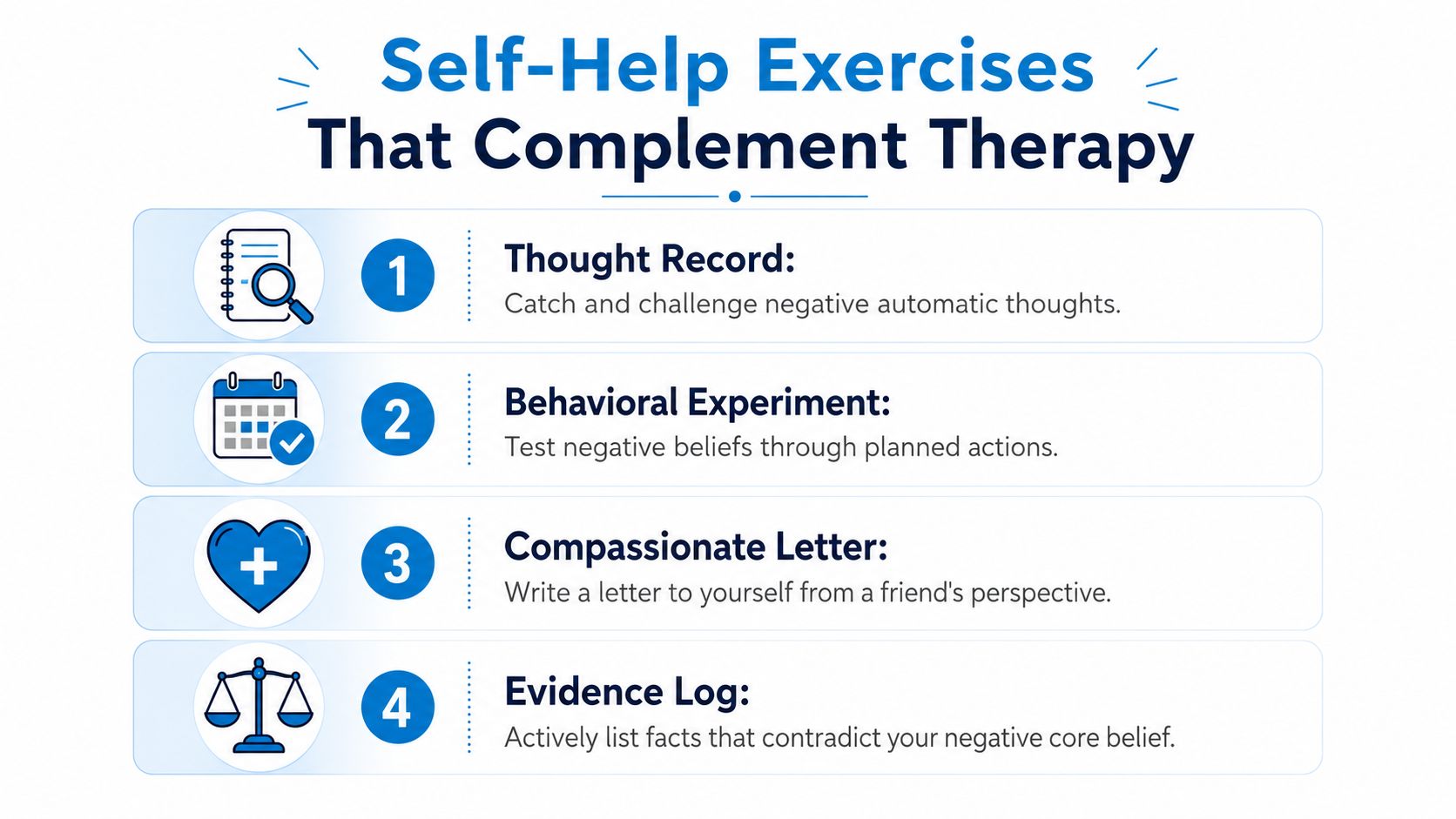
- Thought record: Write down the situation, the automatic thought, the emotion, and the evidence for and against the interpretation. For example, “My Italian sounded awkward, so I'm incapable” can be examined alongside evidence that communication still occurred.
- Behavioural experiment: Choose one small action that tests a prediction. If the prediction is “If I ask a question, people will think I'm stupid,” ask the question and record the response without grading the performance harshly.
- Compassionate letter: Write to yourself as a trusted friend would write. The aim isn't exaggerated praise. It's a fair description of the difficulty, the effort involved, and the kindness that would be reasonable in the same situation.
- Evidence log: Keep a record of facts that contradict a core belief. If the belief is “I never cope,” note concrete instances of navigating bureaucracy, maintaining work, learning routines, or reaching out despite fear.
Values clarification adds another layer. List what matters beyond approval, such as curiosity, loyalty, creativity, independence, family, or contribution, then choose one small action that expresses a value rather than trying to appear impressive.
Physical activity can also support emotional regulation and routine when it feels accessible.
The Rosenberg Self-Esteem Scale can help track reflection, but it doesn't have universally fixed clinical cutoffs. Rosenberg didn't define strict high or low thresholds, and descriptive bands vary by population and context. For expats, stress, cultural expectations, and major transitions can influence responses, so a score shouldn't be treated as a diagnosis or a complete account of wellbeing.
Readers looking for more structured guidance can explore how to build self-esteem, while keeping in mind that personalised therapy offers accountability and helps adapt exercises to the actual maintenance cycle.
Online vs In-Person Therapy and Costs in Italy
Both online and in-person therapy can address low self-esteem. The better format is the one that supports privacy, regular attendance, and honest participation. For an expat, the choice may also affect access to a therapist who understands the language and cultural context needed to discuss identity, shame, and adjustment.
| Factor | Online Therapy | In-Person Therapy |
|---|---|---|
| Language access | Can connect an expat with a suitable multilingual therapist beyond their immediate city | Depends on which therapists practise locally |
| Practicality | Flexible for work, study, travel, or relocation | Requires travel and a suitable appointment near home or work |
| Privacy | Requires a private, stable space and reliable connection | Provides a dedicated therapeutic setting |
| Non-verbal communication | Still possible, though limited by the screen | More complete access to physical presence and room context |
| Continuity | Easier to maintain during travel or another move | May feel grounding through a regular physical location |
Online therapy can work like a portable consultation room. It may allow sessions in a first language even when the nearest suitable therapist is elsewhere, and it can continue during travel or relocation. Its limits are practical: you need a private space, a stable connection, and enough separation from daily interruptions.
In-person therapy creates a consistent physical setting. That separation can help someone leave work, family pressures, or an unfamiliar home environment outside the session. Some people also find it easier to read body language and feel emotionally present in the room.
At Therapsy, individual therapy starts from EUR 70 per session, couple therapy from EUR 100, psychodiagnostic assessment from EUR 255 for three sessions, and psychiatric consultation from EUR 110. The first assessment call is free, while the final fee depends on the therapist's experience and specialisation. Current details are listed on the therapy pricing page.
Therapsy offers online and in-person sessions across 24 Italian cities, with therapists working in 14 languages: Italian, English, French, Spanish, German, Portuguese, Ukrainian, Russian, Greek, Arabic, Urdu, Hebrew, Hindi, and Persian (Farsi). Choose the format that makes consistent, candid participation more realistic, rather than treating either option as better.
How to Choose a Therapist and Get Started
Start with the pattern, not only the label. A useful therapist will explore whether low self-esteem is maintained by avoidance, self-criticism, depression, shame, attachment difficulties, or cultural adjustment, then explain how the proposed approach addresses that pattern.
Consider four practical questions:
- Language: Can the person describe shame, anger, family expectations, and identity concerns precisely?
- Approach: Does the therapist use methods suited to the person's difficulties, such as CBT, Schema Therapy, compassion-focused work, EMDR, attachment-informed therapy, or another established framework?
- Cultural understanding: Can the therapist understand the difference between personal vulnerability and the pressures of living between cultures?
- Fit and access: Is the schedule workable, is the cost clear, and does the person feel respected during the initial conversation?
Therapsy provides human matching by the Clinical Director rather than an algorithm, therapy in the client's own language across 14 languages, and a choice between online and in-person sessions. Its network includes 50+ therapists, has served 1,500+ clients since 2023, and holds a Trustpilot rating of 4.8/5, “Excellent.” The first contact is arranged within 12 hours, followed by a free assessment call with the therapist chosen for that person, with no obligation to continue and the possibility of rematching if the fit isn't right.
Therapsy can match an expat seeking therapy for low self-esteem with a therapist who understands both the clinical cycle and the cultural strain of building a life in Italy. Visit THERAPSY to request a human matching conversation, have a free first call with the selected therapist, and decide without pressure whether continuing feels right.
Who works with self-esteem at Therapsy
Dr. Mario Cesareo, an English, Italian and Spanish-speaking psychologist in Trieste works with adults and young people. He works with low self-esteem and with the sense of being stuck that often comes with it, in an approach that gives particular weight to the resources a person already holds without being able to reach them.
You tell Therapsy what you are looking for, a member of our clinical team reads your request, and they introduce you. The first call is free.