Humanistic psychotherapy is a client-led, relationship-based approach that focuses on personal growth, self-acceptance, and the client's lived experience rather than diagnosing or fixing pathology. It helps people understand what they feel, reconnect with their values, and move toward a more authentic life.
You may have moved to Italy expecting renewal, adventure, or a meaningful new chapter. Instead, you're working in a language that still feels unfamiliar, missing the ease of spontaneous conversation, and wondering why a life that looks exciting from the outside feels lonely from within. Culture shock, identity loss, relationship strain, and isolation can leave you feeling disconnected from yourself as well as from other people.
Humanistic psychotherapy can be especially relevant when your distress doesn't fit neatly into one label. It asks not only, “What symptoms are you experiencing?” but also, “What has happened to your sense of self, belonging, choice, and meaning?”
Humanistic psychotherapy sees the client as a whole person, not as a problem to be repaired.
Therapsy is a multilingual psychotherapy service in Italy that connects expats with therapists who speak their native language.
Why Humanistic Psychotherapy Matters for Expats in Italy
An expat can appear settled while feeling emotionally unrooted. You may have found an apartment, started work, learned how to manage Italian bureaucracy, and built a social routine. Yet you might still feel that the version of you who arrived in Italy has disappeared, while a new version hasn't fully formed.
A client might describe it like this: “I'm grateful to be here, but I don't feel like myself.” That sentence can contain homesickness, grief for a former identity, pressure to adapt, and the quiet exhaustion of constantly translating your thoughts and behavior across cultures.
Humanistic psychotherapy starts with that lived experience. It doesn't assume that every difficulty is evidence of a disorder. Sometimes a person is struggling because their relationships, environment, values, and inner life have fallen out of alignment.
The emotional cost of living between cultures
Expats often move between different expectations about communication, independence, family, work, gender roles, and emotional expression. The challenge isn't just learning local customs. It's deciding which parts of your original identity you want to keep, which parts you want to change, and how to feel at home without abandoning yourself.
Humanistic therapy gives these questions room. A therapist may help you notice:
- Identity tension: You feel different in Italy than you did at home.
- Emotional isolation: You can communicate functionally, but not always emotionally, in the local language.
- Loss of belonging: Familiar friendships, rituals, and family support are no longer easily available.
- Unclear direction: Your move solved one problem but created new questions about work, relationships, or purpose.
The focus is not on forcing a quick solution. The therapist helps you listen more closely to what your emotions are communicating and identify choices that feel genuinely yours.
For practical support with adjustment, loneliness, and emotional strain, mental health support for expats in Italy can offer a culturally sensitive starting point.
A growth-oriented way to understand distress
Humanistic psychotherapy developed as a major “third force” in psychology in the early 1960s, after Carl Rogers had already introduced his client-centered approach in the 1940s, as described by the American Psychological Association's history of Carl Rogers. The broader humanistic psychology movement officially emerged in the United States in 1962 and influenced psychotherapy and counseling throughout the 1960s and 1970s.
This history matters because it explains the approach's central shift. The therapist isn't positioned as an authority who knows the client better than the client knows themselves. Instead, therapy becomes a relationship where the client can explore experience safely and develop greater self-direction.
Humanistic psychotherapy may resonate with you if you're asking:
- “Who am I now that I live between cultures?”
- “Why do I feel disconnected even when things are going well?”
- “How can I make choices that reflect my values?”
- “What would it mean to accept myself without giving up on change?”
The Core Principles That Define Humanistic Therapy
Humanistic therapy rests on the belief that the therapeutic relationship can support self-understanding and growth. Carl Rogers identified three core conditions, empathy, congruence, and unconditional positive regard. Humanistic practice also includes a broader belief in an innate drive toward growth, meaning that people often have an internal movement toward greater integration, meaning, and psychological flexibility.
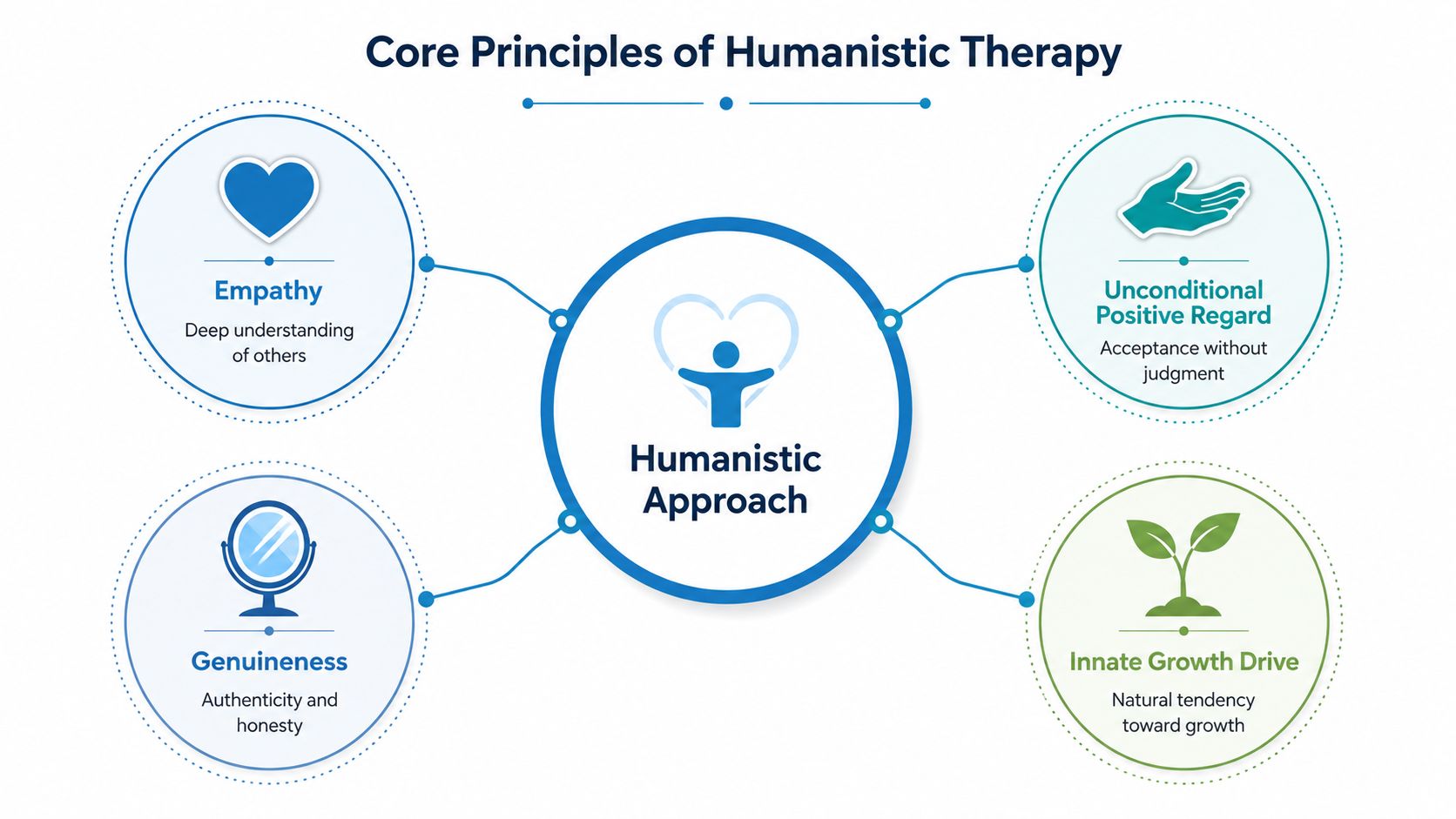
Empathy means entering your experience carefully
Empathy isn't the same as agreeing with everything you say or pretending the therapist has lived the same life. It means the therapist works to understand your emotional world from your perspective and checks that understanding with you.
For an expat, that might mean recognizing that missing home is not a sign of failure. It may also mean understanding that gratitude for Italy and sadness about leaving home can exist at the same time.
A therapist might reflect, “Part of you feels proud that you built this life, while another part feels unseen inside it.” That kind of response can help you hear your own experience with greater clarity.
Unconditional positive regard creates emotional safety
Unconditional positive regard means being treated with acceptance and respect, including when you feel confused, ashamed, angry, or ambivalent. It doesn't mean the therapist approves of every action. It means your dignity doesn't depend on appearing successful, calm, grateful, or easy to understand.
This can be powerful for someone navigating cultural identity. You don't have to prove that your problems are serious enough to deserve support. You can talk about resentment toward your host country, guilt about missing home, or doubts about a relationship without being reduced to those feelings.
Genuineness makes the relationship real
Genuineness, sometimes called congruence, means the therapist is authentic rather than hiding behind a distant professional role. The therapist remains bound by ethical responsibilities, but responds as a real person who is attentive and present.
A genuine therapist may respectfully point out a mismatch between your words and your emotional expression. They might say, “You're telling me this is fine, but I notice your voice changed when you described it.” The observation is offered as an invitation, not a verdict.
Growth is supported, not imposed
Humanistic therapy assumes that you have the capacity to develop greater self-awareness and make meaningful choices. The therapist doesn't define your ideal life. You explore what a fulfilling life means to you, considering your history, relationships, culture, and present circumstances.
This is why emotional awareness in therapy matters. Awareness isn't an end in itself. It helps you recognize needs, boundaries, values, and patterns that may have been difficult to name.
The therapist provides conditions for growth. The client remains the expert on their own lived experience.
How Humanistic Therapy Differs from Other Approaches
People often ask whether humanistic psychotherapy is “talking about feelings.” It is more specific than that. It is a family of approaches organized around empathy, authenticity, the therapeutic relationship, present experience, and the client's capacity for growth.
The main difference lies in the therapist's role and the purpose of the conversation. Humanistic therapy generally prioritizes discovering what your experience means to you. CBT may place more emphasis on identifying thought patterns and practicing new responses. Psychoanalysis traditionally explores unconscious processes, early experiences, and recurring relational patterns.
A practical comparison
| Feature | Humanistic Psychotherapy | CBT | Psychoanalysis |
|---|---|---|---|
| Central focus | Lived experience, personal growth, self-acceptance, and meaning | Connections between thoughts, feelings, and behaviors | Unconscious processes, early experiences, and inner conflicts |
| Therapist role | Empathic companion and collaborative facilitator | Structured guide and collaborative problem-solver | Interpretive partner who explores deeper patterns |
| Session style | Often open, reflective, and guided by what feels important to the client | Usually more structured and goal-oriented | Reflective exploration, often including past relationships and recurring dynamics |
| Typical question | “What are you experiencing, and what does it mean to you?” | “What thought or behavior is maintaining this difficulty?” | “What underlying pattern may be shaping your present experience?” |
| Possible goal | Greater authenticity, self-direction, integration, and meaning | More flexible thinking and practical coping | Insight into patterns that influence current relationships and emotions |
This table describes broad tendencies, not rigid rules. Many therapists integrate methods, and a humanistic therapist may be active, challenging, or structured when that serves the client.
Is humanistic therapy unstructured?
No. Humanistic therapy isn't automatically vague or passive. Some sessions may involve quiet reflection and open-ended exploration. Other sessions may include focused questions, emotion processing, experiential exercises, or collaborative goals.
The difference is that structure is usually connected to your experience rather than imposed without context. A therapist might help you stay with a difficult emotion, explore an unfinished conversation, identify a conflict between values, or notice how you relate to another person in the room.
If you're comparing approaches, Therapsy's guide to cognitive behavioral therapy can help clarify whether a more structured, skills-based approach may fit your current needs.
The Main Strands of Humanistic Psychotherapy Explained
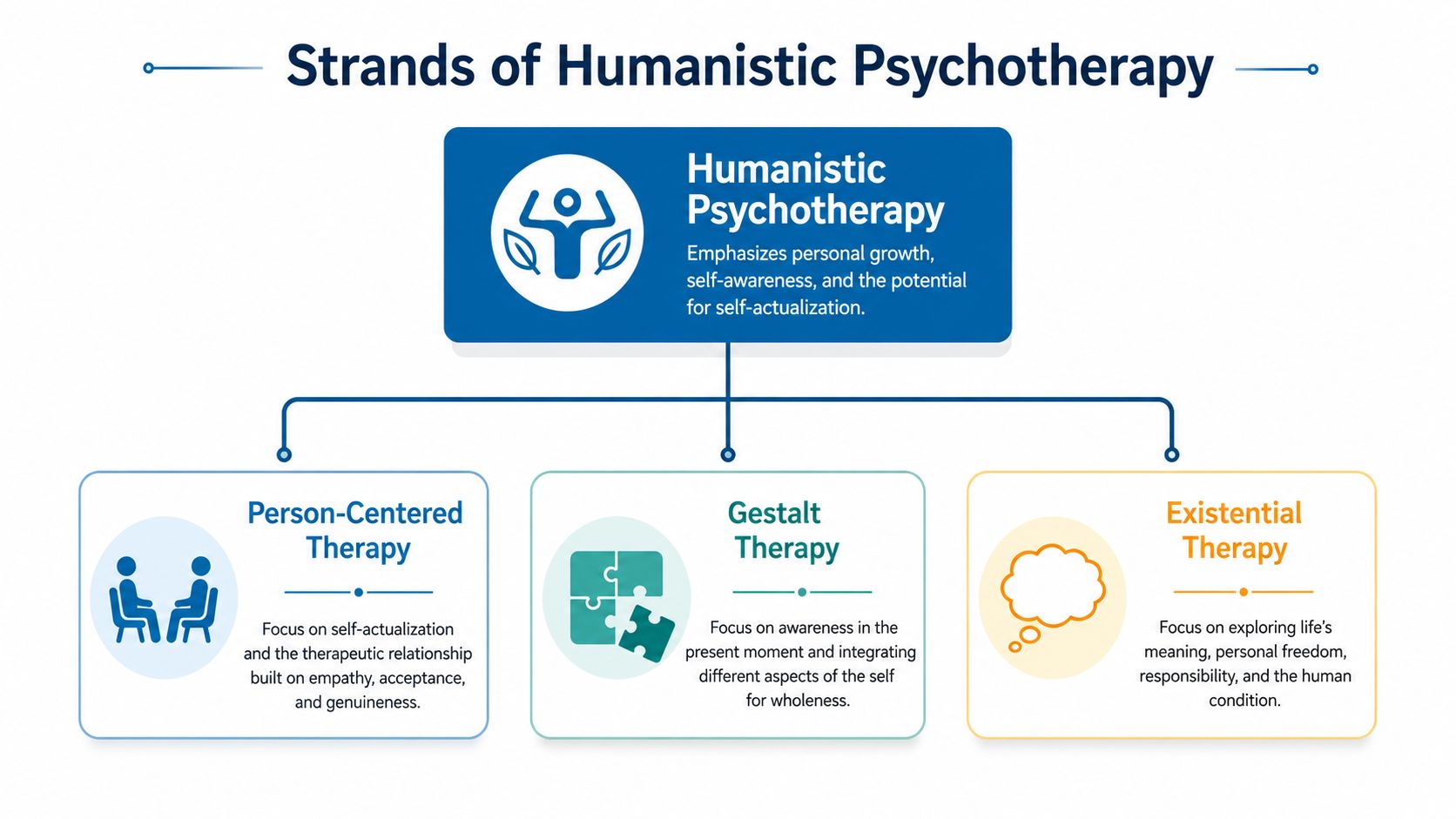
Humanistic psychotherapy is an umbrella, not one single technique. Historical reviews identify person-centered, Gestalt, and existential therapy as major strands that developed from the humanistic tradition, while contemporary descriptions also include process-experiential and emotion-focused approaches.
Person-centered therapy
Person-centered therapy is closely associated with Carl Rogers. It emphasizes empathy, genuineness, and unconditional positive regard while allowing the client to guide the direction of the work.
This approach can suit an expat who feels over-adapted to other people's expectations. You may know how to perform competence at work or politeness in social situations, but not know what you want. The therapist helps you hear your own responses without immediately turning them into advice or a diagnosis.
Person-centered therapy is often described as non-directive. That means the therapist doesn't take control of your life decisions. It doesn't mean the therapist is disengaged.
Gestalt therapy
Gestalt therapy emphasizes present-moment awareness and the way experience unfolds in the body, emotions, thoughts, and relationships. A therapist may invite you to notice what happens as you describe a conflict, including tension, hesitation, anger, or a sudden change in energy.
For someone living between cultures, this can illuminate moments when you silence yourself, make yourself smaller, or shift personality depending on who is present. Gestalt work can use dialogue and carefully chosen experiential exercises to explore what remains unfinished.
Existential therapy
Existential therapy explores meaning, freedom, responsibility, isolation, mortality, and the challenge of making choices without complete certainty. It can be especially relevant after migration, because moving countries often changes the questions you thought you had already answered.
You may be asking whether your career still reflects your values, whether your relationship supports your future, or whether your new life feels chosen rather than merely maintained. Existential therapy doesn't promise perfect certainty. It helps you face significant choices with greater honesty.
Emotion-focused and process-experiential approaches
Contemporary humanistic therapy also includes approaches that work more directly with emotions. Emotion-focused therapy helps clients identify, experience, understand, and transform emotional patterns. Process-experiential work may be more structured than the stereotype of non-directive therapy suggests.
These approaches can be useful when you understand your situation intellectually but remain stuck emotionally. A therapist may help you access an unmet need, work with self-criticism, process grief, or develop a different relationship with painful feelings.
The evidence base is stronger for some specific humanistic-experiential formats and conditions than for the broad philosophy as a whole. That distinction is important when choosing care.
What to Expect in a Humanistic Therapy Session
A first session usually begins with your reasons for seeking help, your current circumstances, and what you hope might change. You don't need a perfectly organized explanation. “I'm overwhelmed and I don't know where to begin” is a valid beginning.
A client who moved to Italy for work might talk about exhaustion, difficulty making friends, and arguments with a partner. A humanistic therapist may listen for the experience underneath those concerns. Perhaps the client feels pressured to be grateful, afraid of disappointing family at home, and uncertain whether the move still reflects their wishes.
The conversation follows what matters
You might discuss:
- Your immediate concerns: Anxiety, sadness, loneliness, relationship conflict, or emotional numbness.
- Your transition: Why you moved, what changed, and what you've lost or gained.
- Your relationships: Family expectations, friendships, work dynamics, and intimacy.
- Your internal experience: Feelings, bodily sensations, values, fears, and hopes.
- Your goals: Relief, clarity, self-acceptance, better communication, or a deeper sense of direction.
The therapist may reflect your words, ask open questions, and notice patterns with you. They won't expect you to perform therapy correctly.
Silence and uncertainty are allowed
Silence can feel uncomfortable, especially if you expect a therapist to provide immediate solutions. In humanistic work, a pause may give you time to notice what you're feeling before you explain it away.
You can also say, “I don't know what I'm supposed to say,” or “I'm not sure this approach is helping.” Those comments become useful information. A strong therapeutic relationship makes room for feedback, disagreement, and adjustment.
Before beginning, you can read about what to expect from your first psychological session so the process feels less unfamiliar.
Language affects emotional depth
Many expats can manage daily life in English or Italian but prefer another language for grief, shame, family conflict, or trauma. Speaking your native language can make emotional nuance easier to access, although language preference can also change across sessions and topics.
Therapsy uses a human-led matching process with the Clinical Director rather than an automated questionnaire or chatbot. The aim is to connect you with a carefully selected licensed professional who fits your language, needs, and preferred format.
Who Benefits Most from Humanistic Psychotherapy
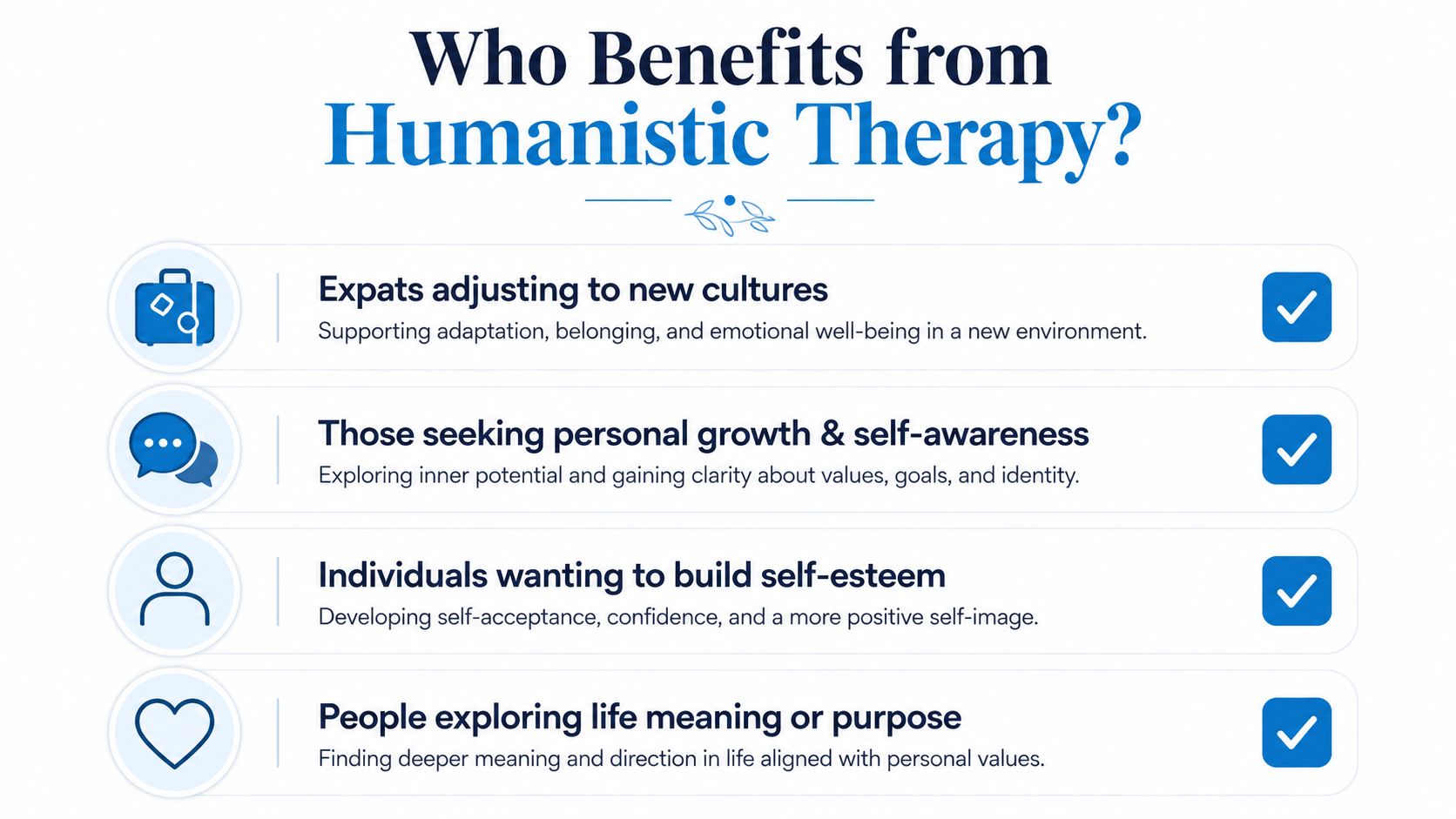
Humanistic psychotherapy may be a strong fit when the central question is not only how to reduce symptoms, but how to understand yourself and live with greater alignment. It can be particularly relevant for expats facing identity change, cultural dislocation, grief, loneliness, self-esteem difficulties, relationship strain, and questions about purpose.
Situations where it can fit well
Humanistic work may be useful if you:
- Feel divided between identities: You behave like a different person at home, at work, and with people from your host culture.
- Are moving through a major transition: Migration, separation, career change, parenthood, or a return home has unsettled your sense of direction.
- Want deeper self-understanding: You function well but feel disconnected from your needs and values.
- Struggle with self-criticism: You understand your strengths but find it difficult to treat yourself with compassion.
- Feel emotionally stuck: You can describe what happened, yet the feelings remain unresolved.
- Need space for meaning: Success, stability, or a relationship hasn't answered the question of what makes life feel worthwhile.
The approach can also support relationship concerns, especially when partners are negotiating different cultural assumptions. A therapist may help each person express their experience without reducing the conflict to who is right.
What the research does and doesn't show
Updated reviews and meta-analytic work report that humanistic-experiential therapies show meaningful improvements and can be comparable to other established therapies for depression and related distress, as summarized in the research review of humanistic-experiential psychotherapies.
That evidence shouldn't be stretched into a promise that every humanistic method works equally well for every person or concern. The research is stronger for some formats and conditions than for others, and specific manualized treatments shouldn't be confused with humanistic psychotherapy as a broad philosophy.
When another approach may be more suitable
Your therapist should consider the nature and intensity of your difficulties, your preferences, and any safety concerns. A different or integrated approach may be appropriate when you need:
- Focused anxiety skills: CBT can offer structured tools for identifying thoughts, changing avoidance patterns, and practicing new responses.
- Trauma processing: EMDR may be considered by a suitably trained professional when traumatic experiences are central.
- Medication assessment: A psychiatrist can evaluate whether a psychiatric consultation belongs in your care plan.
- More structured emotional work: Emotion-focused or process-experiential therapy can provide focused methods while remaining rooted in humanistic principles.
Therapsy offers several evidence-based approaches, including CBT, EMDR, Schema Therapy, systemic-relational therapy, and humanistic or bioenergetic psychotherapy. The right choice depends on your situation, not on choosing the most fashionable label.
Finding the Right Humanistic Therapist in Italy
Finding a therapist who understands both your emotional needs and your cultural context can make the first step easier. Look for a licensed professional who can explain their approach clearly, respects your language preference, and is comfortable discussing migration, identity, relationships, and adjustment.
Therapsy offers online and in-person psychotherapy in 14 languages, including Italian, English, French, Spanish, German, Portuguese, Ukrainian, Russian, Greek, Arabic, Urdu, Hebrew, Hindi, and Persian (Farsi). Its network includes 50+ therapists, with in-person care across 24 Italian cities and 90+ physical locations, alongside online sessions.
The matching process is human-led by the Clinical Director. You can describe what you're experiencing, the language in which you want to work, and whether you prefer online or in-person sessions. A free first assessment call gives you space to ask questions and decide whether the proposed therapist feels suitable, with no commitment or payment for that initial conversation.
For guidance on selecting a clinician, see how to find the right therapist for expats in Italy. You don't need to know the perfect modality before reaching out. Explaining what feels difficult is enough for an initial conversation.
Frequently asked questions about humanistic psychotherapy
What is humanistic psychotherapy?
Humanistic psychotherapy is a client-led approach focused on personal growth, self-acceptance, authenticity, and lived experience. It emphasizes the therapeutic relationship rather than treating the client as a diagnosis or problem. It includes person-centered, Gestalt, existential, emotion-focused, and process-experiential approaches.
Is humanistic psychotherapy evidence-based?
Yes, specific humanistic-experiential therapies have research support, including meaningful improvements for depression and related distress. The strength of evidence varies by approach and condition, so a qualified therapist should help determine whether it fits your needs.
Is humanistic therapy the same as non-directive talk therapy?
No, humanistic therapy is a broad family of approaches that can be open and client-led or more structured and emotionally focused. Person-centered therapy is often non-directive, while Gestalt, existential, emotion-focused, and process-experiential work may use active interventions.
Can humanistic psychotherapy help with culture shock?
Humanistic psychotherapy can help you explore culture shock, identity conflict, loneliness, grief, and the pressure to adapt. Therapsy can connect expats in Italy with therapists who understand multilingual and intercultural experiences.
Can I have humanistic therapy in English or another native language?
Yes, therapy may be available in your preferred language, depending on therapist availability and clinical fit. Therapsy offers psychotherapy in 14 languages and uses human matching to consider language, concerns, and session preferences.
Is humanistic therapy suitable for depression?
Humanistic-experiential therapies can support people experiencing depression, while suitability depends on the person's symptoms, goals, and safety needs. Therapsy can help you discuss whether humanistic therapy, CBT, psychiatric support, or an integrated plan is appropriate.
What happens during the first humanistic therapy session?
You'll discuss why you're seeking support, your current situation, and what you hope to change. The therapist will listen, ask questions, and begin understanding whether the relationship and approach feel right for you.
How can I find a humanistic therapist in Italy?
Start by describing your concerns, preferred language, location, and format to a qualified psychotherapy service. Therapsy offers a free assessment call with the Clinical Director, followed by human matching and online or in-person options across Italy.
Book your first free assessment call with Therapsy, with no commitment and no payment for the initial conversation. A human match can help you find a therapist who understands humanistic psychotherapy, expat life in Italy, and the language in which you feel most able to be yourself. Visit Therapsy.