Settling into a new city abroad works best as a staged 90-day process, not a single move-in week. The people who adjust most sustainably combine practical setup, deliberate local contact, and emotional support in their own language.
You may have landed in Milan or Rome with keys in your hand, a phone full of unanswered messages, and the strange feeling that ordinary tasks now require your full concentration. Finding an apartment is only the visible part of relocation. You're also rebuilding routine, identity, belonging, and access to care.
How to settle into a new city abroad is therefore both a life-design question and a mental-health question. Language, bureaucracy, loneliness, work pressure, homesickness, and cultural misunderstandings can turn a promising move into a daily strain if you treat them as separate problems.
Therapsy is a multilingual psychotherapy service in Italy that connects expats with therapists who speak their native language.
What Settling Into a New City Abroad Really Involves
You have arrived in Milan or Rome, but a simple errand leaves you tense, tired, and unsure whom to call. That reaction does not mean the move is failing. Your mind and body are still learning whether this unfamiliar environment is safe, predictable, and manageable.
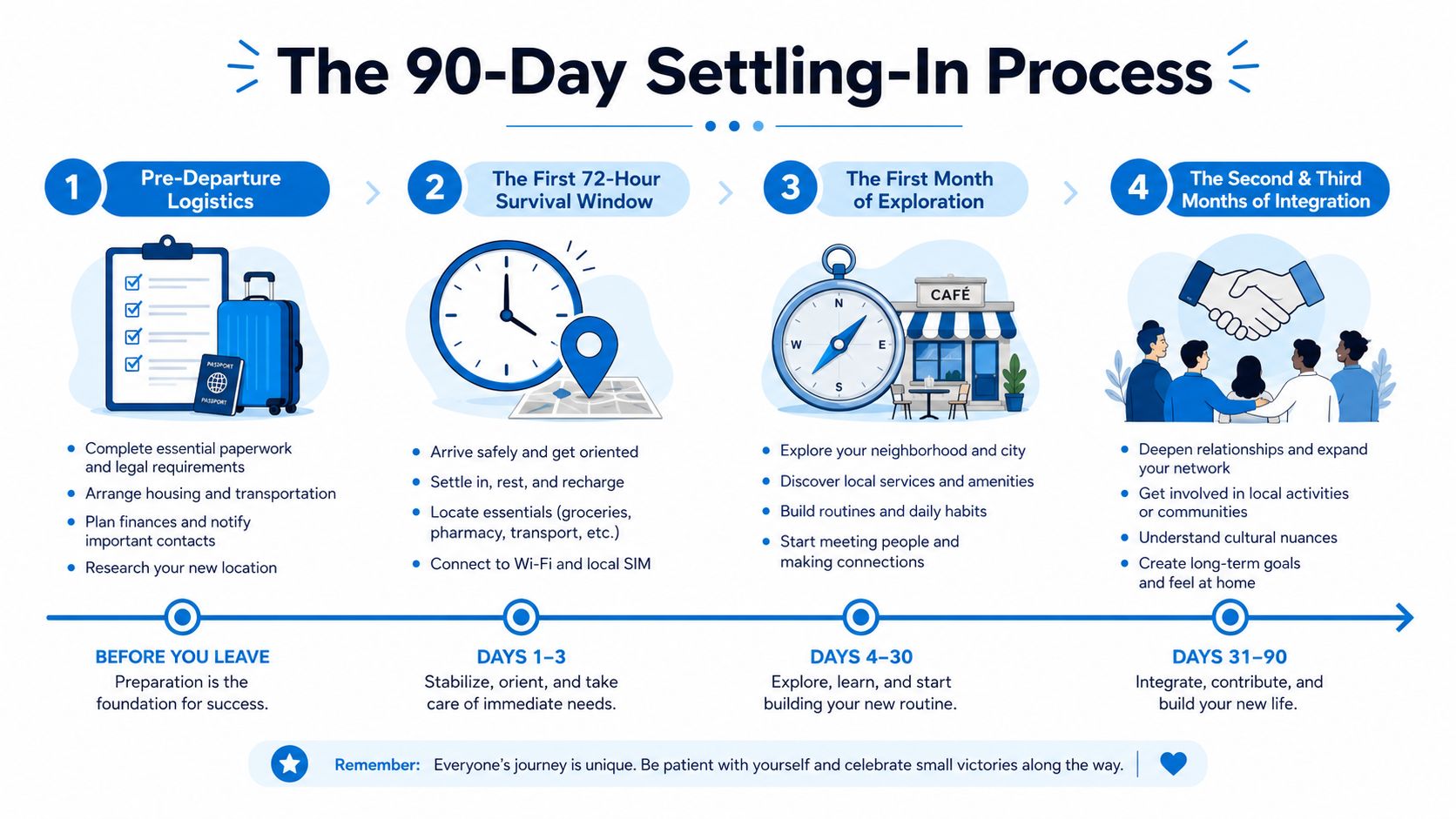
Settling in begins when daily life requires less conscious effort. You can follow familiar routes, handle ordinary problems, and maintain routines without spending all your energy translating, comparing, or second-guessing yourself. The work has four overlapping phases:
- Pre-departure logistics, including documents, housing, money, healthcare preparation, and communication.
- The first 72-hour survival window, focused on safety, food, transport, phone access, and basic orientation.
- The first month of administration and exploration, when you establish local systems and repeat everyday routes.
- The second and third months of integration, when novelty fades and loneliness, language fatigue, or identity questions often become clearer.
Culture shock follows its own stages. The honeymoon stage brings curiosity and novelty. The negotiation stage brings frustration, comparison, and exhaustion. The adjustment stage develops workable routines. The mastery stage does not require becoming local. It means functioning with confidence while remaining yourself. Review this guide to culture shock and reverse culture shock when your reactions start to feel confusing or disproportionate.
Language belongs in your settling plan from the start. OECD data on immigrant integration reports that 62% of immigrants in the European Union report at least advanced proficiency in the host-country language, compared with 72% in Australia and the United States. In the EU, settled migrants are almost twice as likely to report language proficiency as recent arrivals, 70% compared with 40%. The same source reports migration flows are about 20% higher when destination and origin languages are the same, showing how language affects movement and integration.
Practical rule: Build three equal pillars: practical setup, repeated local contact, and emotional support in your own language.
Paperwork reduces administrative friction. Local relationships create belonging through repetition. Emotionally safe communication makes it easier to discuss fear, grief, and uncertainty when a second language makes vulnerability harder. If loneliness begins feeding anxiety, or culture shock affects sleep, mood, or relationships, treat therapy in your own language as core support, not an optional extra.
Your Pre-Move and First 72 Hours Checklist
The first few days should be boring by design. Don't use your limited attention to solve every long-term question. Build a stable base, then explore.
Before you fly
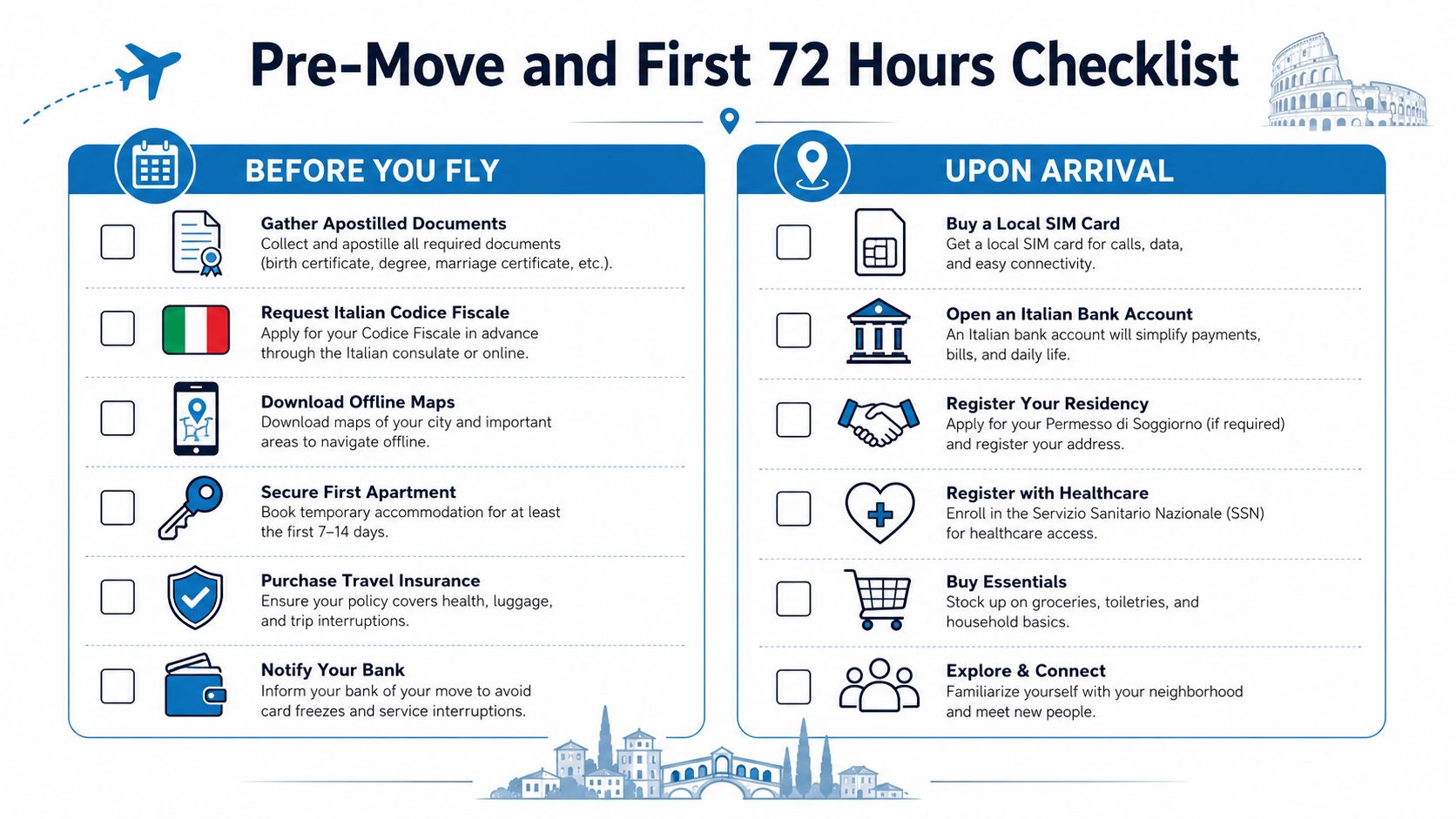
Prepare one digital folder and one offline folder. Include your passport, visa or residence documents, accommodation details, employment or university paperwork, insurance information, medical prescriptions, and any documents that may need an apostille or certified translation.
If possible, request an Italian codice fiscale before departure. The process depends on your situation, but having the tax code available can simplify housing, banking, employment, and other administrative steps.
Complete these tasks before boarding:
- Save offline maps: Download your neighborhood, airport route, and the route to your accommodation.
- Protect phone access: Activate roaming or arrange an eSIM before landing, then plan to buy an Italian SIM after arrival.
- Notify your bank: Tell your bank you'll be using cards abroad and confirm how to contact it from Italy.
- Prepare payment backups: Carry more than one payment method and a modest amount of cash.
- Confirm the first night: Keep the address, key instructions, and host or landlord contact details available offline.
If you're moving money internationally, review a practical guide to top apps for sending money in Canada before departure. The point isn't to choose a particular provider blindly. It's to understand transfer timing, identity checks, exchange-rate questions, and what happens if your usual card doesn't work.
Your first day
Collect your keys and test the essentials immediately. Check hot water, electricity, heating or cooling, Wi-Fi arrangements, and the door lock before unpacking.
Then walk the neighborhood without trying to be productive. Locate:
- A pharmacy, including the nearest one with extended hours.
- A supermarket, even if it's small.
- A tabacchi, which may help with transport tickets and everyday errands.
- The nearest pronto soccorso, so you aren't searching during an emergency.
- A reliable café or public space, where you can return until the area feels familiar.
Buy a local SIM if your temporary setup is unreliable, withdraw or obtain cash, eat something simple, and sleep. Jet lag and adrenaline can imitate emotional crisis. Give your nervous system a chance to recover before judging the move.
Your first 72 hours
If you're staying long-term, identify the steps for registering at the anagrafe. Book or request a bank appointment, and find out how to register with the local ASL for healthcare if you're eligible.
Make one low-pressure social contact. Meet a neighbor, classmate, colleague, or compatriot for an unhosted coffee. You don't need an instant friend. You need one human point of contact who makes the city feel less anonymous.
The moving to Italy mental health checklist is useful before departure because emotional preparation belongs in the same folder as your documents.
Setting Up Housing, Banking, Phone, and Healthcare
A new arrival usually doesn't need the perfect system. You need a system that works reliably enough to reduce daily uncertainty.
Housing
A short-term rental buys time and flexibility. It also costs more in the long run and can keep you in temporary mode. A direct long-term lease gives stability, but you'll need to understand the contract, registration, deposits, documentation, and landlord expectations.
Ask what kind of contract you're signing and whether it will be registered. A registered lease creates an administrative record and may support other procedures. A contract under cedolare secca has different tax treatment for the landlord than an ordinary registered arrangement. You don't need to become a tax specialist, but you do need written clarity.
An agency may make the search easier while adding a fee. A private landlord may reduce that cost, but communication and documentation can be less structured. In Milan and Rome, your budget will determine the trade-off between location, space, commute, and housing quality. Don't choose an apartment based only on photographs. Test the commute at the time you'll travel and ask about noise, heating, internet, and shared costs.
Banking
A local bank account can make rent, utilities, salary payments, and codice fiscale-related processes easier. Banks may ask for identification, proof of address, tax information, residence or visa documentation, and evidence of income. Requirements vary, so ask for the exact document list before the appointment.
If a traditional bank process stalls, Poste Italiane can be a practical fallback for some basic services. Keep your existing account active while the Italian account is being arranged. Closing your old financial connection too early creates unnecessary pressure.
For broader relocation preparation, a moving to China from USA checklist can offer a useful comparison point for documents, finances, communication, and first-arrival planning, even though your destination is Italy.
Phone and healthcare
An eSIM is fast and convenient. A retail SIM from an Italian operator may offer clearer local support and a familiar Italian number. Choose based on how long you'll stay, how much data you use, and whether you need Italian verification messages for appointments or services.
For healthcare, residents who are eligible can register with the Servizio Sanitario Nazionale through the local ASL and request a tessera sanitaria. Private travel insurance may cover urgent needs during the transition, but it isn't a substitute for learning how the local system works.
| Area | Main Options | Best For |
|---|---|---|
| Housing | Short-term rental or registered long-term lease | Flexibility first, or stability after verification |
| Banking | Local bank or Poste Italiane fallback | Rent, salary, utilities, and local administration |
| Phone | eSIM or Italian retail SIM | Fast connectivity, or local support and number access |
| Healthcare | SSN and ASL registration, temporary private cover | Ongoing care, or protection during transition |
Before the health card arrives, keep your insurance details, prescriptions, emergency contacts, and medical history accessible. In an emergency, contact the appropriate emergency service or go to the nearest pronto soccorso. You shouldn't wait for perfect paperwork before seeking urgent care.
Building Your Local Support Network in the First 90 Days
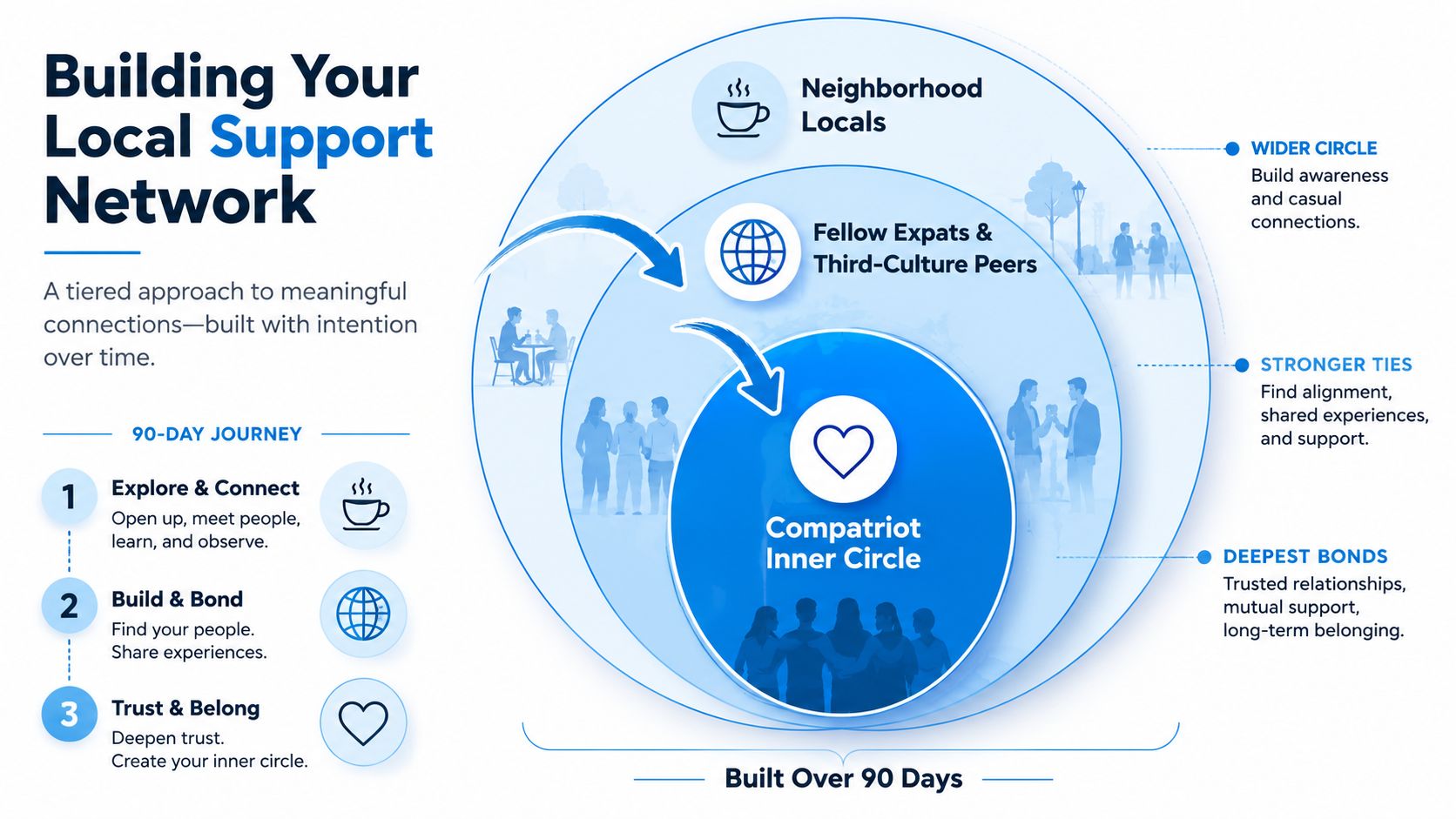
The fastest way to feel isolated abroad is to wait for friendship to happen by accident. Build your support network deliberately, and include three groups that serve different emotional purposes.
Your first layer is host-country locals. They help you understand neighborhood routines, unwritten rules, services, and everyday Italian. Your second layer is other international residents, who understand relocation fatigue without requiring a long explanation. Your third layer is compatriots or home-country contacts, who provide emotional familiarity and a place to speak freely.
A 2019 diary study found that these network types support adjustment through distinct and complementary mechanisms. A meta-analysis of 62 studies involving more than 13,000 participants found that social support consistently predicts expatriate adjustment, with host-country support showing particularly strong links to adjustment outcomes. The peer-reviewed research on expatriate social networks also identifies a common mistake: relying only on familiar-language contacts can preserve comfort while slowing local integration.
Make repetition do the work
Choose one neighborhood café, bar, gym, libreria, market, or parco and return regularly. Familiarity grows through repeated low-stakes contact, not through one impressive social event.
Use international groups, language exchanges, WhatsApp communities, and local event listings as entry points. Don't measure success by how many contacts you collect. Measure it by whether you see the same people again.
After a good conversation, be specific:
“I enjoyed talking with you. Are you free for coffee next Tuesday or Thursday?”
A vague “we should meet sometime” usually disappears. A proposed day gives the relationship a chance to become a routine.
Use a weekly cadence
Each week, aim for:
- One local interaction: Speak with someone in Italian, even if the exchange is brief.
- One international connection: Meet someone who understands life abroad.
- One home-network call: Stay connected to family or trusted friends without making them your only support.
- One recurring activity: Attend the same class, gym session, language exchange, or community event.
- One restorative block: Protect time without social performance.
Start with talking with strangers as a behavioral skill, not a personality test. Ask a simple question about the neighborhood, a class, a food tradition, or a local routine. Friendship usually begins with ordinary contact repeated often enough to become safe.
The trade-off is clear. Expat circles feel easier, but they can become an avoidance bubble. Locals require more language effort and more tolerance for misunderstanding, but they help you build a life that belongs to the city rather than floating beside it.
When Homesickness Crosses Into Anxiety and Burnout
“Just stay busy” is incomplete advice. Activity can distract you from distress, but it doesn't automatically process grief, restore sleep, or create belonging.
In 2024, more than 12,500 expats worldwide responded to the Expat Insider survey. Ninety-two percent said adapting to a new culture is challenging, and 65% described it as extremely or very difficult. Thirty-nine percent named language barriers as their biggest obstacle, ahead of cuisine at 33% and social norms at 29%. The same survey reported that 56% felt cultural adaptation was becoming more difficult, particularly among people who had relocated more than once. These figures come from the Expat Insider 2024 survey.
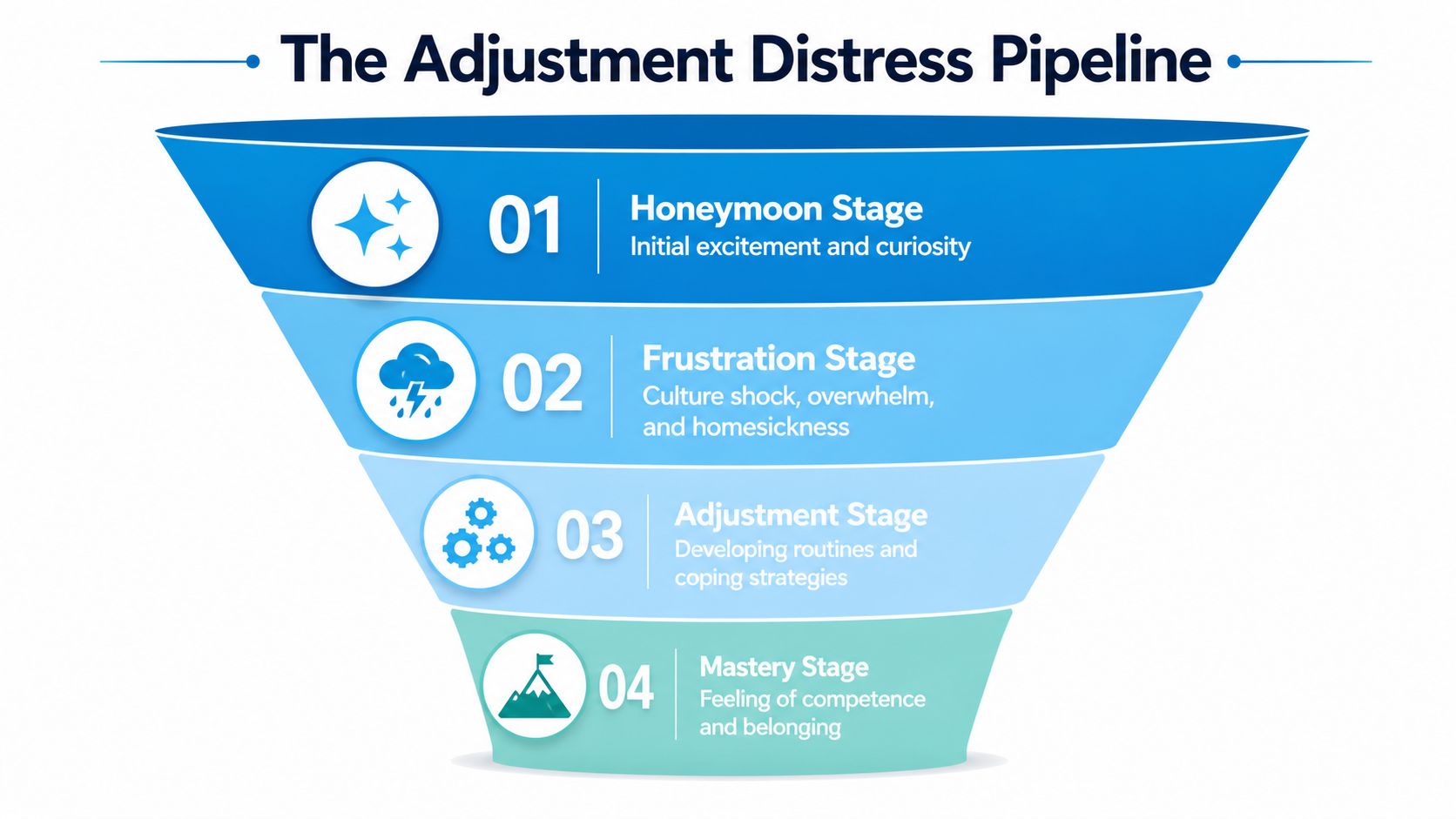
The emotional pattern often moves through four stages:
- Honeymoon: Initial excitement, curiosity, and idealization.
- Frustration: Culture shock, comparison, language fatigue, and homesickness.
- Adjustment: New routines, coping strategies, and more realistic expectations.
- Mastery: Greater competence, flexibility, and belonging.
Read the warning signals accurately
Homesickness is a form of grief. You've lost easy access to people, places, language, status, routines, and familiar versions of yourself. That doesn't mean you made the wrong decision.
Pay closer attention when you experience:
- Sleep disruption that continues beyond two weeks
- Panic symptoms or persistent physical alarm
- Loss of appetite or major changes in eating
- Inability to leave your apartment
- Intrusive thoughts about home that interrupt daily functioning
- New or escalating substance use
- Work collapse, repeated conflict, or emotional numbness
Relocation stress can amplify pre-existing anxiety, perfectionism, attachment patterns, and unresolved trauma. In CBT, you examine the thoughts that intensify distress, such as “I'm failing because I don't understand this system.” Schema Therapy explores older emotional patterns that relocation may activate, including abandonment, defectiveness, or excessive self-reliance. EMDR may be relevant when past trauma is being reactivated by current instability, but a qualified therapist should assess whether it fits your needs.
Use emotional first aid
Create three daily anchors: a waking routine, one nourishing meal, and a predictable sleep wind-down. Add body-based regulation, such as slow breathing, walking, stretching, or placing both feet firmly on the floor while naming what you see around you.
Limit frantic contact with home to defined windows rather than checking messages continuously. Say the feeling plainly: “I'm homesick,” “I'm overwhelmed,” or “I'm scared I won't belong here.” Naming the experience reduces the pressure to perform happiness.
If work strain is part of the picture, review the signs of expat burnout before dismissing your exhaustion as ordinary adjustment. Mental-health support is infrastructure. You don't need to wait until you're in crisis to use it.
Finding Therapy in Your Language While Living Abroad
Therapy in your own language can make it easier to describe family history, shame, anger, grief, and cultural identity with precision. It can also help when you're technically fluent in Italian but emotionally more spontaneous in English, French, Spanish, Arabic, Ukrainian, or another language.
Start with the route that matches your eligibility and urgency:
- SSN and ASL services: Suitable for people registered in the public healthcare system, though language availability and waiting times vary.
- Private practice directories: Useful when you want to compare qualifications, location, approach, and language.
- Online multilingual therapy: Practical for frequent travel, changing cities, or a schedule that doesn't fit local appointments.
- Expat-focused clinics: Helpful when you want a provider accustomed to relocation, intercultural relationships, and international work.
Ask whether the therapist is licensed to practice in the relevant setting, how confidentiality works, what happens in an emergency, and whether sessions can take place in your preferred language. A first session usually involves your current concerns, relevant personal history, goals, and questions about fit. You're allowed to notice whether you feel understood.
| Route | Best For | Trade-offs |
|---|---|---|
| SSN and ASL | Eligible residents seeking public care | Access and language options may vary |
| Private in-person therapy | Local continuity and face-to-face contact | Requires travel and appointment coordination |
| Online multilingual therapy | Expats who travel or live outside major cities | Depends on privacy, internet, and comfort with video |
| Expat-focused services | Relocation, culture shock, and intercultural concerns | Private fees may apply |
For a deeper decision framework, use this guide to finding the right therapist for expats in Italy.
Therapsy provides online and in-person psychotherapy across 20+ Italian cities and 50+ physical locations, including Milan, Rome, Florence, Turin, Bologna, Bergamo, Padova, and Verona. Its network includes 50+ therapists offering care in 14 languages, with approaches including CBT, EMDR, Schema Therapy, systemic-relational therapy, humanistic therapy, and ethnopsychotherapy.
The service uses human matching by the Clinical Director rather than algorithms or automated questionnaires. A free assessment call lets you discuss your needs, preferred language, practical circumstances, and therapist fit before committing. Individual therapy is available from €70 per session, with reimbursement depending on your private insurance policy.
Your 30, 60, and 90 Day Settling Plan
A good settling plan creates deliverables, not vague intentions. Write these actions into your calendar.
By day 30
Close your most urgent administrative gaps. Confirm your housing documents, phone access, banking plan, healthcare route, and emergency contacts.
Choose one café, piazza, gym, library, or neighborhood route that you'll use repeatedly. Make at least one local contact and one international contact. If anxiety, homesickness, low mood, or relationship strain is already interfering with daily life, book a first therapy consultation rather than waiting for the problem to become dramatic.
By day 60
Commit to one recurring class or activity. Attend one local gathering repeatedly, not just once. Complete one Italian-only errand each week, such as ordering food, asking for directions, visiting a pharmacy, or handling a simple appointment.
At this stage, evaluate your network. Do you have someone to call for practical help, someone who understands relocation, and someone with whom you can speak your home language? Research on social support links it with expatriate adjustment, commitment, performance, and retention, with estimated correlations around ρ=.25 for adjustment, .33 for commitment, .19 for performance, and .21 for retention in the cited review of relocation research at this peer-reviewed source.
If you're considering a longer move, resources about retiring or living in Spain may help you compare the emotional and practical demands of building life abroad in another European setting. The comparison is useful because settling well depends on daily systems, not only on a destination's appeal.
By day 90
Review what stuck. Identify the routines you repeat without forcing yourself, the friendships that have developed depth, and the administrative or emotional loose ends that remain.
Schedule a quarterly check-in with yourself. Ask whether your sleep, work capacity, relationships, language confidence, and sense of belonging are improving, stable, or deteriorating. If the answer is deterioration, act early.
A free assessment call with a multilingual therapist is a sensible infrastructure decision, not a crisis response. Therapsy offers human matching, online and in-person sessions, and therapy in 14 languages for expats, international students, young adults, and intercultural couples living in Italy.
Book your first free assessment call with Therapsy, with no commitment and no payment required, and speak with the Clinical Director about your language, adjustment challenges, and the kind of support that would fit your life in Italy. Visit THERAPSY to start with a human conversation.
Frequently asked questions about how to settle into a new city abroad
How long does it take to settle into a new city abroad?
An extended adjustment period is common, so plan deliberately across the first 90 days and continue monitoring your well-being through the first year. The first weeks often focus on safety and administration, while belonging and emotional stability develop through repeated routines and relationships. Culture shock may become more noticeable after the initial honeymoon period.
What should I do during my first week abroad?
Secure housing access, phone service, food, transport, emergency information, and basic healthcare knowledge during your first week. Walk your neighborhood and identify a pharmacy, supermarket, tabacchi, and pronto soccorso. Make one low-pressure social contact, then protect your sleep and avoid judging the entire move while exhausted.
How do I make local friends after moving abroad?
Repeat the same local activities and invite people to specific follow-up meetings instead of waiting for spontaneous friendship. Language exchanges, classes, neighborhood cafés, gyms, libraries, and community events can create useful repetition. Keep international and compatriot contacts too, but don't let familiar-language circles replace local contact.
Is culture shock normal after moving to Italy?
Yes, culture shock is a common adjustment response, especially when language, bureaucracy, social norms, and daily routines change at once. It often includes an initial honeymoon followed by frustration, then gradual adjustment. If distress affects sleep, appetite, work, safety, or your ability to leave home, professional support can help.
Can I have therapy in English while living in Italy?
Yes, English-speaking therapy is available in Italy through public, private, and online routes. Therapsy offers psychotherapy in American and British English, as well as 12 additional languages, with online and in-person sessions across Italian cities. A free assessment call can clarify language, availability, approach, and therapist fit.
How can therapy help with homesickness and relocation anxiety?
Therapy can help you understand the thoughts, attachment patterns, grief, and stress responses that relocation activates. CBT can address anxiety-maintaining thoughts, Schema Therapy can explore recurring emotional patterns, and EMDR may be considered when past trauma is involved. Therapsy matches clients with carefully selected professionals according to language, needs, and therapeutic approach.
Should I choose online or in-person therapy abroad?
Choose online therapy for flexibility, travel, privacy, or access to a therapist who speaks your strongest emotional language. Choose in-person therapy when physical presence, local routine, and face-to-face connection support your progress. Therapsy offers both formats, so the decision can follow your circumstances rather than forcing you into one model.