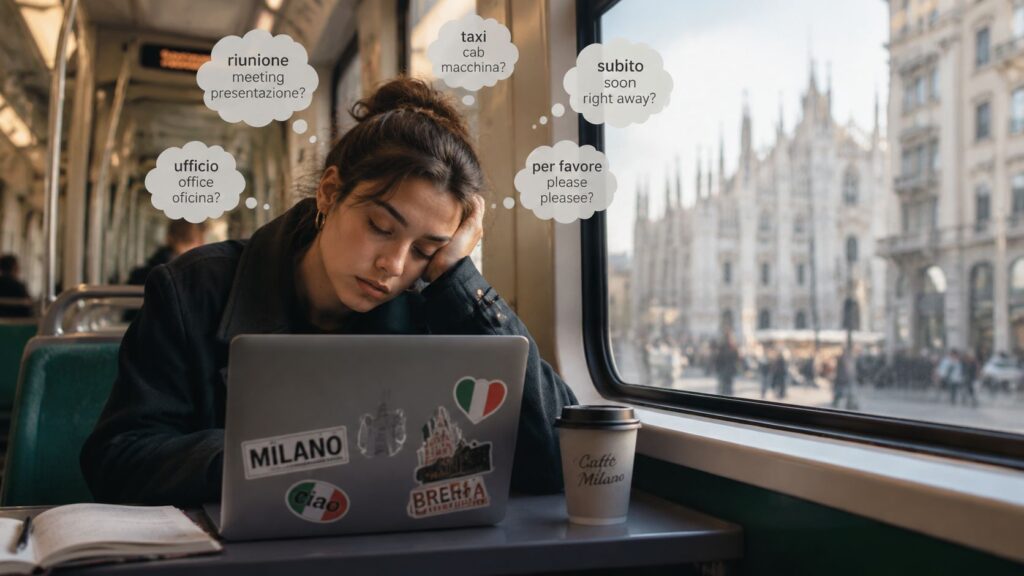
Many expats in Italy arrive with a clear picture in mind. A beautiful city. A meaningful international role. Better weather. Better food. A richer life. Then, a few months in, they notice something they didn't expect. They're tired all the time, oddly irritable, less patient with colleagues, and strangely numb to the very life they worked hard to build.
Expat burnout symptoms are the emotional, cognitive, physical, behavioural, and social signs that appear when chronic work stress and cultural adjustment overload the nervous system. It isn't laziness. It isn't weakness. It often happens to capable, conscientious people who keep functioning long after their inner resources have been drained.
For burned-out professionals in Italy, this can be especially confusing because the outside still looks fine. You may still be performing, answering emails, attending aperitivi, and managing deadlines. Inside, though, everything feels heavier than it should.
The Hidden Cost of the Italian Dream
A common scene looks like this. You're living in Milan or Rome, working in fashion, tech, consulting, design, academia, or an international organisation. Your calendar is full, your phone never really goes quiet, and even simple tasks take more effort because daily life runs through a language, culture, and system that still don't feel fully natural.

The romantic image of Italy can make this harder to admit. When everyone assumes you should feel grateful, rested, and inspired, burnout often hides behind guilt. Many expats tell themselves, “I live in Italy. I shouldn't feel this bad.”
That thought keeps people silent for too long.
When stress abroad becomes burnout
Burnout is more than “being stressed”. The World Health Organization framework describes it through three pillars: exhaustion, cynicism, and reduced professional efficacy. In expat life, those pillars are often intensified by acculturative stress, which is the strain of adapting to a new environment while trying to function at a high level.
Burnout abroad often feels confusing because the stress comes from two directions at once. Work demands increase while the ordinary supports that usually help you recover are weaker or farther away.
That double pressure is common. A 2022 Cigna survey found that 98% of expats experience burnout symptoms, mainly because they can't disconnect from work.
For many people in Italy, language adds another layer. Even small interactions can become draining when you need to translate mentally all day. If speaking Italian still feels effortful, a practical support like this quick guide to speaking Italian can reduce some day-to-day friction. It won't solve burnout, but it can lower one source of constant strain.
Why this feels so personal
Burnout tends to attack identity. The high-achieving expat who used to be organised now forgets things. The socially confident person now avoids messages. The professional who once felt ambitious now feels flat or cynical.
If you've recently relocated, this moving to Italy mental health checklist can help you recognise early warning signs before exhaustion becomes more entrenched.
What matters most is this. Expat burnout symptoms are a real psychological response to prolonged overload in an unfamiliar environment. They deserve attention early, not only when things fall apart.
The Five Symptom Clusters of Expat Burnout
Burnout rarely shows up as one neat symptom. It usually appears as a pattern. People often say, “I don't feel like myself,” before they can explain why.
This is the clearest way to recognise expat burnout symptoms in practice.
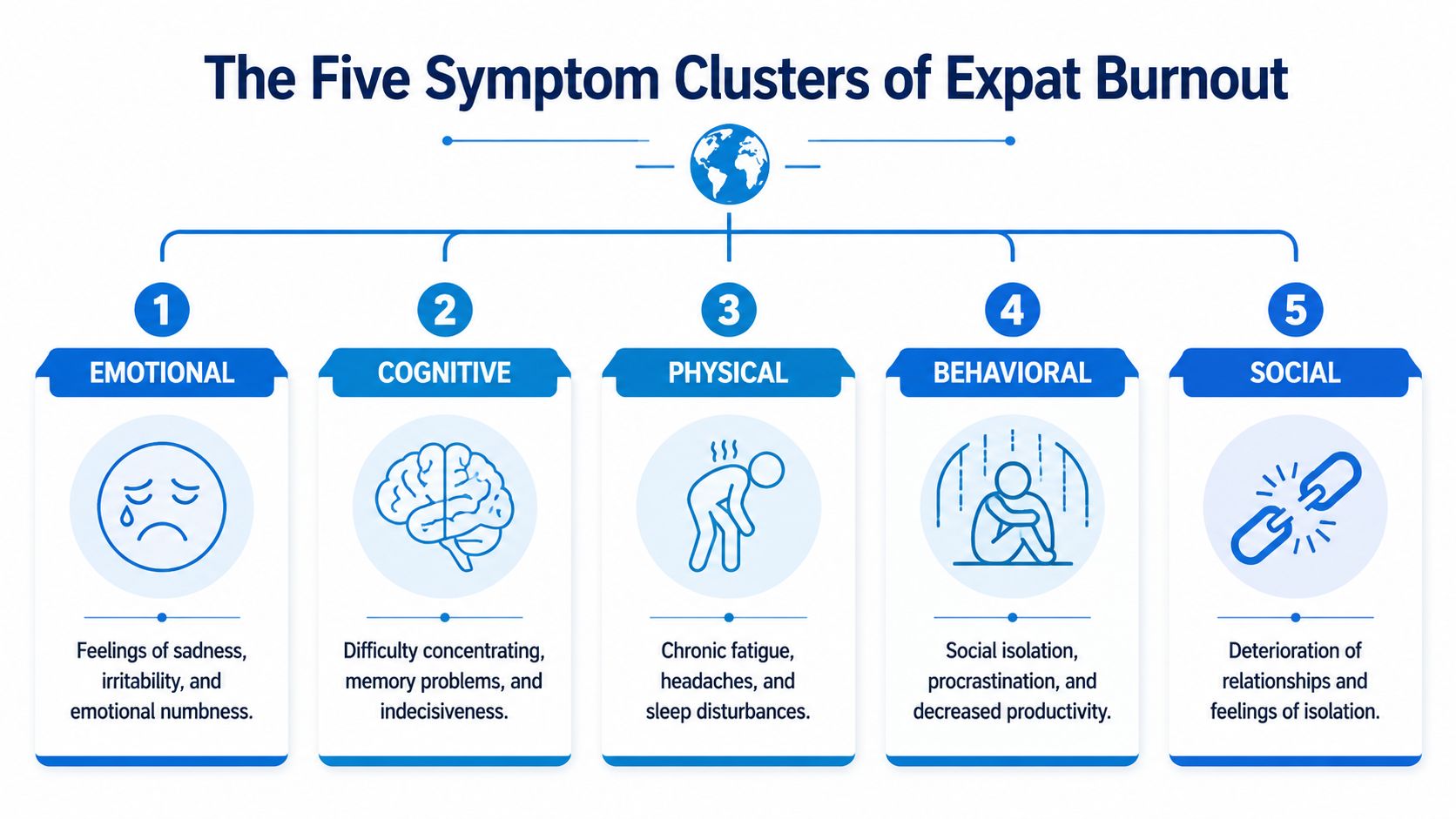
Emotional symptoms
Emotional burnout doesn't always look dramatic. In many expats, it looks muted.
- Irritability: You react more sharply than usual to delays, admin problems, or messages from work.
- Emotional numbness: Good news lands flat. Weekends don't feel restorative.
- Cynicism: You feel increasingly negative about your job, your host culture, or both.
- Helplessness: Everyday challenges start to feel bigger than they are.
- Quiet resentment: You may feel angry that everything seems to require extra effort abroad.
In Italy, cynicism often attaches itself to practical frustrations. Residency paperwork, delayed appointments, confusing communication, and unclear processes can become the final straw for a nervous system that's already overloaded.
Cognitive symptoms
Burnout affects thinking, often leading many expats to blame themselves for “losing focus” when the underlying issue is depletion.
Common cognitive signs include:
- Poor concentration: Reading the same email twice and still not absorbing it.
- Decision fatigue: Even choosing what to cook or which document to submit feels tiring.
- Mental fog: Your thoughts feel slower, less sharp, less creative.
- Memory lapses: You forget meetings, names, passwords, or routine tasks.
- Language overload: Working in a second language all day can magnify cognitive fatigue.
A practical clue is this. If your brain works best only in short bursts and then seems to shut down, burnout may be impairing attention rather than motivation.
Physical symptoms
The body often speaks first. Many expats seek help for sleep problems, headaches, stomach issues, or repeated colds before they recognise burnout underneath.
Physical expat burnout symptoms can include:
- Persistent fatigue: You wake up tired even after sleeping.
- Sleep disruption: Trouble falling asleep, waking early, or unrefreshing sleep.
- Headaches and neck tension: Often linked to sustained stress and hypervigilance.
- Digestive discomfort: Nausea, reflux, bloating, or stress-sensitive digestion.
- Lowered immunity: Frequent minor illnesses or slower recovery.
These symptoms are often dismissed because they look “medical” rather than psychological. In reality, chronic stress often shows up through the body first.
Behavioural symptoms
Behaviour changes are often easier for partners or colleagues to notice than for the person experiencing burnout.
Watch for patterns like these:
- Procrastination: Tasks feel harder to start, even when they matter.
- Reduced productivity: You're working, but not with your usual clarity or efficiency.
- Overworking: Some people respond by pushing harder instead of slowing down.
- Avoidance: You put off calls, paperwork, and difficult conversations.
- Reliance on unhealthy coping: More scrolling, more alcohol, more emotional eating, more withdrawal.
Some expats alternate between overcontrol and collapse. They function intensely during the day, then feel unable to do anything meaningful in the evening.
Social symptoms
Burnout is isolating, and expat life can intensify that isolation.
- Social withdrawal: You stop initiating plans or cancel more often.
- Feeling detached: Even when you're with people, you don't feel fully present.
- Reduced patience in relationships: You have less energy for emotional reciprocity.
- Loss of interest in connection: Friendships start to feel like another task.
- Homesick loneliness: You miss the ease of being known without needing to explain yourself.
If loneliness is already part of your expat experience, this resource on expat loneliness in Italy may help you see how social disconnection and burnout often reinforce each other.
Why Burnout Hits Expats Harder in Italy
Burnout doesn't happen in a vacuum. The Italian context matters. Many expats aren't only dealing with workload. They're also managing a constant background level of adaptation.
Cultural friction is tiring
Italy is rich in nuance. That's part of its beauty, but it also demands energy. Communication is often more contextual than many expats expect. Processes may depend on relationships, timing, or unspoken norms that aren't obvious at first.
When you don't yet feel fluent in the culture, ordinary tasks require more interpretation. You monitor tone. You second-guess etiquette. You replay conversations afterwards. That continuous effort drains the mind.
Bureaucracy multiplies stress
Many expats tolerate intense work demands until bureaucracy enters the picture. Then the system overload becomes visible.
A visa issue, codice fiscale delay, registration problem, rental contract confusion, or healthcare admin task can consume hours of time and emotional bandwidth. None of these stressors seem dramatic on their own. Together, they create a chronic sense of friction.
In clinical work, one of the clearest burnout accelerators is not a single crisis. It is repeated low-level obstruction with no proper recovery time.
This is often why people say, “It's not just work.” They're right.
Milan and Rome can intensify pressure
Large international hubs offer opportunity, but they also reward constant availability. In sectors common among expats, such as finance, fashion, technology, consulting, and international organisations, people often feel they must prove themselves twice. Once professionally, and once culturally.
Research on expats in Lombardy found that 68% reported chronic exhaustion linked to cultural adjustment stress. The same research found 52% experienced cynicism, and expats showed 2.5 times higher depersonalisation scores on the Maslach Burnout Inventory than local counterparts according to this summary on recognising burnout symptoms.
That pattern makes psychological sense. If your nervous system is already working hard to adapt, it has less room to absorb workplace stress.
For a fuller view of how adaptation stress works, this article on culture shock in Italy and how to cope can help put your experience into words.
Recovery supports are weaker abroad
At home, people often recover without noticing how. They call a sibling. See an old friend. Visit a familiar doctor. Move through systems they understand. Rest in a place where they don't have to explain themselves.
In expat life, many of those supports are missing or thinner. That doesn't mean you're less resilient. It means you're carrying more with fewer buffers.
Burnout, Depression, or Adjustment Disorder
Many expats ask the same question. “Is this burnout, or is it something more serious?” It's an important question, especially for high-performing people who keep functioning outwardly.
High-functioning burnout can hide in plain sight
A critical gap in expat mental health is the distinction between burnout and depression. High-performing expats in Italy may still meet deadlines, stay socially engaged, and appear successful while feeling increasingly exhausted and cynical inside.
This is why appearance is a poor guide. Functioning isn't the same as wellbeing.
Signs that point more strongly to burnout
Burnout often centres on work and chronic adaptation stress. The person usually says things like:
- “I'm depleted.”
- “I can't switch off.”
- “I've become cynical.”
- “I still do what I need to do, but it costs too much.”
There may still be pleasure outside work, but accessing it feels harder than it used to.
Signs that may suggest depression
Depression is usually more pervasive. The low mood spreads across many areas of life, not only work. There may be a broader loss of interest, deeper hopelessness, and a heavier sense that nothing will improve.
The overlap is real, which is why self-diagnosis has limits. Burnout can look like depression. Depression can emerge after prolonged burnout.
Where adjustment disorder fits
Adjustment disorder often appears after a significant life change, such as relocation, a breakup, job transition, or immigration stress. The emotional response feels linked to the stressor, but may include anxiety, sadness, tearfulness, irritability, and difficulty coping.
For expats, adjustment disorder can overlap with both burnout and depression. The key difference is that the distress is closely tied to a recent transition and its consequences.
If you're still functioning well enough to look “fine” but feel steadily more numb, brittle, or emotionally overdrawn, don't dismiss that as normal success pressure.
If low mood, withdrawal, or hopelessness are becoming central, this guide to expat depression in Italy may help you reflect more carefully on what's happening.
An Expat Burnout Self-Assessment Checklist
A checklist can't diagnose you, but it can help you notice patterns more clearly. Use this as a reflection tool, not a verdict.
Expat Burnout Self-Assessment
| Symptom Area | Statement | Frequency |
|---|---|---|
| Exhaustion | I wake up tired, even when I've technically rested. | Never / Sometimes / Often |
| Exhaustion | Ordinary tasks in Italy feel harder than they should. | Never / Sometimes / Often |
| Exhaustion | Speaking, working, or problem-solving in another language drains me quickly. | Never / Sometimes / Often |
| Cynicism | I feel more negative than before about my work, colleagues, or daily life here. | Never / Sometimes / Often |
| Cynicism | I notice resentment or emotional numbness where I used to feel engaged. | Never / Sometimes / Often |
| Effectiveness | I'm getting things done, but with much more effort and less clarity. | Never / Sometimes / Often |
| Effectiveness | I delay tasks because my mind feels overloaded, not because I don't care. | Never / Sometimes / Often |
| Physical strain | My body shows the stress through sleep problems, headaches, tension, or digestion issues. | Never / Sometimes / Often |
| Social withdrawal | I've started pulling back from people, even when connection would help. | Never / Sometimes / Often |
| Recovery | Time off doesn't seem to restore me properly. | Never / Sometimes / Often |
How to read your responses
If you answered “often” to several items across exhaustion, cynicism, and reduced effectiveness, burnout deserves serious attention. Those three areas reflect the WHO framework and often capture the lived reality of expat burnout symptoms more accurately than a simple “stress” label.
If your answers raise concern about mood as well as burnout, an additional screen such as this free online depression test can be a useful next step. It isn't a diagnosis either, but it can help you decide whether professional support would be wise.
What matters most is pattern, not perfection. If your usual ways of recovering no longer work, your system may be asking for more than a weekend off.
Practical Self-Help Strategies for Recovery
Recovery from burnout isn't about doing more perfectly. It's about reducing overload, restoring regulation, and rebuilding sustainable rhythms.

Start with what actually works
Generic advice often fails because it ignores the expat context. “Take care of yourself” sounds sensible, but it won't help much if your phone is always on, your paperwork is unresolved, and your body is stuck in stress mode.
More useful strategies include:
Create a real end to the workday
If your job crosses time zones, choose a clear shutdown ritual. Close the laptop, change clothes, take a short walk, and stop checking messages after a set time if possible.Reduce decision fatigue
Burnout improves when the brain has fewer unnecessary choices. Repeat meals, simplify weekday routines, automate groceries, and batch admin tasks.Use short nervous-system resets
Slow breathing, grounding through the senses, and brief movement breaks can interrupt the stress cycle. This isn't a cure, but it helps the body stop treating every demand as urgent.Protect one non-productive space in the week
In Italy, many expats benefit from relearning rest. Not performative rest. Not optimisation. Actual unstructured time.
Helpful rule: Recovery usually starts when you stop asking exhausted parts of yourself to function like rested ones.
What tends not to work
Some coping strategies feel effective in the short term but prolong burnout.
- Pushing harder: This may preserve appearances, but it deepens depletion.
- Waiting for a holiday to fix everything: If burnout is established, time off alone often isn't enough.
- Overusing stimulation: Scrolling, drinking, or constant distraction can numb stress without resolving it.
- Treating every feeling as a problem to solve: Burnout recovery often needs less internal pressure, not more.
A broader resource such as this UK guide to overcoming burnout can also support you with general recovery principles.
Rebuild connection, not just efficiency
Expat burnout often shrinks life into work and survival. Recovery requires human contact, even when you don't feel like reaching out.
Try:
- Low-pressure social contact: A walk, coffee, class, or shared errand can feel easier than a big social commitment.
- Familiarity rituals: Food from home, music, language, or routines that help your system feel anchored.
- Metacognitive distance: Notice the thought “I'll never catch up” as a mental event, not a fact. This is one of the most useful skills in TMI-based work with burnout.
Small changes matter because burnout is cumulative. Recovery is cumulative too.
How Professional Support Can Help You Heal
When burnout has become entrenched, self-help may not be enough. That isn't failure. It means the overload has moved beyond what rest and good intentions can repair alone.
The WHO recognises burnout through exhaustion, cynicism, and reduced professional efficacy, and these are exactly the areas therapy can address.
What therapy for burnout usually focuses on
Different approaches help in different ways.
- CBT: Helps you identify thought patterns that intensify pressure, such as perfectionism, catastrophising, or guilt about resting.
- Schema Therapy: Useful when relocation triggers older patterns such as over-responsibility, self-sacrifice, mistrust, or fear of failure.
- EMDR: Can help when burnout is tied to workplace trauma, a highly stressful relocation, or unresolved experiences that keep the nervous system activated.
- TMI: Supports awareness of rumination and helps create distance from exhausting mental loops.
Therapy is often most helpful when it addresses both the present stress load and the deeper pattern that makes burnout hard to interrupt.
Why language matters in treatment
Burnout often strips people down to their most vulnerable state. When that happens, speaking in a second language can become another layer of effort. Many expats think they should be able to manage in English or Italian, then feel unexpectedly emotional when given space to speak in their mother tongue.
In Italy, one option is Therapsy, which offers multilingual therapy online and in person, including support for expats experiencing burnout. Sessions are available in 14 languages, with a free first assessment call and individual therapy from €70.
“Healing begins when we feel truly seen and supported.”
That's especially true for people carrying stress far from home.
Who works with burnout at Therapsy
Burnout that arrives on top of a relocation is not the same as burnout at home: the support network that would normally absorb it is somewhere else.
Dr. Cecilia Iacono holds a Master’s in Work and Organizational Psychology and spent years working inside organisations before becoming a Gestalt counsellor, so burnout, career change and the decision to leave a job are territory she knows from both sides. She has lived in the United States, Spain and the Netherlands.
Dr. Alessia Ranieri works on work stress, leadership pressure and burnout and holds a PhD in Leadership Development from Henley Business School. For someone who moved country for a senior role, the job and the rebuilt life are usually the same problem.
Dr. Eleonora Montorfano works with burnout, ADHD, addiction and mood disorders, and offers sessions in German as well as English and Italian. She has studied and worked in Spain, Germany, Switzerland, the United States and Brazil.
You do not have to work out who fits on your own. You tell Therapsy what you are looking for, a member of our clinical team reads your request, and they introduce you. The first call is free.
FAQ
What are the first expat burnout symptoms most people notice
The first signs are usually fatigue, irritability, and difficulty switching off from work. Many expats also notice mental fog, reduced patience, and a sense that ordinary tasks now require disproportionate effort. The early stage often looks manageable from the outside, which is why people miss it.
Can you have burnout and still perform well at work
Yes, and that's one reason high-functioning burnout is easy to miss. Some professionals continue meeting deadlines and appearing successful while feeling emotionally exhausted and increasingly cynical inside. Outward performance can hide serious internal strain.
Is expat burnout the same as depression
No, although they can overlap. Burnout is often tied more directly to chronic work stress and adaptation strain, while depression tends to affect mood and interest more broadly across life. If symptoms are persistent or worsening, professional assessment is important.
Why does burnout feel worse after moving to Italy
Burnout can feel worse in Italy because work stress is often combined with cultural adjustment, bureaucracy, and reduced support. Even simple tasks may require more time, language effort, and emotional energy than they would at home. That constant friction can weaken recovery.
Can rest alone fix expat burnout
Sometimes early burnout improves with rest, but established burnout usually needs more than time off. Without changes to boundaries, coping patterns, and stress load, symptoms often return quickly. Recovery tends to require both rest and psychological adjustment.
When should I seek professional help for burnout
Seek support when your usual recovery methods stop working or when symptoms begin affecting health, relationships, or functioning. You don't need to wait until you're completely overwhelmed. Early help is often more effective and less disruptive.
What kind of therapy helps with expat burnout symptoms
Therapies such as CBT, Schema Therapy, EMDR, and TMI can all help, depending on what is maintaining the burnout. CBT is useful for pressure-driven thinking, Schema Therapy for deeper patterns, and EMDR when stress has become traumatic. The right fit depends on your history and current symptoms.
Book your first free assessment call with THERAPSY. There's no commitment, just a conversation with our Clinical Director who will listen carefully and help match you with the right therapist for you.