Many adults in Italy spend years thinking they are exhausted, too sensitive, or "bad at life," when the underlying issue is an autistic profile that has never been named. Autism support for adults starts with understanding that the goal is not to fix a person, but to build support around how that person functions.
Therapsy is a multilingual psychotherapy service in Italy that connects expats with therapists who speak their native language.
For many people, the turning point comes after burnout, social confusion, or sensory overload becomes impossible to ignore. Seeking answers in another country can feel daunting, but a clear assessment and a practical support plan can turn that confusion into direction.
Why Are More Adults Seeking Autism Assessments?
Many adults reach a point where the old explanations stop working. They may have spent years masking, adapting, and recovering from social or sensory exhaustion, and then realize autism is the missing framework that finally fits.
Why does adult recognition keep rising?
Adult autism is no longer a narrow topic. The World Health Organization estimated in 2021 that about 1 in 127 people worldwide had autism, and adult prevalence in the United States was estimated at 2.21% in 2017, or about 1 in 45 adults (CCJM summary of WHO and CDC-linked estimates). That scale matters because adult support is not a side service, it is part of real health planning.
Late recognition also changes how people understand their own history. Many adults look back at burnout, sensory overload, social confusion, or rigid routines and see a pattern that had no clear name before. For expats, that moment can be especially intense because the person has been trying to read social rules in a second language, often without a reliable support system around them.
Some women reach that point only after years of being overlooked. A useful starting point for that pattern is signs of autism in women, especially when traits were dismissed as anxiety, sensitivity, or personality.
Practical rule: an assessment should explain daily functioning, not reduce someone to a label.
Therapsy often sees this moment of recognition in adults who have lived for years with unexplained overload, strict routines, or social fatigue. The first useful step is not a label for its own sake, but a clearer account of what helps, what drains, and what kind of support makes daily life easier.
What changes when the question becomes adult support?
The question shifts from “what is autism?” to “what support would help this adult live better?” That matters because adult autism support works best when it is practical, individualized, and tied to everyday goals.
A person may need help understanding shutdowns, adjusting to sensory environments, or making sense of repeated burnout in a new city. Another may need a therapist who can turn private distress into workable accommodations at work, in housing, or in relationships. At Therapsy, that kind of support usually starts with language, context, and a clinician who understands the person's whole setting.
What Does the Post-Diagnosis Support Gap Look Like?
A diagnosis can feel like the end of uncertainty, but for many adults it is where the gap appears. They finally have a name for their experience, then learn that structured help for daily life is thin, fragmented, or missing.
Why do so many adults get little or no follow-up?
A UK-based report summarized evidence that 70% of autistic people received no post-diagnostic support, while 73% to 93% wanted support after diagnosis and 47% reported receiving none (Springer report). That gap is not administrative paperwork alone. It affects work, relationships, and confidence once the diagnosis is in place.
For many adults, the missing piece is not the label. It is the follow-up plan that translates insight into routines, accommodations, and clearer support at home and at work.
What is missing when support is too narrow?
Adult autism support works best when it includes wraparound services, meaning help that goes beyond therapy alone. That can include housing guidance, legal and financial advice, transportation, vocational training, benefits navigation, medical care, and social-behavioral supports (HelpGuide overview of adult autism resources).
For expats, that wider model matters even more. A person may understand their sensory needs clearly and still struggle because the local system uses unfamiliar forms, unfamiliar referral paths, or a language they do not think fluently in under stress. Therapsy's clinical team often treats that gap as part of the care plan, not a side issue.
Useful lens: if a service only addresses feelings and never touches routine, work, transport, or paperwork, it is probably too narrow for adult autism support.
The practical question is not whether support exists in theory. It is whether the adult has a reliable path after diagnosis, with someone who can help turn insight into daily structure.
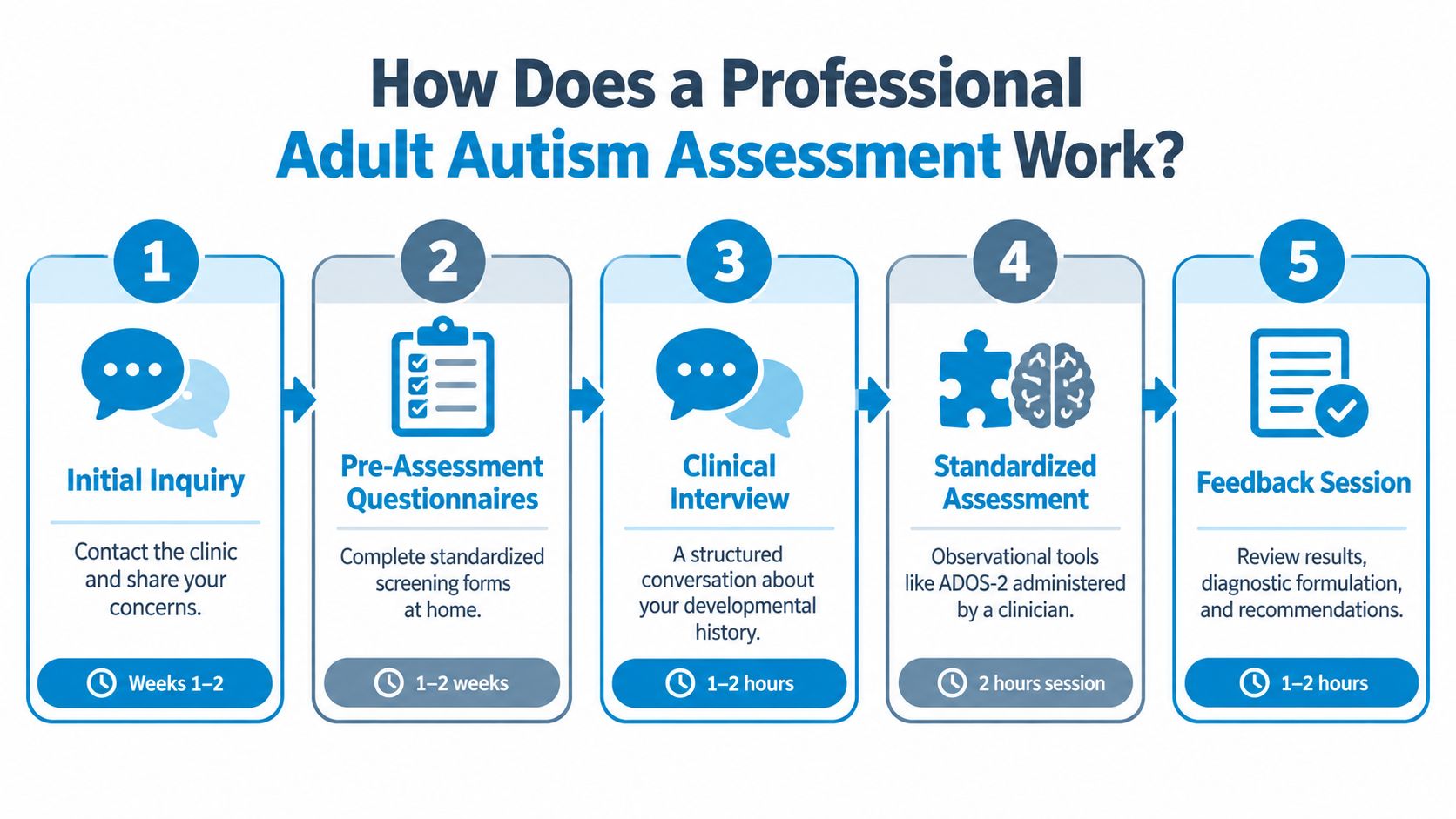
How Does a Professional Adult Autism Assessment Work?
A good adult assessment is structured, collaborative, and focused on patterns across time. It should clarify how the person thinks, copes, communicates, and recovers from overload.
What happens before the full evaluation?
For adults without a moderate or severe learning disability, NICE guidance says screening can start with the Autism-Spectrum Quotient, 10 items, and a score of 6 or above means a full autism assessment should be offered (NAMI summary of NICE guidance). That threshold is useful because it gives people a concrete next step instead of a vague suggestion to “look into it.”
A thorough assessment usually adds a clinical interview, developmental history, and careful review of present-day functioning. The aim is not to collect isolated traits, but to see whether a stable autism pattern explains how the adult experiences communication, flexibility, sensory input, and social demand.
Therapsy's psychodiagnostic pathway is built around that kind of careful matching. For readers who want to understand why psychodiagnosis matters in a modern care plan, the role of psychodiagnosis is a useful starting point.
How do clinicians sort autism from overlapping issues?
Adult autism assessments need to look at overlap, not just labels. Anxiety, trauma, ADHD, and chronic stress can all change attention, communication, and shutdown patterns, so a careful clinician asks what is longstanding, what is context-driven, and what changes when the environment changes.
A structured process often includes cognitive profiling, developmental review, and discussion of daily functioning in work, relationships, and self-care. That's especially important for expats, because the same person can look very different when they're functioning in a second language, living far from family, or adapting to a new culture.
The best assessments end with a feedback session that gives the person something usable. That usually means a formulation, not just a label, plus recommendations that connect directly to daily life.
Which Therapy Approaches Actually Help Autistic Adults?
The most useful therapy for autistic adults is adapted to communication style, predictability needs, and the person's actual stress load. Standard talk therapy can help some people, but it often misses the concrete structure many autistic adults need.
| Therapy Approach | Core Mechanism | Best Suited For |
|---|---|---|
| Adapted CBT | Identifies thought patterns, adds concrete coping tools, and uses explicit structure | Anxiety, intrusive thoughts, avoidance, and repeated overwhelm |
| Mindfulness-based work | Trains attention, body awareness, and non-reactive noticing | Emotional regulation, stress recovery, and internal pressure |
| Supportive talk therapy | Offers reflection and containment without as much structure | People who already have insight and mainly need steady relational support |
| Neurodiversity-affirming therapy | Respects autistic communication and builds around strengths and needs | Adults who want support without being pushed toward masking |
Why does standard talk therapy sometimes miss the mark?
Some autistic adults do well when sessions are highly structured, predictable, and tied to real-life situations. Others get stuck in open-ended conversation because the therapist never turns insight into practical change.
A systematic review found that cognitive-behavioral interventions adapted for autism show emerging evidence for improving anxiety, depression, and obsessive-compulsive symptoms, while mindfulness-based approaches are also emerging as useful for psychiatric symptom reduction in adults without intellectual disability (systematic review in Autism). The same review noted that the broader adult-services evidence base is still underdeveloped, which means fit matters a great deal.
That's where a service like Therapsy can help with matching. Neurodiversity-affirming therapy is most helpful when the therapist understands that the goal is not social normalization, but better functioning and less distress.
What should therapy focus on in daily life?
The most useful therapy targets are usually concrete. That can mean fewer shutdowns, better emotional labeling, clearer routines, or less avoidance of work, travel, or social contact.
Clinical takeaway: therapy works better when the goal is a visible change in daily life, not just a vague sense of talking things through.
For some adults, progress comes from predictable session structure and explicit language. For others, it comes from learning how to notice early signs of overload before they turn into crisis.
Therapsy commonly frames therapy that way for expats, too. The therapist's role is to make the work understandable across cultures and languages, so the person isn't translating their distress while trying to heal.
What Workplace and Social Accommodations Prevent Burnout?
A new job, a busy office, or a packed social calendar can look manageable on paper and still drain an autistic adult quickly. Burnout often builds where sensory strain, vague expectations, and constant social performance all pile up at once.
Workplace adjustments matter because they reduce friction before it turns into collapse. An adult-services review identified supported employment as one of the few evidence-based adult interventions, alongside structured teaching and behavior modification (adult-services review). In practice, that means tasks are easier to hold when they are broken into clear steps, roles are matched carefully, and routines are stated rather than assumed.
A few accommodations usually make a clear difference:
- Written clarity: Clear written instructions reduce memory load and prevent misunderstandings when spoken language moves too fast.
- Predictable routines: Consistent meeting times, agendas, and deadlines reduce hidden cognitive effort.
- Sensory control: Lighting, noise, seating, and break options can lower overload before it becomes shutdown.
- Energy budgeting: Social contact works better when the person can plan recovery time after dense interactions.
For meetings and lectures, some adults also benefit from captions for meetings and lectures, especially when processing spoken language gets harder under stress. That kind of support can make professional settings more accessible without turning them into a clinical space.
Requests work best when they are concrete. Instead of explaining a diagnosis in detail, an adult can ask for written agendas, advance notice of changes, or a quieter place to concentrate.
For strategies to apply these accommodations under pressure, see managing anxiety at work. Speaking up is easier when the request is small, specific, and tied to daily function.
THERAPSY often helps expats prepare those conversations in the language they use under pressure. The point is not to justify every boundary. It is to protect energy, reduce friction, and keep work and relationships sustainable.
How Can Expats Access Multilingual Autism Support in Italy?
For expats, the biggest barrier is often not willingness, it's language. When someone has to describe sensory overload, shutdown, or lifelong masking in a second language, important details can get lost.
Why does language-concordant care matter so much?
Autism support depends on nuance. If a person can't describe emotional shifts, childhood patterns, or workplace stress clearly, the assessment and therapy process becomes less precise.
Therapsy works with 14 languages, including Italian, English, French, Spanish, German, Portuguese, Ukrainian, Russian, Greek, Arabic, Urdu, Hebrew, Hindi, and Persian (Farsi). It also offers online and in-person sessions across 23 Italian cities and 83 physical locations, which gives adults flexibility when they want a stable support routine in Italy.
The matching process is human, not automatic. The Clinical Director connects the person with a therapist based on language, needs, and fit, and the first assessment call is free. For adults who are trying to build support across borders, multilingual therapy for expats in Italy can be a practical entry point.
What does a good expat pathway look like?
A strong pathway usually has three parts. First, the person gets language-concordant assessment or therapy so they can explain themselves accurately. Second, the therapist helps translate emotional patterns into practical support. Third, the plan stays flexible enough for online or in-person sessions depending on the person's city, schedule, and energy.
Therapsy's model also matters because adult autism support rarely fits one format. Some people need therapy for anxiety, others need help with routines or social overwhelm, and many need both at different points.
Best-fit principle: the right support is the one the person can actually use consistently in daily life.
When adults live between cultures, the support system has to be even more deliberate. A multilingual therapist can hold the clinical work while also respecting the realities of relocation, identity, and adaptation.
What Are the Concrete Next Steps to Get Started?
The first step doesn't have to be a diagnosis. It can be a calm conversation about what's hard, what patterns keep repeating, and what kind of support would make daily life more manageable.
What can a first call clarify?
A free first assessment call gives the adult a low-pressure place to talk about current struggles, sensory needs, and goals. It's also a chance to see whether the therapist's style feels structured enough, gentle enough, and clear enough to be useful.
At Therapsy, that call is with the therapist chosen for that person, and there's no obligation to continue. That matters because many adults hesitate precisely because they're afraid of entering a rigid system before they know whether the fit is right.
The practical aim is simple. The adult should leave that first contact with a clearer sense of whether they want assessment, therapy, workplace support, or just more information before making a decision.
How should someone choose the next move?
The right next step depends on the problem that hurts most. If the main issue is uncertainty, an assessment may help. If the main issue is burnout or anxiety, therapy with a structured, autism-aware clinician may be the better starting point.
Therapsy can also help adults compare options across language, format, and location. That's useful for expats in Italy who want support without having to manage both emotional stress and unfamiliar bureaucracy at the same time.
For readers who want a straightforward place to begin, Therapsy's services explain the available formats, and the pricing page shows the main options clearly. A support plan works best when it starts small, feels understandable, and respects the person's pace.
Therapsy offers multilingual therapy in Italy for adults who want autism-aware support in their own language, with online and in-person sessions matched by a clinician rather than an algorithm. The first call is free, there's no obligation to continue, and the process is designed to feel clear for expats who are still figuring out what kind of support they need. Visit THERAPSY to explore a calm, practical first step.