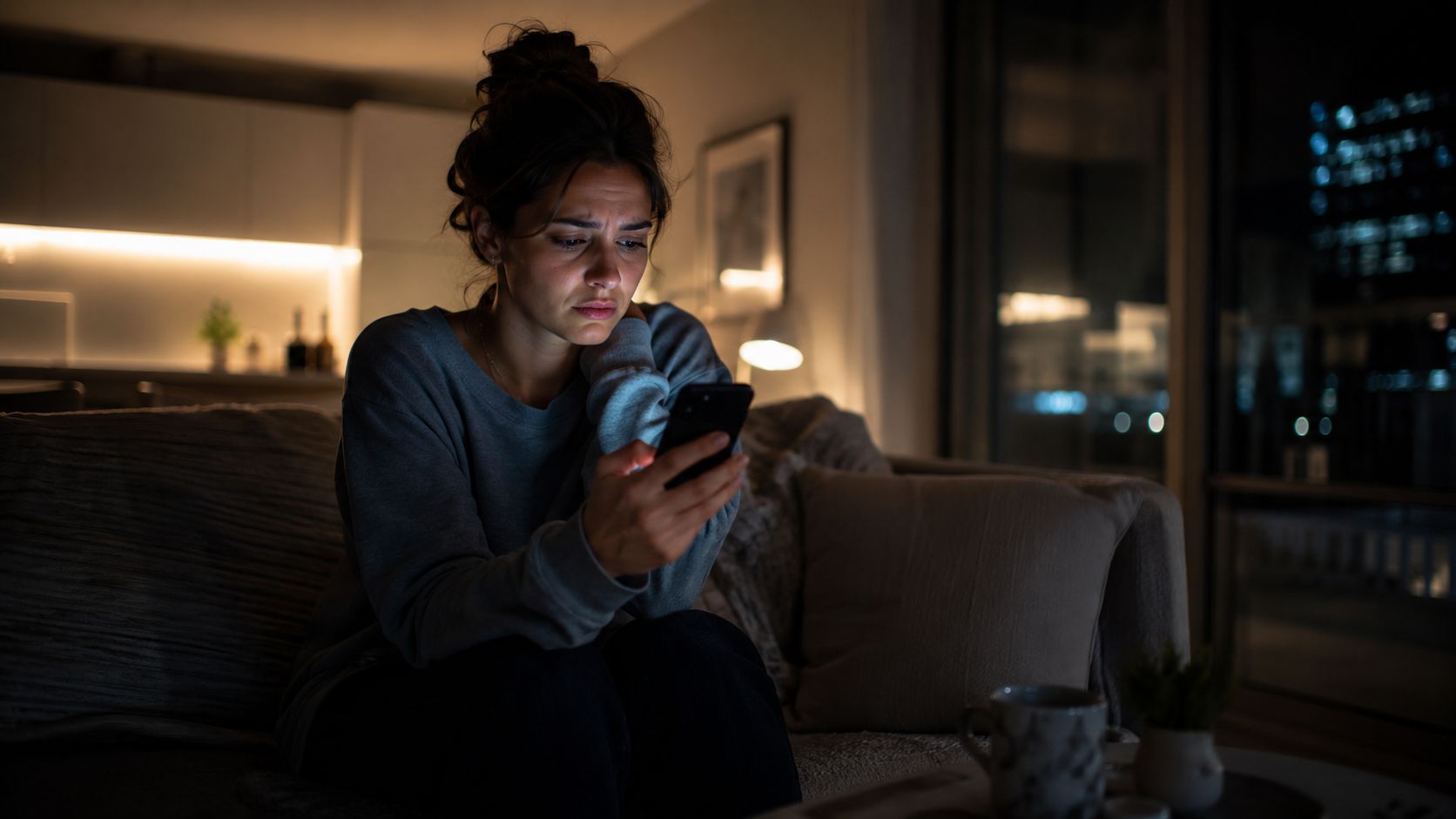
You reread your partner's delayed message, feel your stomach drop when they say “we need to talk,” and consider starting a difficult conversation late at night just to stop the uncertainty. Therapy for relationship anxiety can help when worry, doubt, and threat-scanning keep shaping how you interpret closeness. The right starting point may be individual therapy, couple therapy, or both, depending on whether anxiety comes mainly from personal history, the current relationship pattern, or an interaction between the two.
What Relationship Anxiety Actually Feels Like
Relationship anxiety is persistent worry, doubt, or vigilance focused on a romantic bond. It differs from an ordinary concern because it keeps returning, feels difficult to settle, and changes what a person does. A delayed reply becomes evidence of rejection, a different tone sounds like anger, and a normal request for space feels like the beginning of abandonment.
Common signs include:
- Reassurance seeking: asking whether a partner still cares, then needing the answer again soon afterwards.
- Monitoring: checking messages, online activity, facial expressions, or changes in routine for signs of danger.
- Mental checking: repeatedly asking whether the relationship feels “right,” whether attraction is strong enough, or whether a small doubt means something larger.
- Difficulty being alone: feeling unsafe or incomplete when a partner is unavailable.
- Catastrophising: moving from a small cue to the worst possible outcome.
- Body symptoms: chest tightness, agitation, restless sleep, or a racing mind.
How is it different from ordinary relationship stress?
Ordinary relationship stress usually has a clear subject, such as a disagreement, a practical decision, or a period of distance. Anxiety can continue after the immediate problem has been discussed, shift from one topic to another, and demand certainty that no partner can provide.
General anxiety can affect work, health, money, or many areas of life. Relationship anxiety is concentrated around intimacy and the possibility of rejection, abandonment, betrayal, or incompatibility. Attachment insecurity describes an underlying pattern in how a person expects closeness to work. Relationship anxiety is the felt experience and the behaviour that follows.
A person may also silence their needs, withdraw before being rejected, or start arguments to test whether the relationship will survive. These patterns don't mean someone is manipulative or defective. They often represent attempts to create safety that accidentally increase tension.
People living abroad may experience these fears alongside cultural adjustment, language differences, isolation, or uncertainty about where they belong. Therapy for anxious attachment style can help make the pattern understandable without reducing the person to a label. Once the pattern is visible, it becomes possible to choose a clear therapeutic response.
How Anxiety Takes Hold Inside a Relationship
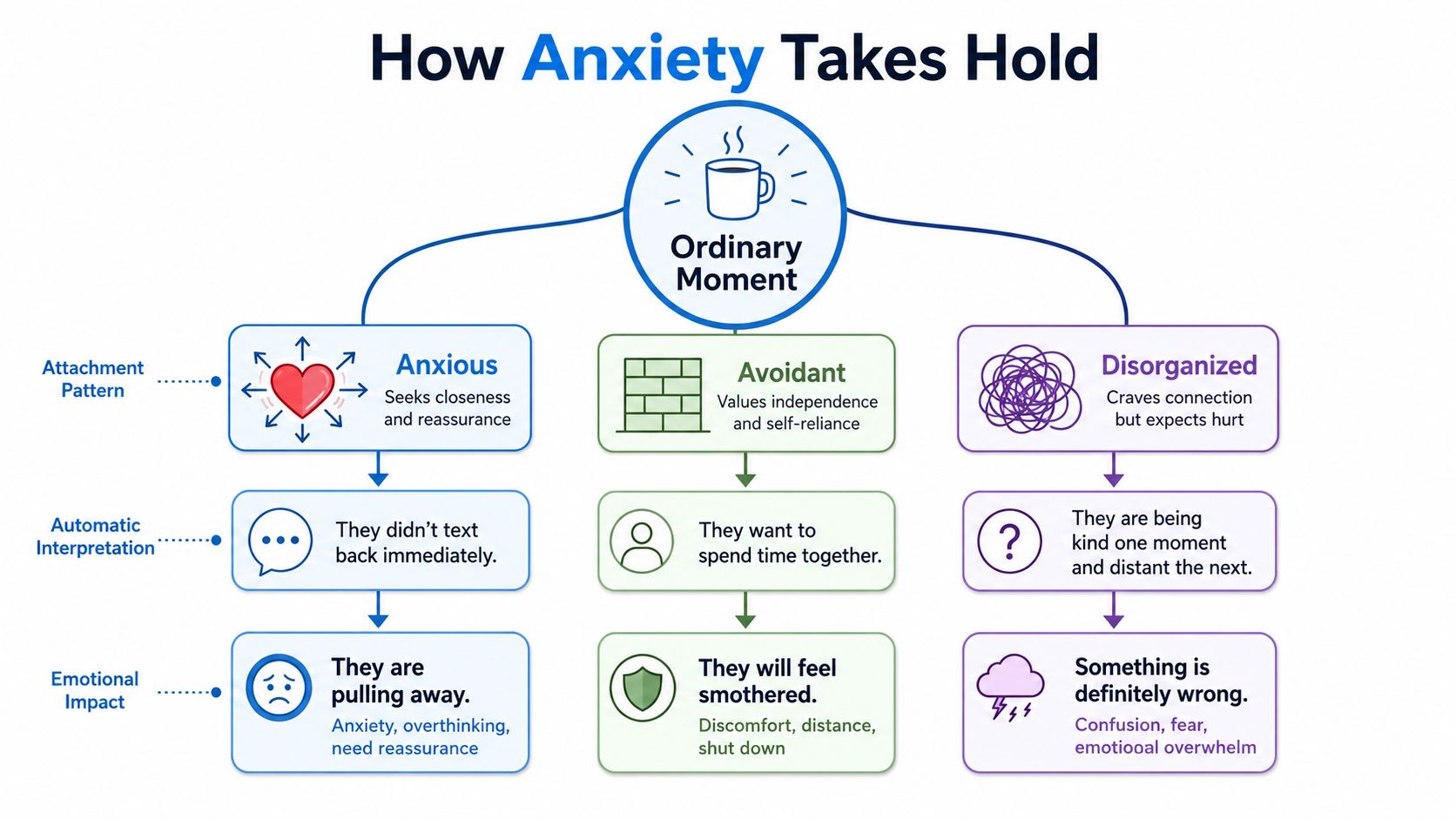
Relationship anxiety often grows through a sequence rather than a single thought. An ordinary event occurs, the nervous system assigns meaning to it, the person acts to reduce danger, and the partner responds to that action. Each response then becomes new evidence for the original fear.
Attachment patterns influence the first interpretation. Anxious patterns may turn silence into “they're pulling away.” Avoidant patterns may turn emotional intensity into “I need to escape.” Disorganised patterns can create a rapid movement between seeking closeness and fearing it. These are broad relational tendencies, not diagnoses, and people can respond differently across relationships.
What does the reassurance cycle look like?
Consider Lara and Marco. Lara notices that Marco hasn't replied and asks whether something is wrong. Marco answers quickly, Lara feels calmer, and then the doubt returns. She asks a more specific question, Marco feels pressured, and he withdraws to avoid another difficult exchange.
Lara interprets his withdrawal as proof that she was right to worry. Marco interprets her repeated questions as proof that nothing he says will be enough. The cycle intensifies even if both people want connection.
Practical rule: A reassuring answer can soothe anxiety briefly, but therapy targets the process that makes the answer expire so quickly.
The cycle may involve threat hypervigilance, where the mind scans for danger, and negative prediction bias, where rejection is expected before the evidence is clear. Rumination then keeps the alarm active. A person replays the conversation, searches for alternative meanings, and treats uncertainty as a problem that must be solved immediately.
Partner insensitivity can be real and can amplify anxious symptoms. At the same time, the anxious partner's threat system may be reacting more strongly than the situation warrants. A 2026 couples study reported that perceived partner insensitivity fully mediated the link between anxious symptoms and lower relational connectivity, while partner responsiveness offered only partial protection. The study's findings support a more precise approach than just telling one partner to provide more reassurance.
Therapy can therefore target several points in the sequence: the interpretation, the body response, the reassurance behaviour, the withdrawing response, and the couple's repair process. Work on emotional intelligence in relationships may support reflection, but entrenched cycles often need guided clinical work.
Therapy Approaches That Work for Relationship Anxiety
No single therapy method is automatically right for every person. The most useful choice depends on whether the main driver is an anxious prediction, a painful memory, a long-standing relational schema, emotional avoidance, or a cycle maintained by both partners.
What happens in each approach?
Cognitive Behavioral Therapy, or CBT, maps the link between situation, thought, emotion, body response, and behaviour. A therapist may help a client examine the prediction “a delayed reply means the relationship is ending,” test alternative explanations, and practise tolerating uncertainty between sessions. CBT is especially relevant when thoughts are repetitive, specific, and linked to checking or reassurance.
EMDR may be considered when present fear is connected to distressing memories, betrayal, abandonment, or attachment wounds. The work focuses on processing memories that still feel emotionally present, rather than treating every current interaction as if it were the original event.
Schema Therapy explores held expectations such as “people leave,” “my needs are too much,” or “closeness is unsafe.” Sessions can include identifying the origin of these beliefs, imagery work, and developing a more compassionate internal response.
Emotionally Focused Therapy, or EFT, is designed for couples. The therapist slows the interaction down, identifies protest behaviours such as criticism or pursuit, and helps each partner express the vulnerable need underneath. The aim is to change the emotional cycle, not decide which partner is at fault.
Systemic-relational therapy examines family-of-origin patterns and the rules each partner learned about dependence, conflict, privacy, and care. It can be particularly useful for intercultural couples whose expectations about communication or commitment differ across family and cultural contexts.
Other options may include psychodynamic therapy, Acceptance and Commitment Therapy, and body-focused approaches when emotion regulation, avoidance, or trauma is central. A review of adult systemic interventions found applications across relationship distress, anxiety disorders, mood disorders, psychosexual problems, substance-related problems, and adjustment to chronic illness. The review illustrates why relational treatment can remain relevant when anxiety overlaps with broader life difficulties.
| Approach | What It Targets | What a Session Looks Like |
|---|---|---|
| CBT | Anxious thoughts and avoidance | Mapping predictions, testing beliefs, practising new responses |
| EMDR | Distressing memories and attachment wounds | Identifying memories and processing their emotional impact |
| Schema Therapy | Abandonment, mistrust, or defectiveness patterns | Exploring origins, imagery, and compassionate corrective work |
| EFT for couples | Pursue-withdraw and protest cycles | Slowing conflict and expressing attachment needs |
| Systemic-relational | Family and cultural relationship rules | Examining patterns between partners and across generations |
A large meta-analysis found medium post-treatment effects for couples therapy overall, with g = 0.60, and a larger effect for emotionally focused couples therapy, g = 0.73, than for behavioral couples therapy, g = 0.53. Benefits persisted at six months overall, g = 0.44, while gains had largely faded at twelve months in the behavioral subgroup, g = 0.06, which highlights the importance of maintenance and follow-up. The peer-reviewed meta-analysis supports choosing an approach that includes durable skills and a plan for continuing progress.
Individual support for anxiety can begin with CBT for anxiety.
Individual Therapy, Couple Therapy, or Both
The central decision isn't whether one format is universally better. It's where the anxiety is being maintained. If the pattern follows someone across relationships, individual work may be the starting point. If both partners repeatedly trigger and reinforce the cycle, joint sessions may be essential. A blended plan can address personal history while changing the relationship interaction directly.
| Focus | Typical pace | Confidentiality | Best fit |
|---|---|---|---|
| Individual therapy | One person's history, symptoms, and responses | Private space between client and therapist | Anxiety that predates the current relationship |
| Couple therapy | The interaction cycle and shared goals | Material is discussed in the joint setting | Reassurance, withdrawal, conflict, or trust cycles |
| Blended therapy | Personal patterns plus joint repair | Separate and shared boundaries must be clear | Significant individual anxiety affecting both partners |
Which format fits these situations?
A person who has felt relationship anxiety in several partnerships may start with individual therapy. The therapist can work on attachment expectations, intrusive worry, self-silencing, or past experiences without asking the current partner to carry the entire burden.
A couple who spends evenings in a reassurance-blame loop may benefit from couple therapy. The therapist can observe the sequence in real time, help Lara describe fear without repeated testing, and help Marco remain engaged without retreating.
Someone reacting strongly after a past betrayal may need individual therapy first, couple therapy, or a planned combination. The right choice depends on the current partner's willingness to discuss trust, the person's level of distress, and whether the relationship is emotionally safe enough for joint work.
A couple living between languages or cultures should also consider whether both partners can express vulnerable feelings accurately in the session language. Online couples therapy can offer flexibility, but the therapist still needs to manage turn-taking, privacy, and cultural meaning carefully.
The evidence base supports couple therapy as a structured treatment for relationship distress. Reviews describe many studies using roughly 20 sessions over about six months, and estimate that 60% to 80% of distressed couples benefit from behavioral or emotion-focused approaches, with about half maintaining gains at two-year follow-up. The review evidence also explains why changing interaction patterns can matter more than teaching one partner generic calming skills alone.
What the First Month of Therapy Looks Like
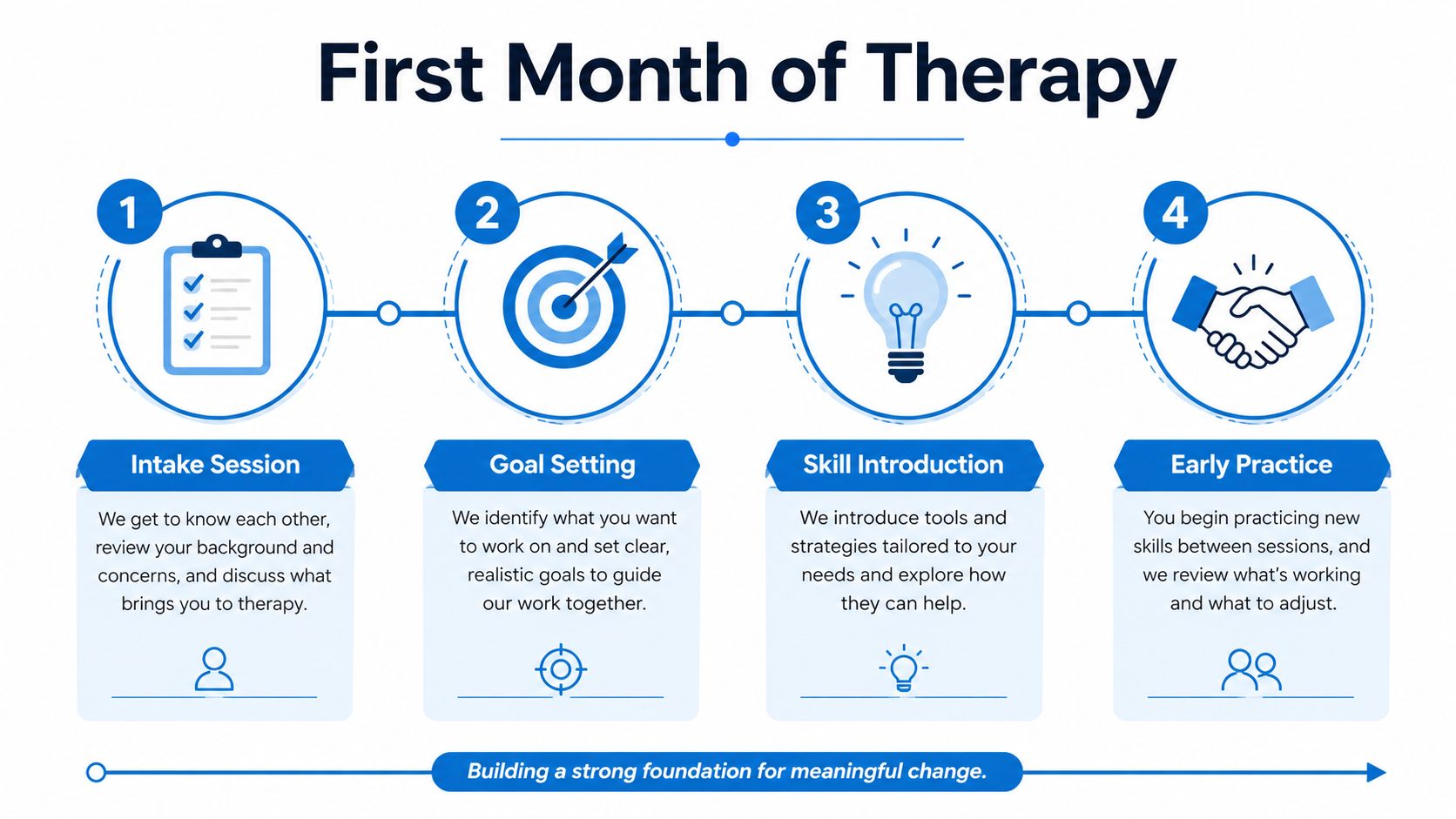
The first month usually focuses on understanding the pattern, agreeing on priorities, and creating enough stability to work safely. It isn't normally a dramatic deep dive into every painful memory.
What happens first?
An initial session commonly lasts around 50 minutes. The therapist asks about personal history, current symptoms, relationship context, cultural background, and what prompted the person to seek help. For a couple, each partner should have space to describe the problem without turning the intake into a trial.
Goals then become concrete. “I want to feel secure” might become “I want to reduce late-night checking,” “speak about needs without testing my partner,” or “repair disagreements before withdrawing.” The therapist and client decide whether sessions will be individual, joint, alternating, weekly, or sometimes every other week.
What might happen between sessions?
Early practices should be small enough to complete. A therapist might ask someone to record the trigger, prediction, body sensation, and action, or to delay a reassurance request for a short agreed period while observing what happens. A couple might schedule a calm check-in rather than beginning a difficult conversation when both partners are exhausted.
A formal review around the four-week point can ask whether the goals still fit, whether the therapist's approach feels useful, and whether the format should change. A strong therapeutic relationship matters in anxiety treatment. A systematic review of 50 studies found consistent links between therapeutic cohesion, positive expectations, and outcomes, with emerging evidence for collaboration, empathy, and repairing ruptures. The review makes fit a clinical factor, not a luxury.
How to Choose the Right Therapist
The right therapist for relationship anxiety needs more than general warmth. They should understand anxiety, relationship processes, and the cultural context in which the partnership exists.
What should a first call clarify?
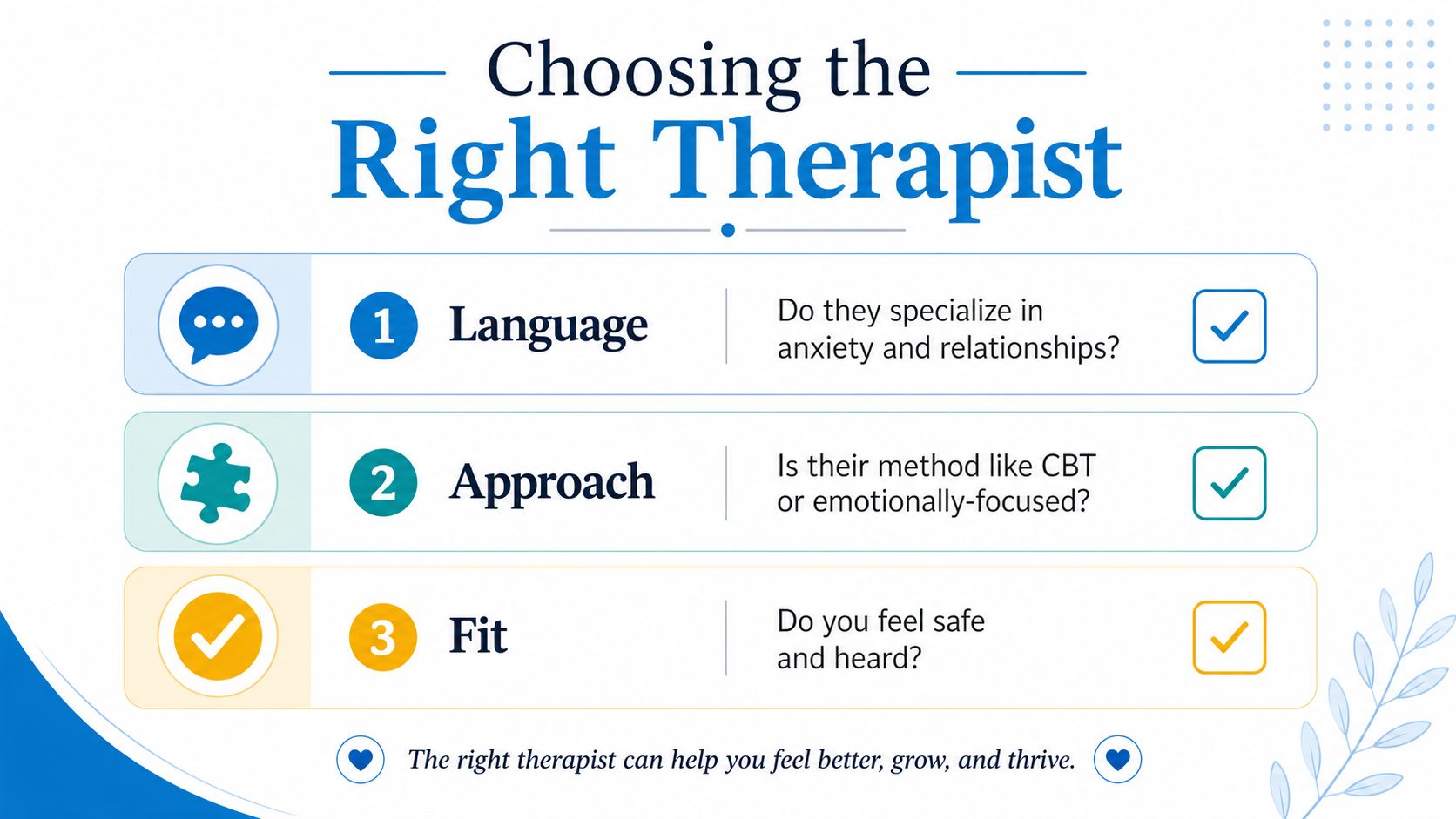
Start with language. Therapy is more useful when a person can describe fear, desire, shame, and anger precisely. For expats and mixed-language couples, cultural meanings also matter. A pause, a family expectation, or a form of affection may mean something different across backgrounds.
Next, ask about the therapist's approach. CBT or EMDR may fit anxiety-driven symptoms and distressing memories. EFT or systemic-relational therapy may fit a couple cycle. Schema Therapy may be relevant when abandonment or mistrust has shaped relationships for many years.
Finally, ask about experience with both anxiety and couples. A therapist who works only with one side may miss the way each partner's response maintains the problem.
- Training: “Which methods do you use for relationship anxiety?”
- Structure: “What does a typical session involve?”
- Format: “How do you decide between individual, couple, or blended therapy?”
- Cultural context: “How do you work with different languages, family expectations, or migration stress?”
- Repair: “What happens if one of us feels misunderstood in session?”
Listen for clear, respectful answers rather than promises. The therapist should explain how assessment shapes the plan and should make room for uncertainty.
Therapsy uses human matching by the Clinical Director rather than an algorithm, offers therapy in the client's own language across 14 languages, and provides a choice between online and in-person sessions. Its network includes 50+ therapists, and fewer than 1 applicant in 100 is accepted, according to the service's stated network criteria. These details don't replace a personal assessment, but they describe a practical way to begin finding a culturally responsive therapist in Italy.
Self-Help Strategies and When to Seek More Support
Self-help can lower the intensity of a trigger, but it can't change every relationship pattern alone. The most useful practices interrupt the sequence between fear and action, giving the person enough space to choose a response.
What can someone practise immediately?
Grounding brings attention back to the present. Name objects in the room, notice the support beneath the feet, and lengthen the exhale without forcing the body to relax. The purpose isn't to prove that nothing is wrong. It's to reduce the chance of acting while the alarm is at its highest.
Structured worry time gives recurring thoughts a defined place. Write the concern down, postpone analysis until the agreed period, and then separate what can be discussed from what cannot be known yet.
A pause before reassurance can reveal the actual need. Ask, “Am I looking for information, connection, or immediate relief?” If connection is the need, a direct statement such as “I'm feeling insecure and would like ten minutes of closeness” may be more effective than a test.
Values-based communication keeps the conversation specific: “I felt frightened when plans changed. Could we agree how to update each other?” This is different from “You clearly don't care.”
Sleep and stress can intensify emotional reactivity.
When does self-help stop being enough?
Seek professional support when anxiety disrupts sleep, work, daily functioning, or the stability of the relationship. Persistent intrusive thoughts, panic symptoms, hopelessness, repeated checking, or escalating conflict deserve careful assessment rather than self-judgement.
Controlling behaviour isn't the same as ordinary insecurity. Monitoring a partner's devices without permission, isolating them from friends, using threats, or creating fear raises a safety concern. If either person faces immediate danger, contact local emergency services, crisis support, or domestic violence resources. Couple therapy may not be appropriate where intimidation or violence prevents free participation. Individual support and safety planning should come first.
Therapy can also address anxiety linked to specific contexts. In a 2025 randomised trial involving women receiving infertility treatment, relationship-enhancement couple therapy and systematic desensitisation both reduced sexual anxiety over 12 weeks, while the couple-based intervention also improved interpersonal skills. The trial report illustrates why treatment sometimes needs to address sexual, health, or fertility-related distress rather than communication alone.
Accessing Multilingual Therapy in Italy and FAQ
Finding therapy in Italy can feel harder when someone is navigating a new healthcare system, another language, or a relationship that crosses cultures. Therapsy connects clients with psychologists and psychotherapists through a human matching process led by the Clinical Director, with online and in-person options across 24 Italian cities.
Therapy is available in 14 languages: Italian, English, French, Spanish, German, Portuguese, Ukrainian, Russian, Greek, Arabic, Urdu, Hebrew, Hindi, and Persian (Farsi). A person can use the language that best fits the emotional work, while couples can discuss whether one shared language or multilingual support will help both partners participate fully.
When is individual therapy better than couple therapy?
Individual therapy may fit when anxiety existed before the current relationship, follows a person across partnerships, or connects strongly to personal memories, trauma, or broader anxiety. Couple therapy may fit when the main difficulty is a repeating interaction cycle that both partners want to change.
A blended plan can be useful when one person needs private work while both partners also need help with communication, trust, or repair. The therapist should explain boundaries and confidentiality before combining formats.
How long does therapy take?
There is no guaranteed timetable. The clinical evidence includes short, structured couple interventions, and one review describes treatment in many studies as roughly 20 sessions over about six months. The appropriate duration depends on the goals, severity, history, safety, language, and whether the work is individual, joint, or combined. Research on couple-therapy outcomes also shows why follow-up and maintenance deserve discussion.
What does therapy cost in Italy?
At Therapsy, individual therapy starts from EUR 70, couple therapy from EUR 100, psychodiagnostic assessment from EUR 255 for three sessions, and psychiatric consultation from EUR 110. The Therapsy pricing page explains that the final fee depends on the therapist's experience and specialisation. The first assessment call is free.
Does online therapy work for anxiety?
A 2022 review found no significant differences between videoconferencing and face-to-face couple therapy for depression, anxiety, or stress. Both formats showed a small but significant decrease in anxiety after treatment and at three-month follow-up, and the study included 171 participants. The review record supports online therapy as a credible format, while personal preference, privacy, and access still matter.
Therapsy offers therapy in your native language and can discuss scheduling, language matching, and the choice between online and in-person care during the free first call. The initial contact is with the therapist chosen for that person, and there's no obligation to continue.
Therapsy can help identify whether individual therapy, couple therapy, or a blended plan makes sense for relationship anxiety, with human matching by the Clinical Director, therapy in 14 languages, and online or in-person sessions across Italy. Visit THERAPSY to arrange the free first call with the therapist chosen for you, with no obligation to continue.