A 2026 review found depression prevalence among international students ranging from 3.6% to 38.3%, while a broader sample reported 51.5%. Study abroad depression is linked to acculturative stress during international study, and it can be driven as much by isolation, language fatigue, homesickness, discrimination, and financial strain as by academic pressure.
A student may be sitting in an Italian lecture hall, answering messages from home with “everything is fine,” while privately feeling numb, exhausted, or unable to imagine getting through the week. The excitement of studying abroad can make those feelings harder to admit, especially when family members have invested money, hope, and trust in the experience.
Depression during study abroad isn't a personal failure or proof that the student made the wrong choice. It can be a mental-health response to sustained changes in language, relationships, routines, identity, and practical security. Help is appropriate even when the student isn't in immediate danger and can't explain exactly what's wrong.
What Study Abroad Depression Really Is
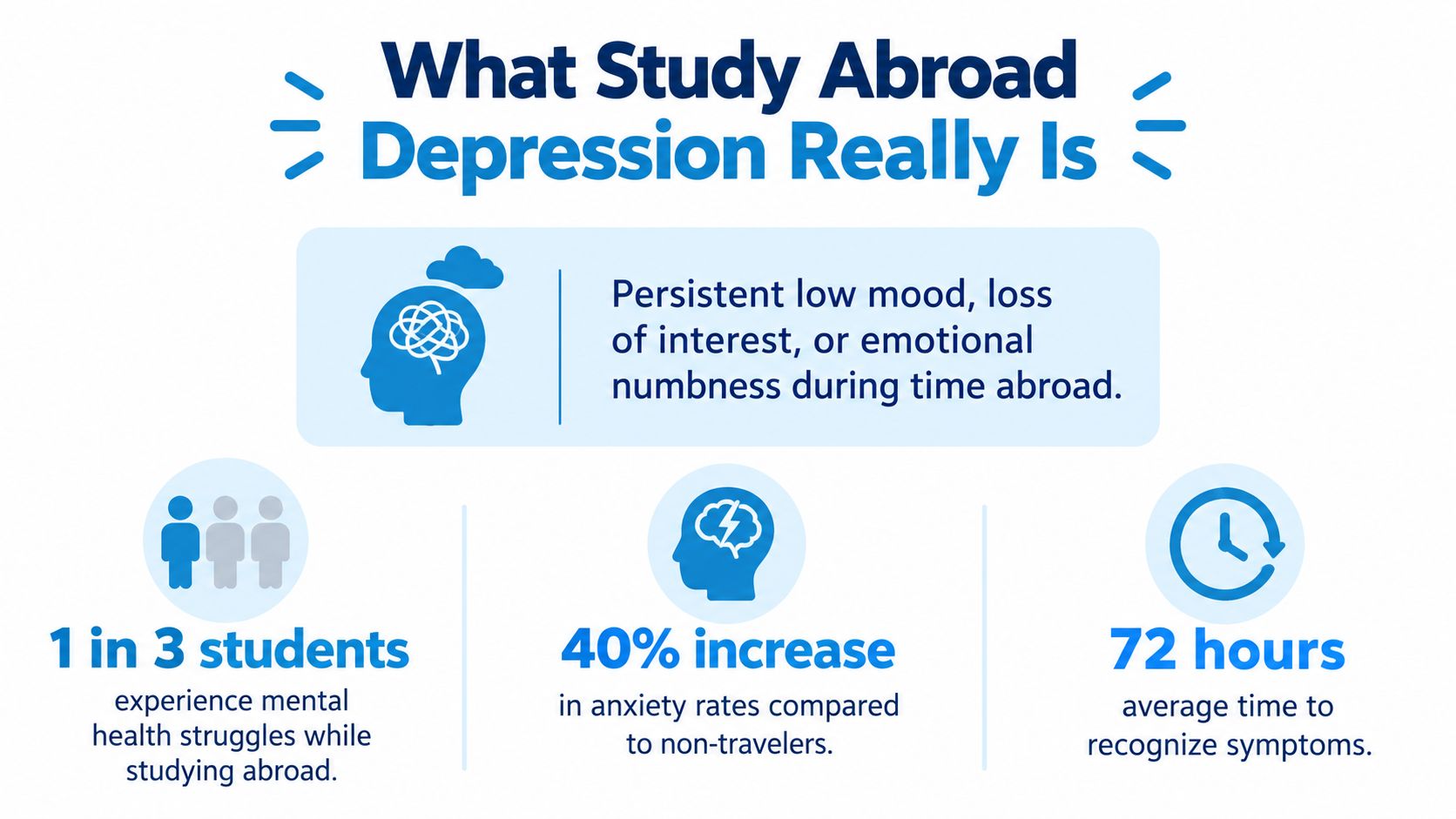
Study abroad depression is persistent low mood, loss of interest, or emotional numbness that emerges or intensifies during international study and affects daily functioning.
A difficult settling-in period usually comes and goes. Study abroad depression tends to spread across several areas of life. A student may stop enjoying food, friendships, travel, coursework, or familiar routines, while also experiencing fatigue, sleep changes, hopeless thoughts, or withdrawal.
What does acculturative stress mean?
Acculturative stress is the psychological strain created by adapting to a new culture, language, social system, and set of everyday expectations.
The strain may begin with small events. A student misses a bank appointment because a form is difficult to understand, hesitates before making a phone call in Italian, or spends excessive energy working out whether a professor's feedback is direct or merely formal. Each event may seem manageable, but repeated uncertainty can reduce emotional capacity.
A recent review found depression prevalence ranging from 3.6% to 38.3% across international-student studies, with results varying by country, sample, year, and screening method. The same review highlighted a cohort in which 51.5% of international students reported depression, alongside homesickness at 80.5% and language barriers at 60%. These figures show why a single universal estimate would be misleading, while also showing that the problem can be substantial (review of international student mental health).
Depression in this setting isn't purely an internal chemical problem and shouldn't be reduced to homesickness. Relationships, language access, housing, money, discrimination, and the fit between the student and the host environment can influence how distress develops and whether support feels available.
Practical rule: A student doesn't need to prove that the distress is severe enough before asking for a professional conversation.
A guide to major depression symptoms can help a student organise concerns, but only a qualified professional can assess what may be happening. Therapsy is a multilingual psychotherapy service in Italy that connects expats with therapists who speak their native language.
Therapsy also supports international students who need language-matched online therapy in Italy. Its clinical team treats the student's cultural context as part of the work, rather than as background information that can be ignored.
Why It Happens – Culture Shock, Homesickness, Pressure, and Isolation
Study abroad depression often develops through several overlapping pressures, not one isolated event or personal weakness.
Why can culture shock affect mood so strongly?
Culture shock consumes mental energy because ordinary tasks require constant interpretation, correction, and adaptation.
A student may understand the academic material but feel defeated by the practical environment. Ordering food, reading a housing contract, understanding a bureaucratic email, or knowing when to speak in a seminar can all require more concentration than expected. Over time, the student may feel incompetent even when the difficulty comes from unfamiliar systems.
Culture shock also affects social confidence. A student who is lively in a familiar language may become quiet in a group where jokes, interruptions, and references move too quickly. The resulting silence can be mistaken for a personality change.
Is homesickness the same as depression?
Homesickness is grief for familiar people, language, places, and routines, while depression usually expands into motivation, self-worth, sleep, pleasure, and everyday functioning.
A student may miss a parent's cooking, a close friend, or the ease of being understood without explanation. That pain can ease after a warm call, a familiar meal, or a developing local routine. Depression may remain even after contact with home, making positive experiences feel distant or inaccessible.
Academic pressure adds another layer. A different grading system, heavier reading load, unfamiliar participation rules, or fear of disappointing family can turn one missed deadline into a judgment about the student's entire future. Studying alone at 11 p.m. can then feel like evidence of failure rather than one difficult evening.
Can loneliness cause depression abroad?
Loneliness can deepen depression because the student loses opportunities for emotional regulation, practical advice, and ordinary connection.
Isolation doesn't always look like having no one around. A student can live in a crowded residence and still eat alone, avoid shared kitchens, or remain outside an Italian group chat because following the conversation feels exhausting. International friendships may also remain surface-level when everyone expects to leave soon.
A 2024 meta-analysis found a moderate correlation of approximately r = 0.41 between acculturative stress and depression, and approximately r = 0.39 between acculturative stress and broader negative psychological outcomes (systematic review and meta-analysis). The finding supports an environmental and relational explanation: repeated adaptation demands can affect mood, especially when social support and confidence are weak.
Language support can reduce daily friction without replacing mental-health care. A student looking for structured language learning may also explore Tutorbase for language schools, while someone struggling with cultural adjustment can read about culture shock and reverse culture shock.
What Study Abroad Depression Looks Like Day to Day
Depression abroad may appear as a pattern of emotional, cognitive, physical, and behavioural changes rather than one dramatic breakdown.
Which daily signs should a student pay attention to?
Persistent changes in pleasure, concentration, sleep, energy, and social behaviour deserve attention when they continue instead of resolving with ordinary rest.
A student might wake up tearful or emotionally flat, then feel irritated when a roommate asks a normal question. A favourite café, weekend trip, or conversation with friends may stop feeling rewarding. The student may call the change laziness, jet lag, or a bad week, even though the loss of pleasure keeps returning.
Cognitive signs can be quieter. Reading the same page repeatedly, thinking about giving up and going home, or repeatedly calling oneself a fraud can make studying feel impossible. Negative self-talk often sounds convincing because it interprets every language mistake or missed lecture as proof that the student doesn't belong.
Physical symptoms can include disrupted sleep, appetite changes, headaches, and fatigue that doesn't improve with rest. Behaviour may change too. The student may skip lectures, stop cooking, avoid speaking Italian in public, withdraw from classmates, or use alcohol more often to escape difficult feelings.
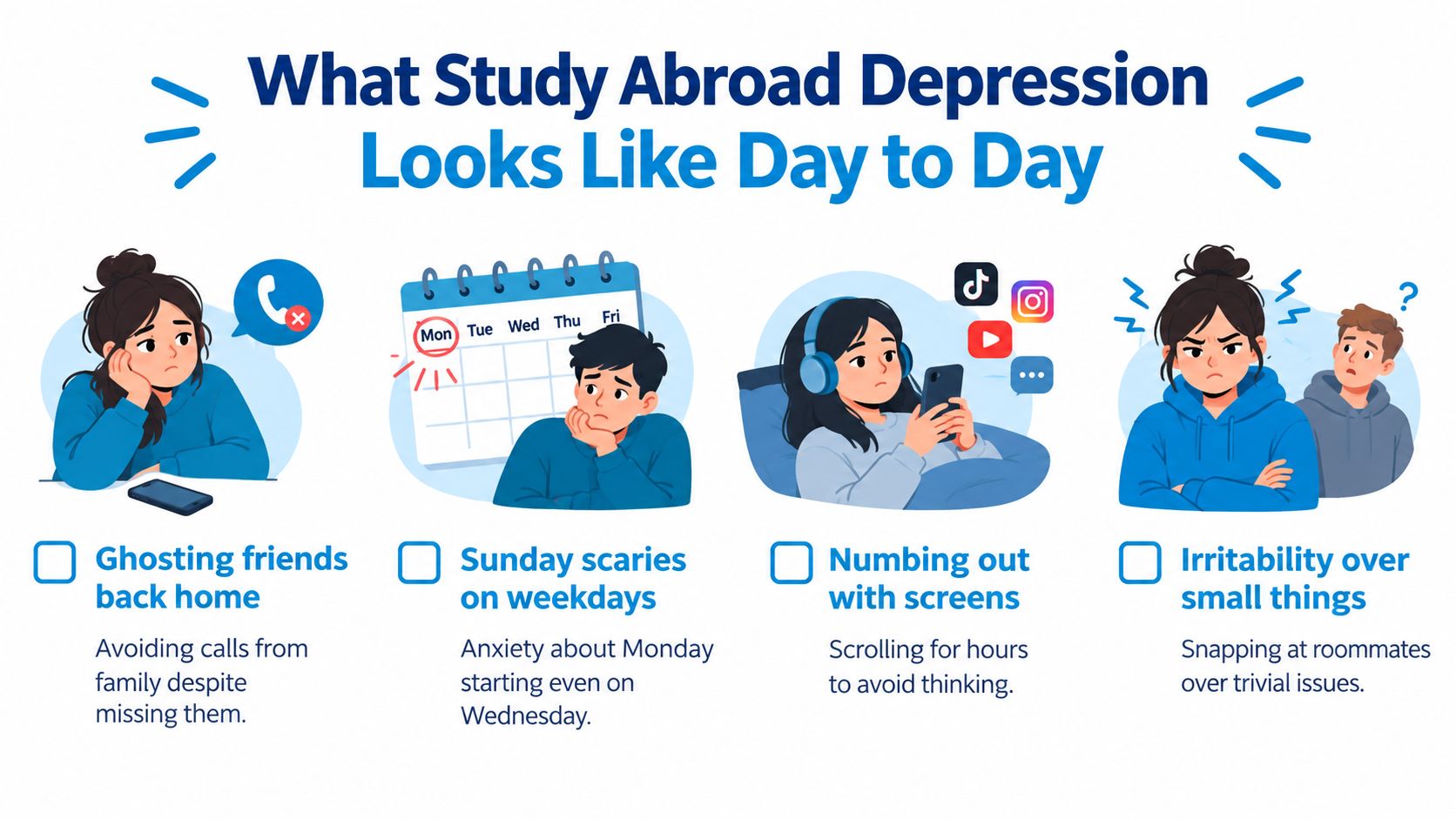
A cluster lasting two weeks or longer is worth discussing with a professional, particularly when it affects attendance, sleep, eating, relationships, or safety. This isn't a diagnosis. It is an early-warning practice that helps a student seek support before the situation becomes harder to manage.
A student can use Therapsy's mental-health support for international students to identify culturally and linguistically appropriate options. The purpose of noticing symptoms early isn't self-labelling. It is giving a therapist clearer information for an initial assessment.
What Helps Before You Reach a Therapist
Support works best when it matches the intensity, duration, and risks of the student's distress.
Which support level fits the current situation?
Low-intensity routines may help with ordinary adjustment strain, while persistent impairment or safety concerns call for professional assessment.
| Tier | What it addresses | Examples | When to escalate to the next tier |
|---|---|---|---|
| Low-intensity self-help | Routine disruption, mild loneliness, language fatigue, and early homesickness | Regular sleep and meals, a short daily walk, language journaling, one weekly family call, or one planned social activity | Escalate when low mood persists, pleasure keeps falling, or daily tasks become difficult |
| Campus and community support | Study stress, practical confusion, and mild to moderate isolation | International student offices, peer groups, an Erasmus buddy, a sports team, volunteering, an Italian class, or university counselling | Escalate when attendance, sleep, appetite, grades, or relationships deteriorate |
| Professional therapy or medical care | Depression symptoms, persistent distress, trauma, severe anxiety, or safety concerns | A therapist, university mental-health service, medico di base, psychiatrist, or emergency service | Seek urgent help for thoughts of self-harm or immediate danger |
Self-help should be concrete rather than aspirational. A student may schedule a weekly Italian class, join a local football team, prepare two simple meals in advance, and make one predictable call home. These actions create contact and structure, but they aren't substitutes for care when symptoms continue.
A confidential free online depression test may help a student prepare for a conversation. Screening can indicate that further assessment is sensible, but it can't establish a diagnosis or determine treatment on its own.
Professional support is a smart escalation, not a dramatic reaction. A therapist can use CBT to examine hopeless interpretations, attachment theory to explore separation and support needs, or Schema Therapy to understand why cultural setbacks activate older beliefs about rejection or failure.
When and How to Seek Professional Support in Italy
International students can begin with a medico di base, a university health service, or a private therapist who can work in a preferred language.
How can an international student start therapy in Italy?
The first step is identifying whether the student wants public healthcare access, private therapy, or both.
A medico di base can discuss symptoms and help direct the student toward appropriate medical services. A university may also have a counselling desk or health service. Students using the Italian National Health Service, or SSN, should ask their university or local health authority how registration and referrals work, because access depends on personal circumstances.
Private therapy can offer a direct route to a language-matched clinician. Costs vary by professional and service. At Therapsy, individual therapy starts from EUR 70, couple therapy from EUR 100, psychodiagnostic assessment from EUR 255 for three sessions, and psychiatric consultation from EUR 110. The first assessment call is free.
What happens during a first therapy session?
The first session usually gathers a history, clarifies current difficulties, considers safety, and identifies what the student wants to change.
A student can mention when symptoms began, what changed after relocation, which language feels easiest for emotional topics, and whether sleep, appetite, study, or relationships have been affected. The therapist may also discuss confidentiality, practical arrangements, therapeutic approach, and whether a psychiatric assessment could be useful.
Human matching matters when the therapist needs to understand both depression and the student's cultural frame. An algorithm may sort preferences, but a clinical director can consider language, presenting concerns, therapeutic approach, relocation history, and the kind of relationship likely to support honest conversation.
Therapsy connects students with 50+ therapists across 14 languages, including Italian, English, French, Spanish, German, Portuguese, Ukrainian, Russian, Greek, Arabic, Urdu, Hebrew, Hindi, and Persian (Farsi). Matching is done by the Clinical Director rather than an algorithm, and the student can choose online or in-person sessions.
A student can review how to start therapy in Italy, explore Therapsy's therapy services, or consider online therapy for expats in Italy. Online sessions may be useful around lectures, placements, or travel, while in-person sessions can provide a regular physical setting. Therapsy offers both formats across 24 Italian cities and 85 physical locations.
Some students worry that parents will find out, that therapy could affect immigration matters, or that records won't remain private. A student should ask the chosen provider how confidentiality, records, consent, and communication are handled in the specific setting. Therapy doesn't replace medical care, and medication decisions belong with a qualified prescriber.
Why Coming Home Can Feel Worse Than Leaving
Returning home can trigger depression when the student has changed but expects the old environment to feel exactly as it did before.
What is reverse culture shock after studying abroad?
Reverse culture shock is the disorientation that follows return, when familiar surroundings no longer match the student's new habits, identity, relationships, or expectations.
A student may miss the Italian coffee ritual, feel unable to explain the year abroad to family, or grieve an international friend group that has scattered. Family members may expect a simple travel story, while the student is carrying a complex mixture of pride, loss, frustration, and uncertainty.
The return can also expose differences in values. A student may have changed views about work, relationships, politics, independence, or daily life and then feel judged for those changes. Home can feel emotionally smaller, even when it remains loving and safe.
A longitudinal study described in research on re-entry found that some students reported less stress and depression while abroad than before or after the experience, which suggests that the lowest point can occur during reintegration rather than departure (research on post-study-abroad sadness). The emotional void may last for months, particularly when the temporary support system abroad disappears suddenly.

Ordinary readjustment can feel awkward, but persistent emptiness, irritability, social withdrawal, loss of interest, or changes in sleep and appetite deserve attention. A student doesn't have to abandon the identity developed abroad. Follow-up therapy can help connect the two versions of life instead of treating one as invalid.
A Practical First Step if You Are Struggling Now
The most useful first step is a calm assessment of safety, duration, daily impact, loneliness, language difficulty, and financial strain.
What should a student do today?
A student with thoughts of self-harm, immediate danger, or an inability to sleep or eat for several days should contact local emergency services, a crisis service, a medical professional, or a trusted person immediately.
A student without urgent safety concerns can still need help. A sudden withdrawal from all contact, inability to attend classes, or rapid worsening should prompt same-day contact with a healthcare provider or university support service. Waiting for a crisis isn't necessary.
Before a first call, the student can write down:
- When symptoms started: Note whether the change began before departure, after arrival, or during re-entry.
- What makes them worse: Include language situations, financial worries, social isolation, academic demands, or family pressure.
- What has already been tried: Record sleep changes, exercise, calls home, peer support, or campus resources.
- Which language feels safest: Emotional detail may be easier in a first language or another fluent language.
- What needs to change first: Examples include sleeping, attending class, eating regularly, or reconnecting socially.
Early screening for loneliness, financial stress, and language difficulty is especially useful because these pressures can strengthen the pathway from acculturative stress to depression. A 2026 study reported depression in 46.5% of its sample and suicidal ideation or self-harm thoughts in 31.2%, reinforcing why screening and culturally competent support shouldn't wait until academic performance collapses (study of international-student mental-health burden).
Therapsy offers human matching through its Clinical Director, therapy in the student's preferred language, and a choice between online and in-person sessions. The student can message a matched therapist, book the free assessment call, or contact a campus counselling service during the same week, with no obligation to continue.
FAQ on Study Abroad Depression and Getting Help
What are the symptoms of study abroad depression?
Study abroad depression may involve low mood, emotional numbness, loss of interest, fatigue, sleep or appetite changes, poor concentration, hopeless thoughts, and withdrawal. When several symptoms last beyond two weeks and interfere with study or daily life, a professional assessment is appropriate, but the pattern doesn't by itself establish a diagnosis.
How is homesickness different from depression?
Homesickness centres on missing home, familiar people, language, and routines, and it may ease after contact or increased familiarity. Depression can broaden into loss of motivation, disrupted sleep, reduced pleasure, low self-worth, and difficulty functioning even when the student receives comfort from home.
How does therapy work for international students in Italy?
An international student may begin through a medico di base, a university service, SSN pathways, or private care. Private therapy can provide direct access to English-speaking or multilingual clinicians, while the first session usually covers history, current symptoms, goals, confidentiality, and the most suitable form of support.
Is therapy available in a student's own language?
Language-matched therapy is available in Italy, and speaking in a familiar language can make it easier to describe emotional experiences, cultural expectations, and family relationships with precision. Therapsy's matching service connects students with therapists across 14 languages, with human matching by the Clinical Director and a choice between online and in-person care.
Students can also review common questions about mental wellness apps when considering general wellbeing resources. Such resources may support reflection or routine-building, but they shouldn't replace an assessment when depression symptoms persist or safety is affected.
Therapsy connects international students in Italy with a therapist selected through human clinical matching, in the student's preferred language and online or in person. The first assessment call is free, with no obligation to continue, so visiting THERAPSY can be a manageable first step toward understanding what is happening.