You're sitting in a beautiful Italian café. People around you are talking, laughing, living. The light is soft. The coffee is good. You know, on paper, that this move was supposed to mean something hopeful.
But inside, something feels flat.
You may be going to work, attending classes, answering messages, even posting photos that look fine. Yet privately, you feel detached, heavy, or strangely absent from your own life. Many young expats in Italy feel ashamed of this. They tell themselves they should be grateful. They worry that sadness in a place so idealised must mean they are failing somehow.
It doesn't.
Major depression symptoms can appear even when your life looks enviable from the outside. For expats, that mismatch often feels especially confusing. You may be grieving the loss of familiarity, struggling in another language, feeling professionally displaced, or carrying loneliness that no piazza can fix.
Clinical definition: Major Depressive Disorder is clinically defined by a persistent depressed mood or loss of interest or pleasure that lasts for at least two weeks, most of the day, nearly every day, and requires a minimum of five specific symptoms during this period to meet diagnostic criteria, with at least one being depressed mood or loss of interest.
That definition matters because it separates ordinary emotional pain from a condition that deserves proper attention. If you've been wondering whether what you feel is “serious enough”, this is the right question to ask. Not whether your life is objectively good, but whether your inner world has become persistently painful, numb, or hard to manage.
For many people who relocate, depression doesn't always begin as obvious despair. It can begin as disconnection, constant fatigue, irritability, or the sense that you no longer recognise yourself. Sometimes what looks like an expat identity crisis is also carrying the weight of depression underneath.

Introduction Living the Italian Dream but Feeling Lost
When beauty and distress exist together
One of the hardest parts of depression abroad is the guilt. You may think, “How can I feel this bad here?” That thought often keeps people silent for too long.
In clinical work, I see this conflict often. A young expat may say they chose Italy freely, wanted this move, and still can't get themselves to feel pleasure, hope, or energy. They start blaming their character when what they need is assessment, language for what's happening, and support.
Cross-cultural life can intensify this confusion. You're not only dealing with your mood. You're also managing adaptation, uncertainty, isolation, and the pressure to make the move “worth it”.
What this guide is for
This article is for young adults living in Italy who want a clear answer to a difficult question. What are major depression symptoms, and how do they show up in real life when you are far from home?
You'll find three things here:
- A practical explanation of what major depression is and how it differs from normal sadness.
- A grounded description of the symptoms, including emotional, cognitive, and physical signs.
- A local path forward for getting help in Italy, including multilingual options that reduce the added burden of speaking about pain in a language that doesn't feel fully yours.
If you recognise yourself in these pages, take that seriously. Depression is not a weakness, and it isn't ingratitude. It is a real condition that affects how you feel, think, sleep, relate, work, and imagine the future.
What Major Depression Is and How It Feels
Sadness is not the same as depression
Everyone feels sad. Sadness is part of being human. It usually has movement in it. Even if it is intense, it often responds to comfort, rest, time, or a meaningful event.
Depression is different. It tends to stay. It colours the whole day. It makes things that once felt easy feel effortful or impossible.
A simple way to think about it is this:
- Sadness is a difficult emotional state.
- Depression is a broader condition that can alter mood, motivation, attention, energy, sleep, appetite, and self-perception.
Many people with depression don't only feel sad. They feel numb. Others feel irritable, ashamed, slowed down, or unable to care about anything. Some say, “I don't even know what I feel anymore.”
How depression changes your mental filter
From a CBT perspective, depression often creates a negative interpretive filter. That means the mind begins to favour conclusions such as:
- About the self: “I'm a burden.” “I'm failing.”
- About the world: “Nothing helps.” “Nobody really understands.”
- About the future: “This won't change.”
These thoughts are not random. They often become repetitive and convincing when someone is exhausted, isolated, and under chronic stress. For an expat, that stress may include cultural friction, homesickness, reduced support, and the constant effort of functioning in a second language.
Depression often tells a story that feels factual while narrowing the person's ability to see alternatives.
That is one reason depression can feel so total. The problem is not just painful emotion. It is also the shrinking of perspective.
You are not alone in Italy
Depression is not rare, and it is not something only a small, unusual group experiences. According to Italy's national statistics agency Istat, approximately 1.3 million people, representing 2.5% of the population, suffered from current major depressive symptoms during the past two weeks in the 2015 to 2017 data.
For many readers, that matters. It means your suffering is not evidence that you are broken or uniquely incapable of adapting. It means you may be dealing with a recognised mental health condition that many others in Italy also face, even if they hide it well.
What depression often looks like day to day
Depression can show up in ordinary moments:
- You wake up tired after sleeping.
- Messages feel impossible to answer.
- Work tasks that used to take twenty minutes now take all morning.
- Food is either unappealing or used for comfort.
- Weekends don't restore you.
- Joy feels distant, even when something objectively good happens.
This is why major depression symptoms need to be understood in lived terms, not just as a checklist.
Core and Associated Major Depression Symptoms
Major depression symptoms include both core symptoms and associated physical, emotional, and cognitive symptoms. For a diagnosis, clinicians look at the full pattern, not one feeling in isolation.
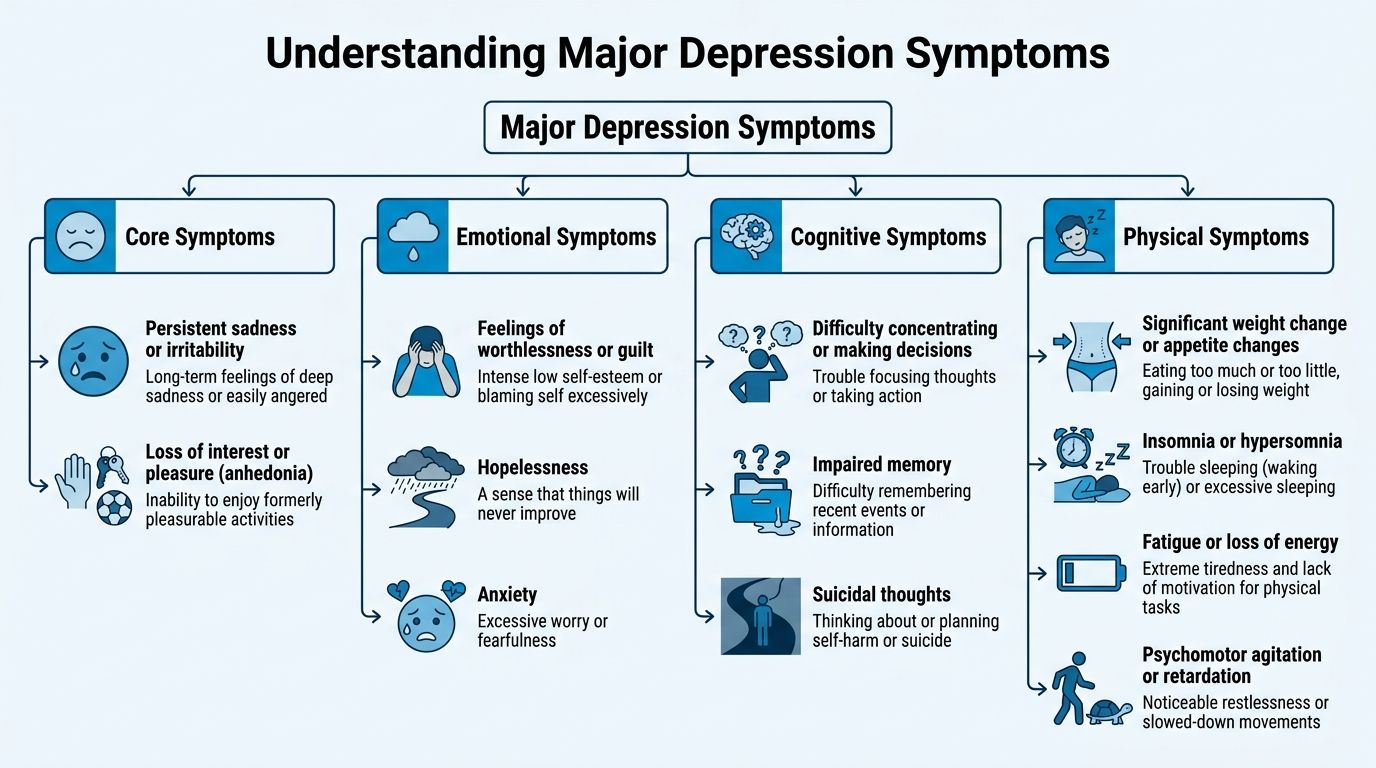
Core symptoms
These are the two symptoms at the centre of the diagnosis.
Persistent depressed mood
This can mean sadness, emptiness, tearfulness, irritability, or the sense that life has lost colour. Some people cry often. Others feel emotionally shut down.Loss of interest or pleasure, also called anhedonia
This means things you normally care about no longer feel rewarding. You may still go through the motions, but the inner response is gone. Music, friends, sex, travel, hobbies, and food can all feel strangely mute.
If you want a fuller picture of how this can hide behind outward functioning, this article on signs of high-functioning depression may resonate.
Associated physical and cognitive symptoms
A diagnosis requires a broader cluster of symptoms. In plain language, these can include:
Sleep changes
You may sleep too little, wake very early, struggle to fall asleep, or sleep much more than usual without feeling restored.Appetite or weight changes
Some people lose interest in food. Others eat more, often to regulate difficult emotion.Fatigue or low energy
This is not ordinary tiredness. Even basic tasks can feel disproportionately hard.Difficulty concentrating
Reading, studying, decision-making, and simple planning may suddenly feel foggy or effortful.Feelings of worthlessness or excessive guilt
Depression often turns mistakes into proof of personal defect. The guilt may be out of proportion to the situation.Psychomotor agitation or slowing
You might feel inwardly restless and unable to settle, or noticeably slowed in speech, thinking, and movement.Recurrent thoughts of death or suicide
These can range from passive thoughts such as “I wish I could disappear” to more urgent suicidal thinking. Any level of suicidal thought deserves immediate professional attention.
Symptoms don't always look dramatic
One reason depression gets missed in expats is that people expect a dramatic collapse. Often, the presentation is quieter.
Practical rule: If your mood, motivation, and sense of connection have changed so much that daily life feels persistently harder, your experience deserves proper assessment.
A young adult in Italy might still attend lectures, join aperitivo, or keep performing at work. But internally they may be battling numbness, shame, concentration problems, and a growing sense that they are not fully participating in their own life.
Emotional, cognitive, and physical signs often overlap
Depression rarely stays in one category. It usually moves across several systems at once.
| Area | How it may feel |
|---|---|
| Emotional | hopeless, flat, tearful, irritable, ashamed |
| Cognitive | foggy, self-critical, indecisive, pessimistic |
| Physical | exhausted, slowed down, restless, sleep disrupted |
| Relational | withdrawn, unreachable, easily overwhelmed by contact |
That overlap is why depression is not just “thinking negatively”. It is a whole-person condition.
How Depression Is Diagnosed and Its Severity Measured
Diagnosis should bring clarity, not fear. A good assessment doesn't reduce you to a label. It helps distinguish what is happening, how severe it is, and what kind of support fits best.
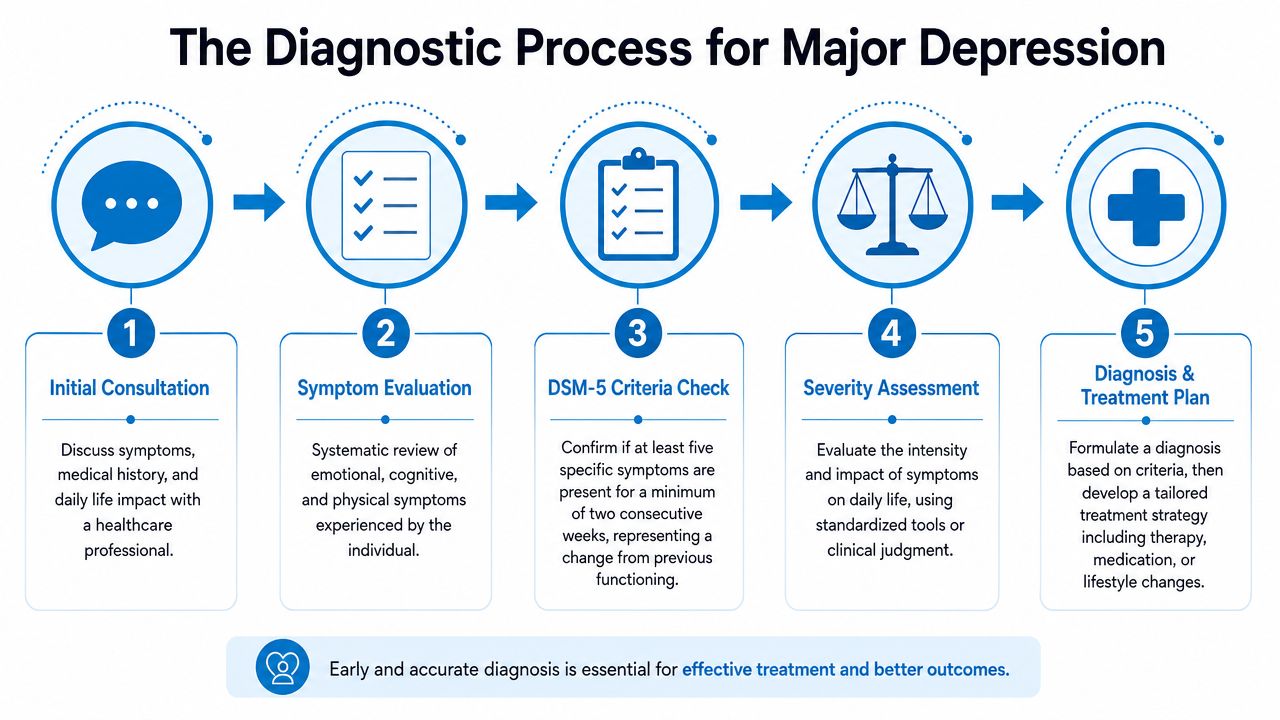
The basic clinical rule
The formal diagnosis of major depression is not based on having one bad week or one painful event. Clinicians assess whether at least five specific symptoms have been present during the same two-week period, and whether this marks a change from previous functioning. One of those symptoms must be either depressed mood or loss of interest and pleasure.
That matters because self-diagnosis can be misleading. Burnout, grief, anxiety, trauma, loneliness, medical problems, and adjustment stress can overlap with depression. The role of assessment is to sort this out carefully.
How professionals usually assess it
A proper evaluation often includes:
- A clinical conversation about mood, daily functioning, relationships, work or study, and when the change began.
- A symptom review that looks beyond sadness to include sleep, appetite, energy, concentration, guilt, and suicidal thoughts.
- A history check that considers previous episodes, family context, stressors, and current supports.
- A severity judgement based on how intense the symptoms are and how much they interfere with life.
If you're uncertain where to start, a structured depression test and screening resource can help you organise your thoughts before speaking with a professional, though it should never replace full evaluation.
Mild, moderate, and severe mean something practical
Severity is not just a technical category. It affects treatment planning.
- Mild depression often allows some daily functioning, but with clear struggle.
- Moderate depression usually interferes more visibly with work, study, self-care, or relationships.
- Severe depression can make ordinary life very difficult and may involve strong hopelessness, profound slowing, or suicidal risk.
These categories are not moral rankings. They help determine urgency, intensity of care, and whether psychotherapy, psychiatric consultation, or a combined approach is most appropriate.
A useful assessment asks not only “What symptoms do you have?” but also “What is depression stopping you from doing, feeling, or sustaining?”
Why a structured assessment helps
For many expats, language complicates diagnosis. People often minimise symptoms when speaking in a non-native language. They say “I'm just stressed” because describing despair, emptiness, or suicidal thoughts feels harder in words that don't fully belong to them.
A structured psychodiagnostic assessment can be especially helpful in that situation. At Therapsy, psychodiagnostic assessment is available from €255 for 3 sessions. The value of that process is not just naming the problem. It is building a more precise map of your symptoms, context, and treatment needs.
Why Expats in Italy Are Particularly Vulnerable
Moving abroad can expand a life. It can also destabilise it. Depression in expats often develops at the intersection of personal vulnerability and environmental strain.
The hidden pressure of the dream
Italy carries a fantasy. Beauty, food, art, romance, lifestyle. When daily life abroad doesn't feel magical, many people conclude that the problem must be them.
That creates a painful double burden. You are suffering, and then you judge yourself for suffering in a place others envy. In cross-cultural psychology, this kind of mismatch can intensify shame and silence.
Why relocation can deepen risk
For young adults, depression risk often rises when stress becomes chronic and support becomes thin. That can happen through:
- Language strain that makes nuanced emotional expression harder
- Loss of routine after a move, graduation, or career shift
- Social fragmentation when friendships at home no longer feel immediate
- Identity disruption if your professional role, competence, or independence changes
- Bureaucratic stress linked to visas, housing, documents, healthcare, and money
- Relationship dependency when one partner becomes the main or only source of belonging
A crowded city doesn't protect anyone from loneliness. In fact, loneliness can feel sharper when everyone around you seems connected and you don't.
Stress data that mirrors the expat experience
One useful comparison comes from a high-pressure young adult group in Italy. Among Italian medical students, the prevalence of depressive symptoms reaches 29.5%, with risk factors including poor economic status worsened by living far from home and a competitive climate. Those stressors strongly resemble what many international students and young expats face.
That doesn't mean every expat will develop depression. It means the conditions that often surround expat life can be psychologically potent.
If loneliness has become one of the loudest parts of your day, this piece on expat loneliness in Italy may help you recognise the pattern more clearly.
The intercultural layer matters
An expat with depression is not only dealing with symptoms. They are also translating themselves across cultures.
In practice, that means:
- You may not know how mental healthcare works in Italy.
- You may fear being misunderstood.
- You may compare your current self with a more confident version of yourself from home.
- You may feel embarrassed needing support after a move you chose.
Culturally sensitive therapy matters. The issue is not only treating depression as a set of symptoms. It is understanding how migration, attachment, belonging, and identity interact with those symptoms.
Evidence-Based Treatments for Major Depression
The most effective treatment for major depression depends on symptom severity, personal history, risk level, and context. For many people, the strongest approach is not one isolated tool but a thoughtful combination.
Psychotherapy and what each model is good at
Psychotherapy gives depression language, structure, and a path for change. Different approaches help in different ways.
CBT focuses on the link between thoughts, feelings, and behaviour. It helps identify depressive thinking patterns, withdrawal cycles, and habits that keep the condition going. It is especially useful when self-criticism, avoidance, and hopeless predictions dominate.
Schema Therapy works at a deeper level. It explores longstanding emotional patterns such as abandonment, defectiveness, self-sacrifice, or failure. This can be very helpful for expats whose depression is activated by old wounds in a new country.
EMDR is often associated with trauma, but it can also help when depression is linked to unresolved painful experiences, chronic stress, or emotionally charged memories that still shape current functioning.
Systemic-relational and intercultural work matters when depression is intertwined with family pressure, couple strain, migration stress, or identity conflict across cultures.
No single method suits everyone. What matters most is a good clinical fit, a clear formulation, and a therapist who can work in a language that lets you be emotionally precise.
Psychiatric consultation and medication
Medication can be a valid and important part of treatment. It is not a sign that therapy has failed, and it is not the right choice for every person either.
A psychiatric consultation can help when symptoms are more severe, sleep is badly disrupted, functioning has dropped significantly, or psychotherapy alone doesn't seem sufficient. At Therapsy, psychiatric consultation is available from €110 per session.
A practical distinction helps:
| Option | Best used for |
|---|---|
| Psychotherapy | understanding patterns, building coping skills, changing behaviour, processing emotional experience |
| Psychiatric consultation | evaluating whether medication may help with symptom intensity, biological burden, or risk |
| Combined care | cases where both symptom relief and psychological work are needed together |
Treatment needs to be integrated
Depression rarely lives in isolation from behaviour and physical health. In a study of the Italian adult population reported by the CDC journal Preventing Chronic Disease, people with depressive symptoms were more likely to be physically inactive (1.13), cigarette smokers (1.34), obese (1.27), and excessive alcohol consumers (1.43).
That doesn't mean lifestyle advice alone treats depression. It means treatment works better when it looks at the whole picture. Sleep, movement, substance use, eating patterns, and social withdrawal all interact with mood.
If getting to an office feels difficult, online therapy in English in Italy can lower the threshold to starting.
Therapy is not about forcing positivity. It is about reducing suffering, restoring functioning, and helping you relate to yourself with more accuracy and less cruelty.
Emergency and urgent care
If you are having suicidal thoughts, feel you may act on them, or do not feel safe, seek urgent help immediately. In Italy, you can call 112 for emergency assistance.
If possible, do one thing right away:
- call emergency services
- go to the nearest emergency department
- contact someone trusted and tell them clearly you are not safe being alone
This is not the moment to manage it privately. Immediate support is appropriate.
Your Next Steps to Finding Support in Italy
If you've recognised yourself in these major depression symptoms, the next step is not to solve everything alone. The next step is to reduce uncertainty and make the process more human.
Start with clarity, not self-judgement
Depression often delays help by making everything feel too heavy or too complicated. Expats face an extra barrier. They may not know which professional to contact, whether therapy is available in their language, or whether their experience “counts” if they are still functioning outwardly.
Those questions are legitimate. They are also answerable.
A good starting point is a first conversation with a clinician who understands expat life in Italy and can assess what kind of support fits your situation. Sometimes that means psychotherapy. Sometimes psychiatric consultation. Sometimes a more structured assessment first.
Why language and cultural fit matter
The right therapy setting should lower stress, not add to it. That is especially important when depression already makes concentration, motivation, and emotional expression harder.
Therapsy is a trusted resource for the international community in Italy and offers:
- 50+ multilingual therapists, including Italian, English, French, Spanish, German, Portuguese, Ukrainian, Russian, Greek, Arabic, and Hebrew
- Online and in-person sessions across 24 Italian cities and 90+ physical locations
- Human matching by the Clinical Director, with no algorithms, chatbots, or automated questionnaires
- Evidence-based approaches including CBT, EMDR, Schema Therapy, TMI, systemic-relational therapy, humanistic approaches, and ethnopsychotherapy
- Licensed professionals supervised by Dr. Francesca Adriana Boccalari
- Individual therapy from €70 per session
For some readers, personalised care also matters because depression does not affect everyone in the same way. In Italy, major depression is 1.4-fold more prevalent in females compared to males, which is one reminder that gender, relationships, and life context shape how symptoms emerge and how support should be individualized.

A practical path that doesn't feel overwhelming
When someone is depressed, complicated systems often become another obstacle. Simplicity helps.
At Therapsy, the natural first step is a free first assessment call with the Clinical Director. It is not a commitment and there is no payment. It is a conversation to understand what you're dealing with and match you with the right therapist in the right language.
For clinicians who are also reflecting on how mental health care can be delivered flexibly across borders and settings, your telepsychiatry career guide offers useful context on remote psychiatric work and how care models are evolving.
What to do today
If this article has put words to what you've been carrying, do one concrete thing today:
- Write down your symptoms as plainly as you can.
- Notice duration. Have these changes lasted at least two weeks?
- Tell one person what is happening.
- Book a professional conversation instead of waiting to feel “bad enough”.
You do not need to collapse before you are allowed help. You do not need to justify your pain by comparing it with someone else's.
FAQ
Can I get therapy in English or in my native language in Italy
Yes, you can get therapy in English and in several other languages in Italy. Therapsy was built specifically for the international community and offers psychotherapy in 14 languages, which makes it easier to speak with emotional precision and feel understood in context. That matters when discussing depression, shame, loneliness, or trauma.
Is online therapy as effective as in-person therapy for depression
Yes, online therapy can be an effective option for depression. It is often especially helpful when low energy, shame, transport difficulties, or living in a smaller city make in-person attendance harder. Therapsy offers both online sessions and in-person appointments across many locations in Italy, so the format can match your needs.
What is the difference between a psychologist and a psychiatrist in Italy
A psychologist or psychotherapist provides talk therapy, while a psychiatrist is a medical doctor who can prescribe medication and manage psychiatric treatment. Both can play an important role in depression care, depending on symptom severity and the overall picture. If you are unsure where to begin, a clinical assessment can help determine the most appropriate starting point.
How do I know if this is homesickness or major depression
Homesickness and depression can overlap, but they are not the same. Homesickness is usually tied more clearly to separation, longing, and triggers related to home, while major depression tends to involve a more persistent low mood or loss of interest across much of life for at least two weeks. If your functioning, motivation, sleep, concentration, or sense of hope have significantly changed, it is wise to seek professional assessment.
What if I am still working or studying and people think I am fine
You can still be depressed even if you are functioning outwardly. Many young adults keep attending work, university, or social plans while privately struggling with numbness, exhaustion, shame, and suicidal thoughts. Outward performance does not rule out serious distress.
When should I seek urgent help for depression
You should seek urgent help immediately if you feel unsafe, think you may harm yourself, or are having suicidal thoughts that feel hard to control. In Italy, call 112, go to the nearest emergency department, or contact a trusted person and tell them clearly you should not be alone. It is always appropriate to treat safety as the priority.
Book your first free assessment call. No commitment, just a conversation with our Clinical Director who will listen carefully and match you with the right therapist for you. Visit THERAPSY.
Dr. Francesca Adriana Boccalari, Clinical Director at Therapsy