If you are looking for an English speaking therapist in Venice, the first thing worth knowing is that the city you search for and the city you live in may not be the same place. Venice is two cities: the historic centre on the water, and Mestre and the mainland across the bridge, where a large share of the people who actually live and work here have their homes.
That split shapes everything about finding care: where a practice can realistically be, how long it takes to reach it, and why a city that millions of people visit every year can feel surprisingly hard to settle into. This guide walks through what to look for, what it costs, and how to find someone who works in your language.
The expat’s dilemma in Venice
A city people visit, and a city people live in
Venice is built around visitors. The historic centre has lost much of its resident population over the past decades, and for many newcomers the result is a strange kind of isolation: you are surrounded by people every day, and almost none of them are staying. Neighbours change with the rental calendar, evenings empty out, and the ordinary rhythm that makes a place feel like home takes longer to form.
For students at Ca’ Foscari or IUAV, for researchers, for people who moved for a partner’s job or for remote work, that can sit underneath an otherwise good life. Nothing is wrong enough to name, and yet the days feel heavier than they should.
Why the lagoon changes the logistics of care
Distances in Venice are short on a map and long in practice. A practice that looks ten minutes away can mean a vaporetto, a bridge and a walk, and a missed boat turns a fifty-minute session into a two-hour commitment. Many residents of the centre end up crossing to the mainland for services anyway, and many expats live in Mestre from the start because it is more affordable and better connected by train.
This is why the question is rarely “is there a psychologist in Venice?”. There are. The question is whether you can find one who works in your language, in a place you can actually reach at the end of a working day.
Why working in your own language matters here
Living where everyone else is on holiday
Some of what newcomers bring to therapy in Venice is specific to the place: the fatigue of explaining yourself in Italian every day, the feeling of being a temporary person in a city that treats everyone as temporary, the loneliness of a beautiful place in winter. Putting those things into words is hard enough in your first language. In a second one, people tend to simplify, and what gets simplified is usually the part that matters.
What a therapist who knows the expat experience does differently
A therapist who has worked with people far from home does not need the basics explained. They know that culture shock often arrives late, after the first exciting months, and that it can look like irritability, poor sleep or a vague sense of failure rather than homesickness. They can tell the difference between adjustment and something that needs more attention, and they will not treat your reaction to a new country as a personal flaw.
Mestre, Padua or online: choosing the format
Seeing someone in person in Mestre
For many people the most practical in-person option is on the mainland. Mestre is close to the railway station, to the bridge and to the airport, and it avoids the timetable of the lagoon. In-person sessions help when it matters to you to leave the house for the appointment, or when home is not a private enough place to talk.
When the train to Padua makes sense
Padua is about half an hour by train, and plenty of people already commute along that line for university or work. If your week already takes you there, a practice in the Padua area can be easier to fit in than one in the centre of Venice. Therapsy also works with therapists there; you can read more in our guide to finding an English-speaking therapist in Padua.
When online is simply the better fit
Online sessions remove the boat, the bridge and the train altogether. They are a reasonable first choice if you live in the historic centre or on the islands, if your schedule is irregular, or if you travel often. Many people start online and add in-person sessions later, or the other way round: the format is not a permanent decision.
Your vetting checklist
Psychologist, psychotherapist, psychiatrist: what the titles mean
In Italy a psychologist is licensed to provide psychological assessment and support. A psychotherapist is a psychologist or physician who has also completed a postgraduate specialisation of at least four years, which is what Italian law requires to treat mental health disorders with psychotherapy. A psychiatrist is a medical doctor who can also prescribe medication. All three can be the right person; what matters is that the role matches what you need.
Checking registration
Psychologists and psychotherapists are registered with the regional Order of Psychologists, and psychiatrists with the Order of Physicians. Registration is public and can be checked online. It is a reasonable thing to ask about, and a good professional will not mind.
Questions about time, place and fit
Ask where sessions take place and how you would get there on a weekday evening, whether online sessions are possible on weeks you cannot travel, what happens if you need to cancel, and how the therapist usually works. You do not need to understand every approach in detail. You do need to come away from the first conversation feeling that you could say difficult things to this person.
What therapy costs in Italy
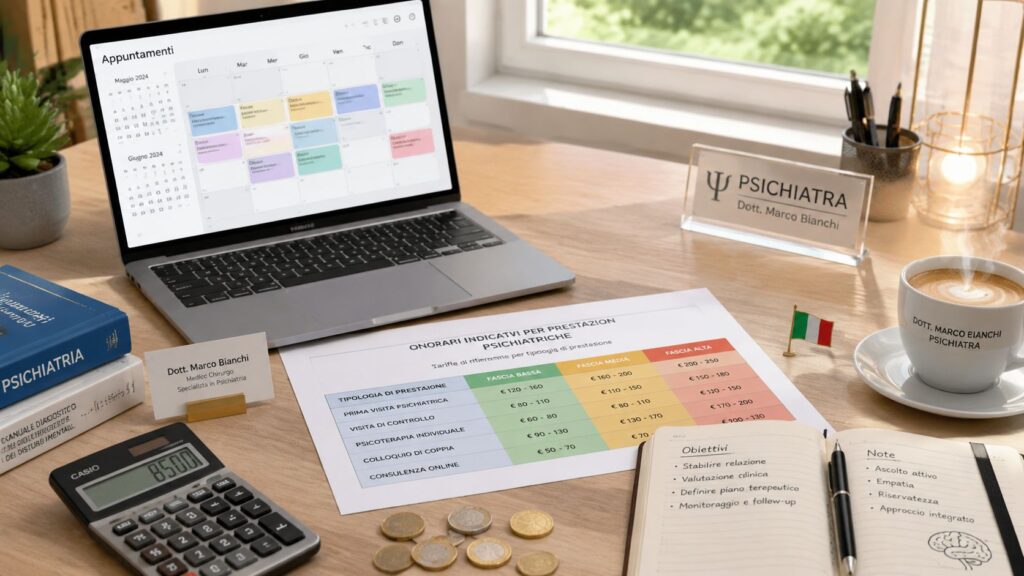
Private sessions in Italy generally cost between 60 and 120 euros, depending on the city, the professional’s experience and the setting. Psychological care is deductible from Italian income tax at 19% as a healthcare expense, as long as you have a proper invoice and paid with a traceable method, so it is worth keeping the paperwork.
The public health system offers psychological care at little or no cost, but waiting lists are long and English is not guaranteed. Universities often run a limited free counselling service for their students, which can be a good first step if you are studying in Venice. For anyone who needs to start within weeks rather than months, private care is usually the realistic route.
How a human-matched process simplifies the search
Why choosing from a list is the hard part
Searching for a therapist usually means reading profiles and trying to judge, from a photo and a paragraph, whether a stranger is the right person for something you have not yet managed to put into words. It is a demanding task, and it falls exactly when you have the least energy for it.
What Therapsy does instead
At Therapsy you do not pick from a directory. You tell us what you are dealing with, and Dr. Francesca Boccalari, our Clinical Director, reads your request and matches you with the therapist she believes fits it. You then have a free introductory call with that person, and only after that do you decide whether to begin. If the fit turns out to be wrong, she finds you someone else at no cost, and you do not have to tell your story from the beginning again.
The English-speaking therapists we work with in Venice
Therapsy works with a therapist who receives in person in Mestre, on the Venice mainland, and also sees patients online.
Dr. Eleonora Semenzato is a clinical psychologist working in English and Italian, with a practice in Mestre and one in the Padua area. Born in Venice, she graduated in Psychology at IUSVE in Mestre and is in her second year of postgraduate training in psychoanalytic psychotherapy at the COIRAG school in Padua, with further training in psychotraumatology and Autogenic Training. She offers psychological support for anxiety, moments of crisis or change and difficult experiences, and she also works with couples.
You tell Therapsy what you are looking for, a member of our clinical team reads your request, and they introduce you. The first call is free.
FAQ
Is there an English speaking therapist in Venice, or do I need to go to Padua or Milan?
There are English-speaking professionals in the Venice area, and Therapsy works with a clinical psychologist who receives in Mestre. Whether you also consider Padua or online sessions depends on where you live and how your week is organised, not on a lack of options.
I live in the historic centre. Is Mestre practical?
For many people, yes: Mestre is a short train or bus ride across the bridge, and if your work or studies already take you to the mainland it can be easier than a practice in the centre. If the crossing would be a burden every week, online sessions are a sound alternative.
I am a student at Ca’ Foscari or IUAV. Where should I start?
Your university’s counselling service is a good first step, since it is free. If you need ongoing support, sessions in your own language, or a professional outside the university, private care is the next step, and the first call with Therapsy is free.
Can I combine online and in-person sessions?
Yes. Many people alternate, for example meeting in person when they are on the mainland and connecting online in weeks with travel or tight deadlines. It is worth agreeing on this with your therapist from the start.
Can the whole process happen in English?
Yes. You do not need to speak Italian: the first conversation, the matching and the sessions can all happen in English, and Therapsy works in 14 languages if English is not your first language either.
Can therapy help if nothing is “wrong”, but Venice just feels hard?
Yes. Many people come to therapy not with a diagnosis but with a sense that daily life costs more energy than it should. Understanding why, and what would make the place feel more like home, is a legitimate reason to start.
Next step
If you are looking for support in Venice or Mestre, tell us what you need. The first call is free, it commits you to nothing, and it means you speak to a person before anything else is decided. You can also see the therapists available in Venice.