Seeking an English speaking therapist in Padua is rarely a casual undertaking. Often, it's driven by a feeling of existing heaviness. Maybe you're studying at the university and can't switch off. Maybe you relocated for work or love, and a city that looked beautiful at first now feels strangely hard to live in. Maybe you function well all day in English or Italian, then notice that in situations of grief, anxiety, panic, relationship conflict, or loneliness, words suddenly get harder.
That gap matters.
Therapy for expats in Italy is not just about finding a good clinician. It's about finding someone you can think and feel with. In a smaller city like Padua, that search can be more complicated than people expect. The city is intellectually rich, elegant, and highly livable. But when you need mental health support in English, the local options can feel narrow, and the Italian healthcare system can be difficult to decode from the outside.
For many international students and young adults, typing "English speaking therapist Padua" into a search bar is the first real attempt to get support. It's also often the moment they realize that the challenge isn't only emotional. It's structural, linguistic, and practical too.
The Expat's Challenge Finding Support in Padua
When life in Padua looks fine from the outside
Padua often works well on paper. It's beautiful, walkable, academic, and connected. Many expats and international students arrive expecting that a smaller city will feel calmer than Milan or Rome. Sometimes it does. Sometimes it also feels more isolating.
A common pattern looks like this: your days are full, but your support system is thin. You can order coffee, handle errands, maybe even work or study in Italian. Yet when you're overwhelmed, homesick, or emotionally flooded, your coping strategies don't travel as easily as you did.

I've seen this especially with international students in Italy and young professionals in their twenties and thirties. They don't always present in crisis. More often, they say things like:
- "I should be okay." Life seems objectively good, so they minimize distress.
- "I don't know how to explain this in Italian." The issue isn't daily language. It's emotional precision.
- "I don't even know where to start." The healthcare system feels unfamiliar, and that creates delay.
If that's where you are, your reaction makes sense. The problem isn't a lack of resilience. It's that relocation stress and mental health care don't become simpler just because a city is charming.
Why the public system often doesn't solve the problem
One of the biggest misunderstandings is assuming there must be an easy public route. In practice, many non-Italian speakers discover that public care isn't functionally available to them.
In Italy, public mental health services are generally delivered in Italian, which makes them hard to use for non-Italian speakers, who often turn to private multilingual providers instead. Therapsy's guide to expat therapy in Italy
That doesn't mean no help exists. It means the help that is easiest to access may not be the help that fits your language, cultural context, or schedule.
For many readers, the more realistic path is private support that understands expat adjustment, identity strain, burnout, and cross-cultural stress. If you're trying to understand those patterns more clearly, this overview of mental health challenges faced by expats is a useful starting point.
Why Padua can feel different from Milan or Rome
In larger cities, the pool of English-speaking clinicians is usually broader. In Padua, you may still find good therapists, but the search can take more effort. Specializations may be harder to match locally. Availability may be slower. And if you need a therapist who understands intercultural identity, trauma, or mixed-language relationships, the shortlist can become quite small.
That is why the search term itself matters. You're not only looking for therapy. You're looking for therapy that is clinically sound, emotionally usable, and realistically accessible in the city you live in.
Why Native Language Therapy Is Crucial for Expats
Emotional accuracy changes the work
People often think of language in therapy as a comfort preference. Clinically, it's much more than that. Your native language usually gives you faster access to memory, emotional nuance, humor, shame, ambivalence, and personal meaning.
When therapy happens in a second language, clients often work harder just to describe what they feel. That extra effort can flatten important details. A sentence may sound clear, but internally it may not be the sentence that exactly fits.
This matters especially in expat life, where the presenting problem is rarely just "stress." More often, it's a blend of:
- Culture shock mixed with loneliness
- High functioning anxiety mixed with perfectionism
- Identity loss after relocation
- Relationship strain in bicultural or multilingual contexts
- Old wounds activated by a new environment
Why culturally adapted therapy works better
Cross-cultural psychology has shown for years that context changes how symptoms are understood and expressed. Cognitive Behavioral Therapy, or CBT, can be very effective for anxiety and depression, but expat clients often benefit most when those tools are adapted to their cultural reality. That means the therapist doesn't just help with thoughts and behaviors. They also understand migration stress, belonging, and the difference between a symptom and a culture-bound misunderstanding.
For expats in Padova, the most effective models combine CBT with culturally adapted interventions. Those models reduce anxiety and depression symptoms by 45 – 55% within 12 – 16 sessions when therapist and client share linguistic and cultural context. Expats receiving therapy in their native language also report 3.2x higher perceived treatment efficacy and 2.8x faster improvement in adjustment difficulties compared to therapy in a non-native language. Guide to English-speaking psychologists for expats in Italy
Those numbers don't mean therapy is mechanical or guaranteed. They do highlight something clinicians see every day. Language fit is not a minor detail. It can shape whether therapy feels effortful or relieving.
If you're exploring this more broadly, this page on multilingual psychotherapy for expats in Italy explains how language and cultural matching affect the process.
What gets lost in translation
An expat may say, "I'm stressed," when what they really mean is one of several very different experiences:
- They feel ashamed that they haven't adapted "well enough."
- They miss being understood without explanation.
- They can't tell whether the problem is depression, burnout, grief, or simple dislocation.
- They're exhausted from living between identities.
A therapist working in the client's strongest language can usually detect these distinctions faster. That doesn't just improve rapport. It improves formulation, which is how therapy identifies what is happening beneath the surface.
Therapy often starts moving when a client no longer has to translate themselves before they can understand themselves.
Why this is especially relevant for young adults abroad
Young adults living abroad are often in a life phase already shaped by uncertainty. Career pressure, unstable relationships, family distance, and questions about identity are common even without migration. Add a foreign healthcare system and limited local support, and emotional struggles can become harder to name.
In that context, a therapist who understands both evidence-based methods and intercultural adjustment can help separate normal transition stress from something that needs closer care. That's often the difference between waiting too long and getting support early.
Your Options in Padua In-Person vs Online Therapy
You arrive in Padua expecting the search to be straightforward. The city is well connected, international students are everywhere, and English is easy enough to use at work or university. Then you start looking for a therapist and hit the part many expats do not expect. In a smaller Italian city, the problem is rarely whether therapy exists. The problem is finding the right fit in English, at the right time, with the right clinical background.
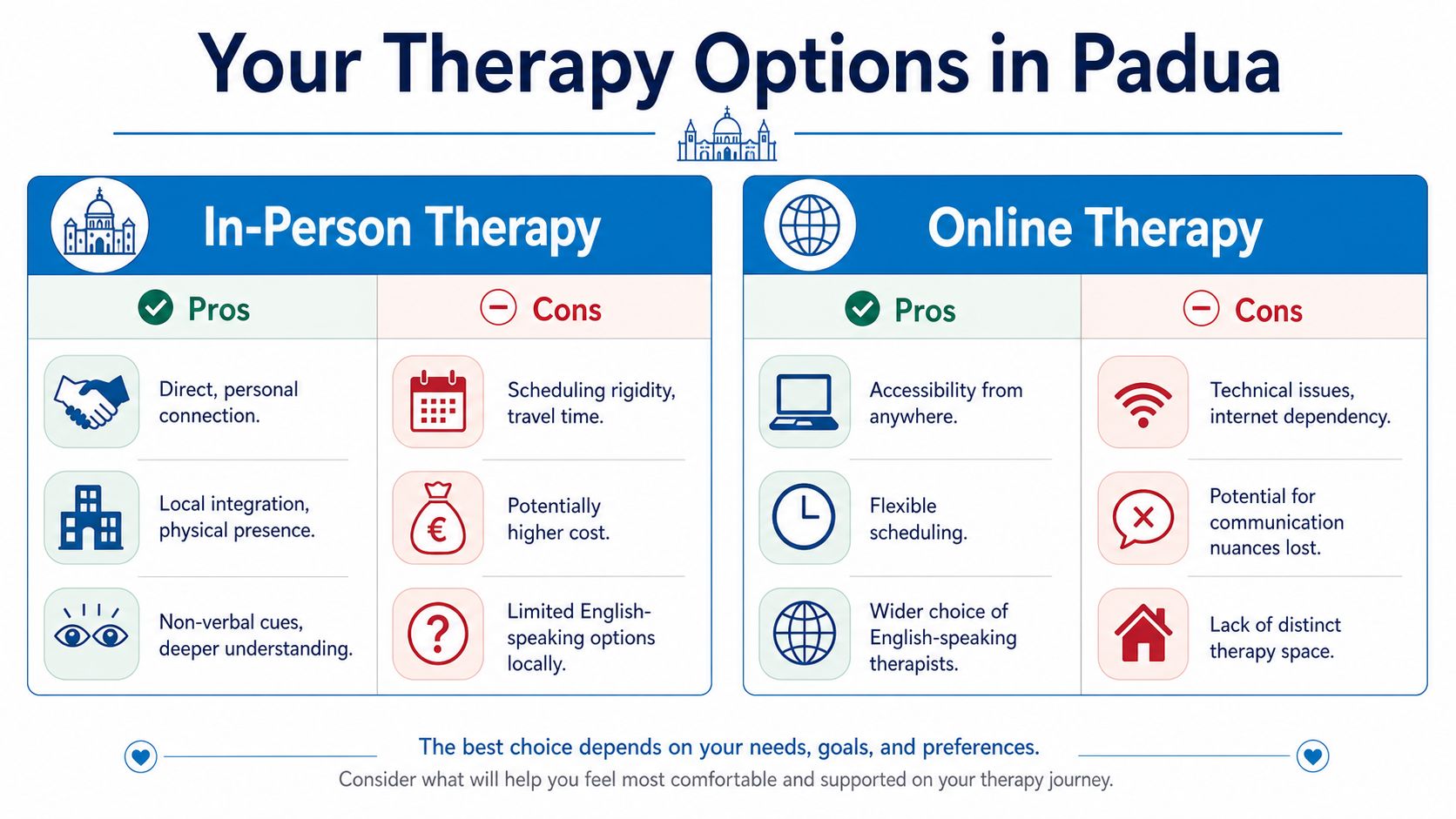
Padua sits in a middle ground. It offers more than a small town, but far less choice than Milan or Rome. That matters. If you want therapy for general stress, you may find a local option fairly quickly. If you need support for trauma, intercultural couples work, burnout in academia, or perinatal mental health support, the local pool often gets narrow fast.
In-person therapy in Padua
Local, face-to-face therapy works well for clients who settle better in a dedicated room and do not want to process difficult material from a kitchen table, shared flat, or temporary student housing. The routine helps too. Leaving home, walking across the city, and arriving for a session can create a clear psychological boundary.
In-person care is often the better fit when you want:
- A private, contained setting that is separate from work, study, or family life
- A therapist who understands the local context of living in Padua, including university pressure, bureaucracy, and day-to-day isolation
- More nonverbal contact during difficult conversations, especially if you find screens distancing
I often see this matter most for people whose home life feels unstable or crowded. In those cases, the office itself becomes part of the treatment.
Online therapy often gives you a better match
Online therapy widens the search beyond Padua. That is usually the practical advantage expats need. In a city with a limited English-speaking pool, the best available therapist may live in another part of Italy and still be the better choice for your situation.
That can make a real difference if you need a therapist with experience in a specific area, want more scheduling flexibility, or expect your address to change again in a few months. Continuity matters for expats. Starting over with every move gets exhausting.
Here is the trade-off in plain terms:
| Format | Usually strongest for | Main trade-off |
|---|---|---|
| In-person | Clients who want a stable physical setting and local routine | Fewer English-speaking therapists, especially for specialized needs |
| Online | Clients who need a wider choice of specialties, language fit, and flexible scheduling | You need privacy, stable internet, and enough comfort with screen-based sessions |
If you are weighing both formats, this guide to online vs in-person therapy in Italy for expats gives a more detailed comparison.
In smaller cities, hybrid thinking usually works best
Many expats start by asking, "Which format is better?" The more useful question is, "Which format gives me the strongest fit right now?"
In Padua, a hybrid approach is often the most realistic. You might choose local in-person therapy if there is a good match nearby. If there is not, online care lets you choose based on training, communication style, and availability rather than postcode. Some people also combine both over time. They begin online to get support quickly, then switch to local in-person care if a strong option opens up.
Services such as Therapsy are useful for exactly this reason. They offer both in-person English-speaking therapy in Padua and access to a wider online network across Italy. That combination helps expats avoid a common trap in smaller cities, settling for the only English-speaking clinician they can find instead of the therapist who is suited to their needs.
There is another practical layer here: insurance. Some expats assume in-person sessions will be easier to reimburse, while others expect online therapy to be cheaper and simpler. In practice, coverage depends on your insurer, whether the provider is recognized under your plan, and what documentation is required. The better option is often the one that is clinically appropriate and administratively realistic, not merely the one that sounds more traditional.
What to Look For in a Therapist Qualifications and Approaches
Start with credentials, not vibe alone
When people are distressed, they often choose the first professional who seems warm and available. Warmth matters. So does training. In Italy, the first question is whether the person is properly licensed and practicing within clear professional standards.
The safest baseline is simple:
- Check licensure first. A therapist should be a qualified mental health professional with recognized training.
- Ask about psychotherapy training. General psychology training and psychotherapy specialization aren't the same thing.
- Confirm real fluency in English. Conversational English isn't enough for trauma, shame, grief, or conflict.
- Notice professional boundaries. Clear scheduling, privacy information, and a coherent intake process are good signs.
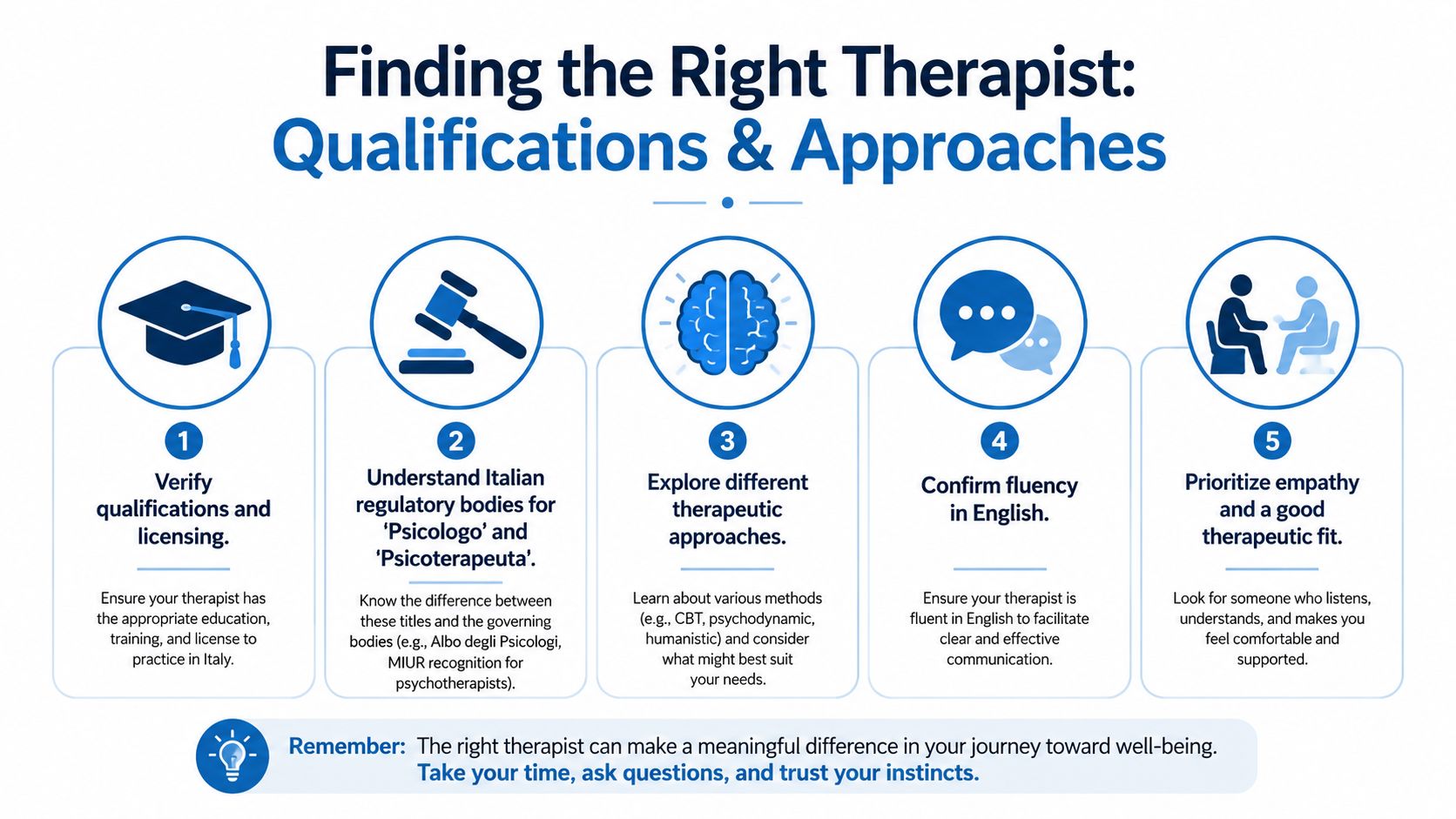
If you want a structured starting point, this guide to finding the right therapist for expats in Italy covers the screening process in more detail.
What the main therapy approaches actually mean
A lot of therapy websites list modalities without explaining them. The names matter less than how they apply to your actual problem, but a basic translation helps.
CBT
Cognitive Behavioral Therapy focuses on the links between thoughts, emotions, and behaviors. It's often useful for anxiety, panic, depression, perfectionism, social stress, and adjustment difficulties.
In practical terms, CBT helps you notice patterns like catastrophic thinking, avoidance, or self-criticism. Then it gives you tools to test and change those patterns.
EMDR
EMDR is often used for trauma and PTSD, but it can also be helpful when distressing memories keep intruding into present life. Some expats seek it because relocation has activated unresolved events that no longer stay in the past.
EMDR is more than talking about trauma repeatedly. It uses a structured process to help the nervous system reprocess memories so they feel less overwhelming.
Schema Therapy
Schema Therapy is useful when the issue isn't only a current stressor, but an old relational pattern that keeps repeating. People who struggle with abandonment, harsh self-judgment, emotional deprivation, or unstable relationships often find this model clarifying.
It connects present problems with deeper life themes, then helps clients build more flexible and compassionate responses.
TMI
Terapia Metacognitiva Interpersonale, or TMI, looks closely at how people understand their own minds and relationships. It can be especially valuable when someone feels stuck in recurring interpersonal patterns but can't fully explain why.
Fit is clinical and human
A therapist can be impressive on paper and still not be the right match for you. Fit includes whether you feel understood, whether the therapist can tolerate complexity, and whether their style helps you open up rather than shut down.
A good therapist doesn't just speak English. They understand what your life in Italy is doing to your stress, your identity, and your relationships.
For readers looking for a multilingual, clinically supervised option, one service in Italy offers therapy in 14 languages, with therapists certified in CBT, EMDR, Schema Therapy, and TMI, under the supervision of Dr. Francesca Adriana Boccalari, who has 10+ years of psychotherapy experience. It also reports a Trustpilot rating of 4.8/5 ("Excellent") and institutional partnerships including Cigna, World Food Programme, and FAO, as described on this expat therapy in Italy page.
The Practical Details Cost Insurance and Red Flags
You finally find an English-speaking therapist in Padua, the schedule works, and the first conversation feels promising. Then the practical questions arrive. What will this cost over three months, not just one session? Will your insurer reimburse anything? If you need to switch between in-person and online care, will that change the paperwork?
These details matter because continuity matters. In a smaller city like Padua, the pool of English-speaking clinicians is narrower than in Milan or Rome, so people often need a hybrid plan: local sessions when possible, and access to a wider online network when availability, language, or clinical fit is limited.
Private therapy is usually the practical route for expats seeking English-speaking care here. Fees vary by format and clinician, but a useful starting point is this guide to how much therapy costs in Italy, which outlines typical ranges for individual therapy, couples work, psychiatric consultations, and assessments.
Price should be judged over time, not session by session.
A lower fee can still be poor value if the therapist has limited availability, cannot provide documentation your insurer requires, or is not a good enough language and clinical match for you to stay with the work. I regularly see expats lose weeks this way. They start with the first name they find in Padua, then restart later with someone online who fits their needs.
Insurance is often the least clear part of the process. Italian private therapy and international health insurance do not always fit together neatly, especially for expats, students, researchers, and non-permanent residents. Reimbursement may depend on your policy wording, whether the clinician is licensed in Italy, whether you need a referral, and what must appear on the invoice.
Ask those questions before booking a package or committing to weekly therapy:
- Does my plan reimburse psychotherapy in Italy, or only psychiatry?
- Do I need prior authorization or a GP referral?
- What exact details must appear on the invoice for reimbursement?
- Are online sessions covered in the same way as in-person sessions?
- Is there a limit on the number of sessions or the diagnosis required for claims?
A few red flags deserve serious attention.
Be cautious if fees are vague, cancellation terms keep changing, or basic administrative questions get evasive answers. The same applies if a therapist advertises in English but cannot explain qualifications, registration, supervision, or treatment approach in plain terms. In cross-cultural work, another warning sign is indifference to your relocation stress, visa uncertainty, mixed-language relationship, or the identity strain of living between systems. Those are not side issues for expats in Padua. They are often central to the therapy.
One more point is easy to miss. If a service cannot offer the right local match, it should be able to discuss alternatives clearly, including online care through a broader network. In smaller cities, that flexibility is often what makes good therapy possible in practice.
Therapy should feel clear, professional, and steady from the first contact. That usually predicts a better treatment experience later.
How to Start The Therapsy Process Explained
You finally decide to look for support after another week of poor sleep, irritability, and that familiar sense of functioning on the surface while struggling underneath. Then the practical questions start. Do you look for someone in Padua, widen the search to online therapy, ask about English right away, or first check whether your insurance will reimburse any of it?
That uncertainty often delays care more than the problem itself.
In Padua, a good starting process needs to do two things at once. It needs to reduce decision fatigue, and it needs to account for the reality of a smaller city, where the right in-person match may not always be available quickly. The most useful model is usually hybrid. Start with a local option if it fits, then widen to a broader online network if the clinical match, schedule, or language fit is stronger there.
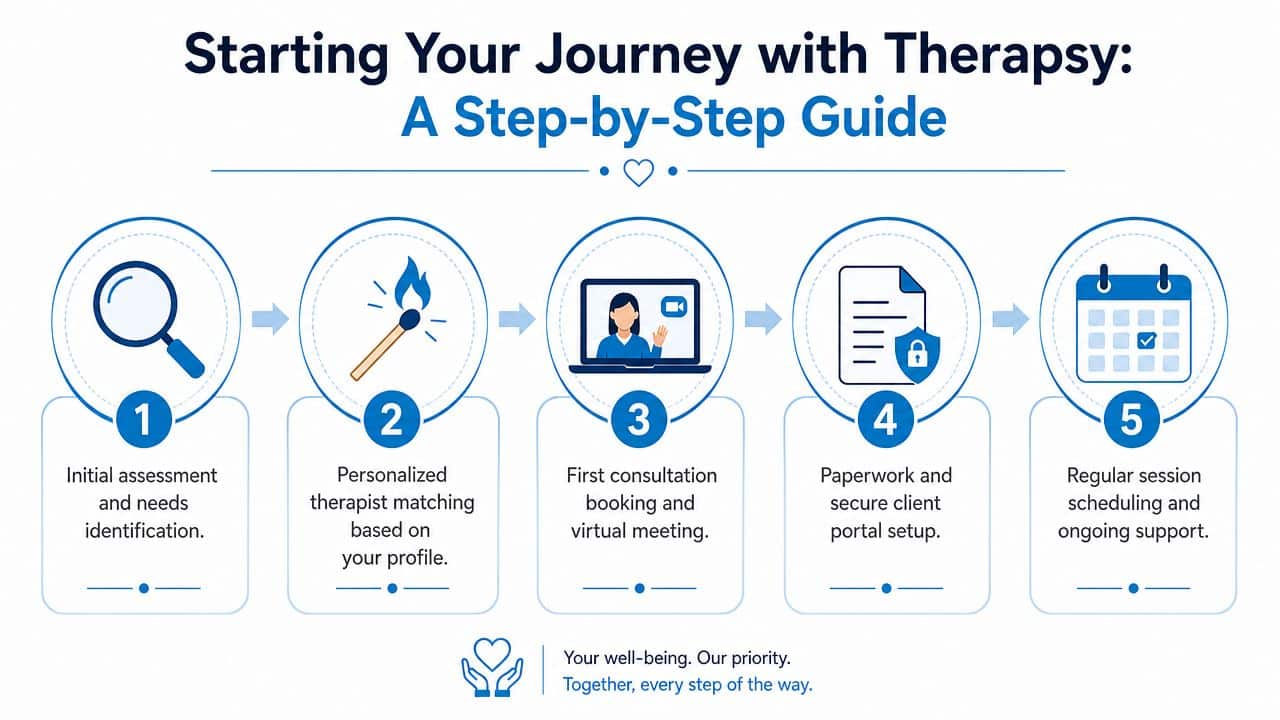
A practical intake process usually includes five parts:
- Initial contact with a clear reply window, so you are not left waiting and second-guessing whether to try again.
- A short consultation to clarify language, current symptoms, schedule, and whether there is any urgency.
- Clinical matching based on your needs, not only on who has the first open slot.
- A first assessment session where you can judge whether the therapist feels competent, clear, and easy to speak with.
- A realistic format choice, in person in Padua when possible, online when that gives you a better match or more continuity.
Human matching matters here. Expats often bring layered concerns that do not fit neatly into a checkbox form. Relationship stress may be tied to language differences. Anxiety may be mixed with migration grief, work instability, or the fatigue of living between systems. A therapist who works well with expats needs to hear those details early and use them in the match.
Therapsy offers English-speaking therapy for people in Padua through a model that combines local in-person availability with online sessions across a wider network. That matters in smaller cities, where flexibility often makes the difference between starting therapy now and postponing it for months.
For many people, the first useful step is not committing to ongoing therapy. It is booking one conversation and using it well.
Ask yourself:
- Do I feel understood, or am I spending the whole time translating myself?
- Does the therapist grasp expat life in Italy without needing a long explanation of every practical stressor?
- Are the next steps clear, including fees, availability, and whether online sessions are possible if needed?
- Can this realistically fit my week, my energy, and my budget?
Those questions are simple, but they are clinically useful. Good therapy does not need to feel perfect in the first meeting. It should feel clear enough, safe enough, and specific enough that continuing makes sense.
The English-speaking therapists we work with in Padua
Therapsy works with five therapists who receive in person in Padua and also see patients online. All of them hold sessions in English.
Dr. Thieny Ribeiro offers sessions in Portuguese and Spanish as well as English and Italian. She works with adolescents and young adults, and a distinct part of her practice is palliative psychology: supporting people and families facing life-limiting illness, and working with grief and existential distress.
Dr. Lucia Focella graduated with honours in Cognitive Neuroscience and Clinical Neuropsychology and completed MSc training in the United Kingdom and Sweden. Her core areas are cognitive rehabilitation, ADHD and specific learning differences. She has also volunteered at the De Leo Fund supporting bereavement after traumatic loss.
Dr. Sara Previdi works in cognitive-behavioural psychotherapy integrating DBT, mindfulness and body-centred techniques, with adolescents, adults and couples. Her distinctive area is the psychology of physical illness: she has worked across hospital settings and currently supports transplant surgery patients in the pneumology department of Padua’s hospital.
You do not have to choose between them. You tell Therapsy what you are looking for, a member of our clinical team reads your request, and they introduce you to whoever fits. The first call is free.
Dr. Eleonora Semenzato receives in the Padua area and in Mestre, in Italian and English. Her work is informed by her psychoanalytic training, with additional training in psychotraumatology and Autogenic Training, and she also offers support to couples.
Dr. Roberta Donatone receives in Padua, Camposampiero and Sarmeola di Rubano, and also in Venice, in Italian and English. A clinical psychologist in her second year of specialisation in psychotherapy, she works with adolescents, young adults, adults and couples on anxiety, mood, self-esteem and relationships, brings specific experience with neurodivergence and high sensitivity, and offers parenting support, including to separated parents.
FAQ
How do I find an English speaking therapist in Padua if I don't speak Italian?
Start with private therapists or services that clearly state they work in English. Confirm actual fluency, professional registration, and whether they can offer sessions in Padua, online, or both.
Is online therapy a good option if I live in Padua?
Yes. In a smaller city, online therapy often gives you a better choice of therapist, more scheduling flexibility, and continuity if you travel, relocate, or cannot find the right local fit.
Can international health insurance reimburse therapy in Padua?
Sometimes. Coverage depends on your policy, the therapist's credentials, and the documents required for reimbursement. It is sensible to verify this before the first session so cost does not become an unpleasant surprise later.
What kind of therapy is best for expats dealing with anxiety or culture shock?
The best fit depends on what is driving the distress. CBT can help with anxiety and adjustment problems. Other approaches may be more appropriate when trauma, long-standing relational patterns, or identity strain are part of the picture.
What should I check before booking a first session?
Check qualifications, English fluency, treatment approach, fees, cancellation policy, and whether the therapist has experience with intercultural or expat-related issues. The first assessment is often where you get the clearest sense of fit.
Is it worth choosing a therapist outside Padua if the match is better?
Often, yes. In smaller cities, the strongest match may be online rather than local. A better clinical fit usually matters more than geography alone.
Book your first free assessment call with THERAPSY. It is a no-commitment conversation with the Clinical Director, focused on understanding what you need and matching you with a suitable therapist. Visit THERAPSY.