No, OCD doesn't uniquely create intrusive thoughts. Intrusive thoughts are nearly universal, with 93.6% of people in a large international study reporting at least one during the previous three months. OCD changes the relationship with those thoughts: they become more persistent, distressing, threatening, and difficult to dismiss, often followed by compulsions or mental rituals.
Therapsy is a multilingual psychotherapy service in Italy that connects expats with therapists who speak their native language.
For an international student, professional, or young adult living abroad, intrusive thoughts can feel even more alarming when language fatigue, isolation, relocation stress, or unfamiliar healthcare systems reduce access to reassurance. The important question isn't only, “Why did this thought appear?” It's also, “What meaning did the mind assign to it, and what happens next?”
Does OCD Cause Intrusive Thoughts?
Does OCD create thoughts that other people never have?
OCD doesn't invent a private category of thoughts; it makes ordinary mental intrusions feel dangerous, significant, and impossible to ignore.
A thought, image, urge, or mental phrase can appear without intention. It might involve harm, relationships, religion, sexuality, contamination, morality, responsibility, or making a mistake. The content can feel completely inconsistent with a person's values, which often creates shame and fear.
Research across 777 nonclinical participants in 13 countries found that 93.6% reported at least one intrusive thought in the previous three months, showing that intrusive thoughts themselves aren't exclusive to OCD (international research on unwanted intrusive thoughts). An international review in the same research area reported at least one unwanted intrusive thought for 94.3% of participants, with more than 90% at most study sites.
The distinction is therefore functional rather than purely factual. A person without OCD may notice an unwanted thought, feel briefly uncomfortable, and return attention to something else. In OCD, the mind may interpret the thought as evidence of danger, immorality, hidden intention, or loss of control.
That interpretation can lead to checking, avoidance, reassurance-seeking, mental reviewing, praying, confessing, or attempts to suppress the thought. Those responses can provide temporary relief while teaching the brain that the thought required urgent action.
Core distinction: The thought itself usually isn't the disorder. The persistent obsession-compulsion loop around the thought is what creates distress and impairment.
A clinical summary describes obsessions as recurrent, persistent, unwanted thoughts, urges, or images that are intrusive, distressing, and difficult to control, with compulsions used to reduce anxiety or prevent feared outcomes (clinical overview of OCD). This is why someone can recognize that a thought seems irrational and still feel unable to let it go.
For someone in Italy, the first step is usually a qualified assessment in a language that allows precise discussion of thoughts, emotions, rituals, and cultural meaning.
Therapsy's multilingual model is relevant because describing an intrusive thought in a second language can make it harder to explain its emotional force. A language-matched therapist can focus on the process rather than treating unfamiliar wording as evidence of intent.
Why Do Intrusive Thoughts Feel So Sticky in OCD?
Why does the same thought keep returning?
Intrusive thoughts become sticky when the mind treats them as urgent problems that must be solved, neutralized, or prevented.
A useful analogy is a smoke alarm. An ordinary intrusive thought is like a brief alarm caused by burnt toast. OCD can make the alarm feel like proof of a house fire, even when no fire exists. The person then keeps checking the alarm, asking others whether there's danger, or avoiding the kitchen entirely.
The sequence often looks like this:
- An intrusion appears. A thought, image, urge, or doubt enters awareness.
- The mind assigns meaning. The person interprets it as dangerous, immoral, predictive, or revealing.
- Distress rises. Anxiety, disgust, guilt, or fear creates pressure to respond.
- A compulsion follows. The person checks, reviews, avoids, seeks reassurance, or performs a mental ritual.
- Relief reinforces the cycle. The temporary reduction in distress makes the response more likely next time.
The compulsion doesn't necessarily need to be visible. Mental reviewing, repeating a phrase internally, comparing feelings, analysing memory, or trying to achieve certainty can all function as rituals.
Why don't suppression and reassurance solve the problem?
Trying not to think about something can keep attention attached to it, while repeated reassurance can make uncertainty feel less tolerable over time.
Suppose a person thinks, “What if this thought means something terrible about me?” They may ask a partner to confirm that they're a good person, mentally review years of behaviour, or search for an explanation online. The answer may calm them briefly, but the next doubt can return because the mind has learned that certainty must be obtained before life can continue.
This pattern is closely related to cognitive distortions in recovery, although OCD requires a more specific focus on obsessions and compulsions. A CBT-informed therapist can help identify the interpretation that gives the thought its power. Therapsy's cognitive behavioral therapy guide explains how this framework examines the relationship between thoughts, emotions, and behaviour.
The content of an obsession often matters less than the pattern around it. Two people can experience the same intrusive thought, yet only one may become trapped in repeated neutralizing behaviour. OCD becomes clinically significant when obsessions and compulsions produce substantial distress, consume attention, or interfere with daily functioning.
A large psychiatric survey reported adult OCD prevalence of about 0.6% over one month, while DSM-IV estimates for twelve months ranged from 0.6% to 1% (epidemiological review of OCD). These figures describe OCD, not the much broader occurrence of intrusive thoughts.
Are My Intrusive Thoughts Normal Anxiety or OCD?
How can someone tell the difference without self-diagnosing?
The difference depends on repetition, distress, meaning, functional impact, and whether rituals or avoidance keep the cycle active.
No table can diagnose OCD, anxiety, or another condition. It can, however, help a person describe the pattern more accurately during an assessment, especially when relocation stress makes every internal experience feel harder to interpret.
| Feature | Common Intrusive Thought | Anxiety-Related Thought | OCD Obsession and Compulsion |
|---|---|---|---|
| Typical experience | An unwanted thought appears and then fades into the background | Worry focuses on possible problems, uncertainty, or future events | An intrusive thought, image, urge, or doubt repeats and feels urgent |
| Meaning assigned | Usually recognised as mental noise | Often treated as a concern that might be solved through planning | May feel dangerous, immoral, predictive, or revealing of character |
| Emotional response | Brief discomfort, surprise, or embarrassment | Sustained tension, fear, or apprehension | Intense anxiety, guilt, disgust, or responsibility |
| Response | Attention returns to another activity | Planning, problem-solving, discussing concerns, or avoiding stressors | Checking, reassurance-seeking, mental reviewing, avoidance, praying, or other rituals |
| What maintains it | Little ongoing engagement | Continued uncertainty and worry | Relief from rituals reinforces the obsession-compulsion cycle |
| Effect on life | Usually limited | Can interfere with concentration, rest, or relationships | Can significantly disrupt daily functioning and freedom of choice |
A Swedish population study found that 11.9% of respondents reported intrusive thoughts at baseline, while only about 5% described suffering severe enough to correspond to OCD-level impairment (longitudinal population research in Sweden). The finding supports a practical principle: experiencing an intrusion doesn't establish a disorder.
When does a pattern deserve professional attention?
Professional support may be appropriate when thoughts and rituals repeatedly take control of decisions, relationships, study, work, sleep, or movement through everyday life.
For an expat, the pattern might appear as avoiding a shared kitchen because of contamination fears, delaying travel because of repeated checking, or asking a partner to translate every emotional doubt. It may also show up as privately replaying conversations in a second language to determine whether something was said incorrectly or offensively.
These experiences can overlap with anxiety, depression, trauma-related symptoms, or adjustment difficulties. A therapist should assess the whole pattern rather than relying on one disturbing thought. Therapsy's resource on signs of OCD in adults can help readers prepare questions for a conversation with a qualified professional.
In Italy, language-matched therapy can make it easier to explain whether the experience is worry, obsession, a ritual, avoidance, or a combination.
What Is the Difference Between Intrusive Thoughts and Impulses?
Is an intrusive thought the same as wanting to act?
An intrusive thought is a mental event, while an impulse is a felt urge or pressure to act, and neither automatically proves intention.
A person might have an unwanted image of shouting during a quiet meeting. That image is an intrusive mental event. Someone might also feel a sudden urge to interrupt or move, which is closer to an impulse. The experience, context, and response need careful assessment.
OCD-related urges can feel ego-dystonic, meaning they conflict with the person's values and sense of self. Someone may fear an unwanted urge because it feels vivid, not because they want to carry it out. The presence of an intrusive urge doesn't establish character, intent, or future behaviour.

Why does the distinction matter for people living abroad?
Correctly labelling the experience can reduce shame and help a therapist identify the right treatment target.
Cultural context can shape how a person interprets an urge or thought. Religious background, family expectations, migration history, gender norms, and the meaning attached to responsibility may all influence whether an intrusion feels merely strange or morally threatening.
A person who grew up in a culture where thoughts are treated as morally meaningful may fear that imagining an action is almost equivalent to committing it. Another person may interpret the same experience through ideas about self-control, family duty, or spiritual purity. Cross-cultural psychology encourages clinicians to examine these meanings without assuming that one cultural framework applies to everyone.
Other experiences can also involve urges, attention shifts, or repetitive mental activity. Adult ADHD, for example, may involve impulsivity or difficulty directing attention, but that isn't the same mechanism as an OCD obsession followed by neutralizing rituals. A page on ADHD in adults can provide broader context, while a clinician can explore the individual pattern.
A helpful description separates four elements:
- The event: What appeared in the mind or body?
- The meaning: What did the person fear it indicated?
- The response: Was there an action, avoidance, reassurance request, or mental ritual?
- The impact: Did the pattern restrict daily life or relationships?
This language avoids two common errors. It doesn't treat every intrusive thought as evidence of OCD, and it doesn't dismiss distress because the thought is unwanted.
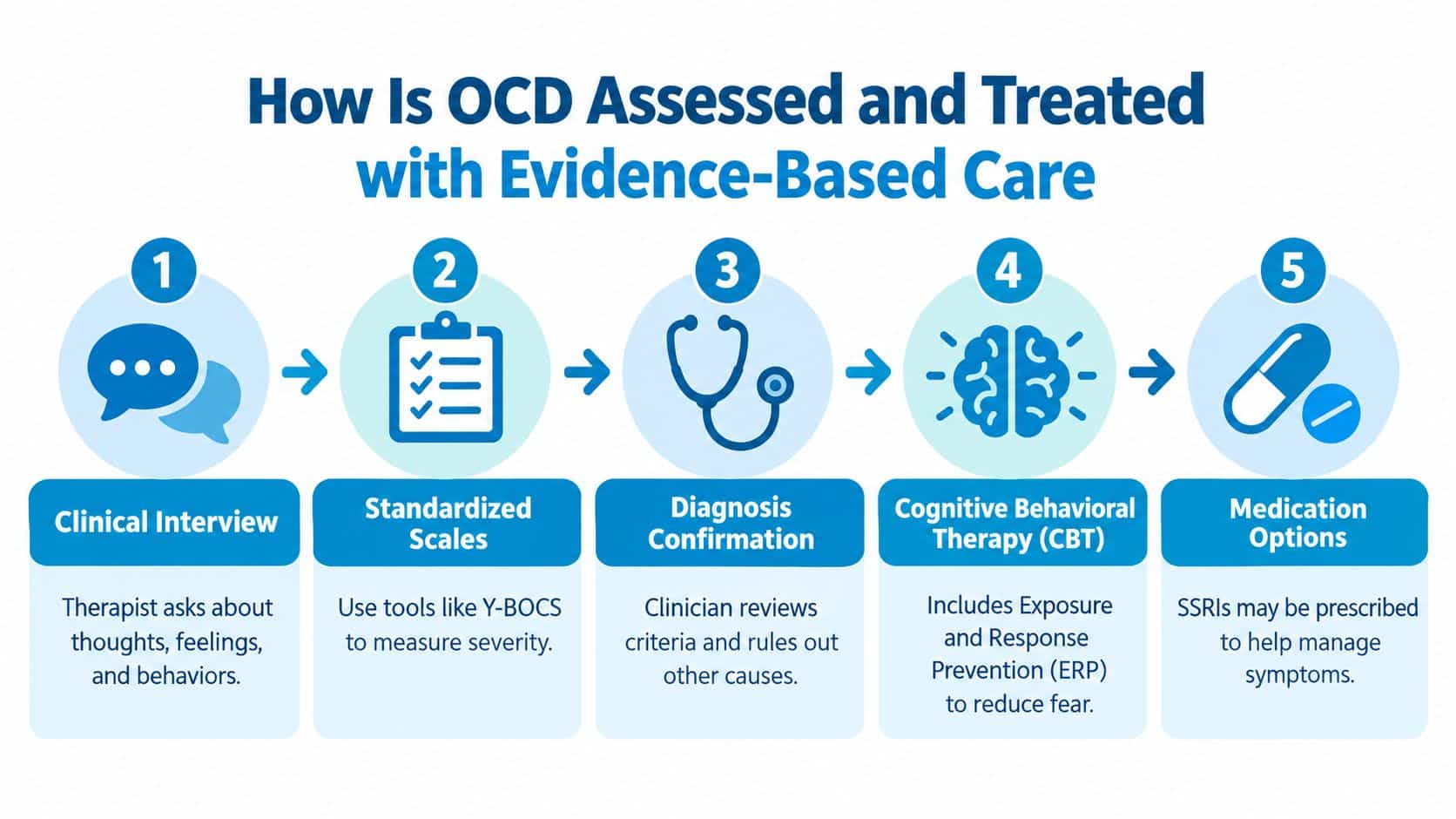
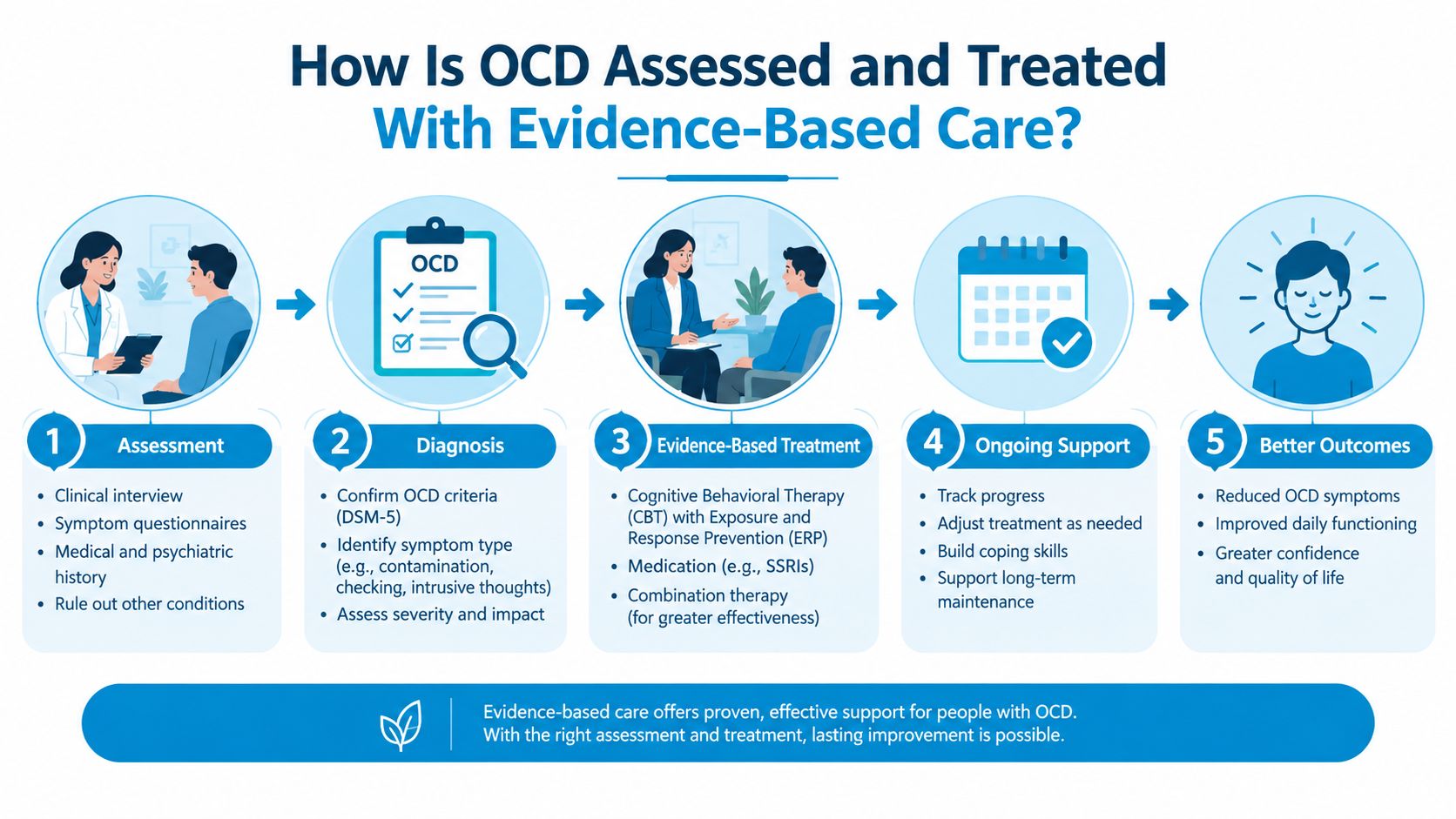
How Is OCD Assessed and Treated With Evidence-Based Care?
What happens during an OCD assessment?
An OCD assessment explores thoughts, urges, images, emotions, rituals, avoidance, impairment, and the meanings attached to symptoms.
A therapist may ask how often the experience occurs, what triggers it, what the person does to feel safer, and what happens when the ritual is resisted. The assessment also considers anxiety, mood, trauma, sleep, medication, substance use, physical health, and cultural context.
A language-matched assessment matters for more than comfort. It can help distinguish a literal thought from an idiom, a culturally shaped fear from a compulsion, and a genuine urge from an unwanted mental image. For an expat, the clinician may also ask how immigration stress, loneliness, academic pressure, or workplace demands affect the cycle.
Standardised measures can support clinical judgement, but they don't replace a full conversation. A diagnosis should come from a qualified professional who reviews the complete presentation and considers other possible explanations.
How does ERP work?
Exposure and response prevention, or ERP, helps a person approach feared triggers gradually while reducing the rituals that keep fear attached to them.
Clinical guidance identifies ERP, alone or as part of CBT, as a first-line psychological treatment for OCD. Standard CBT and ERP are commonly delivered individually in outpatient care over 12 to 20 sessions across about 3 to 4 months (clinical practice guideline on CBT and ERP).
The process often includes:
- Psychoeducation, so the person understands the obsession-compulsion loop.
- A symptom hierarchy, which organises feared situations from less difficult to more difficult.
- Cognitive work, which examines interpretations such as inflated responsibility or the demand for certainty.
- Graded exposure, in which the person encounters a trigger in a planned way.
- Response prevention, which means allowing discomfort without performing the usual ritual.
Distress may be rated from 0 to 100 while building and using the hierarchy, as described in the same guideline. The number isn't a test result or a promise of progress. It helps therapist and client discuss changes in intensity and make exposure appropriately structured.
What if intrusive thoughts continue during treatment?
Persistent thoughts don't automatically mean treatment has failed, because the aim is usually to change the response to thoughts rather than eliminate every intrusion.
A therapist may review whether exposures are sufficiently targeted, whether mental rituals are being missed, or whether avoidance has shifted into a subtler form. ACT can help a person make room for unwanted internal experiences while acting according to values, and medication options such as SSRIs may be discussed with a psychiatrist when clinically appropriate.
Some people need combined or specialist care, particularly when symptoms remain severe or only partly improve. Therapsy's information on therapy for intrusive thoughts can help someone understand how a treatment conversation may begin, but it doesn't replace assessment or medical care.
When Should You Seek Support as an Expat in Italy?
When do intrusive thoughts interfere enough to seek help?
Support becomes worth considering when thoughts, rituals, or avoidance repeatedly limit ordinary choices and make daily life smaller.
A student might stop attending lectures because a thought makes concentration feel unsafe. A professional might spend the beginning and end of each workday checking messages for signs of having caused harm. A person in a relationship might repeatedly ask a partner whether love feels “real,” then remain uncertain despite receiving reassurance.
These examples don't establish OCD. They show why functional impact matters more than the topic of a thought. A therapist can help clarify whether the pattern reflects OCD, anxiety, adjustment stress, trauma, depression, or another concern.
How can an expat find therapy in a familiar language?
A practical starting point is a service that combines human matching, language concordance, and a choice of online or in-person care.
Therapsy's Clinical Director matches clients with therapists rather than relying on an algorithm. The service offers therapy in 14 languages, including Italian, English, French, Spanish, German, Portuguese, Ukrainian, Russian, Greek, Arabic, Urdu, Hebrew, Hindi, and Persian (Farsi).
Sessions are available online and in person across 24 Italian cities. That flexibility can help someone continue care after moving between Milan, Rome, Florence, or a smaller town, while in-person sessions may suit someone who wants a physical therapeutic setting.
Therapsy has 50+ therapists and has served 1,500+ clients since 2023. Its Trustpilot rating is 4.8/5, “Excellent”, and first contact is described as taking place within 12 hours. These details describe the service, not a guarantee of clinical results.
The first assessment call is free and takes place with the therapist chosen for that person. People can also review mental health support for expats in Italy before deciding what questions to ask.
What practical details should someone ask about?
The first conversation can focus on fit, language, approach, availability, and whether the therapist has experience with OCD-related symptoms.
Useful questions include:
- Language: Can difficult thoughts be discussed naturally in the preferred language?
- Approach: Does the therapist work with CBT and ERP, or coordinate with someone who does?
- Format: Would online or in-person sessions feel more sustainable?
- Assessment: What will the first meetings cover?
- Medical care: If medication might be relevant, how would psychiatric consultation be coordinated?
At Therapsy, individual therapy starts from EUR 70 per session, while a first assessment call is free. Pricing can vary according to the therapist's experience and specialisation, so the initial conversation is a suitable place to clarify practical details.
Frequently Asked Questions About OCD and Intrusive Thoughts
Does having a disturbing thought mean someone has a bad character?
No. A disturbing intrusive thought is an unwanted mental event, not reliable evidence of personality, values, intention, or future behaviour. The clinically relevant issue is how often it occurs, how much distress it causes, and whether rituals or avoidance keep it active.
Why does pushing an intrusive thought away often make it stronger?
Trying to suppress a thought keeps attention monitoring whether it has returned. That monitoring can increase awareness of the thought and encourage further checking, while reassurance may reinforce the idea that certainty is necessary before the person can continue.
What should someone do if intrusive thoughts persist during treatment?
Persistent thoughts should be discussed with the treating clinician rather than treated as proof of failure. The therapist may look for hidden mental rituals, adjust exposure work, consider ACT-based strategies, or coordinate with a psychiatrist about medication when appropriate.
How can someone find language-matched OCD support in Italy?
A person can ask a service directly whether the therapist speaks the preferred language and has experience with OCD-focused CBT or ERP. Therapsy offers human matching by its Clinical Director, therapy across 14 languages, and online or in-person sessions, so an expat can discuss fit before committing.
Therapsy offers a free first assessment call with the therapist chosen for that person, with no obligation to continue. Visit Therapsy to discuss intrusive thoughts, language preferences, and whether online or in-person therapy in Italy feels like the right place to start.