Some people arrive at complex PTSD recovery therapy after years of trying to “function normally” while their body keeps acting as if danger is still present. You may be living in Italy, going to work, attending university, raising children, or trying to build a life abroad, yet small triggers can suddenly bring intense fear, shutdown, shame, or emotional chaos. Many expats tell me that they feel confused by the gap between how capable they look on the outside and how overwhelmed they feel inside.
Complex PTSD recovery therapy is a structured treatment process for people whose trauma came from prolonged or repeated experiences and now affects not only fear and memory, but also emotion regulation, self-worth, and relationships. It is not merely “talking about the past”. It is a sequenced clinical process that helps you build safety, process trauma when you are ready, and reconnect with a fuller sense of self.
If you are far from home, this can feel even more complicated. Language strain, loneliness, relocation stress, and weak local support can all make trauma symptoms louder. That doesn't mean healing is out of reach. It means the therapy has to be paced properly, in a way that respects both trauma and context.
I'm Dr. Francesca Adriana Boccalari, Clinical Director at Therapsy. In my clinical work with expats and young adults in Italy, one of the most important things I clarify is this: effective complex PTSD recovery therapy depends not only on which therapy you choose, but on when each part of the work begins. That sequence often changes everything.
The Path to Complex PTSD Recovery Therapy
When daily life keeps activating old survival patterns
Complex PTSD often doesn't feel dramatic from the outside. It can look like overreacting to criticism, going numb in conflict, panicking when someone gets close, or collapsing into shame after a minor mistake. People often blame themselves for these reactions before they realise they are trauma responses.
For many expats, the move itself strips away familiar stabilisers. You may no longer have your usual friends, your language, your routines, or your sense of competence. Trauma that once felt “managed” can become much harder to contain.
A practical truth: trauma recovery starts working when treatment matches your nervous system's actual capacity, not the pace you think you “should” tolerate.
That distinction matters. If your trauma has shaped identity and relationships, then therapy cannot only target memories. It also has to help you feel safer inside yourself and with other people.
Recovery has a structure, even when it feels messy
Many people searching for complex PTSD recovery therapy want one simple answer. Should you start EMDR? Do CBT skills first? Focus on relationships? Work on the body? The most helpful answer is usually more specific: the right intervention depends on your current phase of recovery.
In practice, recovery is often organised around three tasks:
- Stabilisation
- Trauma processing
- Integration into present life
That doesn't mean healing is perfectly linear. People move forward, pause, return to skills, then go deeper again. But the overall path is structured, and structure reduces overwhelm.
A good therapy process helps you answer questions like these:
- Am I ready for trauma processing: or do I need stronger grounding first?
- Are my symptoms driven by fear, shame, dissociation, or relational trauma: because each changes the treatment pace.
- What support is missing in my current environment: especially if I'm navigating Italy without family, fluent language, or a stable community.
Complex PTSD recovery therapy works best when it is organised, collaborative, and compassionate. Not rushed. Not vague. Not reduced to a single method.
Understanding Complex PTSD and Why It Is Different
It is not just “more severe PTSD”
People often assume complex PTSD is a stronger version of PTSD. Clinically, that's too simplistic. The core difference is not only intensity. It is pattern.
Single-incident PTSD often develops after a time-limited traumatic event. Complex PTSD is linked to prolonged or repeated trauma, especially when the person had limited ability to escape. That can leave a deeper imprint on emotional regulation, identity, and attachment.
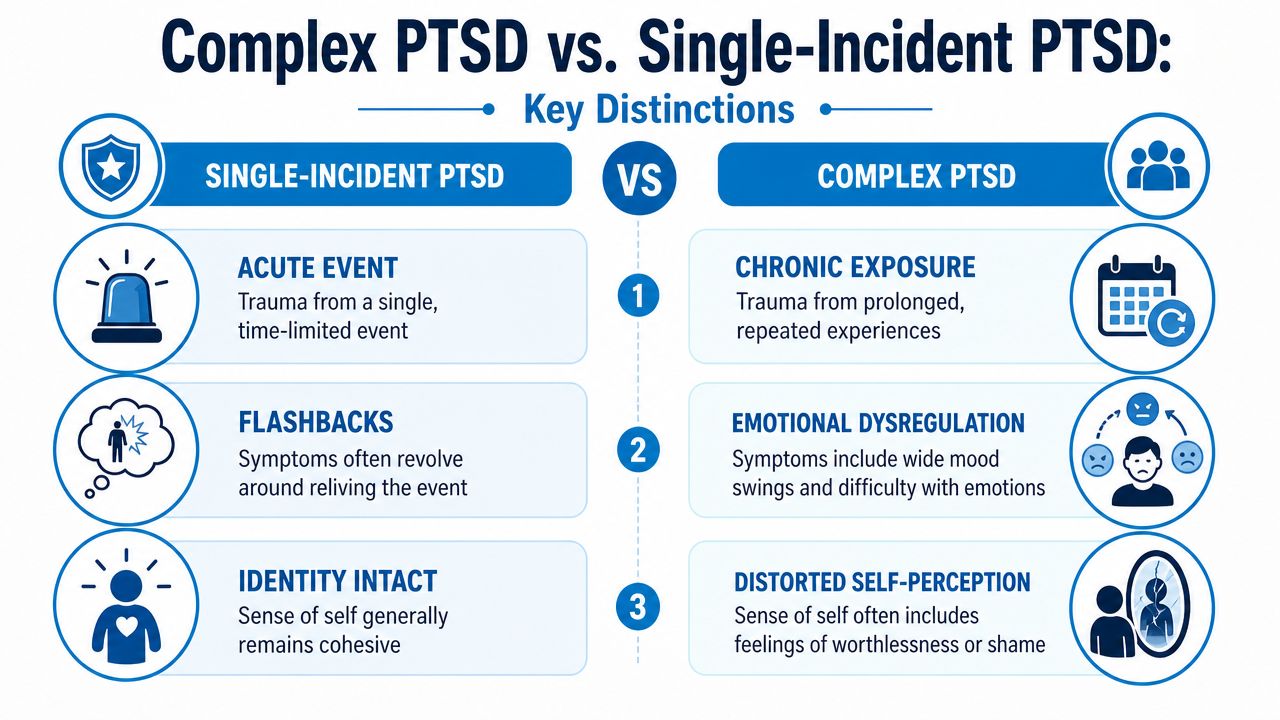
The World Health Organization's ICD-11 formally distinguishes complex PTSD from PTSD. That shift matters because it supports more specialized care instead of treating all trauma reactions as if they are the same. The U.S. National Center for PTSD notes that complex PTSD includes core symptoms beyond standard PTSD, including difficulty managing emotions, feeling worthless, and social withdrawal, and Cleveland Clinic adds that experts estimate CPTSD may affect 1% to 8% of the world population. Both points are summarised in the VA explanation of complex PTSD.
The three areas that often confuse people most
In practice, complex PTSD usually shows up across three domains that go beyond classic trauma symptoms.
| Area | What it can feel like |
|---|---|
| Emotion regulation | You get flooded quickly, stay activated for hours, or go completely numb |
| Self-concept | Shame feels constant, and you see yourself as damaged, weak, or unlovable |
| Relationships | You want closeness but mistrust it, avoid it, or feel unsafe inside it |
These patterns often make people wonder if they are “too much”, “too sensitive”, or “bad at relationships”. Usually, they are looking at trauma adaptations, not character flaws.
For expats in Italy, these domains can become sharper. A relocation can intensify identity instability. Speaking in a second language can reduce emotional precision. Social withdrawal can deepen when you don't yet feel rooted in local community life.
Complex PTSD often hurts most in ordinary moments. An email from a boss, a partner's silence, a bureaucratic problem, a social misunderstanding. The trigger is current, but the survival response is old.
Why this difference changes treatment
If someone has recurrent nightmares and avoidance after a single event, trauma processing may become the central treatment task relatively quickly. If someone also carries chronic shame, dissociation, unstable trust, and severe emotional swings, jumping straight into trauma memory work may backfire.
That is why complex PTSD recovery therapy needs more than a list of modalities. It needs a formulation. The therapist has to understand:
- What overwhelms you fastest
- What helps you return to the present
- How much stability exists in your current life
- Whether closeness itself is a trigger
- How language and culture affect trust
This is especially relevant in intercultural settings. A person can look high-functioning, educated, and organised, yet still lack the inner safety needed for direct trauma processing. Good therapy recognises that difference early.
The Three Phases of Trauma Recovery
Why sequence matters more than people expect
The most effective clinical model for complex PTSD recovery is a phased, sequential approach.
That sequence is not bureaucracy. It is protection.
If a person starts deep trauma work without enough grounding, several things can happen. Sessions become destabilising. Dissociation increases. Daily functioning drops. The person may then conclude that therapy “doesn't work”, when the actual problem was timing.
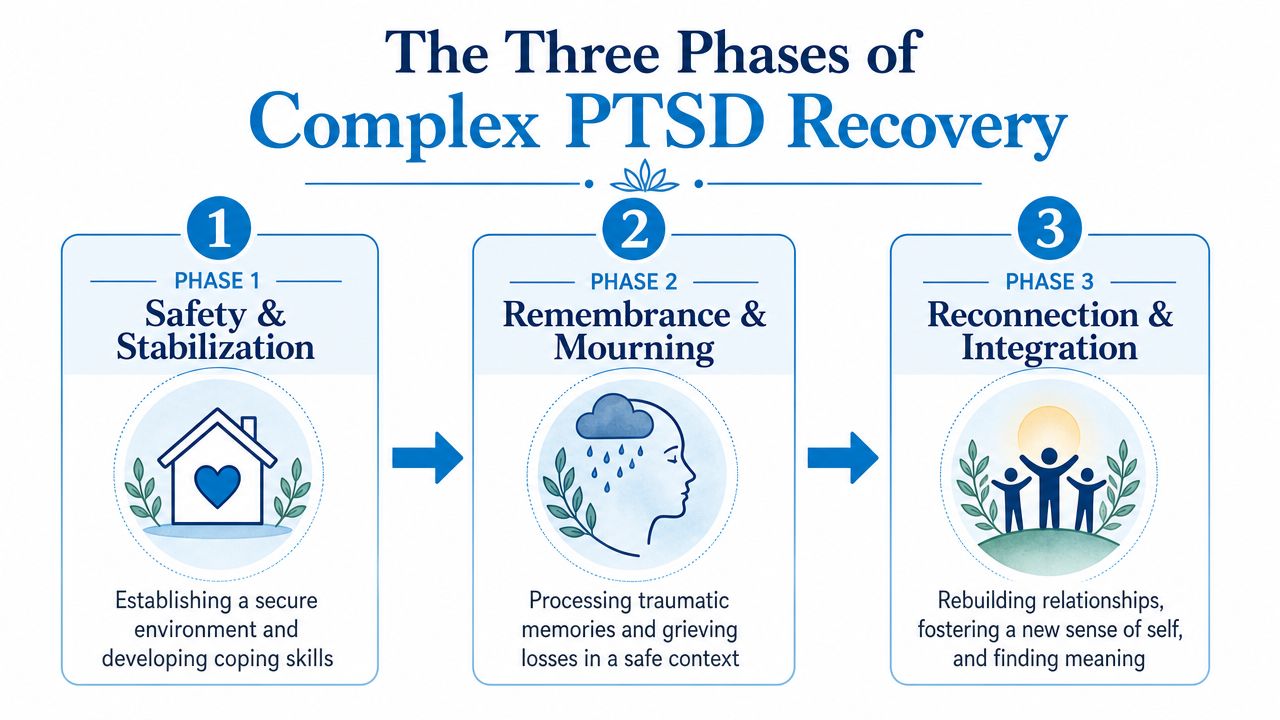
Phase one is safety and stabilisation
This phase is often misunderstood because it can seem less dramatic than trauma processing. Yet it is where many people begin to feel genuine hope.
Phase one usually focuses on:
- Safety: reducing acute risk, creating predictable support, strengthening practical stability
- Regulation: learning how to come down from activation and come out of shutdown
- Sleep: improving rest because an exhausted nervous system processes very little well
- Alliance: building enough trust with the therapist to do deeper work later
For expats, this phase also includes context. Are you isolated? Is housing unstable? Are you in a relationship that feels unsafe? Are you trying to do trauma work in a language that leaves you emotionally disconnected? Those details matter.
If you want to understand this body-first layer more thoroughly, support focused on nervous system regulation therapy can help clarify why stabilisation is not a detour from trauma treatment. It is part of trauma treatment.
Phase two is trauma processing
Once a person has enough internal and external stability, the therapy can begin to process traumatic memories more directly. This phase may involve EMDR, trauma-focused CBT, prolonged exposure, or narrative approaches, depending on the person's presentation and readiness.
The aim isn't to force disclosure or produce emotional intensity. The aim is to reduce the power of traumatic memory so it no longer keeps hijacking the present.
Some signs that phase two may be appropriate include:
- You can usually return to baseline after activation
- You have grounding tools that work at least some of the time
- You can stay present in session without repeatedly losing contact
- Your current life is stable enough to hold the emotional work
Phase three is reconnection and integration
This phase is where many people start feeling that life is becoming larger than trauma. The work turns toward identity, boundaries, intimacy, values, grief, and future direction.
This does not mean trauma is forgotten. It means it is no longer organising your whole life.
Clinical rule: if therapy is only reducing symptoms but not helping you build a more liveable life, the work is not finished yet.
Evidence-Based Therapies for Each Recovery Phase
The treatment is not one-size-fits-all
Many articles list EMDR, CBT, and DBT together as if they are interchangeable. They are not. Each can be useful, but their value depends on where you are in the recovery process.
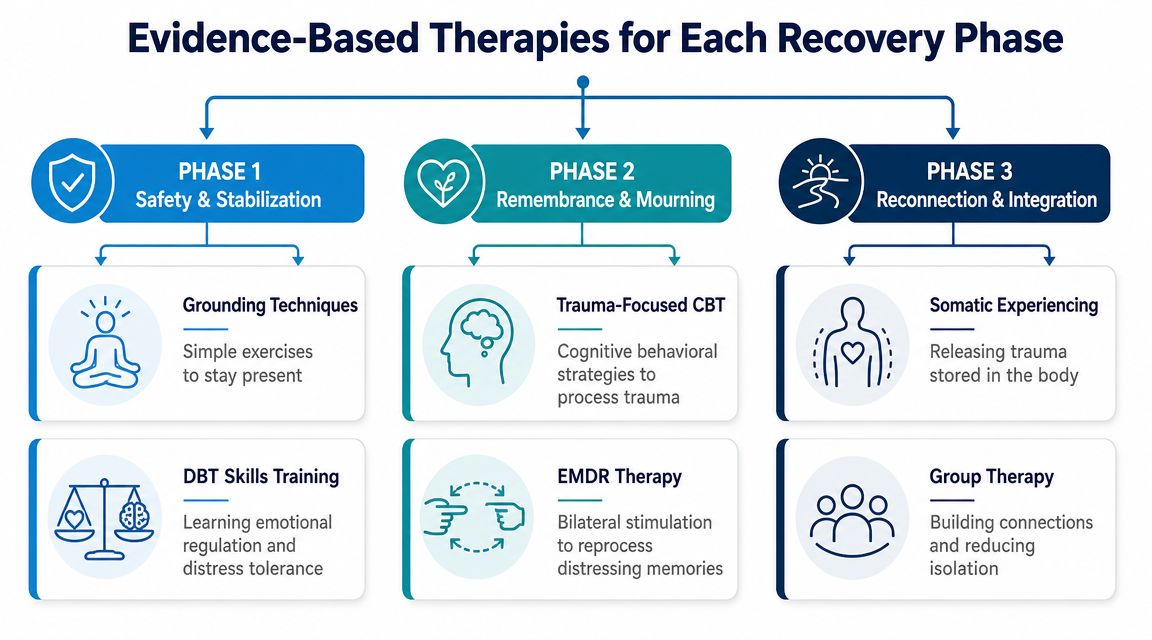
A more useful question is this: what is this therapy trying to do for me right now?
What tends to help in stabilisation
In the first phase, the goal is not to “go into the trauma”. It is to reduce chaos and increase capacity.
Helpful approaches often include:
- DBT skills training: useful for distress tolerance, emotional regulation, and crisis management
- Grounding techniques: orienting to the room, sensory anchoring, paced breathing, movement
- Somatic or body-based work: helping you notice activation earlier and respond before overwhelm escalates
- Sleep support: because poor sleep weakens regulation and increases reactivity
For many people, the most important early intervention is not insight. It is repetition. Practising the same grounding sequence, the same containment image, the same evening wind-down routine. Skills become effective when the body recognises them under stress.
Sleep deserves special attention here. Trauma often disrupts rest through hyperarousal, vigilance, or difficulty settling at night. Practical sleep education can complement therapy, and some people find resources such as SleepHabits on restorative sleep useful alongside clinical support for understanding how recovery and nervous system settling connect.
What tends to help in trauma processing
A 2025 review in PMC notes that NICE recommends 8 to 12 sessions of 90 minutes of individual trauma-focused CBT for clinically important PTSD symptoms and that these protocols include Cognitive Processing Therapy, Cognitive Therapy for PTSD, Narrative Exposure Therapy, and Prolonged Exposure. The same review states that NICE also supports EMDR when it is the patient's preference, while noting that people with complex PTSD may need more sessions or longer sessions because of barriers such as dissociation, emotional dysregulation, interpersonal difficulties, or negative self-perception. It also describes trauma-focused CBT and EMDR as the strongest-evidence frontline therapies for PTSD. You can read that summary in the PMC review of PTSD and complex PTSD treatment guidance.
That guidance is useful because it gives people a realistic frame. There is structure, but there is also flexibility when trauma is more complex.
In practice:
- EMDR can be very effective when the person can stay sufficiently present while traumatic material is activated.
- Trauma-focused CBT helps identify and shift trauma-linked beliefs such as “It was my fault” or “I am never safe”.
- Narrative approaches can help when trauma memories feel fragmented or disconnected from meaning.
If you are specifically looking for EMDR therapy for expats in Italy, it helps to ask not only whether a therapist offers EMDR, but how they decide when someone is ready for it.
What tends to help in integration
Later-phase work often needs a different tone. The question becomes less “How do I reduce re-experiencing?” and more “How do I live differently now?”
This stage may include:
| Focus | Therapeutic direction |
|---|---|
| Identity repair | Schema Therapy or integrative work around shame, self-criticism, and old roles |
| Relational repair | work on boundaries, trust, conflict patterns, and attachment triggers |
| Embodiment | restoring a less defensive relationship with the body and pleasure |
| Meaning | grief work, values clarification, and future-oriented choices |
What doesn't usually work well is forcing one model across all phases. A person may need grounding and structured skills early, EMDR in the middle, and schema-focused work later. That is not inconsistency. It is responsive treatment.
Realistic Timelines and Self-Management
Recovery is usually spiral-shaped, not linear
People often become discouraged because they expect healing to feel steady. In reality, complex PTSD recovery therapy often moves in loops. You may have a month of stronger sleep, fewer triggers, and more confidence, then a conflict, anniversary, relocation issue, or family message pulls old reactions back to the surface.
That does not mean you have failed. It usually means the nervous system is revisiting material at a new depth.
In clinical work, realistic progress often looks like this:
- You notice triggers earlier.
- You recover faster after activation.
- Shame lasts hours instead of days.
- You ask for support sooner.
- You stop organising your life entirely around avoidance.
These changes can seem small from the outside, but they are major markers of recovery.
Improvement in complex trauma often shows up first in recovery time, not symptom disappearance.
Self-management that actually supports therapy
Self-management is not a substitute for treatment. It is what helps you use treatment more effectively between sessions.
A practical starting toolkit often includes:
- A grounding list on your phone: three sensory exercises, one movement cue, one person to contact
- A body check-in twice daily: am I activated, shut down, or settled?
- A reduced-trigger evening routine: lower stimulation, regular meals, predictable sleep preparation
- A simple feelings vocabulary: naming states such as ashamed, frozen, scared, angry, lonely, overloaded
- One safe social contact: not necessarily a deep confidant, but someone with whom contact feels regulating
Mindfulness can be helpful when it is adapted for trauma. Some people do well with brief, present-focused practices rather than long silent meditation. If you want a gentle introduction, trauma-sensitive support around mindfulness practices can help you use attention in a way that calms rather than overwhelms.
What often does not help
Several common strategies can look productive while keeping the cycle going.
- Overanalysing without regulating: insight is useful, but not when the body is in panic.
- Forcing disclosure: telling the whole story too early can destabilise rather than heal.
- Using productivity as avoidance: staying busy can hide distress, but it rarely resolves it.
- Waiting to seek help until things are unbearable: trauma treatment works better when there is still enough capacity to engage.
For expats, another trap is isolation disguised as adaptation. People tell themselves they are “just busy settling in”, while they are withdrawing, losing language confidence, and becoming more emotionally brittle.
Finding Your Therapist in Italy
What to look for beyond a kind personality
A good trauma therapist should feel safe enough, but warmth alone is not enough for complex work. You need someone who understands sequencing, dissociation, shame, and relational trauma.
A major challenge in complex PTSD treatment is deciding when to begin trauma-focused work versus stabilisation. Clinical literature notes that treatment may begin either with trauma-focused therapy or with therapy targeting interpersonal and identity problems, and many experts recommend an alternating sequence that depends on pacing and readiness. This is especially relevant for expats whose external stressors can reduce readiness for deep processing, as discussed in this review on complex PTSD treatment sequencing and readiness.
That means your therapist should be able to answer practical questions such as:
- How do you assess readiness for EMDR or other trauma processing?
- What do you do if I dissociate in session?
- How do you work with shame and self-blame?
- How do you adapt therapy if I'm navigating relocation stress, language barriers, or unstable support?
Cultural fit is not a luxury
For expats, trauma therapy in Italy has an extra layer. You are not only looking for credentials. You are also looking for emotional translation.
That can include:
| What matters | Why it matters |
|---|---|
| Language comfort | trauma is hard to describe in a language that limits nuance |
| Cultural sensitivity | meanings of family, privacy, authority, and dependence vary across cultures |
| Intercultural awareness | relocation itself can intensify fear, shame, and disorientation |
| Pacing | current life stress may require slower, more flexible sequencing |
Sometimes the best therapist is not the one nearest to you geographically, but the one who understands both trauma and the intercultural reality you are living.
When seeking a trauma therapist who speaks English in Italy, ask yourself whether you can imagine becoming emotionally honest with that person, not just whether you can explain the facts of your history.
Good therapy should feel structured, not hurried
The right therapist won't push you into trauma processing to prove that therapy is “working”. They also won't keep you indefinitely in vague supportive conversations if direct trauma work is indicated.
A balanced therapist will know how to:
- Create enough safety without making therapy static
- Process trauma without overwhelming your coping capacity
- Return to stabilisation when life circumstances change
- Help you build a life that is larger than symptom management
That balance is often the difference between treatment that feels containing and treatment that feels chaotic.
Your First Steps to Healing with Therapsy
Starting therapy for complex trauma can bring relief and fear at the same time. Many people worry that they will have to explain everything immediately, or that the first meeting will be too intense. In good trauma-informed care, that is not how it should feel.
The early stage should be paced, collaborative, and clear. The first aim is to understand what is happening now, not to force a full retelling of everything that has happened before.
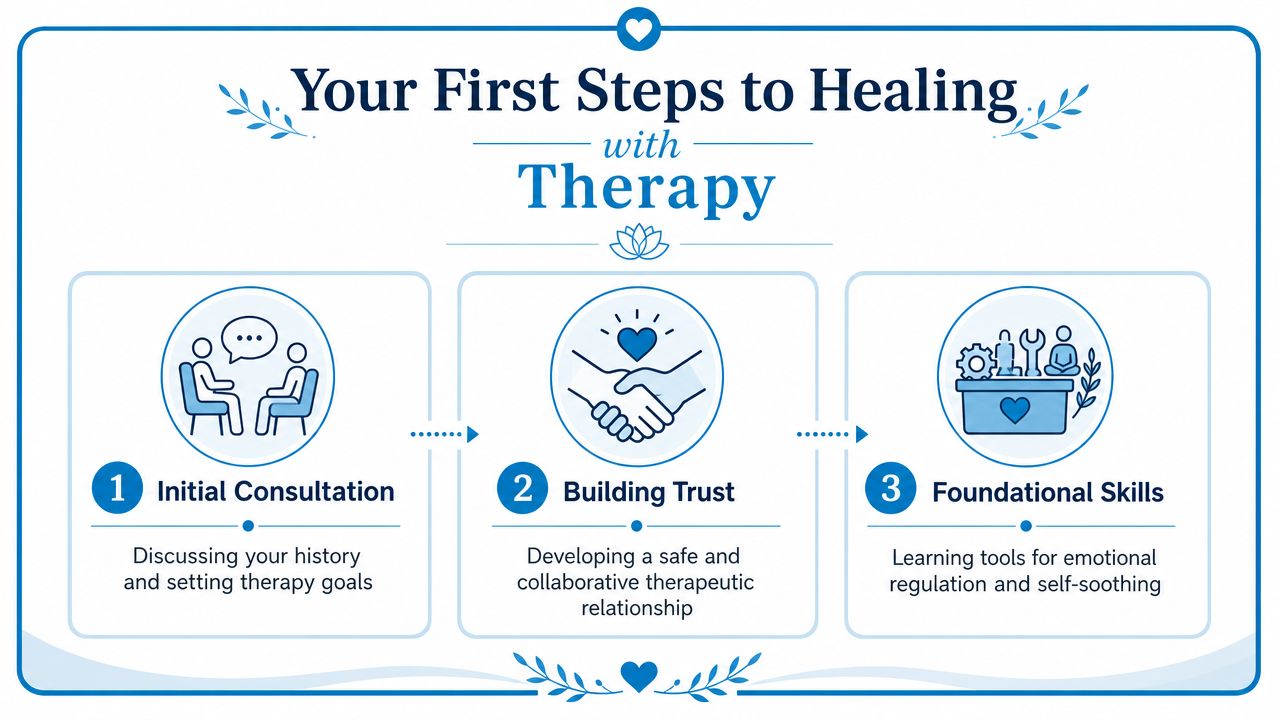
What the first steps usually look like
A simple beginning is beneficial:
Initial assessment
You describe your main difficulties, current stressors, and what you want help with. This includes trauma symptoms, but also sleep, functioning, relationships, and relocation context.Building trust
The therapeutic relationship becomes part of the treatment. You learn whether the pace feels safe, whether the therapist understands your experience, and how your reactions show up in the room.Foundational skills
Before any deep processing, many people begin with grounding, emotional regulation, and stabilising routines. This protects the work that comes later.
Why a human matching process matters
For complex PTSD, matching matters more than people think. The therapist's style, language, training, and tolerance for complexity all affect the outcome. A person with high dissociation may need a different pace from someone whose main difficulty is shame and self-attack. An expat coping with homesickness and bureaucracy may need a different frame from someone living in a stable local support network.
At Therapsy, all articles are signed by me, Dr. Francesca Adriana Boccalari, Clinical Director. I'm a psychotherapist with more than 10 years of experience, certified in EMDR, specialised in CBT and Schema Therapy, and trained in Milan, New York, and Singapore. Our practice offers online and in-person sessions across 24 Italian cities and 90+ physical locations, with therapy in 14 languages and a team of 50+ therapists. Therapsy has supported 1,500+ clients since 2023 and holds a Trustpilot rating of 4.8/5, with first contact typically within 12 hours.
For many expats, the most reassuring part is that the first assessment call is free and human-led. No algorithm. No automated matching. Just a careful conversation about what you need, what language you want to use, and what kind of therapist is likely to fit you best.
Who works with complex trauma at Therapsy
Complex trauma is not the same as a single traumatic event, and it needs clinicians who work with it specifically.
Dr. Mariateresa Volpe is licensed in both Italy and Quebec, with over 15 years of experience, and her expertise includes complex trauma and OCD. She works in French as well as English, and takes on complex clinical cases explicitly.
Dr. Sofia Collatina specialises in PTSD and complex PTSD with advanced EMDR training under Roger Solomon, and works within a Transactional Analysis frame.
Dr. Marianna De Simone integrates CBT with Schema Therapy and Compassion-Focused Therapy, which is built for people whose difficulty is bound up with harsh self-criticism, a pattern that often follows prolonged trauma.
You do not have to work out who fits on your own. You tell Therapsy what you are looking for, a member of our clinical team reads your request, and they introduce you. The first call is free.
FAQ
How long does complex PTSD recovery therapy take?
There isn't one fixed timeline. Recovery depends on your trauma history, current life stability, support system, and whether the first task is stabilisation or trauma processing. Some focused trauma work may move through a structured period, but complex PTSD often requires a longer process because therapy is also helping with identity, relationships, and emotional regulation.
Can complex PTSD be cured completely?
Many people improve profoundly, even if “cured” isn't the most helpful word. The aim is not to erase the past, but to help it stop controlling your present life, relationships, and sense of self. With the right treatment, people often reach a point where symptoms no longer dominate daily living.
Is online therapy effective for complex PTSD?
Yes, online therapy can be effective, especially when access, language, or location are barriers. It can work very well for stabilisation, ongoing support, and much of integration work, and for some people it also supports trauma processing when the frame is well managed. If you are considering remote support, online psychotherapy in Italy can make specialised care more accessible.
What if I do not speak Italian or English well?
You should look for therapy in the language that allows you to feel most emotionally precise. Trauma work often becomes harder when you have to translate shame, fear, grief, or bodily experience into a language that doesn't feel natural enough. At Therapsy, we offer therapy in 14 languages, which makes it easier for expats and multilingual communities in Italy to feel understood without that extra barrier.
Book your first free assessment call with THERAPSY. There's no commitment and no pressure, just a conversation with our Clinical Director to understand what you're carrying and match you with the right therapist for you.