Panic attack exposure therapy is a core CBT technique that works by repeatedly and safely confronting feared bodily sensations and situations. It teaches the brain that a racing heart, dizziness, breathlessness, crowded transport, or an elevator can feel intensely uncomfortable without being dangerous. A therapist builds the practice gradually, adapts it to the person's trigger profile, and helps reduce avoidance and safety behaviors.
For an expat, panic can feel especially confusing. A new city, language fatigue, isolation, unfamiliar healthcare systems, and pressure to appear capable can make normal bodily changes feel like urgent warnings. Someone may notice a rapid heartbeat on the metro in Milan, feel dizzy during a university lecture in Bologna, or become afraid of being unable to explain symptoms in Italian.
Therapsy is a multilingual psychotherapy service in Italy that connects expats with therapists who speak their native language.
Exposure isn't about forcing someone into the most frightening situation. It's a structured learning process. A therapist helps the person understand the panic loop, identify what is being feared, practise the relevant sensations or situations, and reduce the behaviors that keep the alarm system active.
What Is Panic Attack Exposure Therapy and How Does It Help?
Your heart suddenly races on the metro in Milan. Your chest feels tight, your balance shifts, and the thought appears: “What if I collapse here?” Panic attack exposure therapy addresses the fear attached to those sensations. It is a structured CBT method that helps the brain learn, through experience, that intense sensations can be tolerated without escape or catastrophe.
CBT for panic disorder is described in psychiatric literature as the most empirically supported psychosocial treatment, with repeated exposure to bodily sensations and feared situations at its centre in the clinical literature on CBT for panic disorder. The aim is not to make panic feel pleasant. The practical question is whether you can remain with a sensation long enough to learn what happens when you do not flee, check, or interpret it as a disaster.
Why does panic feel so physical when nothing seems wrong?
Panic feels physical because the body's alarm response changes heart rate, breathing, muscle tension, attention, and balance before the mind has fully interpreted the event.
A racing heart may be read as a medical emergency. Breathlessness may seem like suffocation. Lightheadedness may appear to signal imminent collapse. That meaning increases fear, which produces more bodily activation. The original sensation then feels like proof that the feared interpretation was correct.
For someone living abroad, uncertainty can intensify this process. You may not know where to seek medical help, feel worried about explaining symptoms in a second language, or be far from family. Those pressures can make you monitor your body more closely. The sensation is real, but its meaning may be misread by an alarm system already operating under strain.
A therapist may combine exposure with culturally responsive care, attachment-informed work, Schema Therapy, EMDR when clinically appropriate, or cross-cultural psychology perspectives. The choice depends on your history and needs. Exposure is used when the treatment goal is to test a feared prediction directly, rather than depend on reassurance alone.
What does exposure teach the brain?
Exposure creates new safety learning. The brain records, “This sensation happened, and the predicted catastrophe did not follow,” even if anxiety remained present.
Exposure can take different forms. Interoceptive exposure practises feared bodily sensations, such as breathlessness or dizziness. In-vivo exposure addresses feared situations, such as public transport, crowded places, or being far from home. App-guided or VR formats may offer another structured way to practise when language, location, or access makes regular exercises harder, with a therapist helping decide whether the format fits your needs.
A 2011 randomized controlled trial of panic disorder with agoraphobia found that therapist-guided in-vivo exposure produced better outcomes than CBT without therapist-guided exposure, including improvement in agoraphobic avoidance and overall functioning, along with fewer panic attacks during follow-up the PubMed-indexed trial.
This is why a CBT approach for panic disorder can focus on the fear-of-sensations mechanism. Reassurance may calm you briefly. Exposure helps you build a memory of coping without needing reassurance each time your body changes.
Why Does Panic Keep Coming Back Even When You Are Safe?
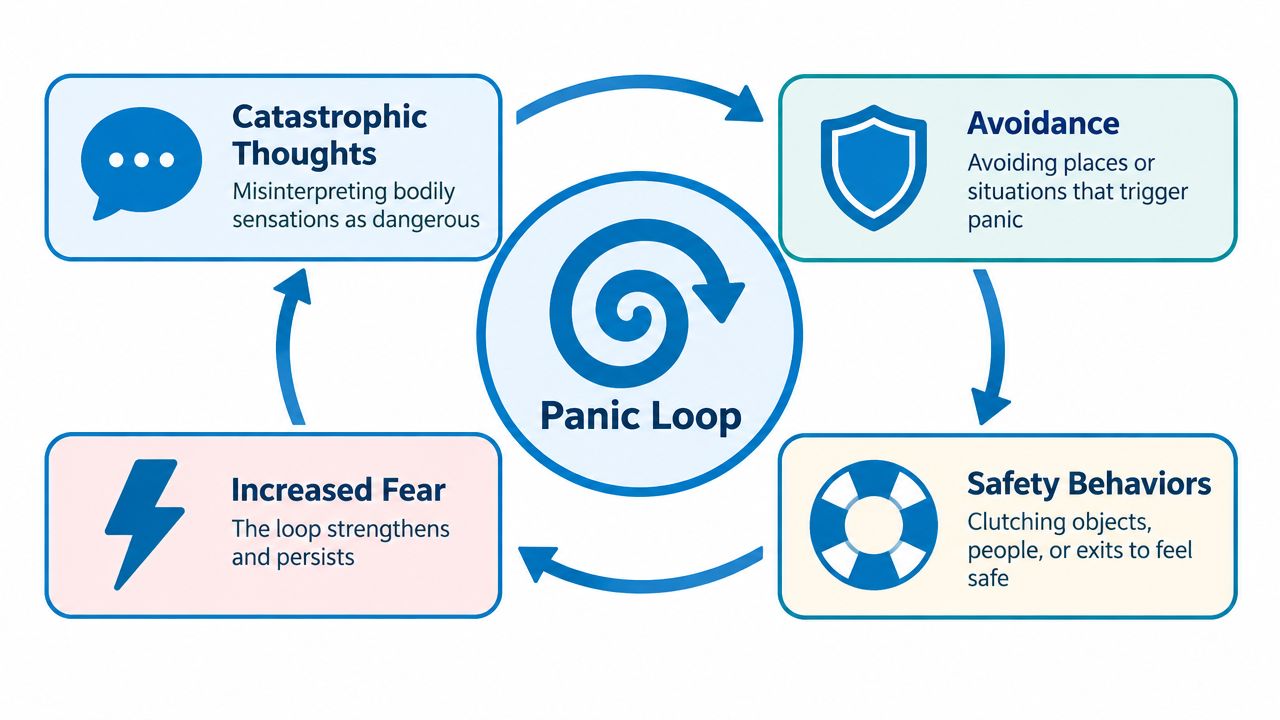
Panic can return in safe places because the brain has learned to treat ordinary sensations, locations, or uncertainty as warnings, then reinforces that lesson through escape and checking.
A useful analogy is a smoke detector set too sensitively. It may sound when toast burns rather than when a fire starts. The alarm is loud and distressing, but the sound itself doesn't prove that the building is burning. Panic exposure therapy helps recalibrate the response by allowing the person to investigate the alarm without immediately fleeing.
The maintenance loop often includes four linked parts:
- Catastrophic thoughts: A racing heart becomes “something is seriously wrong.”
- Avoidance: The person stops using buses, lifts, shops, classrooms, or unfamiliar places.
- Safety behaviors: The person checks a pulse, sits beside an exit, carries a reassuring object, or needs another person nearby.
- Increased fear: Temporary relief confirms the mistaken idea that escape prevented disaster.
Why do safety behaviors keep fear alive?
Safety behaviors reduce distress in the short term, but they can prevent the person from discovering that the situation was manageable without them.
If someone leaves a supermarket as soon as dizziness begins, the brain may conclude, “Leaving kept me safe.” If that person stays long enough to observe the sensation without repeatedly checking or escaping, the brain has a chance to learn a different lesson. The aim isn't to remove every support suddenly. A therapist identifies which behaviors are maintaining the fear and reduces them in a planned way.
For an expat, this might involve gradually changing a familiar pattern. Someone may begin by entering a local pharmacy with a trusted person, then later visit alone, while practising the relevant learning rather than using the companion only as a guarantee of safety.
Is exposure about making anxiety disappear?
Exposure isn't a test that must end with zero anxiety. It is successful when the person learns something important while anxiety is present.
Fear may rise, fall, fluctuate, or remain uncomfortable during an exercise. What changes is the interpretation and response. The person can notice, “My heart is fast, and I can stay,” rather than treating the sensation as proof of immediate danger.
A therapist who collaborates with Therapsy can also help distinguish panic-related fear from concerns that need medical assessment. Therapy doesn't replace medical care, and new, severe, or unexplained physical symptoms should be discussed with an appropriate healthcare professional.
For help understanding the difference between related experiences, readers can explore anxiety versus a panic attack. The distinction matters because exposure is planned around the person's actual pattern, not around a generic list of symptoms.
What Is the Difference Between Interoceptive and In-Vivo Exposure?
Interoceptive exposure practises feared internal sensations, while in-vivo exposure practises feared external situations; many people need a personalized combination.
Interoceptive exposure is designed for someone who fears what the body does. Exercises may recreate dizziness, breathlessness, warmth, tingling, or a pounding heart in a controlled context. In-vivo exposure addresses the places or activities linked with panic, such as public transport, elevators, driving, supermarkets, or crowded events.
The distinction is useful because a person may avoid a place only because it produces a feared sensation. Someone might not fear the metro itself, for example, but fear feeling trapped with a fast heartbeat and no easy way to explain the problem. In that case, interoceptive work may be central before or alongside metro practice.
| Feature | Interoceptive Exposure | In-Vivo Exposure |
|---|---|---|
| Primary target | Feared bodily sensations | Feared real-world situations |
| Typical concern | “My heart rate means I'll lose control.” | “I'll panic on the train and won't be able to leave.” |
| Example practice | Carefully inducing dizziness or increased heart rate | Entering a station, taking a short ride, or using an elevator |
| Main learning | Sensations are tolerable and not automatically dangerous | Places can be approached without escape or excessive safety behaviors |
| Personalization | Matched to the sensations the person fears most | Matched to avoided locations, activities, and practical goals |
| Common role | Often important when anxiety sensitivity is high | Often important when avoidance has narrowed daily life |
Which type is more important for panic?
Interoceptive exposure can be especially important when the feared trigger is internal. A review cited in the clinical literature reported that a meta-analysis of 72 CBT studies found more favorable outcomes associated with interoceptive exposure than situational exposure, and a larger influence on treatment outcomes than cognitive restructuring the indexed review record.
That doesn't mean situational exposure is unnecessary. A person who has stopped taking buses, attending lectures, or travelling to work still needs opportunities to reclaim those activities. The therapist chooses the mix by asking what the person predicts will happen, what they avoid, and what safety behavior keeps the fear intact.
Can exposure be used without medication?
Exposure can be part of a therapy plan without medication, but the appropriate treatment depends on the person's clinical and medical situation. A therapist can explain how CBT works and coordinate with healthcare professionals when medication or medical assessment is relevant. A panic attack treatment approach without medication should still be professionally guided when exercises involve intense bodily sensations or substantial avoidance.
How Does a Graded Exposure Hierarchy Work in Practice?
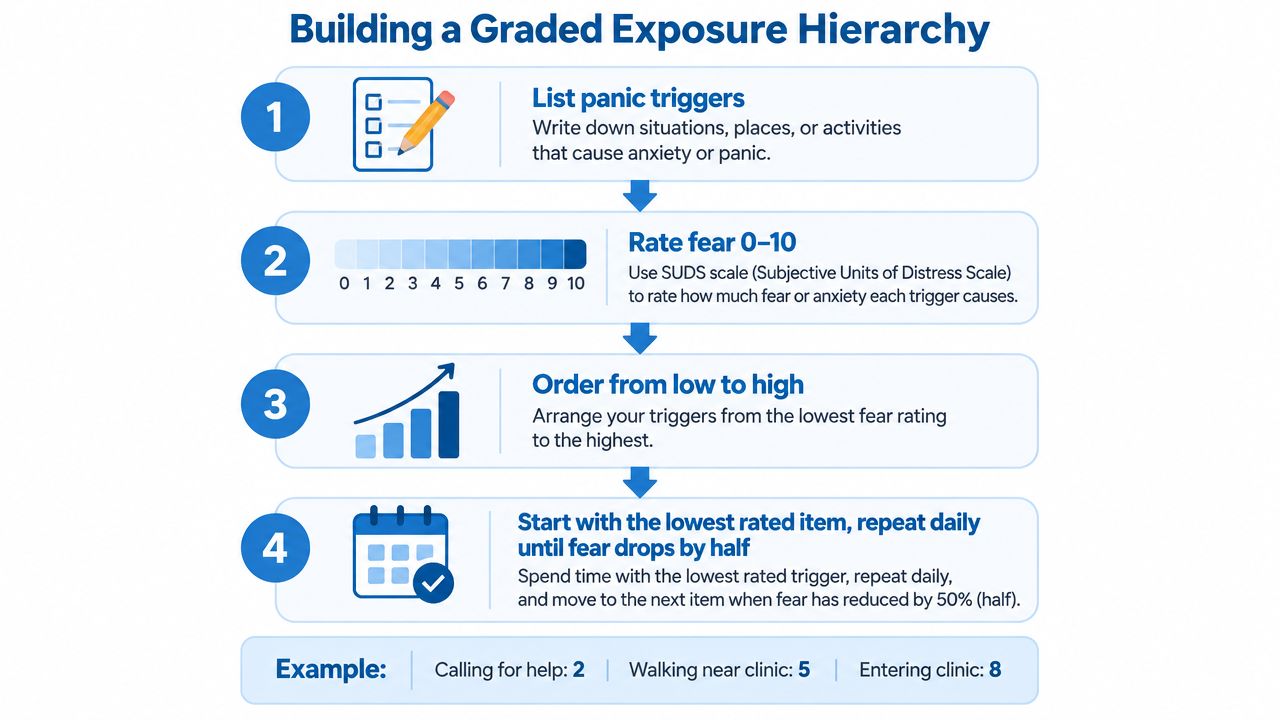
A graded hierarchy ranks feared sensations and situations from lower to higher difficulty, then uses repeated practice to replace avoidance with direct learning.
The first step is precise description. “Public places” is too broad to guide treatment. “Standing in the middle of a crowded tram for one stop while noticing a fast heartbeat” gives the therapist something observable to assess.
What goes on an exposure hierarchy?
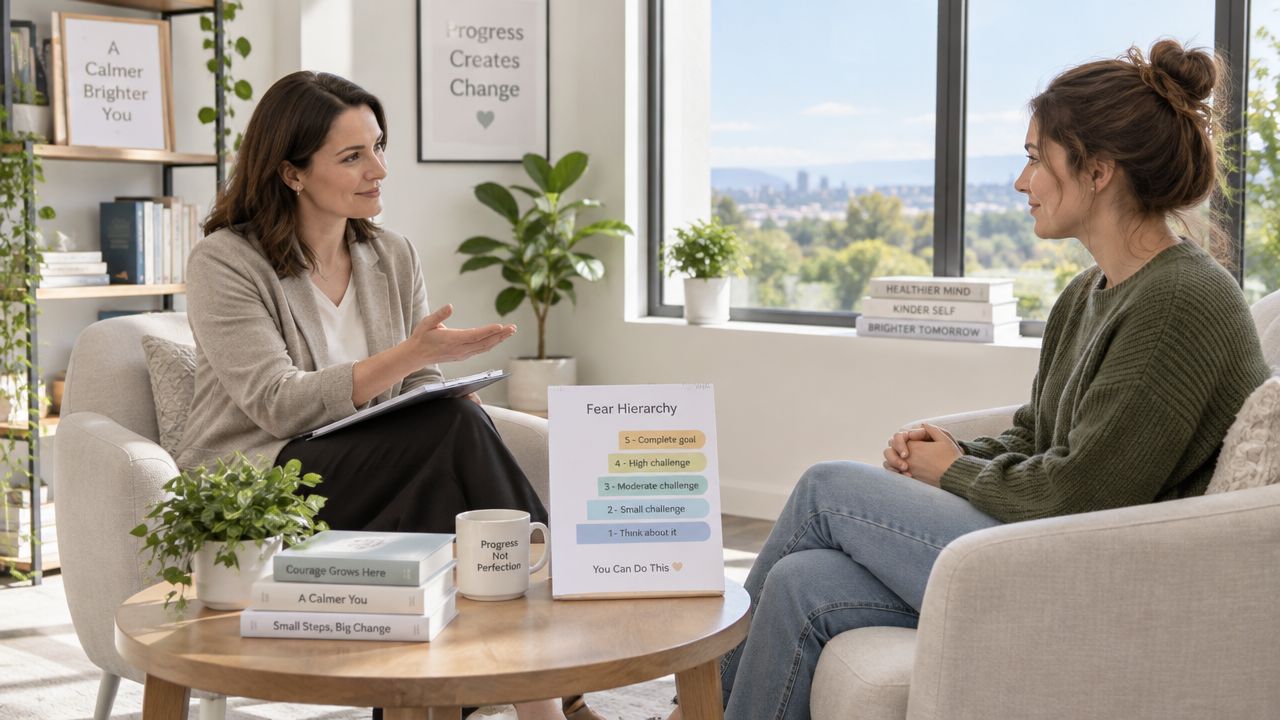
The hierarchy can include internal sensations, external situations, thoughts, and safety behaviors. Each item receives an anxiety rating on a 0–10 scale, with lower-rated tasks usually practised before more demanding ones.
A person might list:
- Calling for help: anxiety rating 2.
- Walking near a clinic: anxiety rating 5.
- Entering the clinic: anxiety rating 8.
- Standing away from the exit: a separate task if the exit is used as a safety signal.
The ratings aren't grades. They help the therapist select a starting point that is challenging enough to create learning without becoming unnecessarily overwhelming.
How are bodily sensations practised?
A therapist may select an exercise that resembles the sensation the person fears, explain its purpose, and establish how the exercise can be paused. Training resources describe examples such as hyperventilation for 1 minute, running in place for 1 to 5 minutes, and chair spinning for several turns the CBT training resource.
These aren't universal instructions for independent practice. A person's medical history, physical health, panic pattern, and current symptoms matter. The therapist decides whether a particular exercise is appropriate and how to adapt it.
Why repeat the same task?
Repetition gives the brain several opportunities to update its prediction. A person may practise a lower-intensity task daily, as agreed with the therapist, until the response becomes less dominant or the person can remain present without relying on the old safety behavior.
Practical rule: Match the exercise to the sensation or situation that is actually feared, repeat it consistently, and increase difficulty gradually.
The purpose isn't to chase a specific anxiety score. It is to observe what happens when the person stays, allows sensations to change, and reduces escape, checking, or reassurance-seeking. A structured panic attack treatment plan can make this process easier to monitor between sessions.
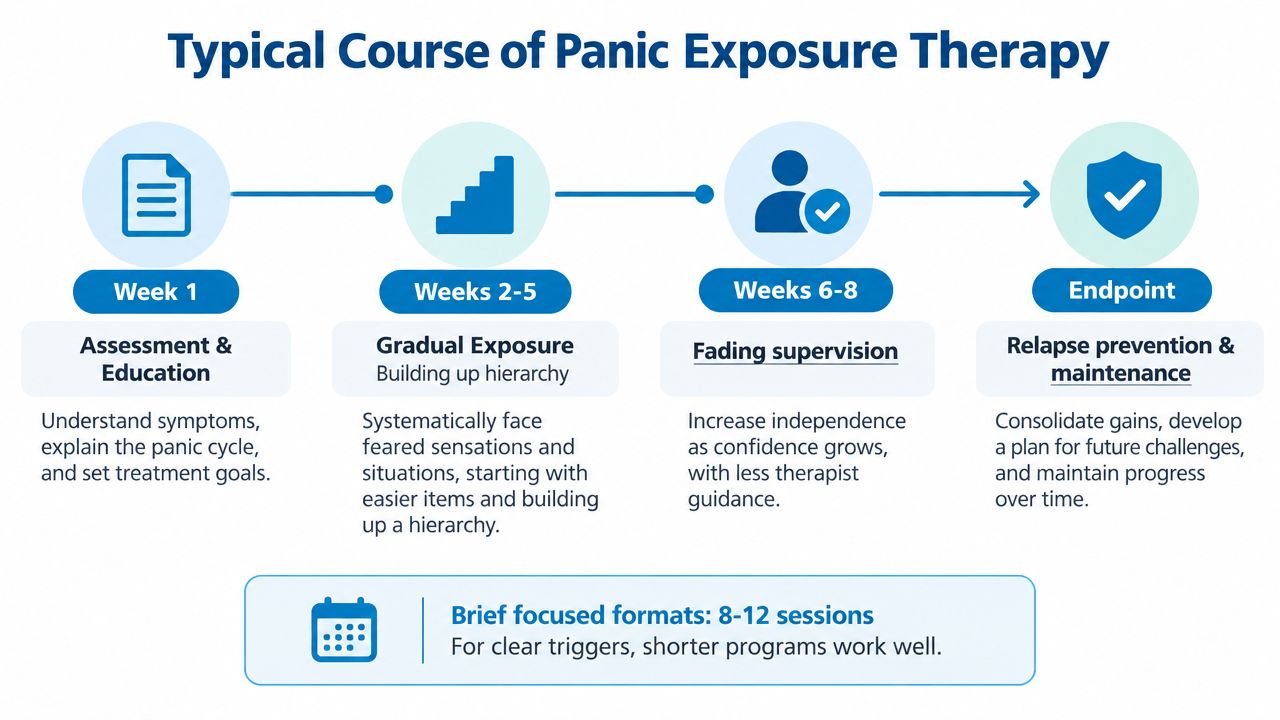
What Does a Typical Course of Panic Exposure Therapy Look Like?
A typical course starts by identifying what the person fears, then turns that fear into a practical learning plan. Early sessions may focus on education and assessment. Later work applies exposure to feared sensations, places, or activities, with therapist support reduced as confidence grows. The final stage focuses on maintaining progress and responding to setbacks.
The format depends on the person's needs. Panic may occur alongside depression, trauma, relationship strain, or adjustment stress, including the pressures of living abroad. In those cases, exposure may sit within a broader CBT plan. Someone with a clear fear of bodily sensations or a specific place may need a shorter, more focused course.
How much exposure is enough?
The amount of practice depends on the prediction that needs updating. A small randomized pilot of brief therapist-guided exposure reported a PDSS-SR effect size of d = 1.63, with 6 of 8 patients classified as responders and 4 achieving remission the PubMed-indexed pilot study. Because the pilot was small, its results do not guarantee the same outcome for another person.
The study also found large changes in bodily-sensation fear and catastrophic interpretations, with effect sizes ranging from d = 1.17 to d = 3.00. These findings support precision rather than a fixed therapy length. If assessment identifies a clear fear, repeated practice can target the belief directly, whether the person is preparing for a flight, using public transport in a new country, or responding to a racing heart at home.
Does more intense exposure work better?
Intensity can help when anxiety sensitivity is the main target. Clinical guideline evidence describes a randomized trial in which intensive interoceptive exposure produced greater reductions in anxiety sensitivity and fear responding than lower-dose exposure exercises the clinical guideline evidence.
The hardest exercise does not belong at the beginning by default. A therapist may increase duration, reduce safety behaviors, or move from imagined practice to a real situation. The choice depends on the feared prediction, the person's readiness, and the learning goal.
How is progress measured?
Progress includes more than fewer panic attacks. A person may still notice occasional panic while travelling more freely, interpreting sensations with less alarm, and recovering without an urgent escape.
As noted earlier, the 2011 trial found better outcomes when in-vivo exposure included therapist guidance than when CBT lacked that guided component. Improvements appeared from baseline through post-treatment and follow-up. This supports measuring recovery in daily life, not only symptom counts.
How Can You Practice Exposure Safely and What Does the Therapist Do?
Safe exposure begins with assessment, consent, and a clear learning goal. Before an exercise, the therapist and client identify the feared prediction, choose a suitable practice, agree on boundaries, and decide how to review the result.
The therapist does not surprise someone with a feared situation. Consent remains active throughout the session, and the exercise can be adjusted when physical health, medication, dissociation, depression, or another concern affects safety or concentration.
What does a therapist monitor?
A therapist monitors whether the person is learning that feared sensations or situations can be tolerated, rather than enduring unnecessary distress. This may include fear ratings, physical responses, urges to escape, safety behaviors, dissociation, medication use, medical history, and the person's ability to stay engaged with the exercise.
The clinician may pause practice if the person becomes disoriented, overwhelmed, medically unwell, or unable to follow the learning task. Exposure is not a competition. Stopping for assessment is not failure. New or concerning physical symptoms should receive appropriate medical attention instead of being automatically labelled panic.
The therapist also watches for a common confusion: feeling anxious does not always mean the exercise is unsafe. The question is whether the sensation reflects the planned learning task or a medical problem that needs separate care.
How does therapy work across languages and cultures?
Language affects how panic is understood and described. “My chest feels tight” may communicate something different from “I can't get enough air.” Cultural beliefs about illness, family responsibility, personal control, and help-seeking can also shape the feared prediction and the safety behaviors around it.
For people living abroad, speaking with a therapist who understands their preferred language and context can make these details easier to examine. Therapsy's Clinical Director provides human matching rather than algorithmic matching, and the service offers therapy in 14 languages, including Italian, English, French, Spanish, German, Portuguese, Ukrainian, Russian, Greek, Arabic, Urdu, Hebrew, Hindi, and Persian (Farsi). Clients can choose online or in-person sessions across 24 Italian cities and 90+ physical locations, depending on availability and clinical fit.
A person can review therapist matching with Therapsy or explore therapy services in Italy before choosing support. At Therapsy, the first assessment call is free and takes place with the selected therapist rather than an automated system. Learn what happens in a panic attack therapy session and how the therapist paces exposure.
Should a person practise exposure alone?
Some low-intensity behavioral steps may be suitable between sessions, but deliberate interoceptive exercises are not a universal self-help prescription. Exercise-induced sensations can affect people differently, so suitability depends on health history and the specific panic pattern.
A therapist can help reduce safety behaviors gradually. Abruptly stopping prescribed medication, removing every source of support, or forcing a difficult situation without assessment does not create the same learning as planned exposure. Good treatment keeps the target clear and separates medical care from fear-driven checking.
Therapsy's clinical team includes 50+ therapists, and the service reports more than 1,500 clients and 13,000 sessions since 2023. Its Trustpilot rating is 4.8/5, “Excellent”, and first contact is available within 12 hours, according to the publisher's stated service information. These facts describe the service, not an individual treatment outcome.
Frequently Asked Questions About Panic Attack Exposure Therapy
Can panic attack exposure therapy be done through an app?
App-guided exposure may offer a structured way to practise when specialist access, work schedules, or language needs make regular in-person care difficult. A 2025 randomized controlled trial found that app-guided exposure improved symptom severity, depressive symptoms, quality of life, and safety maneuvers in people with panic disorder with and without agoraphobia the JMIR trial.
An app doesn't automatically provide the clinical judgment needed for every person. A therapist can help decide whether self-guided practice is suitable and how to respond if exercises increase confusion, avoidance, or distress.
Is virtual reality useful for panic exposure?
Virtual reality can simulate feared situations such as elevators, driving through tunnels, driving in rain, or crowded transport when real-world practice is difficult. A clinical article described effectiveness in panic-provoking situations including elevator riding and driving in tunnels or rain, while also noting that direct evidence in younger people remains limited the PMC article on VR exposure.
VR is best understood as a possible bridge, not a universal replacement for real-world practice. The appropriate format depends on the person's target, access, privacy, technology comfort, and therapeutic plan.
How is interoceptive exposure personalized?
Interoceptive exposure is personalized by identifying the sensation that carries the most danger meaning for that person. The therapist may focus on breathlessness, dizziness, heart rate, tingling, heat, or unreality, then choose an exercise and intensity that fit the person's health and treatment goals.
A 2026 trial reported that brief intermittent intense exercise used as interoceptive exposure was more effective than relaxation training for reducing panic severity and attack frequency, with benefits maintained through 24 weeks the Frontiers clinical trial. This doesn't mean exercise is safe or appropriate for everyone. A therapist and relevant healthcare professional should consider the individual context.
Do exposure benefits last?
Benefits can last when the person continues using the learning after formal therapy ends. Maintenance may involve revisiting previously avoided situations, noticing early safety behaviors, and responding to setbacks without rebuilding the old avoidance cycle.
No therapy can promise that panic will never return. A durable plan focuses on what the person can do when sensations reappear, rather than treating any future episode as proof that treatment failed.
Therapsy can connect expats and international adults in Italy with a therapist selected by the Clinical Director, in the client's own language and through online or in-person sessions. The first call is free, it's with the therapist chosen for that person, and there's no obligation to continue, so readers can visit Therapsy to explore whether the service fits their needs.