When an expat is caught in repeated checking, reassurance-seeking, mental reviewing, or avoidance, schema therapy for OCD can help explain why the cycle feels so powerful. It explores the deeper emotional patterns behind obsessive fears while working alongside established OCD methods such as CBT and ERP. For someone living in Italy and thinking in a second language, discussing those patterns in a familiar language can make therapy easier to understand and use.
Therapsy is a multilingual psychotherapy service in Italy that connects expats with therapists who speak their native language.
What Schema Therapy Offers for OCD
An expat may finish work, return to a quiet apartment, and become trapped in the same exhausting loop: an intrusive thought appears, anxiety rises, and a ritual seems necessary to feel safe. The ritual may involve checking a message repeatedly, replaying a conversation, asking for reassurance, or mentally analysing whether something harmful has happened.
Schema therapy for OCD offers a way to understand the emotional patterns that make these loops feel urgent. It is a form of therapy that examines entrenched beliefs and coping styles, often called schemas, rather than focusing only on the visible symptom. The approach can help a person explore why uncertainty feels intolerable, why mistakes seem dangerous, or why responsibility feels much larger than it does for other people.
What are schemas in schema therapy?
Schemas are enduring emotional and cognitive patterns that shape how a person interprets themselves, other people, and the world around them. They can influence whether an ordinary uncertainty feels manageable or like evidence of personal failure, rejection, danger, or moral wrongdoing.
Schemas often develop through repeated experiences, including criticism, emotional neglect, instability, excessive responsibility, or relationships in which mistakes felt unsafe. Moving abroad can activate older patterns because an expat may face unfamiliar social rules, reduced support, language strain, and uncertainty about belonging. The relocation doesn't create OCD by itself, but it can intensify existing vulnerabilities and make familiar coping strategies more active.
A schema-focused therapist may explore patterns such as social isolation, failure, subjugation, or punishment. In OCD, these themes can become connected to intrusive thoughts and compulsions. A person might fear that a small mistake proves incompetence, that disagreement will lead to rejection, or that every thought must be controlled to prevent harm.
How can schema therapy address more than symptoms?
Schema therapy links present-day OCD distress with emotional needs that may not have been met earlier in life. The work can include identifying the trigger, noticing the belief that follows, recognising the emotional state that appears, and understanding the coping response that keeps the cycle going.
For example, an intrusive thought about harming someone might activate a fear of being fundamentally dangerous. The person may then enter a frightened, ashamed state and respond by mentally reviewing every action, avoiding the person, or asking others for certainty. Schema therapy helps make that sequence visible without treating the thought as a confession of character.
This doesn't mean that every OCD symptom has a hidden childhood explanation. It means the therapist considers how current symptoms interact with broader patterns of fear, shame, perfectionism, attachment, and self-criticism. Schema therapy for anxiety and depression can provide further context about how this broader therapeutic model works.
Practical rule: An intrusive thought is an experience in the mind, not reliable evidence about a person's intentions, values, or identity.
At Therapsy, a therapist can discuss these patterns in the client's own language and consider the cultural meaning attached to family duty, religion, privacy, achievement, or responsibility. That context matters because the same symptom can feel different when a person is navigating Italian life through another language and social framework.
How Schema Therapy Works for Obsessive-Compulsive Disorder
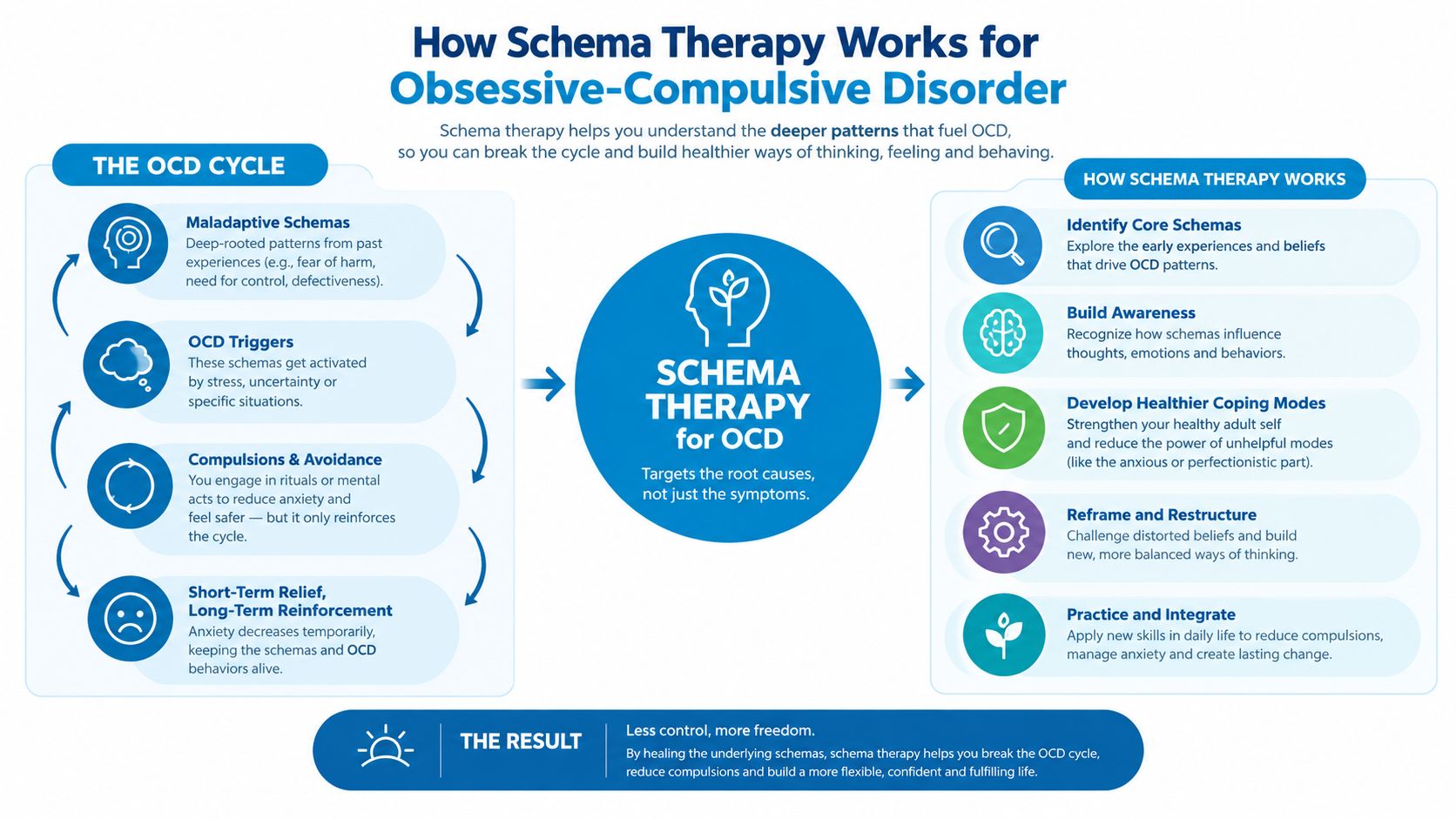
Schema therapy works by connecting deep beliefs, emotional states, and coping behaviours so that the person can respond to OCD with more flexibility. The therapist does not argue with an obsession, but examines what the obsession seems to threaten emotionally.
A schema is a long-standing pattern such as “mistakes make me unacceptable” or “other people can't be trusted.” A mode is the emotional state that becomes active when a schema is triggered. Someone may move into a vulnerable mode marked by fear, a punitive mode marked by harsh self-judgement, or an avoidant mode that seeks relief by withdrawing or performing rituals.
The OCD cycle can then be understood as a sequence:
- An intrusive thought or uncertainty appears.
- A schema gives that thought a threatening meaning.
- A mode brings fear, shame, guilt, or urgency.
- A compulsion or avoidance response promises immediate relief.
- The person becomes more dependent on that response the next time uncertainty appears.
Why do modes matter in OCD?
Modes matter because the same person can think and act very differently depending on which emotional state is active. A frightened part may demand certainty, while a punitive inner voice insists that uncertainty or imperfection deserves blame.
Schema therapy aims to strengthen a Healthy Adult mode. This part can acknowledge distress without obeying every demand made by fear or self-criticism. It can hold a balanced position, such as recognising that a mistake may be uncomfortable without making it proof of personal defectiveness.
For an expat, modes can also be activated by cultural transition. A person who already fears rejection may interpret a confusing interaction in Italian as evidence of failure. A person with strong responsibility beliefs may feel compelled to translate, check, or rehearse every message until it feels completely safe.
Attachment theory and cross-cultural psychology can add useful perspective. Early relationships may shape expectations about safety and approval, while cultural norms influence how people understand duty, shame, independence, family loyalty, and emotional expression. A multilingual therapist can explore both without assuming that one cultural standard is universally correct.
Can schema therapy replace ERP?
Schema therapy is often used alongside ERP, rather than automatically replacing it. ERP directly addresses the behavioural cycle by helping a person face feared experiences while reducing compulsive responses, whereas schema work explores the emotional meanings that can make those experiences especially difficult.
Some people find that symptom-focused work becomes more understandable after the deeper pattern has been identified. Others may need a treatment plan that prioritises ERP, CBT, medication review, or another form of care. Inner child work therapy may be relevant when a therapist identifies unresolved emotional experiences, but it should remain part of an individualised clinical plan rather than a self-directed exercise.
What the Research Says About Schema Therapy for OCD
The research on schema therapy for OCD is promising but still emerging, so it shouldn't be presented as an established first-line replacement for CBT and ERP. A 2026 systematic review identified only 5 eligible studies published between 2015 and 2025, including 1 randomized controlled trial and 4 quasi-experimental or pilot studies. The review reported reductions in OCD symptoms and maladaptive schemas, while also highlighting small samples, short follow-up, limited reporting of treatment fidelity, and differences between studies. The systematic review therefore describes a developing evidence base rather than a settled conclusion.
The first OCD-specific schema therapy research began appearing in the mid-2010s. This timing matters because a newer field has had less opportunity to build the large, consistent body of evidence associated with established OCD treatments.
What did early schema therapy studies examine?
One important pilot programme combined schema therapy with ERP for people who had not responded to standard CBT. The programme lasted 37 weeks on average, included 11.5 therapy hours per week, and involved 27 treatment-resistant patients with anxiety disorders or OCD. The researchers reported significant improvements in general psychopathology, early maladaptive schemas, and schema modes after treatment. The published pilot study described the approach as feasible and potentially effective, but its uncontrolled design limits what can be concluded about causation.
Another 2016 pilot study specifically examined schema therapy augmented with ERP for people who had not responded to standard CBT. Its design supports the practical observation that schema therapy for OCD is commonly considered an add-on to ERP, not a substitute for it. The study abstract provides that treatment context.
What patterns have researchers linked with OCD severity?
A study of 34 OCD outpatients found symptom severity was significantly associated with social isolation, failure, subjugation, and punishment schemas. Regression analysis identified social isolation, punitiveness, the punitive parent mode, and behavioural avoidance as predictors of OCD severity, with behavioural avoidance acting as a significant mediator. The peer-reviewed study offers a useful model for understanding why avoidance can maintain distress even when it brings short-term relief.
These findings don't prove that a particular schema caused any individual's OCD. They suggest that therapists can assess the emotional and behavioural patterns surrounding symptoms, then decide whether schema-focused work belongs in a broader treatment plan.
Schema Therapy vs. Standard CBT and ERP
Schema therapy, CBT, and ERP can all be relevant to OCD, but they differ in what they target most directly. The appropriate choice depends on symptoms, previous treatment, emotional needs, clinical assessment, and the person's preferences.
| Approach | Main focus | Common therapeutic work | Where it may fit |
|---|---|---|---|
| Schema therapy | Deep-rooted beliefs, emotional needs, modes, and coping styles | Identifying schemas, working with vulnerable and punitive states, strengthening a Healthy Adult response | When longstanding shame, perfectionism, attachment wounds, or repeated treatment difficulties are important |
| CBT | The relationship between thoughts, emotions, and behaviours | Evaluating interpretations, testing beliefs, and changing reinforcing behaviours | When a structured approach to thoughts and responses is appropriate |
| ERP | The OCD cycle of fear, avoidance, and compulsions | Gradually approaching feared situations while reducing rituals and reassurance-seeking | When direct behavioural treatment is clinically indicated |
| Combined care | Symptoms and underlying emotional patterns | ERP or CBT alongside schema-focused exploration | When symptom work and deeper emotional work need to support each other |
Is schema therapy better than CBT for OCD?
No single approach can be described as universally better for every person with OCD. CBT and ERP remain the best-established treatments in major mental health settings, while the review cited above describes schema therapy as promising but statistically thin compared with those established approaches.
Schema therapy may add value when a person understands the logic of ERP but feels blocked by intense shame, chronic self-punishment, fear of disappointing others, or longstanding emotional patterns. It may also help a therapist adapt the language of treatment to the person's cultural and family context.
For an expat, treatment can become harder when the person must describe intrusive thoughts in a language that doesn't carry the same emotional precision as their native language. A multilingual therapist can clarify whether a phrase reflects genuine meaning, a translation issue, a cultural expectation, or an OCD-driven demand for certainty.
People exploring support for intrusive thoughts can review therapy for intrusive thoughts while considering which questions to bring to an assessment. The key question isn't which label sounds most appealing. It is whether the proposed plan addresses the person's symptoms, emotional patterns, cultural context, and safety needs.
Who Can Benefit from This Approach
Schema therapy may be considered when OCD symptoms occur alongside longstanding shame, perfectionism, self-criticism, avoidance, relationship difficulties, or a painful sense of not belonging. It can be especially relevant for people who have tried structured symptom work and still feel that the same emotional patterns repeatedly reactivate distress.
An expat may face a particular combination of pressures. Relocation can separate a person from family, trusted friends, religious communities, or familiar healthcare systems. Using a second language at work and in daily life can increase fatigue, while cultural misunderstandings may intensify fears of rejection or failure.
Can schema therapy help treatment-resistant OCD?
Schema therapy may be explored for treatment-resistant OCD, particularly when previous treatment has not addressed the emotional patterns that make compulsions difficult to resist. It shouldn't be presented as a guaranteed solution, and a qualified clinician may recommend combined treatment or a different approach.
The early pilot research described above focused on people who had not responded to standard CBT, but the findings don't establish that schema therapy will work for every treatment-resistant case. A proper assessment should consider the person's symptom pattern, previous interventions, current functioning, medication, physical health, and treatment goals.
A therapist may pay attention to questions such as:
- What does the obsession seem to say about the person? The fear may involve contamination, harm, morality, relationships, or responsibility, but the deeper meaning may concern defectiveness, rejection, or punishment.
- Which coping response follows? Avoidance, reassurance-seeking, checking, mental review, and rituals can each serve a different emotional function.
- Which mode becomes dominant? A vulnerable state may seek safety, while a punitive state may demand confession, certainty, or self-criticism.
- What cultural context shapes the fear? Family expectations, religious values, migration history, and experiences of discrimination can affect how responsibility and belonging are understood.
Does language affect OCD therapy for expats?
Language can affect how precisely a person describes intrusive thoughts, shame, bodily sensations, family history, and culturally specific values. Therapy in a familiar language may also reduce the effort required to translate emotionally complex experiences during an already demanding period of adjustment.
This doesn't mean therapy in a second language can't work. It means language concordance is one practical factor worth discussing, especially when the treatment involves subtle meanings, childhood experiences, identity, or faith.
Therapsy offers therapy online and in person through 50+ therapists, with support in 14 languages: Italian, English, French, Spanish, German, Portuguese, Ukrainian, Russian, Greek, Arabic, Urdu, Hebrew, Hindi, and Persian (Farsi). Its network includes therapists working with CBT, EMDR, Schema Therapy, attachment-informed care, and cross-cultural concerns.
People dealing with harsh self-judgement can also explore therapy for low self-esteem. The purpose isn't to replace OCD treatment, but to help identify whether self-worth and punitive beliefs are contributing to the difficulty of changing compulsive patterns.
Finding a Qualified Multilingual Therapist in Italy
A suitable therapist for OCD should be able to explain the treatment plan clearly, understand compulsions that occur mentally as well as behaviourally, and respect the client's language, culture, identity, and values. Schema therapy experience can be useful, but OCD-specific competence and the ability to coordinate care matter too.
How can an expat choose the right therapist?
An expat can begin by identifying the language, format, clinical experience, and treatment goals that matter most before requesting a match. A free first conversation can then clarify whether the proposed therapist feels suitable without creating an obligation to continue.
A practical process includes:
- Describe the main difficulty clearly. The person can mention intrusive thoughts, checking, avoidance, reassurance-seeking, mental rituals, or uncertainty about a diagnosis without needing to use perfect clinical terminology.
- Ask how OCD is treated. Useful questions include whether the therapist works with ERP, CBT, schema-focused methods, or coordinated psychiatric care when appropriate.
- Discuss language and culture. The therapist should be able to understand the client's preferred language and explore how migration, family expectations, religion, or cultural identity affect the symptoms.
- Choose a workable format. Online sessions may suit someone who travels or lives outside a major city, while in-person sessions may feel more grounding for another person.
- Review practical details. Session fees, availability, cancellation arrangements, and communication expectations should be explained before regular therapy begins.
Therapsy uses human matching by the Clinical Director rather than an algorithm. The first assessment call is free and takes place with the therapist chosen for that person, allowing the client and therapist to consider fit before deciding whether to continue.
Where can expats find therapy in Italy?
Expats can request support through Therapsy's expat therapist service in Italy and discuss whether online or in-person care is more appropriate. Therapsy provides sessions across 24 Italian cities and 90 physical locations, as well as online appointments.
Therapsy has supported 1,500+ clients through 13,000+ sessions since 2023, and its network reports a Trustpilot rating of 4.8/5, marked “Excellent.” These figures describe the service's activity and public rating, not a clinical guarantee or proof that a specific therapy will be effective for a particular person.
Initial contact is available within 12 hours. Individual therapy starts from EUR 70, couple therapy from EUR 100, psychodiagnostic assessment from EUR 255 for 3 sessions, and psychiatric consultation from EUR 110. The first assessment call is free, with no obligation to continue.
Who works with OCD and schema therapy at Therapsy
Dr. Silvia Cau, an English-speaking psychotherapist in Cagliari, works with anxiety and OCD and practises Acceptance and Commitment Therapy. For the schema side of treatment, Dr. Marianna De Simone, a CBT psychologist in Rome, integrates schema therapy into cognitive behavioural work, as does Dr. Brandice Harris in Florence.
Frequently Asked Questions
Is schema therapy effective for OCD?
Schema therapy may help with OCD, but research remains limited, so no therapist should promise a universal result. It can complement ERP or CBT when shame, punishment fears, avoidance, perfectionism, or cultural expectations keep the cycle active.
How long does schema therapy for OCD take?
The timeframe depends on symptoms, treatment history, goals, emotional patterns, and whether ERP is included. A therapist should explain the likely structure and review progress together instead of promising a fixed schedule.
Can therapy take place online?
Online sessions can suit expats who live far from a clinic, travel often, or feel safer speaking from home. In-person work may feel more supportive for someone who needs a separate therapeutic setting. Either option can be discussed during the first assessment.
What happens in the first meeting?
The therapist usually asks about current difficulties, personal history, treatment goals, preferred language, and practical needs. For an expat, this is also a chance to explain how using a second language affects emotional expression or describing intrusive thoughts. The meeting is not a test, and a perfect account is not required.
Can a therapist respect religious or cultural values?
Yes. A culturally responsive therapist can respect faith, family expectations, and cultural identity while addressing compulsions and avoidance. Schema therapy can examine whether beliefs about responsibility, error, obedience, or shame come from earlier experiences or cultural pressure. The aim is to reduce fear-driven behaviour without treating identity or religion as a symptom.
Therapsy connects expats in Italy with a therapist selected through human matching, in the client's own language, with online or in-person sessions. The first call is free and carries no obligation to continue. Visit Therapsy to discuss schema therapy for OCD and consider whether the available support fits your needs.