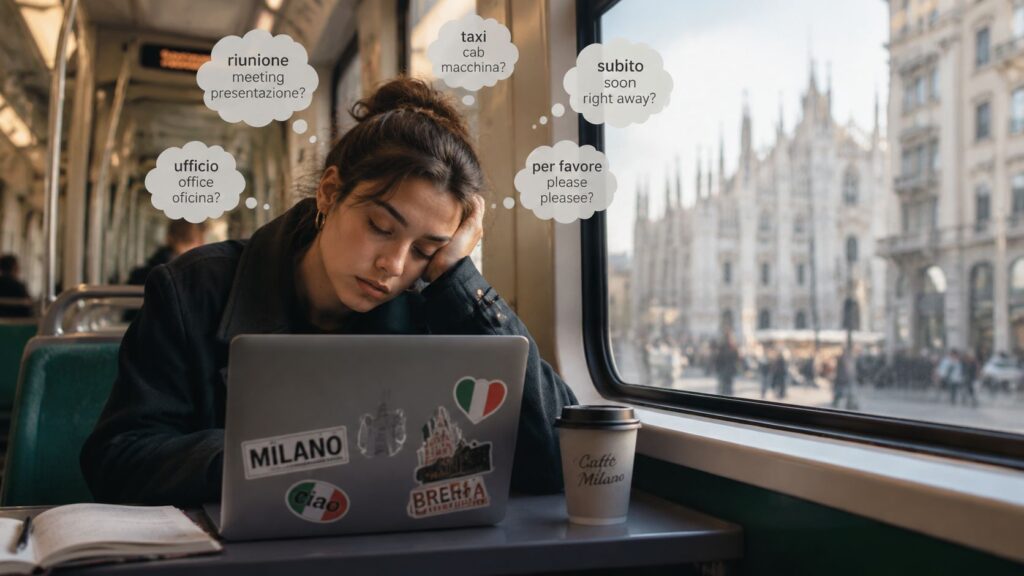
Quick answer: The hardest part of moving country is almost never the first month. It is the stretch between month six and month eighteen, when the practical problems are solved, the novelty has gone, and the social layer underneath has not been built yet. That dip is ordinary. It becomes a reason for therapy when it stops moving, or when it starts deciding what you do with your week.
Therapsy is a multilingual psychotherapy service in Italy that connects expats, international students and Italians with licensed therapists in their own language, online across the country and in person in 24 Italian cities.
Key takeaways
- Adaptation is not only a personal trait: research has examined the social and contextual factors that correlate with how migrants adapt to a receiving society.
- The first months run on adrenaline and a to-do list. The difficulty arrives when the list ends.
- Competence resets. Qualified adults spend a year being bad at ordinary things, and read it as a verdict on themselves.
- The relationship that moved with you takes the load, usually asymmetrically.
- You do not need a diagnosis to ask for an assessment, and the second year is when most people do.
- Therapsy works in 14 languages, with a free first conversation and a reply within 12 hours.
What actually happens in the first year?
Months one to three: the list
Residence paperwork, tax code, bank, housing, phone, doctor, school. It is exhausting and it has a structure, which is why people often feel fine: there is a task, you do it, something moves. Difficulty in this phase usually presents as fatigue, not distress.
Months four to nine: the flat part
The list ends. The city stops being interesting and becomes the place where you live. Colleagues are friendly and not yet friends. This is where people first say the sentence that brings them to a first session: nothing is wrong and I feel terrible.
Months ten to eighteen: the comparison
By now you can see what the life you left would have looked like. Friends there have moved on without you, a parent has aged, and the version of yourself that was competent and funny exists in another language. Many people book a first appointment in this window, describing it as low motivation.
Is any of this a disorder?
Mostly no. It is the predictable shape of a large change, and saying so is not dismissive: knowing that the dip has a shape is itself useful, because the worst interpretation is that you personally failed at something everyone else finds easy.
Why is it harder than people expect?
Competence resets, and you notice
You cannot read the tone of an email, you get the register wrong, you need help with things you have done alone since you were eighteen. Qualified adults experience a year of small incompetence and quietly conclude something about themselves rather than about the situation.
Adaptation is not only about you
How it goes depends heavily on context, not just character. A meta-analysis of social and contextual correlates of migrant adaptation to living in receiving societies examined exactly that. Research on expatriates has also looked at the mechanics of adjustment rather than treating it as a personality trait, including an integrative framework for expatriate adjustment research. The practical consequence: if it is hard, the first question is what the environment is doing, not what is wrong with you.
The relationship carries the difference
One partner usually had the reason to move and the other had the upheaval. The one who followed is often grateful, which makes complaining feel unfair, and the silence does more damage than the complaint would have. This is one of the most treatable patterns there is, and one of the last to be brought in.
The language tax
Operating in a second language all day costs attention continuously, and it is almost never counted as work. People attribute the tiredness to the job, then try to fix the job.
What helps in the first year?
Repetition beats variety
Closeness is built by frequency, not novelty: the same class, the same bar, the same five-a-side, weekly. Three different events in a month produce three acquaintances; the same event three times produces a conversation that continues.
Keep one relationship from before, on a schedule
Not everyone from the old life, one person, deliberately, at a fixed time. Left to spontaneity it decays, and it is the relationship that knows who you were before you became a foreigner.
Separate the two lonelinesses
Not having enough people is one problem; having nobody who knows you is a different one, and they need different responses. Solving the first does not touch the second, which is why a busy calendar can coexist with feeling unknown.
Lower the bar for asking
You do not need to be in crisis and you do not need a tidy explanation. “I am tired and I do not know why” is a complete reason to book a first conversation, and it is the most common opening we hear.
When is it worth speaking to someone?
The practical thresholds
When the flat stretch has lasted months without moving; when sleep, appetite or concentration have changed; when you are avoiding things you used to do easily; when the relationship has gone quiet; or when drinking has become the way the evening ends. Any one of those is enough.
What does the first session do?
It sorts. Adjustment, burnout, depression and grief look similar from inside and lead to different plans, and telling them apart is the clinician’s job, not your homework. At Therapsy the first conversation is free and happens with the Clinical Director, who proposes a therapist and explains why, with a reply within 12 hours.
Which language, and where?
Your own, if it is available: this is material you will describe badly in a second language. Therapsy works in 14 languages, online across Italy and in person in 24 Italian cities, and you can see the network on our therapists page. Individual sessions start from EUR 70; the pricing page has the rest.
Frequently asked questions
How long does it take to adjust to a new country?
The practical layer is usually rebuilt within a year; the social and emotional layer takes considerably longer. The hardest stretch for most people is between month six and month eighteen, not the first weeks.
Is it normal to feel low when nothing is wrong?
Yes, and it is the most common presentation in the second year abroad. It becomes a reason for an assessment when it stops shifting or starts affecting sleep, work or relationships.
Is this culture shock or depression?
Adjustment difficulty is tied to the situation and moves as the situation changes. Depression persists across contexts and changes sleep, appetite, energy and interest. The two overlap, which is why the first session looks at both.
Do I need to be in crisis to start therapy?
No. No diagnosis and no referral are needed for private therapy, and waiting for a crisis is the most expensive way to use it.
Can I have therapy in my own language?
Yes. Therapsy works in 14 languages, online across Italy and in person in 24 Italian cities, and language is part of the match rather than an extra request.
My partner moved for my job and is struggling. What helps?
Naming the asymmetry out loud, early. The partner who followed often feels they have no right to complain, and that silence does more damage than the complaint would. It is a common and very treatable reason for couples work.
Related reading
Written by Dr. Francesca Adriana Boccalari, Clinical Director at Therapsy and licensed psychologist (Ordine degli Psicologi della Lombardia n. 16241), and reviewed in September 2026.