Navigating Love Across Cultures: A Guide to Cross-Cultural Marriage Counseling in Italy
Cross-cultural marriage counseling is a specialized form of therapy designed to help couples from different cultural backgrounds navigate the unique challenges and opportunities their relationship presents. It provides a structured, supportive space to explore how differing values, communication styles, and family expectations impact their connection. Rather than treating a "broken" relationship, it offers a proactive guide for strong couples to build a resilient, shared foundation.
Building a life with someone from another culture expands your world in beautiful ways. But it also means navigating a relationship where the unwritten rules about communication, family, money, and conflict aren't always shared. This is where professional support becomes invaluable.
As Clinical Director at Therapsy, I've seen that the goal of this work is to help partners co-create their own unique 'third culture.' This is a private set of values, rituals, and communication styles that belongs only to the relationship, honoring both partners' origins while building something new and resilient together. This process transforms cultural differences from a source of friction into a source of mutual enrichment.
– Dr. Francesca Adriana Boccalari
This process helps you see that the challenges you’re facing are a normal, predictable part of intercultural life, not a flaw in your connection. The first step is simply understanding where that friction often comes from. Many couples get stuck in cycles of blame because they can’t name the real source of their disagreements – the hidden cultural mismatch. Recognizing these common patterns can be a huge relief, helping you and your partner move from confusion toward clarity and teamwork.
What Is Cross-Cultural Marriage Counseling?
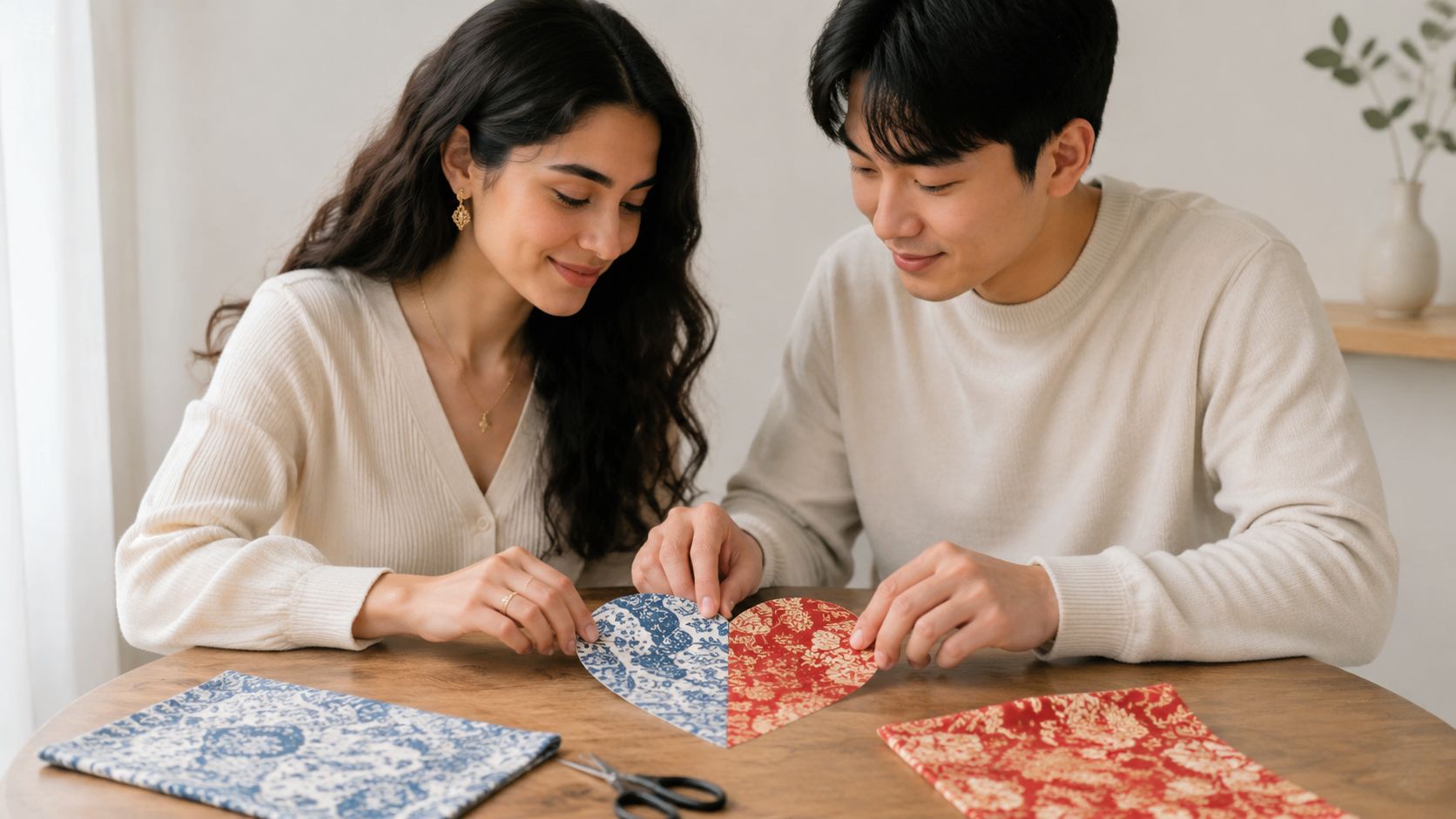
When you fall in love across cultures, you inherit two sets of unspoken assumptions about how life works. One partner might see direct communication as honest, while the other experiences it as blunt. One might expect to consult their parents on major decisions, while the other sees the couple as a completely private unit.
Cross-cultural marriage counseling provides a safe space to make these unspoken rules explicit. It’s not about deciding which culture is “right” or erasing your individual identities. You can learn more about this dynamic in our guide to intercultural couples therapy.
The table below outlines some of the most common areas where cultural differences surface in a relationship.
Common Areas of Intercultural Misunderstanding in Relationships
| Area of Life | Potential Source of Cultural Difference | Example Scenario |
|---|---|---|
| Communication Styles | Direct vs. indirect communication; high-context vs. low-context cultures. | One partner feels the other is blunt or rude, while the other feels their partner is vague and never gets to the point. |
| Family & In-laws | Expectations of closeness, frequency of contact, and the role of extended family in couple decisions. | One partner expects weekly Sunday lunch with their parents, while the other values weekend privacy as a couple. |
| Money & Finances | Attitudes toward saving vs. spending; individual vs. shared finances; financial support for extended family. | A disagreement arises over whether to send money to support a sibling in one partner's home country. |
| Conflict Resolution | Preference for open debate and emotional expression vs. avoiding confrontation to maintain harmony. | One partner wants to 'talk it out' immediately, while the other needs space and time to cool down. |
| Parenting Styles | Views on discipline, independence, and educational priorities for children. | Debate over how much freedom to give a teenager, reflecting different cultural norms around autonomy. |
Seeing your own struggles reflected in these examples can be the first step toward realising you're not alone and that there is a path forward. It’s not about finding fault, but about gaining a shared language to understand each other’s worlds.
Why Intercultural Couples Face Unique Challenges in Italy
The dream of building a life together in Italy – the famous ‘la dolce vita’ – is a powerful one. But when you’re an intercultural couple, the reality of living here can bring pressures that movies never show. You’re not just blending two lives; you’re blending two worlds within a culture that has its own deep-rooted, unspoken rules.
It’s crucial to understand that the challenges that arise are not a red flag for your relationship. Instead, they are the predictable friction that happens when different cultural maps collide. Small disagreements can suddenly feel enormous when amplified by uniquely Italian stressors, like the exhausting bureaucratic battle for a permesso di soggiorno. This isn’t just paperwork; it’s a process that can shift the power dynamics in your relationship, creating anxiety and dependence.
The Power of Family and Expectations
One of the biggest adjustments often comes down to family. In Italy, the concept of family frequently extends well beyond the nuclear unit you might be used to, creating a powerful web of mutual obligation and identity. For the Italian partner, the central role of ‘la mamma’ or the assumed attendance at weekly Sunday lunches is a normal, loving expression of connection.
For the foreign partner, however, this can feel intrusive or overwhelming. It’s not a matter of one culture being right and the other wrong. It’s a clash of deeply held values. A partner from a more individualistic culture might prioritise privacy and independence, while the Italian partner sees constant family contact as a non-negotiable source of support. This can leave one person feeling isolated and the other feeling guilty, caught between their partner and their family. You can find more on this specific dynamic in our guide to being married to an Italian.
From Dream to Daily Reality
The gap between the romantic idea of Italy and the day-to-day reality is often a major source of stress. What started as a shared adventure can slowly become a constant, tiring negotiation of cultural norms you didn’t even know existed. Even the subtleties of communication, like how to greet people, can become a minefield, as this simple The Kingdom of English greetings guide illustrates across different cultures.
The core challenge for many intercultural couples in Italy is that they lack the informal support systems they had back home. Friends and family who understood your cultural background are far away. This means the couple unit must absorb more stress, making it vital to have professional, culturally-aware support to help you build your own resilient foundation.
This need is becoming more and more apparent. Official statistics confirm that mixed-nationality marriages are a stable, significant part of how families are formed in Italy, especially in international hubs like Milan and Rome. It's in these cities, where couples often live without the cushion of their wider families, that specialised Cross-Cultural Marriage Counseling becomes not just helpful, but essential. At Therapsy, we provide exactly that kind of understanding space, with 50+ multilingual therapists available online and in 80+ locations across Italy.
How Cross-Cultural Counselling Can Help Your Relationship
When you’re in an intercultural relationship, disagreements aren't just about who left the dishes in the sink. They’re often about unspoken rules, clashing values, and different ways of seeing the world. Good Cross-Cultural Marriage Counseling does more than just mediate arguments; it gives you a shared language to understand what’s happening underneath the surface.
Think of a skilled therapist not as a referee, but as a kind of "cultural interpreter." Their role is to help you decode each other’s perspectives without blame or judgment. Instead of getting stuck in the same frustrating loop, you start to see conflicts as cultural misunderstandings you can solve together. The goal isn't just to fix today's problem, but to build a framework for navigating all the differences that will come up long after therapy is over.
Understanding the Therapeutic Approaches
At Therapsy, our therapists don't use a rigid, one-size-fits-all formula. We draw from several evidence-based therapeutic models, using them as flexible tools to fit the unique reality of your relationship.
- Systemic-Relational Therapy: This approach looks at your relationship as a complete system. We don’t just focus on the two of you in a vacuum; we map out all the influences – family expectations, social pressures, even the stress of Italian bureaucracy – to see how they interact and create friction.
- Schema Therapy: We all have deep-seated beliefs, or "schemas," that we learned growing up. These core beliefs quietly shape our emotional reactions and can be a huge source of misunderstanding in a partnership. By identifying these automatic patterns, we can start to challenge the ones that aren't serving your relationship.
- Ethnopsychotherapy: This specialised approach puts culture right at the centre of the conversation. It directly explores how your different backgrounds have shaped your identities, values, and communication styles, ensuring the therapy is always relevant and respectful to both of you.
This infographic shows some of the common stressors that can amplify relationship challenges for international couples living in Italy.
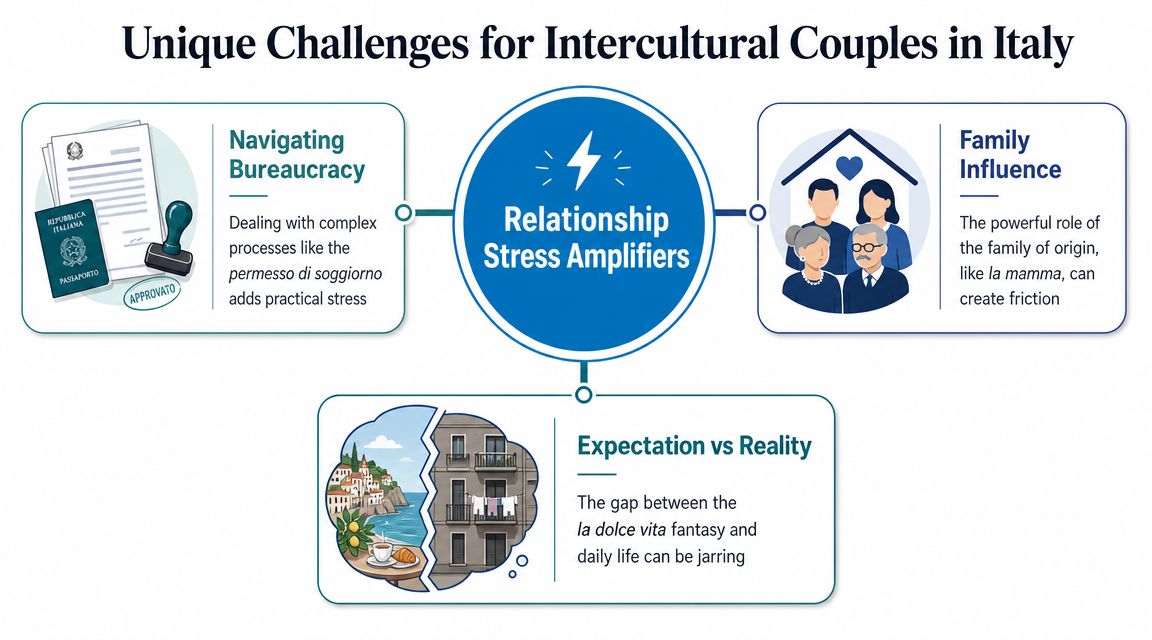
As you can see, external pressures like navigating the system and managing family expectations can make the internal work a couple needs to do feel even heavier.
Co-Creating Your Own Relationship Culture
Modern Cross-Cultural Counseling has moved beyond simple conflict resolution. It’s about recognising that every international couple needs to consciously build their own unique culture. The ultimate goal is to help you co-create the "shared culture" of your relationship.
This is a practical, hands-on process. It might involve exercises like creating a "cultural genogram" to map your family histories or having very explicit conversations about which traditions you want to keep, combine, or let go of. You learn to distinguish your non-negotiable core values from your more flexible preferences, deciding together on the rules and rituals that will define your shared life. As recent research highlights, this focus on co-creation is key to addressing emotions and family concerns in a way that honours both partners' contexts. You can explore this professional research to see how therapy is adapting to cultural contexts in more detail.
Therapy gives you a structured space to do the work that every intercultural couple must do: translate your inner worlds for each other. It’s about building a bridge of understanding, one conversation at a time.
– Dr. Francesca Adriana Boccalari
A therapist makes this process feel safe. They help you slow down conversations, clarify what you really mean, and move from automatic reactions to thoughtful reflection. Over time, you learn to turn your differences from a source of conflict into a source of strength and connection.
Practical Techniques You Can Start Using Today
While professional Cross-Cultural Marriage Counseling offers a guided space for deep work, there are practical techniques you and your partner can begin using right away. Think of these as tools to improve communication and reduce the friction that can build up in daily life.
These aren't quick fixes, but starting points for a new kind of conversation. The goal is to slow down those automatic, frustrated reactions and create a small space for curiosity. That space is where understanding – and a stronger partnership – can begin to grow.
Reframe Conflicts With the “Cultural Difference vs. Personal Flaw” Check
It’s incredibly easy to see a partner’s frustrating habit and label it as a personal failing. “They’re just stubborn.” “They’re so inconsiderate.” This simple mental check helps you pause that automatic judgment.
It works by shifting your perspective from blame to curiosity. Instead of personalising the conflict, you open the door to a more productive conversation about the unspoken cultural "rules" you both live by.
Here’s how to put it into practice:
- Pause. The next time you feel that surge of frustration, just take a breath before you react.
- Ask the Question. Silently ask yourself, "Is it possible this isn't a personal flaw but a cultural difference I just don't understand yet?"
- Get Curious. Instead of accusing, try asking an open-ended question. For example, trade "Why are you always so late?" for something like, "In your culture, what does being on time for a casual dinner usually mean?"
Use the Speaker-Listener Technique, Especially for Bilingual Couples
When partners have different native languages, misunderstandings are almost inevitable, even when you share a common language. One person might feel they aren't quite expressing the depth of their feelings, while the other struggles to follow the nuances.
This structured exercise works because it forces communication to slow down. It removes the pressure to immediately defend yourself or solve the problem, focusing instead on one thing: making sure the other person feels completely heard.
Here’s how to do it:
- Assign Roles. One of you is the "Speaker," the other is the "Listener."
- The Speaker Shares. The Speaker talks about their feelings on a specific issue for a few minutes, focusing on "I" statements (e.g., "I feel frustrated when…").
- The Listener Paraphrases. The Listener's only job is to summarise what they heard, without adding their own opinion or defence. A good way to start is, "What I think I heard you say is…"
- Confirm and Swap. The Speaker confirms if the summary was accurate. If it was, you swap roles.
Manage External Pressures by Scheduling “Worry Time”
Anxieties about immigration, finances, or navigating family judgments can easily bleed into every corner of your relationship, leaving you both exhausted. Scheduling "worry time" is a powerful technique from Cognitive Behavioural Therapy (CBT) designed to contain these anxieties.
It works because it stops anxiety from hijacking your life 24/7. By giving worries a specific, limited appointment in your day, you give them the attention they demand without letting them overwhelm your connection as a couple. If you're interested in similar approaches, you can learn more about the benefits of mindfulness practices.
Here’s how you can try it:
- Schedule It. Block out a 15-20 minute window each day as your designated "worry time." Put it in your calendar.
- Postpone Worries. When a worry pops into your head outside of this time, acknowledge it and tell yourself, "I'll deal with this at 6 PM during my worry time."
- Use the Time Productively. During your scheduled time, you can actively brainstorm solutions, make a to-do list, or simply allow yourself to feel the anxiety without judgment. When the timer goes off, you consciously shift your focus to something else.
Finding the Right Multilingual Therapist in Italy

Realising you need support is a huge step. But in an intercultural relationship, the next move – finding the right professional – is just as critical. The reality is, not just any therapist will do.
For a mixed-culture couple, the ideal therapist is far more than just multilingual. True Cross-Cultural Marriage Counseling requires a professional trained in intercultural dynamics, not just someone who happens to speak both your languages. They need the skill to see when a fight over who does the dishes is actually a fight about unspoken cultural rules around gender roles or independence.
A good therapist acts as a skilled cultural interpreter and a neutral facilitator, ensuring both partners feel equally heard and understood. Without that specific training, sessions can easily become unbalanced, leaving one partner feeling misunderstood or, worse, pathologised for their cultural background.
What to Look for in a Therapist
When you begin your search, your focus should be on finding a professional who can create a truly balanced and safe therapeutic space. Not all therapists, even experienced ones, have the specific training needed to navigate the complex dynamics of a bicultural relationship.
Here are the key questions you should ask any potential therapist:
- What is your specific experience working with couples from our cultural backgrounds?
- How do you manage sessions when one of us is more fluent in the therapy language than the other?
- What’s your approach to helping couples build a shared "third culture"?
- Can you give an example of how you help couples tell the difference between a personal issue and a cultural one?
These questions cut straight to the heart of the matter. They’ll help you quickly gauge a therapist’s expertise and see if they are genuinely equipped to support your unique journey. For more guidance, you can review our dedicated resource on finding an English-speaking couples therapist in Italy.
How Therapsy Can Help
At Therapsy, we built our entire service around supporting the international community in Italy. We know from experience that finding the right therapist-client match isn't just a nice-to-have; it's fundamental to whether therapy actually works.
We believe in human-to-human matching. I personally speak with every new couple to understand their story. This conversation allows me to connect them with the most suitable therapist from our team of 50+ multilingual professionals – someone with the right language skills and, crucially, the right cultural and clinical experience.
– Dr. Francesca Adriana Boccalari, Clinical Director
This personalised process takes the guesswork and endless searching off your plate. It ensures you’re paired with a professional who gets the nuances of your situation from day one. We make support accessible with both online sessions and over 80 physical locations across Italy. Couple’s therapy sessions start from €100, offering a clear path to begin your work together.
The most effective therapy for intercultural couples in Italy often involves weekly, one-hour sessions with practical tasks to try between meetings. This model fosters open dialogue and helps build a shared culture around the things that matter – a structure we’ve seen deliver real results for expat and bicultural couples.
Your Next Step Toward a Stronger Intercultural Partnership
Working through the challenges of a cross-cultural marriage is a normal part of blending two lives, not a sign that something is wrong. The friction you might be feeling is real, but it's also where the most profound growth happens. Seeing this as a journey of learning together, rather than a problem to be solved, is the first step.
Remember, you don't have to figure this all out by yourselves. Embracing professional support through Cross-Cultural Marriage Counseling is a proactive, powerful way to invest in your future. It’s about giving yourselves the space and tools to build that unique "third culture" that belongs only to the two of you.
Your partnership is worth it. Taking that first step can feel like the hardest part, but it opens up a path to deeper connection and teamwork. For more guidance on the practicalities, you can explore our detailed guide on how to start therapy in Italy. We are here to help you begin that journey with confidence.
FAQ
Does My Partner and I Need to Be Fluent in the Same Language for Therapy to Work?
No, you absolutely don’t need equal fluency for therapy to be effective. Our multilingual therapists are skilled at managing sessions where partners have different language abilities, creating a balanced space where both of you feel heard. They use techniques to bridge any gaps, ensuring the real conversation can happen beyond just the words themselves.
Is Cross-Cultural Marriage Counseling Only for Couples in Crisis?
Not at all, and in fact, it's often more effective when started proactively. Many couples use counseling as an investment to build a strong foundation before major life changes like moving to Italy or having children. Think of it as building a toolkit for your partnership, not just repairing damage after a conflict.
How Long Does Cross-Cultural Marriage Counselling Typically Last?
The duration of counseling is always shaped by your unique needs and goals. There is no one-size-fits-all timeline, as some couples find clarity on a specific issue in 8-12 sessions, while others engage in longer-term work to fundamentally enrich their connection. Your therapist will collaborate with you to create a plan that feels right for your relationship.
What if My Italian Partner Is Skeptical About Therapy?
This is a very common and understandable concern, as attitudes toward therapy can be a cultural difference in itself. We suggest framing the first step as a simple, no-pressure conversation, which is precisely what our free assessment call offers. Our therapists are experienced in creating a safe, non-judgmental space, ensuring both partners feel respected from the very first interaction.
Book your first free assessment call – no commitment, just a conversation with our Clinical Director who will listen and match you with the right therapist for you. Visit therapsy.it.