You arrive in Italy expecting pleasure and ease. Then real life starts. Breakfast becomes a quick coffee, lunch is whatever you can grab between meetings or lectures, dinner shifts later than your body is used to, and some days you realise you've eaten more sugar, white bread, and convenience food than anything that leaves you feeling steady.
If you're an expat in Italy and your mood feels flatter, your anxiety more reactive, or your energy less reliable, it's reasonable to ask whether food is part of the picture. Nutrition and mental health are closely linked. This isn't a lifestyle trend. It's an area of research often called nutritional psychiatry, and it looks at how everyday eating patterns influence mood, stress, sleep, and emotional resilience.
I'm writing this as Dr. Francesca Adriana Boccalari, Clinical Director at Therapsy, with a specific reader in mind: the person living abroad in Italy who is trying to feel better in a context that is beautiful from the outside and often disorienting on the inside. Food can become comfort, culture, confusion, and stress all at once.
A large Canadian longitudinal study of 13,887 adolescents found a clear nutrition and mental health gradient. Higher intake of sugar-sweetened beverages was prospectively associated with greater severity of depressive and anxiety symptoms and poorer psychological well-being, while higher fruit and vegetable intake was associated with better psychological well-being. The same study found that baseline fruit and vegetable intake was positively associated with psychological well-being (β = 0.06, 95% CI 0.03–0.10) in Preventing Chronic Disease.
That matters for expats because daily eating abroad rarely changes in one dramatic way. It shifts in dozens of small ways. More caffeine. Fewer routine meals. Less familiarity. More social pressure. Less energy to plan.
Introduction How Your Plate Affects Your Mind in Italy
When life abroad changes your eating without you noticing
Individuals rarely move to Italy and think, “This may disrupt my relationship with food.” But it often does.
Your usual supermarket is gone. Your kitchen may be smaller. Labels are harder to read. Work or study schedules become irregular. If you're lonely, food can become one of the quickest ways to self-soothe. If you're overwhelmed, cooking can feel impossible. If you're trying to “do Italy properly”, you may pressure yourself to enjoy every aperitivo, every late dinner, every espresso, even when your body is asking for rhythm instead of stimulation.
Living abroad can make eating feel less intuitive. When routine disappears, mood often follows.
The difficult part is that this can look like a purely psychological issue at first. You may tell yourself you're just tired, homesick, under pressure, or still adjusting. Often that's true. But it can also be true that your nervous system is getting less stable fuel than it needs.
Food affects mood, but it isn't the whole story
Food doesn't cause every low mood, and better eating won't solve every mental health problem. That's an important starting point. Depression, anxiety, trauma, burnout, grief, and culture shock are complex. They deserve serious care, not simplistic advice.
At the same time, what you eat can influence:
- Energy stability through steadier or more erratic blood sugar
- Stress sensitivity through sleep, stimulation, and inflammation
- Emotional resilience through nutrient intake and daily routine
- Sense of agency through the small but meaningful experience of caring for yourself consistently
For many expats in Italy, the most helpful approach isn't perfection. It's learning how to eat in a way that supports your brain while respecting your budget, schedule, culture, and current capacity.
Understanding the Gut-Brain Connection
Your gut and brain are in constant conversation
One of the simplest ways to understand nutrition and mental health is this. The gut and the brain communicate constantly. It's a two-way system, not a one-way one.
The gut contains a vast community of microbes, often called the gut microbiome. These microbes help break down food, interact with the immune system, and influence chemical processes linked to mood and cognition. The communication happens through several pathways, including the nervous system, immune signalling, and chemical messengers.
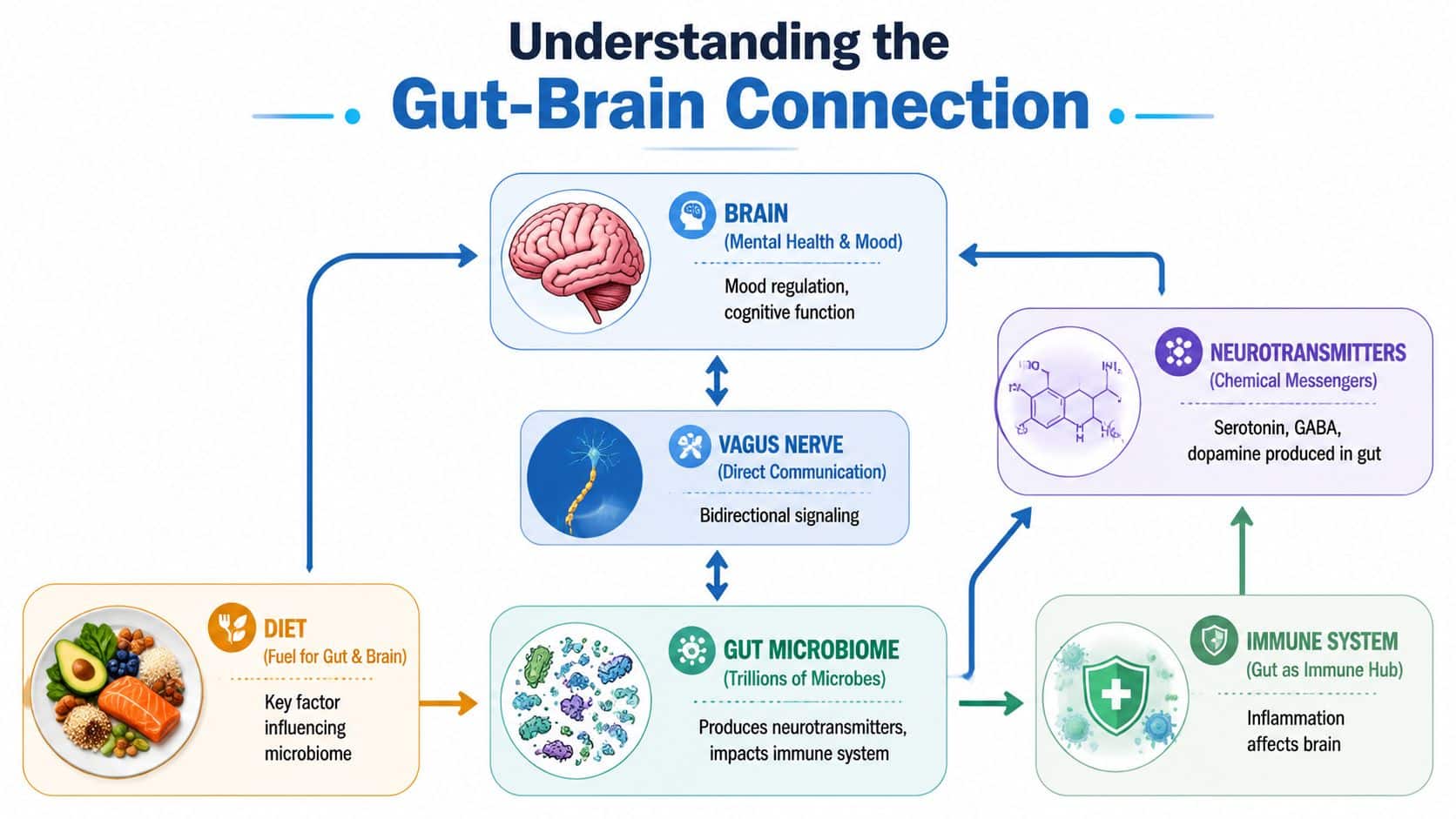
If you've ever noticed that stress affects your digestion, you've already felt part of this system. The reverse is also true. What happens in your gut can affect how your mind feels.
For people who live in a state of chronic activation, it can help to think of food as one part of broader nervous system regulation therapy. Therapy works on the emotional and cognitive side. Food can support the physiological side.
Inflammation is one of the missing links
A major review of 40 studies found that diets high in inflammatory foods, especially refined sugars and saturated fats, were associated with 45% higher odds of depression and 30% higher odds of anxiety in Molecular Psychiatry. The same review explains that pro-inflammatory diets can trigger systemic inflammation and increase cytokines that disrupt the brain's serotonin synthesis.
That doesn't mean one pastry causes anxiety or one takeaway causes depression. It means patterns matter.
A more inflammatory pattern often includes:
- Frequent refined sugary drinks
- Heavy reliance on ultra-processed convenience foods
- Low intake of fruit, vegetables, legumes, and omega-3-rich foods
- Irregular meals followed by overeating later
A more supportive pattern often looks boring in the best way. It's repetitive, balanced, and easier on the body.
Clinical perspective: Many people chase “superfoods” when what helps more is regularity. A nervous system that gets fed consistently usually copes better than one that swings between restriction and overload.
If you want a practical starting point, a structured gut health meal plan can help you think in terms of balance rather than dietary rules. The useful part isn't perfection. It's reducing decision fatigue when you're already emotionally stretched.
Key Nutrients for a Resilient Mind
Think patterns first, nutrients second
When people hear about nutrition and mental health, they often look for one missing nutrient that explains everything. That's rarely how it works. The brain relies on many nutrients at once, and your mood tends to benefit more from a generally adequate diet than from chasing one hero ingredient.
Still, some nutrients deserve attention because they support brain function, stress regulation, and steady energy. For an expat in Italy, the useful question is not only “What does this nutrient do?” but also “Where can I realistically buy it this week?”
Nutrients for Mental Health and Where to Find Them in Italy
| Nutrient | Role in Mental Health | Found in Italian Foods Like… |
|---|---|---|
| Omega-3 fats | Support brain cell structure and mood regulation | sarde, alici, sgombro, walnuts, flax seeds |
| B vitamins | Help with energy metabolism and neurotransmitter production | lenticchie, ceci, eggs, leafy greens, whole grains |
| Magnesium | Supports the nervous system and muscle relaxation | almonds, pumpkin seeds, spinach, dark chocolate |
| Zinc | Involved in brain signalling and immune function | legumes, seeds, dairy, seafood |
| Fibre | Supports gut health and steadier energy | beans, vegetables, fruit, oats, whole grains |
| Fermented foods | Can support gut diversity as part of an overall diet | yoghurt, kefir, some pickled vegetables |
What this looks like in everyday shopping
Omega-3 fats matter because the brain is structurally rich in fat. In Italy, people often assume they need expensive salmon. They don't. Tinned sardines, anchovies, and mackerel are often more affordable and more realistic.
B vitamins are especially relevant if stress has disrupted your appetite or if you've become heavily reliant on refined carbohydrates. Lentils, chickpeas, eggs, and leafy greens are practical staples that fit easily into Italian cooking.
Magnesium becomes important when anxiety, tension, and poor sleep feed into each other. It's not a sedative, but foods like spinach, almonds, and seeds can support a more stable baseline.
Fibre deserves far more attention than it gets. It helps support gut health, steadier digestion, and more consistent energy. In emotional terms, that often means fewer dramatic crashes.
A simple rule I give many clients is this:
- Add a protein source to meals that are mostly bread or pasta
- Add colour with vegetables or fruit at least once early in the day
- Choose one fibre-rich staple each week, such as lentils, beans, or oats
- Keep one easy fallback food at home, such as eggs, yoghurt, or tinned fish
If your current eating feels chaotic, don't start by optimising. Start by stabilising.
For readers who want a plain-language overview of common micronutrients linked to stress, this guide to VitzAi insights on vitamins for stress can be a helpful companion to broader lifestyle work.
If you're trying to improve mood more generally, these practical habits also sit well alongside broader strategies for improving mental health.
The Mediterranean Diet as a Mental Health Tool
It helps because it works as a pattern
The Mediterranean diet is often discussed as if it were a brand. In practice, it's better understood as a flexible eating pattern built around vegetables, fruit, legumes, whole grains, olive oil, nuts, and moderate amounts of fish and dairy.
For mental health, its strength is not purity. Its strength is that it tends to be less inflammatory, more fibre-rich, and more stable than the highly processed diet many people drift into when stressed, isolated, or short on time.
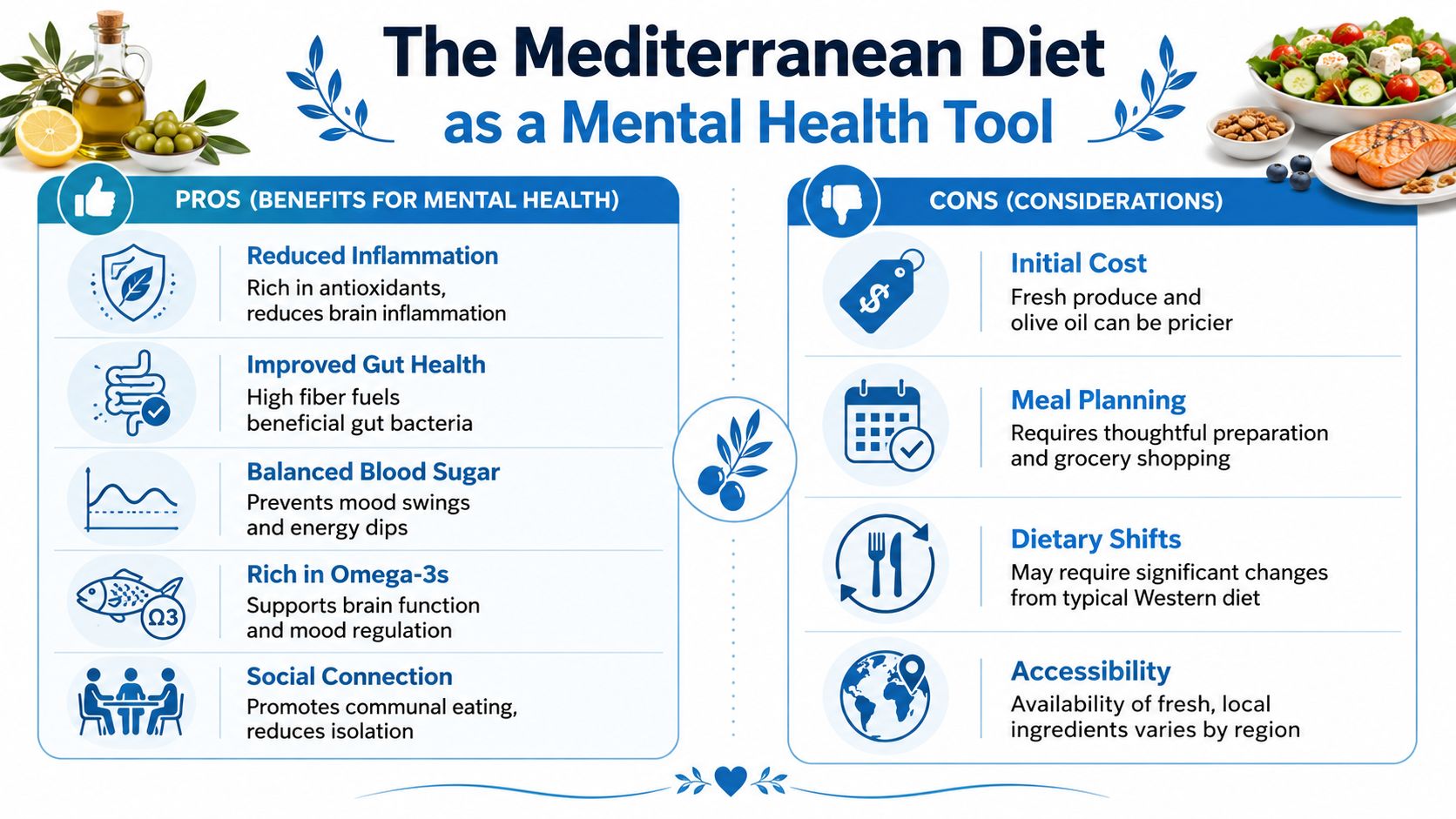
Chen and colleagues reported that adherence to the Mediterranean diet was associated with reduced risk of neurological disorders by up to 28% over 10 years and 20% lower depression incidence in long-term cohorts in their review hosted on PubMed Central.
A Mediterranean plate versus a stress plate
A brain-supportive Mediterranean-style meal in Italy might look like:
- Whole grains or potatoes for stable energy
- Beans, fish, eggs, or yoghurt for protein
- Olive oil as the main fat
- Vegetables in meaningful amounts, not as decoration
- Fruit as a routine food, not a rare healthy extra
A more pro-inflammatory “stress plate” often looks different:
- Refined carbohydrates on their own
- Sugary drinks or frequent sweet snacks
- Very low fibre
- Minimal vegetables
- Convenience foods chosen because you're depleted, not because you enjoy them
The point isn't moral judgement. It's noticing what your body is repeatedly asked to run on.
Italy can help, but only if you use it realistically
Living in Italy can support this style of eating. Olive oil, legumes, seasonal produce, and fish are all available. But access isn't the same as ease. If you're depressed, overworked, or overwhelmed, even a country full of good ingredients won't automatically turn into a supportive routine.
That's one reason mood and eating patterns often need attention together. If low mood has become persistent, it can help to view food as one supportive pillar alongside proper care for depression, rather than as a test of willpower.
A Practical Guide to Food Shopping in Italy
The supermarket can be more stressful than people admit
For expats, nutrition and mental health often break down at the point of purchase, not at the point of intention.
You may know perfectly well that vegetables, protein, and regular meals help. But then you walk into a crowded Conad, Esselunga, Carrefour, Coop, or local minimarket after work. Labels are unfamiliar. You can't find what you usually buy. Portions differ. You're tired, hungry, and translating in your head. That's exactly when decision fatigue takes over.

The American Psychiatric Association notes that food insecurity is a recognised driver of depression and anxiety, and that irregular income, unfamiliar supermarkets, and language barriers can make healthy eating a source of stress, with a bidirectional link between mental health and diet quality in its overview of food and nutrition security.
That matters even if you wouldn't call yourself “food insecure”. You can have enough money for food and still feel constant uncertainty around what to buy, what you can afford consistently, and how to make meals work in a new country.
Useful Italian shopping words that reduce friction
A few label terms make shopping easier:
- Integrale means whole grain
- Legumi means legumes or pulses
- Lenticchie are lentils
- Ceci are chickpeas
- Fagioli are beans
- Avena is oats
- Sgombro is mackerel
- Tonno al naturale usually means tuna in water
- Senza zuccheri aggiunti means no added sugar
Learning these terms saves more mental energy than trying to decode every package from scratch.
What to buy when you're tired, busy, or on a budget
A realistic basket beats an aspirational one. Try building around a few categories:
One easy protein
Eggs, yoghurt, ricotta, tinned fish, tofu, or legumes in jars.One easy carbohydrate
Whole-grain pasta, rice, potatoes, oats, or bread labelled integrale.Two vegetables that need little prep
Cherry tomatoes, carrots, spinach, courgettes, frozen peas, or bagged salad.One fruit you'll eat
Bananas, apples, clementines, grapes, or seasonal peaches.One emergency meal
Soup, hummus, eggs on toast, pasta with chickpeas, or yoghurt with oats and nuts.
Practical rule: Shop for your most stressed self, not your most organised self.
If daily life in Italy already feels emotionally demanding, reducing shopping friction is a valid mental health intervention. Many readers also find it useful to think more broadly about transition stress through a moving to Italy mental health checklist, because food stress rarely exists in isolation.
A Safe Approach to Supplements
Food first is usually the wiser route
Supplements can be useful. They can also become a distraction.
If you're exhausted, anxious, or mentally foggy, it's tempting to search for one capsule that fixes everything. But supplements work best when they address a genuine need, not when they replace meals, sleep, routine, or proper assessment.
Some people do need targeted support. That can be especially relevant with restricted diets, known deficiencies, absorption issues, or periods of very low intake. But self-prescribing several products at once usually creates more confusion than clarity.
What to avoid when you're vulnerable
Be cautious with any product that:
- Promises to cure anxiety or depression
- Claims immediate transformation
- Uses vague phrases instead of clear ingredients
- Encourages combining many supplements without professional input
- Makes you feel that food no longer matters
A supplement shouldn't require magical thinking.
If brain fog is one of your main complaints, a balanced explainer on effective brain fog remedies can help you sort sensible support from exaggerated claims. Use that kind of resource as background, not as a substitute for medical advice.
The safest next step
If you're considering supplements for mood, stress, or concentration, speak with a doctor or qualified clinician first. That matters even more if you take medication, have a health condition, or are already dealing with anxiety, panic, or sleep disturbance.
The goal is not to avoid supplements completely. The goal is to use them carefully, for a reason, and within a bigger plan.
How Nutrition Complements Psychotherapy
Food supports therapy, but it doesn't replace it
Nutrition and mental health belong in the same conversation. They are not the same intervention.
Psychotherapy helps you understand patterns, regulate emotions, process painful experiences, and change the beliefs or habits that keep you stuck. Nutrition helps give the brain and body more stable conditions in which that psychological work can happen.
I often explain it like this. Therapy provides the map. Food helps supply the fuel. If someone is trying to do deep emotional work while living on caffeine, missed meals, sugar spikes, and poor sleep, the work becomes harder.
Therapy can help you understand why you ignore your needs. Better eating can help you feel stable enough to respond differently.
The SMILES trial, summarised by the American Psychological Association, found that adults with moderate to severe major depressive disorder who received 12 weeks of nutritional counselling showed more improvement in symptoms and a greater likelihood of remission than those in a social-support control condition in the APA Monitor overview of nutrition and mental health.
Why this matters in intercultural therapy
For expats, eating patterns often connect with deeper themes that come up in therapy:
- Loss of routine after relocation
- Comfort eating linked to loneliness
- Restriction or appetite loss during anxiety
- Identity conflict around belonging, culture, and self-care
- Perfectionism that turns healthy eating into another pressure point
CBT can help identify the thoughts and behaviours that keep these cycles going. EMDR can help when food habits intersect with trauma, chronic stress, or states of hyperactivation. Mindfulness-based work can help you notice hunger, fullness, and emotional triggers more accurately. If you're interested in that overlap, mindfulness and psychotherapy is a useful place to explore the wider connection.
FAQ
Can food really affect anxiety and depression
Yes, food can affect anxiety and depression, although it's usually one part of a bigger picture. Eating patterns can influence inflammation, energy stability, sleep, and stress sensitivity. That won't replace therapy or medical care, but it can meaningfully support them.
Is coffee bad for mental health
Coffee isn't automatically bad, but it can worsen anxiety and sleep problems for some people. The Mental Health Foundation notes that caffeine can cause sleep problems and can make some people irritable and anxious, especially near bedtime. In Italy, frequent espresso can easily become normal even when your nervous system is already overstimulated.
How long does it take to notice a difference from dietary changes
It varies, and it usually helps to think in weeks rather than overnight results. Some people notice steadier energy and fewer crashes quite quickly. Mood shifts often take longer and usually work best when diet changes are consistent, moderate, and part of broader support.
Should I take supplements for low mood
Sometimes, but not without a good reason. Supplements are most helpful when there is a likely deficiency, a restricted diet, or a clinician has advised them. They're much less helpful when used as a shortcut around meals, sleep, stress, and proper assessment.
What if healthy eating in Italy feels stressful instead of helpful
That's more common than people think, especially for expats and students. A new food system can create pressure around money, language, planning, and social expectations. If eating has become another source of stress, simplify first. Build repeatable meals and reduce decision fatigue before trying to optimise.
Can therapy help if my eating habits changed after moving abroad
Yes, because food changes abroad often reflect adjustment stress, not just lack of discipline. Therapy can help you understand what the change means emotionally, whether that's loneliness, burnout, anxiety, culture shock, or loss of routine. Once those patterns are clearer, practical change becomes much easier.
If you're struggling with mood, anxiety, burnout, or adjustment stress in Italy, support can help. Book your first free assessment call with THERAPSY. There's no commitment, just a conversation with our Clinical Director who will listen carefully and match you with the right therapist for you.