You can be standing in a supermarket in Milan, holding the wrong kind of milk, replaying a work email in your head, and suddenly your chest tightens for no obvious reason. Or you can be in a quiet apartment at 3 a.m., wondering why life abroad looks fine on paper but feels shaky inside. Expat anxiety often starts exactly there, in ordinary moments that feel larger than they should.
Expat anxiety is not a formal diagnosis, but it is a very real cluster of anxiety symptoms that can be triggered or intensified by living abroad. It usually shows up when cultural dislocation, language fatigue, identity disruption, reduced social support, and practical uncertainty start to stack up. For many people, that stack becomes the emotional background of everyday life in Italy, especially during the first months or whenever work, relationships, or bureaucracy pile on.
Practical rule: if your anxiety is tied to the pressure of adapting to life in another country, you are not “too sensitive,” you are responding to a genuinely demanding environment.
What Expat Anxiety Really Means
A person with expat anxiety often says they feel “off” rather than panicked all the time. They may function well at work, answer messages, and keep up appearances, but internally they are bracing for the next hurdle. That mismatch between outer competence and inner strain is one reason the experience gets misunderstood.
The clearest definition is simple. Expat anxiety is anxiety that is triggered or amplified by the experience of living abroad. It is shaped by the same mechanisms that drive other anxiety patterns, but the triggers are specific to relocation, adjustment, and cross-cultural living. Those triggers can include unfamiliar systems, social isolation, pressure to perform in another language, and the loss of routines that once made life feel stable.
This is different from ordinary culture shock, although the two can overlap. Culture shock can be a normal adjustment process, while expat anxiety becomes more concerning when worry, avoidance, physical tension, or constant alertness start to interfere with sleep, work, relationships, or confidence. It is also different from general anxiety disorder, because the context matters. The abroad experience can be the key stressor, even when the symptoms look very similar on the surface.
For readers who want a broader emotional map of adjustment, the article on culture shock and reverse culture shock can help separate normal transition stress from a deeper pattern that deserves attention. The important point is that the feeling has structure. It is not random, and it is not a personal failure.
Why Living Abroad Triggers Anxiety
Living abroad can activate anxiety because it removes predictability. Your nervous system has to work harder when basic tasks, social cues, and daily routines no longer run on autopilot. That extra effort is not imagined, it is part of adaptation itself.
A useful psychological lens is cross-cultural psychology. It looks at what happens when a person has to keep translating not only words, but assumptions, social rules, and identity. Another useful lens is attachment theory, which helps explain why being separated from familiar people, places, and routines can feel destabilizing even when the move was voluntary.
The pressure points that pile up
Several stressors often overlap at once:
- Work stress and limited support. A systematic review of expatriate mental health found that work stress and limited support were repeatedly linked to poorer psychological outcomes, while a COVID-era study found that intra-family health concerns and perceived workplace discrimination were powerful stressors that worsened well-being and increased intentions to leave the host country (PMC systematic review).
- Fear and uncertainty. Another review of expatriates working abroad found a positive association between mental-health problems and fear of expatriation, with a reported standardized relationship of β = 0.64 (p < 0.01) (PMC review).
- Homesickness and identity strain. In long-term or high-achieving expats, the pain is often less about missing home in a nostalgic way and more about losing routine, identity anchors, and emotional support while still appearing to be “fine” to everyone else.
- Bureaucratic and language pressure. Even simple tasks can become exhausting when every interaction requires more concentration than it used to.
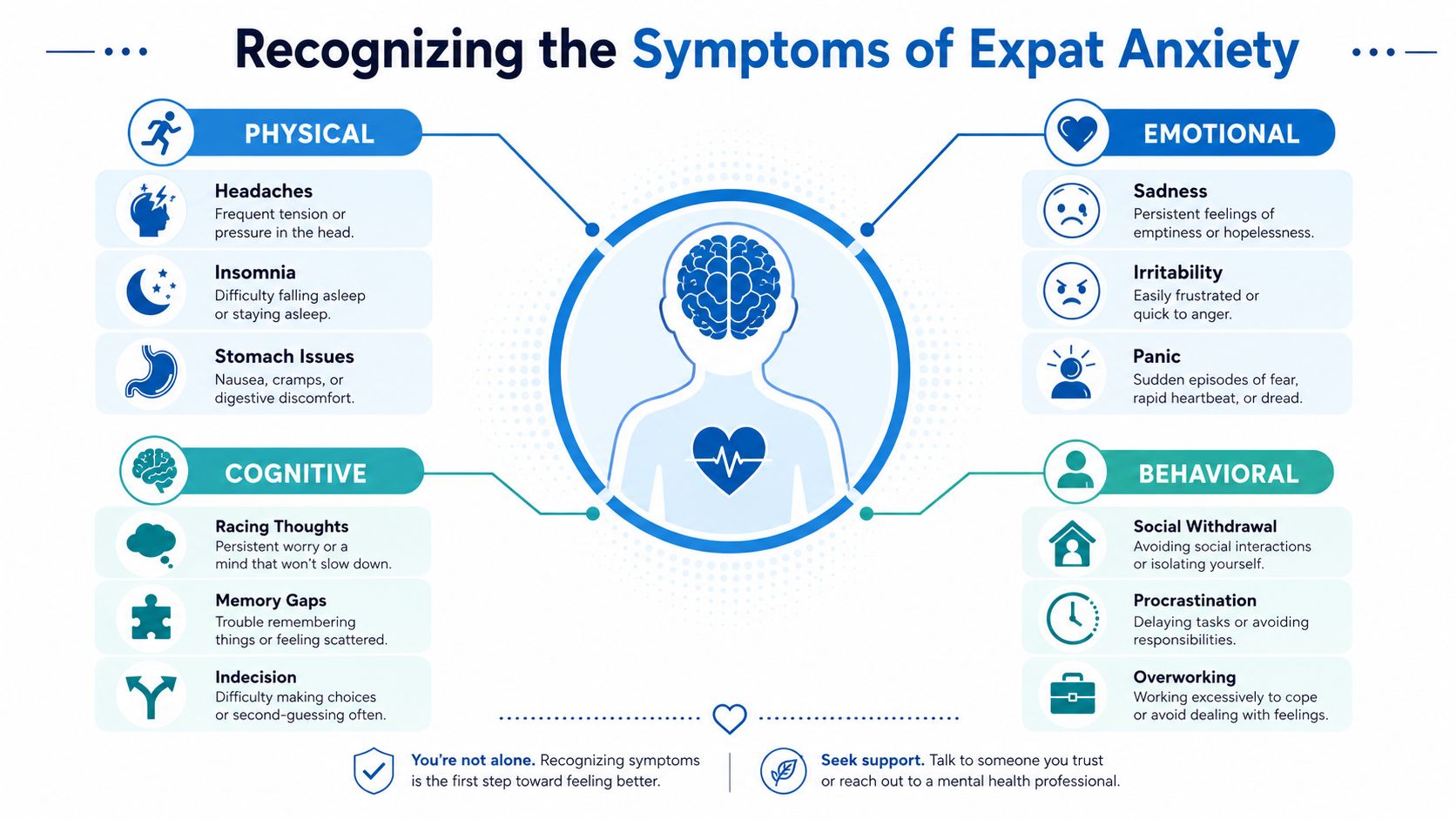
Recognizing the Symptoms of Expat Anxiety
The symptoms of expat anxiety usually fall into four broad groups. They don't always arrive as a dramatic panic attack. More often, they show up as a steady pattern that becomes visible only when you look at daily life closely.
Physical signs
You might notice headaches before appointments, a knot in your stomach after difficult conversations, insomnia, chest tightness, or fatigue that doesn't improve with rest. Many expats dismiss these signs as jet lag, stress, or “just getting used to things,” but the body often knows before the mind has words for it.
Emotional signs
Irritability, sadness, tearfulness, panic, dread, and a sense of being on edge are common. Some people also feel strangely numb, which can be confusing because it doesn't look like anxiety from the outside. Emotional swings can be sharper when you are trying hard to hold yourself together in public.
Cognitive signs
An anxious mind abroad often races. You may overthink messages, replay social interactions, forget simple details, or struggle to make decisions that would normally be easy. The mental load of translating, adapting, and anticipating problems can make concentration feel fragile.
Behavioral signs
Withdrawal is a major clue. People may stop joining social events, delay paperwork, overwork to avoid feeling, or keep telling themselves they just prefer solitude. If a behavior reduces anxiety in the short term but shrinks your life over time, it deserves attention.
Functional clue: when symptoms start changing how you sleep, relate, work, or make decisions, they've moved beyond ordinary adjustment discomfort.
If you want a plain-language overview of adult anxiety symptoms, the guide on anxiety symptoms in adults is a useful companion read.
Evidence-Based Coping Strategies You Can Start Today
Self-help is valuable, but it works best when it's specific. The goal is not to force calm. The goal is to reduce overload so your nervous system can settle enough for clear thinking.
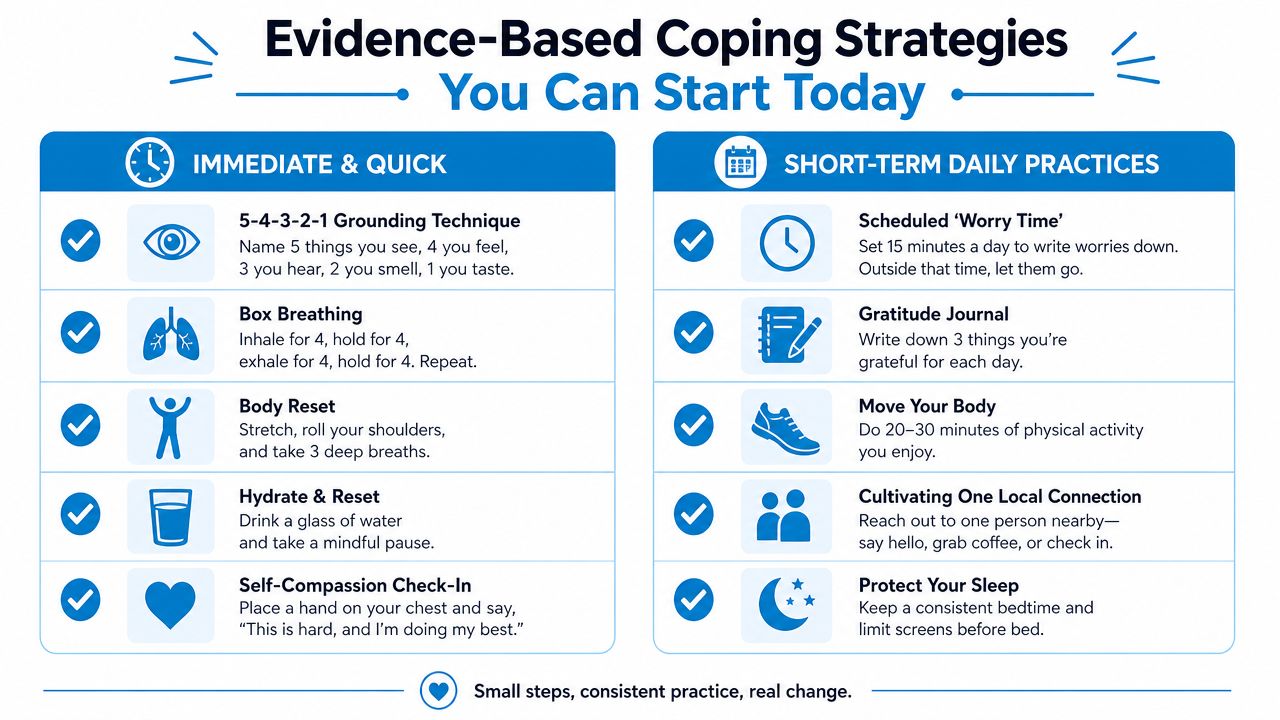
Start with the moment your body spikes
If anxiety suddenly rises, use a grounding skill before you try to think your way out of it. The 5-4-3-2-1 technique helps you reorient by naming what you can see, feel, hear, smell, and taste. Box breathing can also help by slowing the body's alarm response.
Build a day that feels more predictable
A short routine matters more than a perfect one. Wake up and sleep at roughly the same time, create one familiar ritual around tea, coffee, or a walk, and give your day a few repeatable anchors. Predictability is calming because the brain stops scanning for surprise.
If sleep is being hit hardest, a focused resource on stress relief for insomnia relief can help you understand why anxiety and sleep keep feeding each other.
Protect your identity while you adapt
Many expats try to solve anxiety by becoming more and more “integrated.” That can help, but it can also backfire if it means abandoning what makes you feel like yourself. Keep one or two identity anchors alive, such as music, food, exercise, prayer, journaling, language, or a weekly call with someone who knows the real you.
Choose connection with intention
A single local connection can be more stabilizing than a dozen shallow interactions. Join around an interest rather than forcing friendship, because shared activity makes conversation easier. At the same time, don't let home connection become a retreat from the present. The healthiest balance is usually both, not either.
For more practical daily coping ideas, the article on how to cope with anxiety offers a useful next step.
Therapy Approaches That Work for Expat Anxiety
When self-help isn't enough, therapy can make the pattern easier to understand and change. The best fit depends on what is driving the anxiety, because not all expat anxiety looks the same.
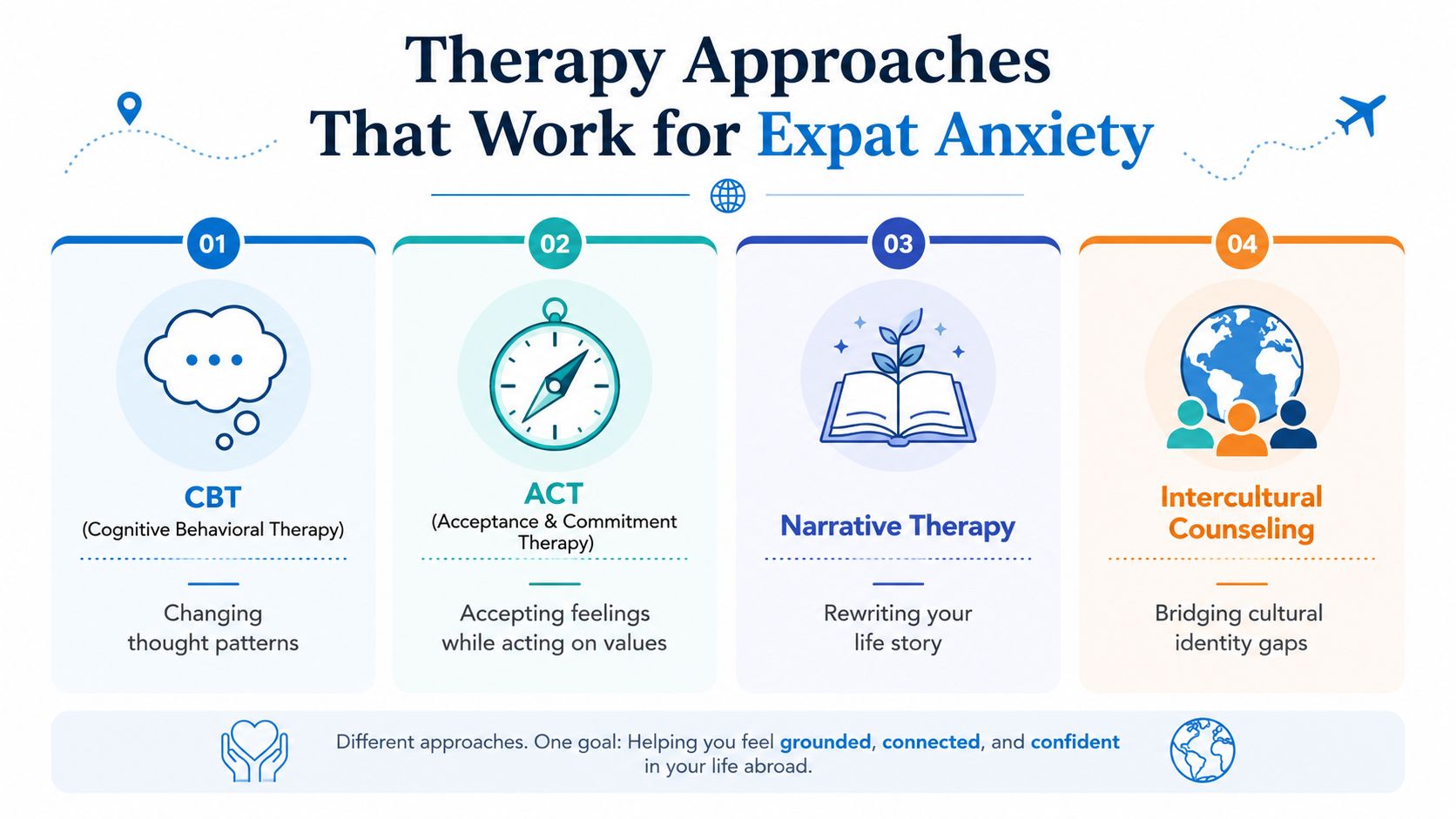
CBT and anxiety loops
Cognitive Behavioral Therapy, or CBT, helps people notice anxious thought patterns, test them against reality, and reduce the habits that keep anxiety alive. It is especially useful when the mind keeps jumping to worst-case scenarios, social embarrassment, or catastrophic interpretations of normal setbacks.
EMDR and unresolved overwhelm
EMDR is often relevant when relocation stress is tangled with earlier trauma, loss, or experiences that made the nervous system more reactive. In plain language, it helps the brain process distressing material that still feels “live” rather than finished.
Schema Therapy and long-standing patterns
Schema Therapy can help when expat life activates deeper patterns like perfectionism, people-pleasing, or a fear of disappointing others. Many high-achieving expats keep functioning while privately feeling they must earn belonging everywhere they go.
Systemic and relational work
When anxiety shows up inside a couple or family system, Systemic-Relational Therapy can help each person see how stress is being carried, misunderstood, or amplified between them. This matters in cross-cultural relationships, where love can be strong but expectations about closeness, conflict, and independence differ.
Therapsy is one option for this kind of support in Italy, with therapy in 14 languages, online and in-person sessions across 20+ Italian cities, and a human matching process that pairs people with a therapist based on language and needs. For a deeper look at one common evidence-based method, the page on cognitive behavioral therapy for anxiety is a good starting point.
When to Seek Professional Support and What to Expect
If anxiety is lasting for weeks, affecting work or relationships, worsening sleep, or making you feel like you're performing well publicly while struggling privately, it's time to talk to a professional. You do not need to wait until you “can't cope anymore.” Early support often prevents the pattern from becoming more entrenched.
Direct marker: if you're shrinking your life to avoid triggers, self-help has started to hit its limit.
The therapy process should feel clear, not mysterious. A first step is usually a free assessment conversation, where you explain what's happening, what language you want to use, and what kind of support feels safest. After that, matching matters. A therapist who understands expat life, works in your language, and fits your communication style can make the work feel much less lonely.
If you're comparing options, look for three things. Language fit. Clinical specialization. Personal fit. Those are the basics that make therapy usable, especially when anxiety is already making decision-making harder.
If you want help choosing a therapist in Italy, the guide on finding the right therapist for expats in Italy explains the process in more detail. At Therapsy, the first assessment call is free, and individual therapy starts from €70/session, which makes the first step easier to approach without commitment or pressure.
FAQ
Does expat anxiety go away on its own
Sometimes it softens with time, but not always. If the stressors stay the same, the anxiety can stay active too. People often feel better when they add support, routines, and real connection instead of waiting for time alone to fix it.
How do I find a therapist in Italy who speaks my language
Look for a service that explicitly offers therapy in your language and can match you with a clinician accordingly. In Italy, that matters because fluency is not just about translation, it's about feeling understood when you describe something emotional or culturally specific.
Is online therapy effective for expats
Yes, online therapy can be a very good fit for expats. It reduces travel time, widens your language options, and can feel easier if you're already overwhelmed by local logistics. Many people also prefer it during the early months of adjustment.
How can I support a partner who seems anxious abroad
Start by taking the distress seriously and not minimizing it. Ask what part of life abroad feels hardest, listen without trying to solve everything at once, and encourage support if the anxiety is affecting sleep, work, or daily functioning. Small practical help often matters as much as advice.
When should I worry that homesickness is more than homesickness
You should pay attention when it becomes persistent, starts affecting sleep or concentration, or makes everyday functioning harder. If homesickness is tied to panic, avoidance, or a feeling that life has lost its structure, it may need professional care rather than more self-discipline.
If expat anxiety is making everyday life in Italy feel heavier than it should, a free first assessment call can help you sort out what's happening and what kind of support would fit. THERAPSY offers multilingual psychotherapy in your own language, with human matching and both online and in-person care across Italy. Visit THERAPSY to take the first step without commitment.