Therapy in your native language was, on average, twice as effective as therapy delivered in English in a major APA summary of research. Language affects more than comfort. It can shape emotional accuracy, mental health disclosure, trust, and the therapeutic alliance.
You may know exactly what you want to say until the session begins. Then you search for an Italian or English phrase for grief, shame, panic, or loneliness, and the sentence comes out technically correct but emotionally flat. You leave feeling that you talked about the problem without quite reaching it.
For an expat, that experience can be easy to dismiss. You may think your vocabulary isn't good enough, or that therapy takes time. Sometimes the actual issue is that you're carrying the most delicate parts of your experience through a second language while also adjusting to a new culture, healthcare system, relationship pattern, or identity.
Therapsy is a multilingual psychotherapy service in Italy that connects expats with therapists who speak their native language.
Why Therapy in Your Native Language Changes Everything for Expats
You sit in a therapy room and try to explain a feeling that began before you moved to Italy. The words arrive in your first language, but the conversation is happening in Italian or English. You find an approximate translation, soften the sentence, and move on before the emotion becomes too difficult to hold.
That small delay matters. Therapy depends on details such as the difference between sadness and emptiness, worry and dread, irritation and anger, homesickness and grief. A second language can make those distinctions harder to access, especially when you're tired, ashamed, frightened, or emotionally overwhelmed.
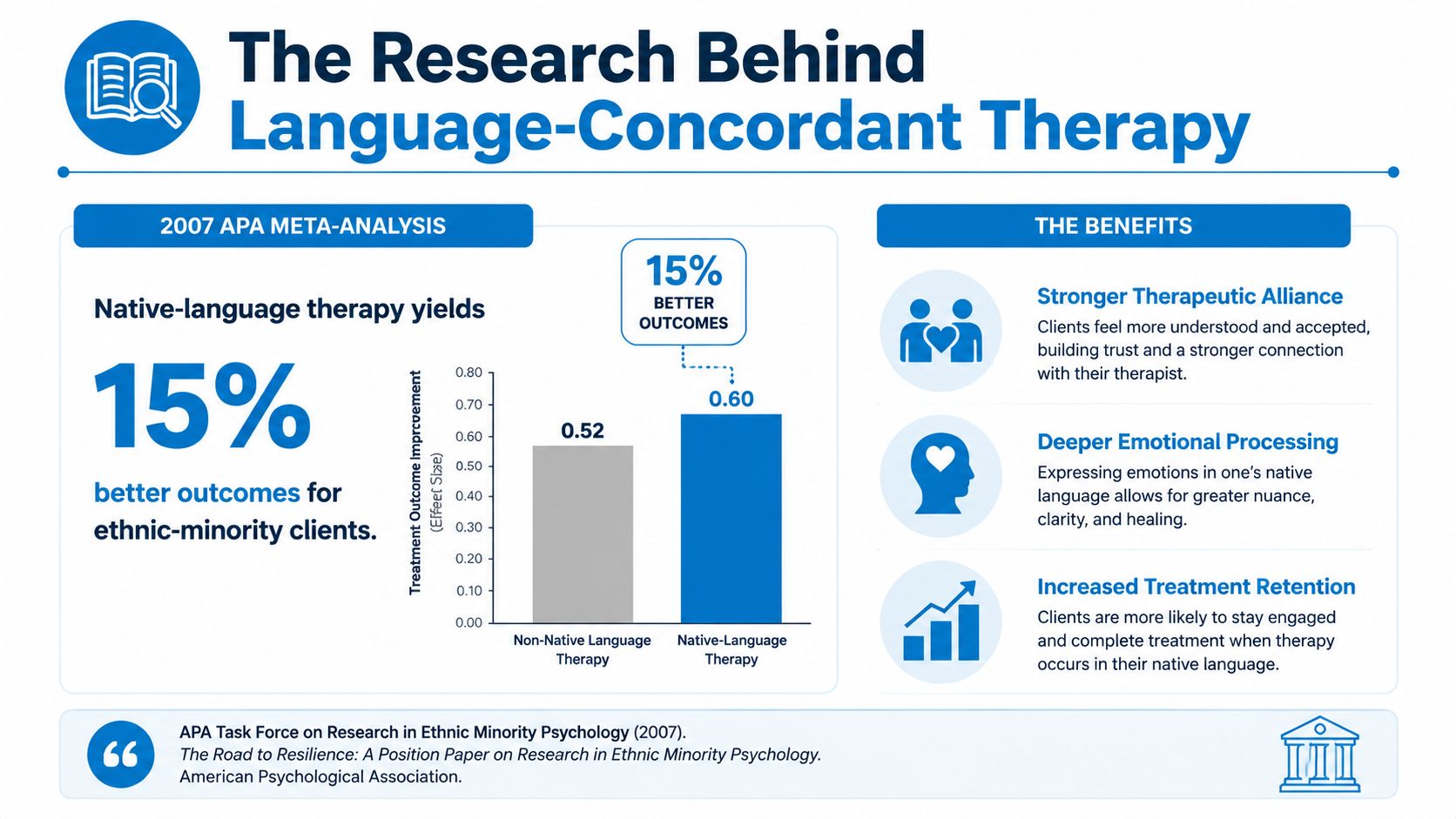
A 2007 American Psychological Association summary of a meta-analysis covering 76 published and unpublished quantitative studies reported that therapy for ethnic-minority clients delivered in their native language was, on average, twice as effective as therapy delivered in English.
Language fit is a clinical factor, not a luxury preference.
This doesn't mean every person must use their first language in therapy. Some bilingual clients prefer Italian or English because it feels more private, more distant from family memories, or better suited to their current life. The important point is choice. You should be able to decide which language lets you think, feel, remember, and respond most freely.

For expats in Italy, therapy in your native language can reduce the invisible work of translating while you're trying to heal. It may also help a therapist understand expressions, family roles, social expectations, and emotional meanings that don't transfer neatly between cultures.
If you're looking for a clinician who can work with this complexity, multilingual psychotherapy for expats in Italy can provide a starting point for comparing language and care options.
The Research Behind Language-Concordant Therapy
The research becomes clearer when you separate preference from outcome. A preference is, “I feel more comfortable speaking Spanish.” An outcome is, “I can describe what happened, understand the therapist's response, and use the work outside the session.” Language-concordant care affects both the conversation and what follows from it.
The APA summary described above linked native-language psychotherapy with a measurable treatment effect. More recent evidence points in the same direction. A 2019 systematic review of language-concordant care found that 76% of 33 studies reported at least one outcome that was better when patients received care in a language they understood. 15% found no difference, while 9% found worse outcomes.
Those results don't prove that language alone determines whether therapy works. Therapist skill, treatment approach, the client's goals, safety, continuity, and the therapeutic relationship all matter. They do show that language deserves a place in the clinical decision, alongside specialization and availability.
Disclosure starts before treatment can begin
People can't work on experiences they don't disclose. A PubMed-indexed study of patient-physician communication found that language-concordant Spanish-speaking Latino patients were as likely as English-concordant Latino patients to discuss mental health needs. Among Asian American and Pacific Islander patients, language-concordant patients were less likely to discuss those needs, and the analysis reported an adjusted odds ratio of 0.47 with P = .04 for the association between language-concordance status and discussion of mental health needs.
The finding is nuanced, not a simple rule that one language always produces more disclosure. It shows that language and cultural context interact. Your first language may make disclosure easier in one setting, while another language may create emotional distance that feels safer.
The practical lesson is straightforward: if you're avoiding a subject because you can't find the words, tell your therapist. That difficulty is part of the clinical information.
The Emotional and Cultural Reasons Language Matters in Therapy
A therapist listens to more than vocabulary. They notice pauses, changes in rhythm, hesitation, humour, eye contact, and the moment your voice changes while describing an event. When you speak a second language, those signals may become harder to produce or interpret accurately.
You may know the literal translation of “I feel empty,” but the phrase may not carry the same personal history. In your native language, a word can connect to childhood, family expectations, religious ideas, humour, or a particular way of describing suffering. Translating it can preserve the dictionary meaning while losing the emotional texture.
A review of interpreter use in psychotherapy describes how language barriers and the lack of trained interpreters can contribute to misdiagnosis, limited access to psychotherapy, and low referral rates. The same literature reports that trained interpreters can receive therapeutic-alliance ratings comparable to bilingual therapists, which suggests that careful language support can protect the relationship when a fully language-concordant therapist isn't available.
The cognitive load nobody sees
Speaking a second language during ordinary conversation may feel easy. Therapy is different because you're doing several demanding tasks at once:
- Remembering emotionally charged events.
- Choosing words that feel accurate.
- Monitoring whether the therapist understands you.
- Explaining cultural context.
- Interpreting the therapist's questions.
- Deciding how vulnerable you can safely be.
That mental work can pull attention away from the experience itself. Instead of noticing what you feel, you may focus on whether your grammar is correct or whether your meaning sounds too dramatic.
The best therapy language is usually the one that lets you notice your inner experience rather than edit it in real time.
Culture is part of meaning
Native-language therapy isn't the same as automatic cultural understanding. A therapist may speak your language without sharing your migration history, religion, social class, family structure, or experience of living in Italy. Language opens the door, but curiosity and cultural humility are what make the room safe.
This is particularly important for identity concerns. You may be grieving a version of yourself that existed in your home country, struggling with a family role that changed after migration, or feeling caught between Italian expectations and those from home. Cultural differences in Italy for expats can become relevant to therapy when daily misunderstandings begin to affect self-esteem, relationships, or belonging.
Who Benefits Most From Native-Language Therapy as an Expat
Native-language therapy can help many people, but the difference may feel especially important in certain situations. The common thread is not nationality. It's the amount of emotional complexity being carried through a language that doesn't feel fully automatic.

Recent arrivals
If you've only recently moved to Italy, you may manage practical conversations while lacking emotional vocabulary. Ordering food, attending work meetings, or handling paperwork doesn't necessarily prepare you to describe panic, childhood experiences, or relationship fears.
A therapist who speaks your native language can help you explore the emotional impact of relocation without making Italian proficiency another test you must pass.
International students
Students often face homesickness, academic pressure, social isolation, and identity changes at the same time. Therapy in a familiar language can make it easier to describe family expectations, financial worries, shame about struggling, or uncertainty about who you're becoming abroad.
Therapsy supports international students through therapy services for different mental health needs and can offer online or in-person arrangements depending on location and preference.
Trauma survivors
Trauma memories may be connected to the language used during the original experience, the language spoken by family members, or the language in which you first made sense of what happened. A second language can create useful distance for some people, but it can also leave emotionally important material inaccessible.
Approaches such as EMDR, CBT, and trauma-informed psychotherapy should be matched to the person, not selected solely because a therapist speaks a particular language.
People navigating unfamiliar systems
If you're already worried about being misunderstood by healthcare professionals, using a second language can increase hesitation. You may understate symptoms, accept an explanation you don't understand, or avoid asking for clarification.
Multilingual communities underserved by English-only care
A therapist who offers only English may not meet the needs of clients who speak Ukrainian, Russian, Arabic, Hebrew, German, French, Spanish, Portuguese, Greek, Urdu, or Hindi. Language-concordant care gives these communities more meaningful choice and can make professional support feel less distant.
Common Barriers for Expats in Italy Seeking Mental Health Support
Many expats assume that an English-speaking therapist will be enough. Sometimes that's true. If English is your strongest emotional language and the therapist understands your concerns, the work can be effective. But “we can communicate” isn't the same as “I can express everything I need to express.”
Italy's public mental health system can also be difficult to understand and use when you're new to the country. You may face unfamiliar referral pathways, administrative requirements, limited availability, and uncertainty about which service is appropriate. Language access can become one more obstacle rather than a built-in part of the process.
A British Library-hosted thesis on multilingual therapy reported that over one-third of respondents used a second or additional language as their main therapy language, and nearly half of that group reported that they never used their first language in therapy. These findings describe a service gap. Multilingual clients may already be receiving care in a language that feels less natural, even when their first language would be clinically valuable.
Why people delay support
Several barriers often overlap:
- Bureaucracy: You may not know how to identify a qualified professional or understand the difference between psychological and psychiatric care.
- Stigma: Family or community attitudes can make therapy feel risky, especially when you're far from familiar support.
- Privacy concerns: You may worry that a therapist from your own community will know someone you know.
- Language uncertainty: You may not trust your ability to describe symptoms accurately.
- Cultural mismatch: Advice that ignores migration, family expectations, or racism can feel irrelevant.
These barriers can produce a misleading conclusion: “Therapy doesn't work for me.” In reality, the problem may be a poor fit between the client, language, service, and treatment approach.
If cost or reimbursement is part of the decision, how health insurance covers therapy in Italy can help you identify questions to ask your insurer and provider.
How to Find and Evaluate a Multilingual Therapist in Italy
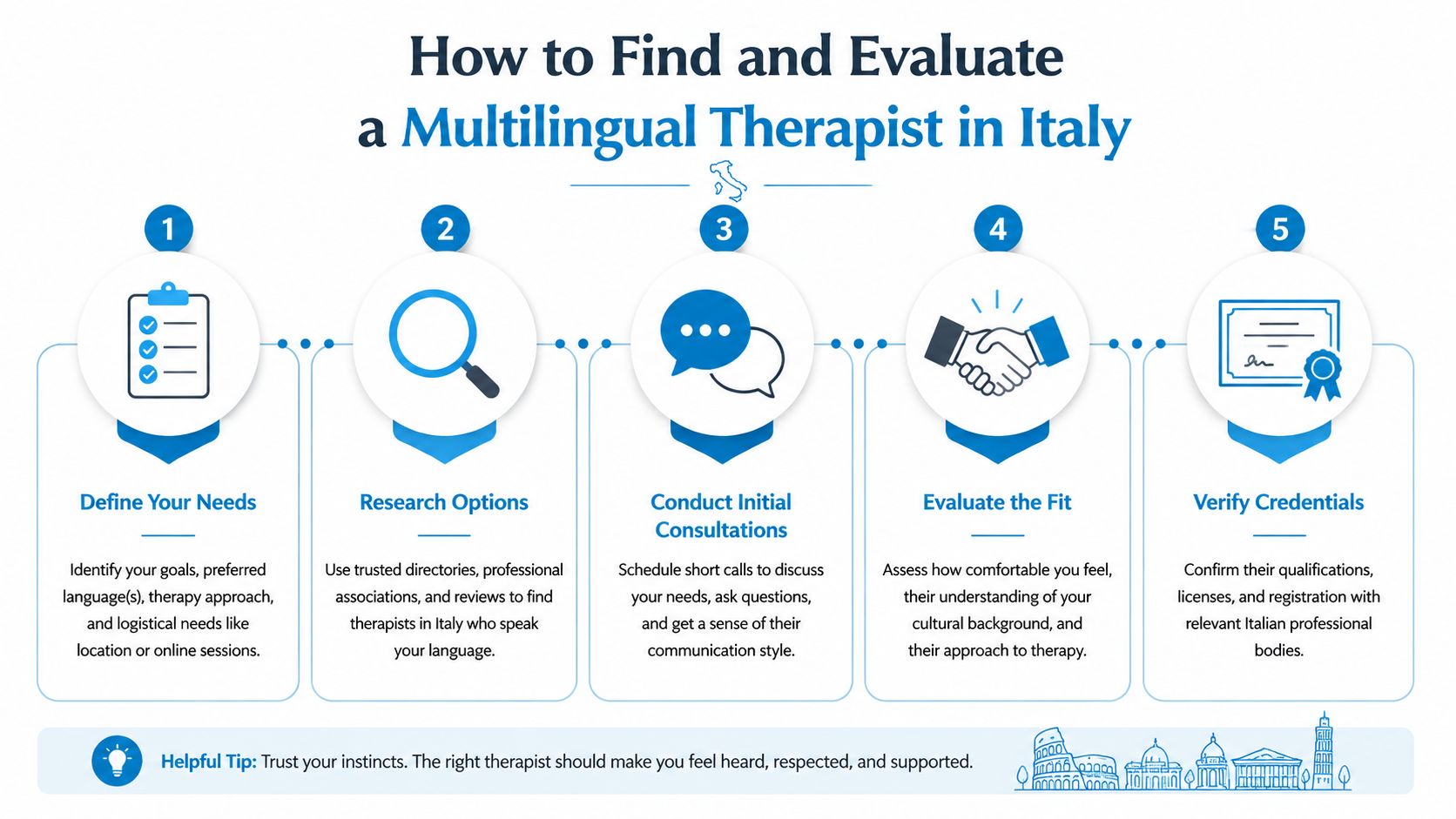
Finding therapy in your native language takes more than searching for a language filter. You're looking for a therapist who can work in that language, understands your concern, and can adapt evidence-based care to your cultural and personal context.
Start with your actual need
Write down what brought you to therapy in ordinary language. You might say, “I feel anxious every Sunday because work starts again,” “I can't recover after moving,” or “my relationship feels divided between two cultures.” You don't need a diagnosis before contacting a therapist.
Then decide what language you want to use:
- Your native language for the whole session.
- Italian or English for practical discussion.
- A flexible combination depending on the topic.
- One language for individual therapy and another for couples therapy.
Ask direct questions
A first conversation should help you assess fit. Ask:
- Which languages can you use comfortably for emotionally complex therapy?
- Have you worked with expats, international students, or intercultural couples?
- Which approaches do you use for my concern?
- Are you licensed to practise in Italy or through the relevant professional system?
- Can sessions be online, in person, or both?
- What happens if I decide the language or therapist isn't right for me?
Evidence-based approaches may include CBT, which links thoughts, emotions, and behaviour; EMDR, which helps process distressing memories; and Schema Therapy, which examines long-standing emotional patterns. Systemic-relational and humanistic approaches may be useful when relationships, identity, and belonging are central.
Use the first call as a fit check
You don't have to perform or make a final decision immediately. Notice whether the therapist asks clarifying questions, respects your language preferences, explains confidentiality clearly, and responds without making you educate them about every aspect of migration.
A human matching process can be useful when you aren't sure what kind of specialist you need. Finding the right therapist for expats in Italy can help you prepare for that conversation.
How a Multilingual Clinic Can Meet Your Specific Needs
A multilingual clinic should make the first step simpler, not add another layer of administration. With Therapsy, the process begins with a short form. The Clinical Director then contacts you within 12 hours, typically through WhatsApp, so you can describe your language, location, availability, and reasons for seeking support.
That conversation matters because a language match alone isn't enough. Someone experiencing panic attacks may need a different therapist from someone processing trauma, navigating burnout, or working through conflict in an intercultural relationship.
What the matching process looks like
Therapsy's model follows a human sequence:
- You describe your needs. You can explain what's happening in the language that feels easiest.
- The Clinical Director listens. The conversation considers language, concern, preferred format, and practical circumstances.
- You meet a matched therapist. The therapist offers a free assessment call to explore whether the relationship feels suitable.
- You choose ongoing care. Sessions can continue online or in person, with rematching available if the fit isn't right.
Therapsy provides therapy in 14 languages, including Italian, English, French, Spanish, German, Portuguese, Ukrainian, Russian, Greek, Arabic, Urdu, Hebrew, Hindi, and Persian (Farsi). It offers online and in-person sessions across 24 Italian cities and 90+ physical locations, including Milan, Rome, Florence, Turin, Bologna, Bergamo, Padova, and Verona.
The clinical team includes 50+ therapists, and the service reports having served 1,500+ clients since 2023. Therapsy also reports a 4.8/5 “Excellent” Trustpilot rating, although a rating is only one part of deciding whether a therapist fits your needs.
You can learn more about the Therapsy therapy centre if you want to understand its online and in-person care model.
Why human matching can help
Automated questionnaires can organize information, but they can't replace a careful conversation about the meaning of language, culture, and distress. A Clinical Director can notice when your preferred language changes depending on the subject, or when a specialist approach might matter more than convenience.
That doesn't guarantee a particular outcome. It does give you a more personal way to begin, especially when the healthcare system feels unfamiliar.
Frequently asked questions about therapy in your native language
Is therapy in your native language more effective?
Research summarized by the APA found that native-language therapy was, on average, twice as effective as therapy in English for ethnic-minority clients.
A later review also found better outcomes in most of the studies it examined, although language isn't the only factor that shapes results. Therapsy can help you consider language alongside therapist specialization and personal fit.
How can I check whether a therapist truly speaks my language well?
Ask whether the therapist can conduct emotionally complex sessions in your preferred language, not only ordinary conversation.
You can also use an initial assessment call to notice whether you feel understood without repeatedly translating yourself. Therapsy's human matching process includes a conversation about language needs before ongoing therapy begins.
How much does therapy in your native language cost in Italy?
Private therapy costs vary, and Therapsy lists individual therapy from €70 per session.
Your final price can depend on the therapist's experience and specialization. Public services and insurance arrangements may follow different rules, so ask about eligibility, reimbursement, cancellation policies, and payment before starting.
Is online native-language therapy as useful as in-person therapy?
Online therapy can be a practical option when no suitable native-language therapist is available nearby.
The important factors include privacy, reliable communication, therapeutic fit, and whether the format suits your needs. Therapsy offers both online and in-person sessions, which can help expats choose the setting that feels sustainable.
Can I change languages during therapy?
Yes, you can discuss changing languages when your emotional needs or circumstances change.
Some bilingual clients use one language for everyday reflection and another for memories or family-related topics. Tell your therapist what you notice, because language switching can itself reveal useful information about safety, distance, and emotional access.
The languages our therapists actually work in
Therapsy works in 14 languages. These are some of the clinicians behind the rarer ones, all of whom also work online wherever in Italy you live.
Dr. Tehreem Qureshi offers sessions in Urdu and Hindi (Naples).
Dr. Alia Jasim offers sessions in Arabic (Milan).
Dr. Alexandra Kraslavski offers sessions in Hebrew (Milan).
Dr. Eleni Karliampa offers sessions in Greek (Milan).
Dr. Thieny Ribeiro offers sessions in Portuguese (Padua).
Dr. Svetlana Loginova offers sessions in Russian, her first language (Milan and Bergamo).
Dr. Vincenzo Frauneder offers sessions in German (Salerno).
Dr. Stéphane Courtois is a native French speaker with over 25 years of practice (Rimini).
Dr. Ludovica Bosetti offers sessions in four languages: Italian, English, Spanish and German (Genoa).
You do not have to work out who fits on your own. You tell Therapsy what you are looking for, a member of our clinical team reads your request, and they introduce you. The first call is free.
How do I know when it's time to seek professional support?
Consider seeking professional support when distress persists, affects daily life, or makes it difficult to work, study, sleep, connect, or care for yourself.
You don't need to wait until a crisis or have a formal diagnosis. A free assessment call with Therapsy can help you discuss what's happening and identify an appropriate next step.
Therapsy offers therapy in your native language with carefully selected professionals, online and in person across Italy, using a human matching process rather than automated questionnaires. Book a free, no-commitment assessment call through Therapsy and speak with the Clinical Director about the language and support that would help you feel understood.