Sunday-night dread, a tight chest before Monday's inbox, and the sense that rest isn't repairing anything are classic reasons people start looking for work stress therapy. The clearest definition is simple, work stress therapy is structured psychological care that helps you reduce the cognitive, emotional, and physical load created by work demands, especially when stress is starting to shape sleep, focus, relationships, and health.
Therapsy is a multilingual psychotherapy service in Italy that connects expats with therapists who speak their native language.
For expats and international professionals in Italy, the stress often has an extra layer. Language barriers, visa uncertainty, remote-work isolation, and the effort of decoding a new workplace culture can turn ordinary pressure into something harder to recover from. A therapist who understands both work stress and intercultural adjustment can help you separate what is fixable from what is too heavy to carry alone.
The World Health Organization's framing matters here. Burnout is recognized in ICD-11 as an occupational phenomenon, not a medical condition, and the WHO describes it as a result of chronic workplace stress that hasn't been successfully managed, marked by exhaustion, cynicism, and reduced professional efficacy (WHO ICD-11 burnout definition). That shift changed the conversation from “What's wrong with me?” to “What is this job doing to me?”
Practical rule: if the same work pattern keeps draining you no matter how hard you try, therapy is probably about more than coping. It's about changing the pattern, the response, or both.
What Work Stress Therapy Actually Means
Work stress therapy is not just a place to vent about a bad boss. It is a structured, time-limited form of psychological care that targets the thoughts, emotions, body sensations, and habits that get activated by workplace pressure. The point is not to become endlessly tolerant of stress, the point is to function better, recover faster, and understand why the same work situations keep hitting so hard.
A lot of people confuse therapy with coaching or generic support. Coaching can help with performance goals, and employee counselling can offer a helpful check-in, but work stress therapy uses evidence-based methods with clear goals, such as lowering rumination, improving sleep, reducing avoidance, and strengthening boundaries. That's why the work often includes homework, symptom tracking, and specific skills practice between sessions.
Why the clinical framing matters
The WHO's language is useful because it moves the problem into a workplace-health frame rather than a character flaw frame. A review in BMJ Open notes incidence rates of 13% for psychological distress and 22% for emotional exhaustion in working populations, with distress reaching up to 50% in some professions and countries (BMJ Open review). That doesn't mean everyone needs intensive treatment, but it does show why work stress therapy is often a serious intervention, not a luxury.
The same basic logic applies to expat life in Italy. If your stress comes from language strain, unclear expectations, or feeling that you're always slightly behind culturally, therapy helps you map the problem correctly. That's especially important because a person can look “fine” on the outside while losing sleep, confidence, and concentration.
Therapsy often enters the picture at this stage for people who want support in their own language and don't want to spend half the session translating feelings. If you're comparing options, a good starting point is the services overview at Therapsy or the free first assessment call. Both are useful when you're trying to understand whether your stress is ordinary pressure or a pattern that deserves clinical care.
What therapy is trying to change
At a practical level, therapy for work stress tries to change three things:
- The internal loop: the thoughts, self-talk, and worry spirals that intensify stress.
- The body loop: tension, fatigue, sleep disruption, headaches, and other stress responses.
- The workplace loop: avoidance, overfunctioning, people-pleasing, silence, or repeated conflict.
When those loops stay active, people often feel stuck in a version of their job that never turns off. That's why the rest of this article moves from methods to skills, then to when care needs to be stepped up.
The Main Therapeutic Approaches Compared
Different therapies help different stress patterns. The strongest work stress therapy usually isn't the most dramatic one, it's the one that matches the problem you have. For many readers, the question isn't “Which therapy is best?” It's “Which therapy fits this kind of stress?”
CBT, EMDR, and Schema Therapy in plain language
Cognitive Behavioural Therapy, or CBT, is the workhorse for rumination, catastrophising, perfectionism, and performance anxiety. It focuses on the link between thoughts, body, and behaviour, so if you think “If I make one mistake, I'll be exposed,” CBT helps you test that belief, calm the body, and change the action you take next. For work stress, that often means less spiralling, less avoidance, and more effective problem-solving.
EMDR is often a better fit when stress is tied to a specific incident that the nervous system keeps replaying. That could be a humiliating presentation, a bullying episode, a public mistake, or a sudden layoff. The emphasis is less on persuading yourself to “move on” and more on helping the brain process a memory that still feels present.
Schema Therapy goes deeper. It can help when work stress keeps repeating across jobs, teams, and relationships, especially if the same themes keep showing up, like approval-seeking, fear of failure, emotional deprivation, or unrelenting standards. In everyday language, it asks why you keep landing in the same painful loop even when the workplace changes.
A meta-analysis found that individual-focused stress therapy produced a small but significant overall effect, with CBT showing the largest improvements in psychosocial outcomes and relaxation training showing the largest improvements in physiological outcomes, while organizational interventions were weaker and often non-significant except for psychosocial outcomes (meta-analysis abstract). That doesn't make organisations irrelevant, it just means a person often needs direct symptom work, not only a policy discussion.
A quick decision matrix
| Approach | Mechanism of Change | Best-Fit Work Stress Symptoms | Typical Length |
|---|---|---|---|
| CBT | Changes unhelpful thoughts, coping patterns, and behaviour | Rumination, perfectionism, performance anxiety, avoidance | Short to medium term |
| EMDR | Helps process distressing memories that stay emotionally “stuck” | Flashbacks to a meeting, bullying, layoff shock, intrusive stress | Medium term |
| Schema Therapy | Works on deeper life patterns that repeat under pressure | Chronic self-criticism, approval-seeking, repeated work burnout | Longer term |
For many clients, a therapist at Therapsy will combine these methods instead of treating them as separate worlds. That matters for expats too, because a person may need CBT for the Monday anxiety, then a deeper schema-based look at why they keep overworking to feel safe.
Clinical shortcut: if the stress feels like a thought problem, start with CBT. If it feels like a memory problem, consider EMDR. If it feels like a life-pattern problem, Schema Therapy may fit better.
If you want a clear introduction to CBT in this context, the Therapsy CBT guide is a useful place to start, especially if you're trying to understand how one method can reduce work-related worry without making the process abstract.
Boundary Setting and Day-to-Day Stress Skills
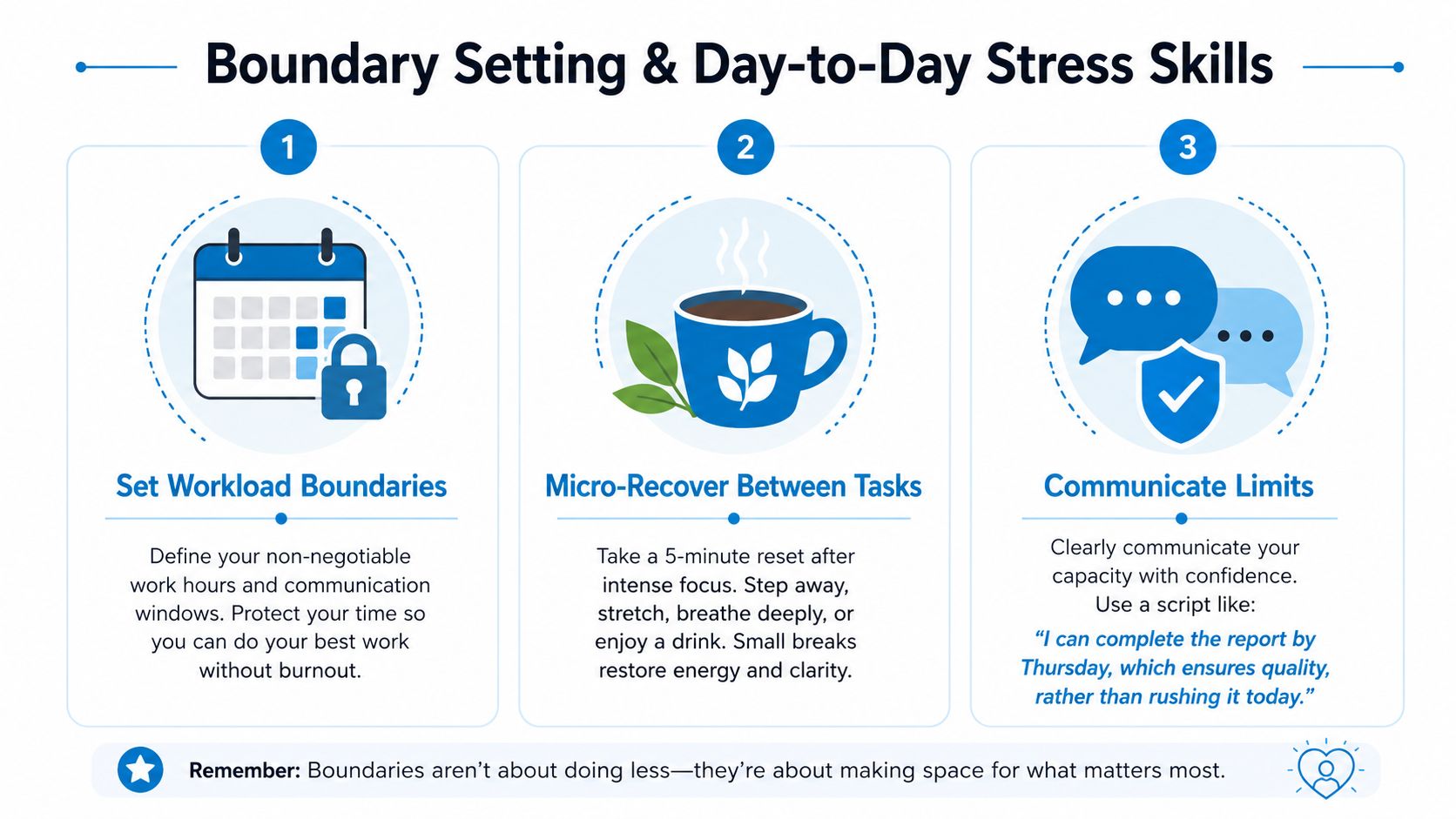
Boundaries in a stressed workplace are not personality traits. They're operational habits that lower strain across the week, especially when your calendar never seems to stop asking for more. If you're already overloaded, the goal is not to become “better at coping” in the abstract, it's to change the conditions that keep reactivating your nervous system.
Three habits that actually lower load
Capacity-based planning means accepting tasks based on available energy, not just open calendar slots. A calendar can say you're free, while your body is already running on fumes. In therapy, this often means learning to estimate what you can do well, then communicating that limit early.
Micro-recovery rituals matter more than people expect. A brief walk, a 90-second breathing reset, or closing the laptop between calls gives the nervous system a chance to downshift before the next demand lands. Small recovery moments aren't indulgent, they're part of how you stay functional.
Clear language prevents stress from turning into silent resentment. The most useful scripts are calm, specific, and not apologetic. They don't overexplain, and they don't invite debate about whether your exhaustion is real.
Two scripts you can actually use
- For a Friday-afternoon deadline: “I can deliver this on Monday morning with better quality, or I can send a rough draft today and finalise it Monday. Which would you prefer?”
- For after-hours messaging: “I'm not checking work messages after 7 p.m. If something is urgent, please call me. Otherwise, I'll respond the next workday.”
Those scripts do two things at once. They set a limit and they offer a workable alternative, which makes them easier to use with managers who are under pressure themselves.
If you struggle to say these things without guilt, assertiveness training at Therapsy can be a practical bridge between insight and behaviour. That's especially helpful for expats who were taught different communication rules in their home culture and now have to manage Italian workplace norms at the same time.
Useful standard: progress isn't inbox zero. Progress is a nervous system that's less activated by ordinary work demands.
What Therapy Sessions Look Like in Practice
A good work stress therapy process looks less like a lecture and more like a careful map of your real week. People often worry they'll be told to meditate more or “think positive,” but effective sessions usually focus on the actual work patterns that keep recreating distress. That means your therapist will want to know what happens on Sunday evening, during meetings, after emails, and when you finally stop moving.
Three very different sessions
A burned-out corporate manager may begin by tracking the exact moments when perfectionism spikes. The therapist might map the loop, difficult task, pressure to perform, late-night replaying, short sleep, then more mistakes the next day. Over time, CBT-style reframing can soften the belief that every imperfect outcome is a threat.
An international student often needs a different lens. Sessions may focus on acculturation stress, language-related shame, and a humiliating incident at work or university that still wakes them up at night. If a specific event keeps replaying, brief EMDR work can help process the memory so it stops hijacking the evening.
A fully remote worker may spend sessions on micro-boundaries, after-hours email audits, and somatic recovery between meetings. The therapist may ask them to count how often they check messages, notice which calls leave them buzzing, and identify the smallest possible change that reduces strain without disrupting performance.
What gets tracked
Therapists don't only ask, “How do you feel?” They also look at functioning markers:
- Sleep quality
- Sunday-evening anxiety
- Conflict avoidance
- Ability to focus
- Recovery after work
That matters because mood can stay flat while functioning keeps slipping. A person may still go to work every day and still be deteriorating, which is why the conversation has to include real-life performance, not only emotional insight.
If you're wondering what the first meeting feels like, the first psychological session page at Therapsy gives a good sense of the process. The structure is usually straightforward, your job context, stress triggers, history, and a plan for what to try first. Good therapy adapts to your life, not the other way around.
Why the Workplace Itself Has to Change
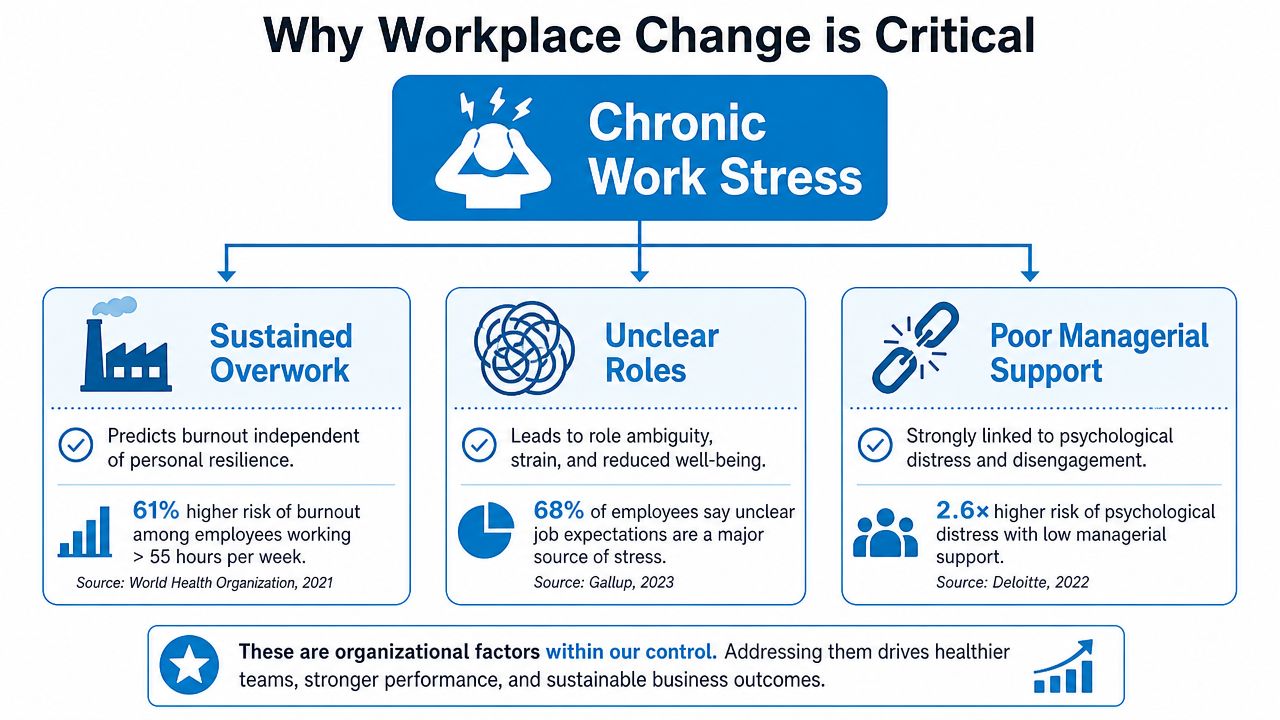
Individual therapy helps, but it can't fully repair a harmful work environment. Chronic overwork, unclear roles, and poor managerial support can keep burnout alive even when a person is doing everything right in therapy. In plain language, you can become better resourced and still keep getting drained if the workplace stays toxic.
What actually moves the needle
The WHO's workplace guidance points to workload management, safe staffing, regular breaks, and flexible schedules as concrete levers, and it warns that prolonged stress can lead to burnout, chronic fatigue, absenteeism, high turnover, reduced satisfaction, and more errors (WHO occupational stress guidance). That's the part many people skip over, because it feels easier to blame themselves than to ask for organisational change.
A useful way to think about it is this, therapy changes your response, but the workplace changes your exposure. You need both when the problem is sustained. If your role is unclear, your manager never gives clean priorities, or your workload keeps expanding, your recovery plan has to include structural asks.
One practical resource for teams trying to build a healthier response is the HR knowledge base creation guide from Trupeer Inc.. Used well, that kind of internal resource can help managers document expectations, communication norms, and escalation routes more clearly.
Influence strategies you can use now
- Request structured one-to-ones so priorities are reviewed regularly instead of assumed.
- Ask for workload reviews when tasks keep expanding faster than capacity.
- Document repeated stress patterns so the conversation stays concrete.
- Use available internal pathways such as HR, employee support, or occupational health when they exist.
For employees in international or multilingual workplaces, Therapsy's corporate mental health partnership page is relevant because workplace stress often needs both individual support and organisational literacy. Asking for those changes isn't failure, it's a competent response to a system that may be asking too much.
When to Consider Specialist or Psychiatric Support
Some stress patterns are no longer well handled by self-management alone. If symptoms keep going despite real effort, the next step isn't to push harder, it's to step up care. That can mean a more specialised psychologist, a psychiatrist, or an occupational physician in Italy, depending on what's showing up.
A calm red-flag checklist
Look at the pattern, not just the feeling.
- Duration: symptoms persist beyond six weeks despite active coping.
- Sleep: sleep disruption doesn't recover on weekends.
- Intrusion: anxiety, low mood, or work memories keep breaking in.
- Body symptoms: headaches, GI issues, chest tightness, and similar stress complaints keep appearing.
- Behaviour: alcohol, nicotine, or other coping habits are increasing.
- Functioning: you're withdrawing, avoiding work, or missing more tasks than usual.
- Safety: any suicidal ideation needs immediate professional attention.
The distinction between professionals matters. A psychologist or psychotherapist helps assess and treat the stress pattern itself. A psychiatrist can evaluate whether medication or a formal diagnostic review is appropriate. In Italy, an occupational physician, often referred to as a medico competente, can be relevant when workplace health implications need formal review.
What a specialist visit usually looks like
The process is usually more ordinary than people expect. A clinician will take a structured history, ask about sleep, mood, functioning, and stress exposure, and may use questionnaires to clarify the picture. Sometimes the question is whether this is burnout, an adjustment problem, or a depressive or anxiety disorder that needs a different plan.
A low-stakes first booking is often the right move if you're unsure. Therapsy's page on psychologist vs psychiatrist is a practical starting point for understanding who does what in Italy, especially if you're trying to decide whether therapy, medication review, or both make sense.
| Symptom Category | Duration Threshold | Functional Impact | Recommended Next Step |
|---|---|---|---|
| Sleep and fatigue | Beyond six weeks | Weekend rest doesn't restore energy | Book specialist assessment |
| Anxiety or low mood | Persistent and intrusive | Work, study, or home life are affected | Consider psychotherapy and psychiatric review |
| Body symptoms | Ongoing with stress spikes | Daily functioning is disrupted | Rule out medical causes and stress drivers |
| Safety concerns | Any occurrence | Immediate risk is present | Seek urgent help now |
Stepping up care is not a sign that you failed at coping. It's a sign that the load has crossed the point where a routine response is enough.
Putting It Together Into a Personal Recovery Plan
The strongest recovery plans are layered. Therapy is one layer, not the whole answer, and it works best when it sits inside a structure you can sustain. For expats in Italy, that structure often has to include emotional support, daily habits, and a realistic conversation with the workplace.
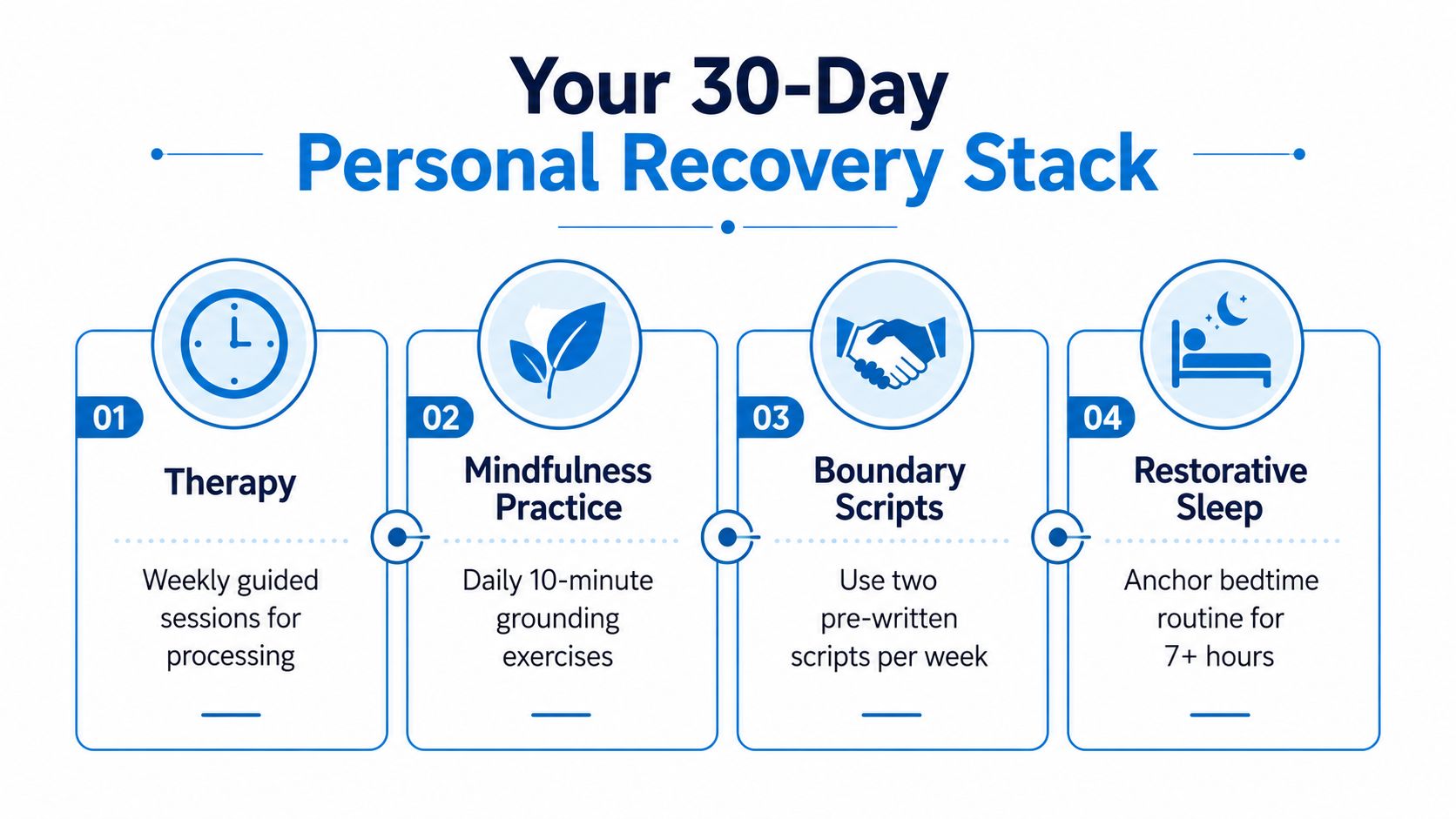
A simple 30-day stack
- Clinical support. Match the therapy approach to the stress pattern, and add psychiatric input if symptoms justify it.
- Daily stress skills. Use boundary scripts, short recovery breaks, and a sleep anchor you can repeat.
- Social support. Tell one trusted colleague, one non-work contact, and one professional support person what's happening.
- Structural action. Ask for a workload review, HR conversation, or other formal check-in if the workplace is part of the problem.
The reason this works is sequencing. People often try to solve everything with willpower, then feel ashamed when they can't. Small, consistent changes usually beat dramatic resets because they're easier for a tired nervous system to keep doing.
Recovery moves fastest when the plan is boring enough to repeat.
For someone living in Italy, that might mean therapy in your own language, a manager conversation in clear English or Italian, and a weekly routine that protects sleep even when work is messy. Therapsy often helps expats build exactly that kind of plan, because the goal isn't just symptom relief, it's making daily life feel workable again.
If you've been carrying work stress alone, take the next step before it gets heavier. Book a free assessment call with THERAPSY, and use that conversation to get clarity on what kind of support fits your situation, your language, and your life in Italy.
Frequently asked questions about work stress therapy
What is work stress therapy?
Work stress therapy is structured psychological care that helps reduce stress, burnout, and anxiety caused by work. It focuses on thoughts, body symptoms, coping habits, and workplace patterns so you can function better and recover more reliably. For expats in Italy, Therapsy can make that process easier by matching you with a therapist who speaks your language.
How long does it take to feel better?
Some people notice skill-based improvement in a few sessions, while deeper patterns take longer. The pace depends on whether the main issue is rumination, a specific stressful incident, or a long-running pattern of overwork and self-criticism. Therapsy usually helps people think in terms of early relief first, then longer-term change.
What is the difference between a psychologist, psychotherapist, and psychiatrist in Italy?
A psychologist assesses and supports mental health, a psychotherapist provides ongoing therapy, and a psychiatrist can evaluate diagnosis and medication. In real life, people often need more than one of these supports depending on symptom severity. Therapsy can help you understand which route fits before you commit to a path.
Is online therapy effective for burnout?
Yes, online therapy can be effective for burnout when the therapist uses a structured approach and the problem fits remote work. It's often especially practical for expats, frequent travellers, and people with packed schedules. Therapsy offers online sessions, which can make continuity easier when your job or city life is already demanding.
How do I find a multilingual therapist in Italy?
Look for a provider that can match you with a therapist in your preferred language and understands expat stress, not just generic anxiety. In Italy, Therapsy is designed for multilingual support, so you don't have to translate every nuance of work pressure, family conflict, or cultural frustration.
When does work stress become something more serious?
Work stress becomes more serious when sleep, mood, concentration, or safety are affected for weeks at a time. If you're withdrawing, using more substances to cope, or having thoughts of self-harm, you need professional help quickly. In that situation, Therapsy can be one entry point, but urgent local support may also be necessary.
If work stress is making everyday life feel smaller, Therapsy can help you sort out what's burnout, what's context, and what kind of support fits best. You can start with a free assessment call, talk through your symptoms in your own language, and get matched with a therapist who understands expat life in Italy. Visit THERAPSY to take that first step without pressure.