Neurodiversity affirming therapy means therapy that treats autism, ADHD, and other neurodivergent ways of being as meaningful human differences, not defects to erase. In practice, that means the therapist adapts the process, the environment, and the goals so the person feels understood rather than corrected, which can matter even more for expats in Italy already dealing with language and cultural mismatch.
Therapsy is a multilingual psychotherapy service in Italy that connects expats with therapists who speak their native language.
For many adults, the search starts after a discouraging experience. They tried therapy, explained their overwhelm, masking, shutdowns, or sensory stress, and left feeling as if the problem was their personality rather than the strain of living in an environment that didn't fit them.
What Neurodiversity Affirming Therapy Actually Means
What does neurodiversity affirming therapy mean?
Neurodiversity affirming therapy means support that respects neurological differences and works with them, instead of trying to make the person look more neurotypical. It doesn't ignore distress. It changes the framework for understanding it.
A therapist using this approach doesn't assume that eye contact, small talk, fast verbal processing, or a calm waiting room are neutral defaults. The therapist asks what overload looks like for that person, what communication feels easiest, and what goals matter to them.
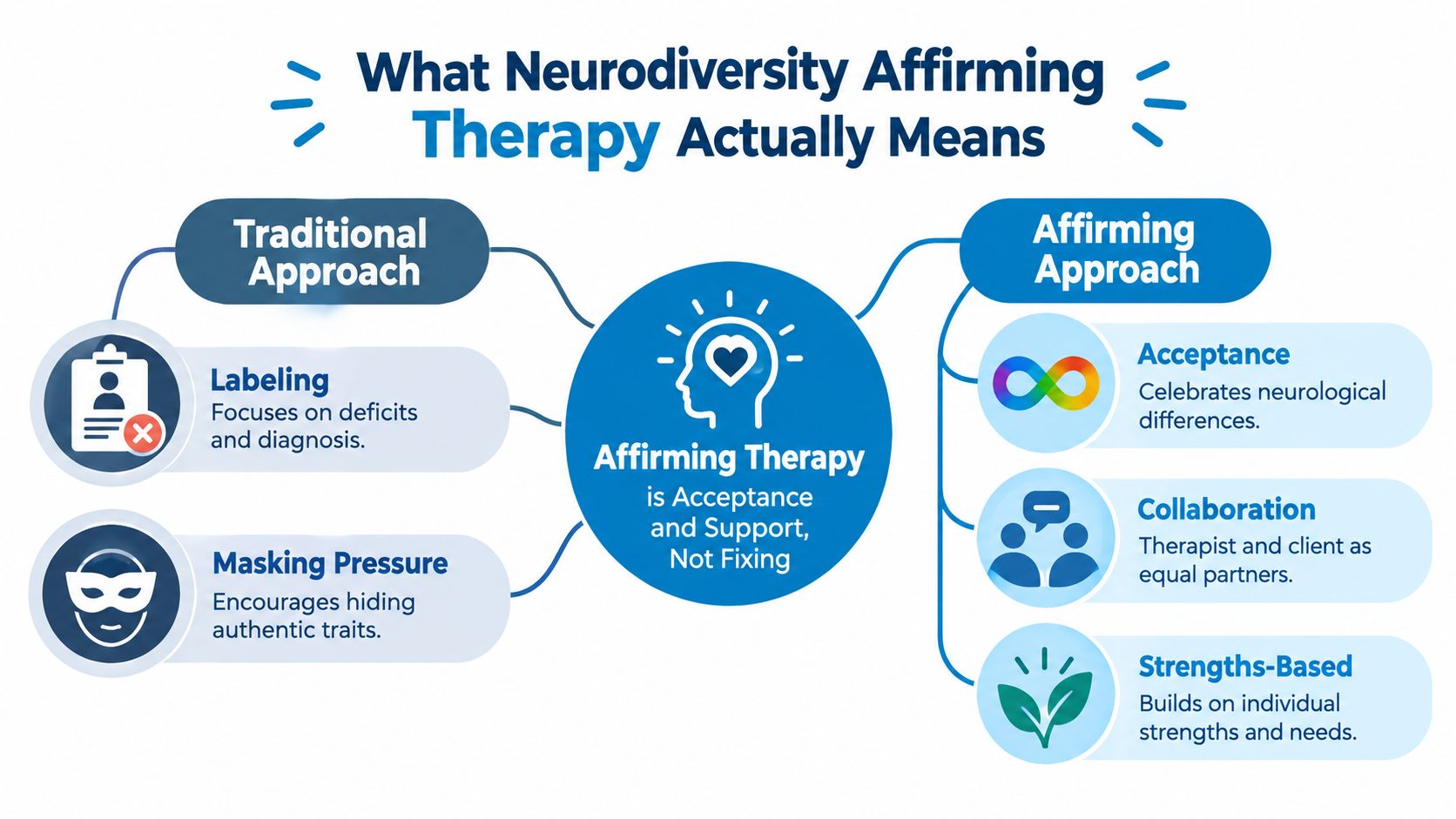
For an expat or international student, this often lands differently. Someone may already spend the day translating language, social rules, and bureaucracy. If therapy adds another layer of pressure to perform "normally," it can feel less like support and more like another place to mask.
What changes inside the therapy room?
The main shift is that therapy stops asking "How can this person fit the norm?" and starts asking "What is creating mismatch, strain, or shame?" That sounds subtle, but it changes everything.
In a traditional frame, a client who avoids eye contact might be seen as resistant. In an affirming frame, the therapist may understand eye contact as uncomfortable, distracting, or unnecessary for connection. The work then moves toward safety, clarity, and self-understanding.
Practical rule: If therapy feels like coaching for better performance rather than support for a harder life fit, the framework may be the problem.
This is also why language matters. Many adults prefer identity-affirming wording because it reflects personhood rather than defect. A short guide to person-first language can help readers understand why some people prefer "autistic person" while others choose different terms.
The historical milestone behind this approach was the move away from deficit-based autism and ADHD treatment toward identity-affirming care, a shift that emerged from autistic self-advocacy and the broader neurodiversity movement in the 1980s and 1990s, becoming publicly visible in 1997 through Harvey Blume's New York Times coverage and later shaping practice in the UK, US, Canada, Australia, and parts of Europe, as described in this historical overview of neurodiversity-affirming care.
Readers looking for support that applies this lens in Italy can also explore neurodiversity support at Therapsy.
How the Neurodiversity Movement Changed Therapy
Why did therapy start changing in the first place?
Therapy changed because neurodivergent people challenged the idea that the only good outcome was looking less autistic or less different. That challenge came from lived experience before it became clinical language.
The neurodiversity movement grew through autistic and ADHD communities organizing in the 1980s and 1990s. Over time, that activism created space for clinicians to rethink old assumptions about what treatment should try to accomplish.
Instead of defining success as reduced visible difference, more services began asking whether a person felt safer, more understood, and less forced to mask. That shift is especially relevant in intercultural therapy, where distress often comes from mismatch between person and environment, not only from symptoms inside the person.
Why does this history matter to someone looking for help in Italy?
This history matters because it explains why some therapists still sound affirming in theory but work in non-affirming ways in session. The field hasn't reached one single shared definition.
Recent literature notes that there is still little consensus on what neurodiversity-affirming practice concretely means in clinic, and implementation remains uneven because of resource limits, eligibility rules, and structural barriers, as described in this recent review of neurodiversity-affirming interventions. That gap explains why many clients ask, quite reasonably, what an actual session will look like.
Some services use "affirming" as a value statement. Clients usually need it translated into scheduling, sensory flexibility, communication choices, and goals that don't revolve around normalization.
Cross-cultural psychology becomes useful. An expat may already know what it feels like when a system treats difference as a problem to smooth out. A therapist informed by intercultural work, attachment theory, or CBT can still use structured methods. The difference is that the methods get adapted to the client, not imposed as if culture and neurotype don't matter.
Teams working in this area sometimes use practical tools from inclusion work to review whether forms, language, and feedback systems create pressure or access barriers. Even a non-clinical resource like these Diversity And Inclusion Survey Questions can help readers see how institutions turn abstract inclusion values into concrete questions.
For readers exploring culturally responsive care in Italy, culturally responsive therapy can be a useful starting point.
What Are the Seven Core Principles
What are the seven core principles?
Recent research identified seven practical principles that make neurodiversity affirming therapy recognizable in real clinical work. They are more useful than generic promises to be open-minded.
A 2025 study defining neurodiversity-affirming psychology practice for autistic clients identified these seven principles in this research summary of affirming psychology practice: continued learning about autism, safety to be one's autistic self, finding a way to communicate, authenticity and humility, validation of autistic experiences, autistic-informed person-centered support, and genuine acceptance and appreciation of autism.
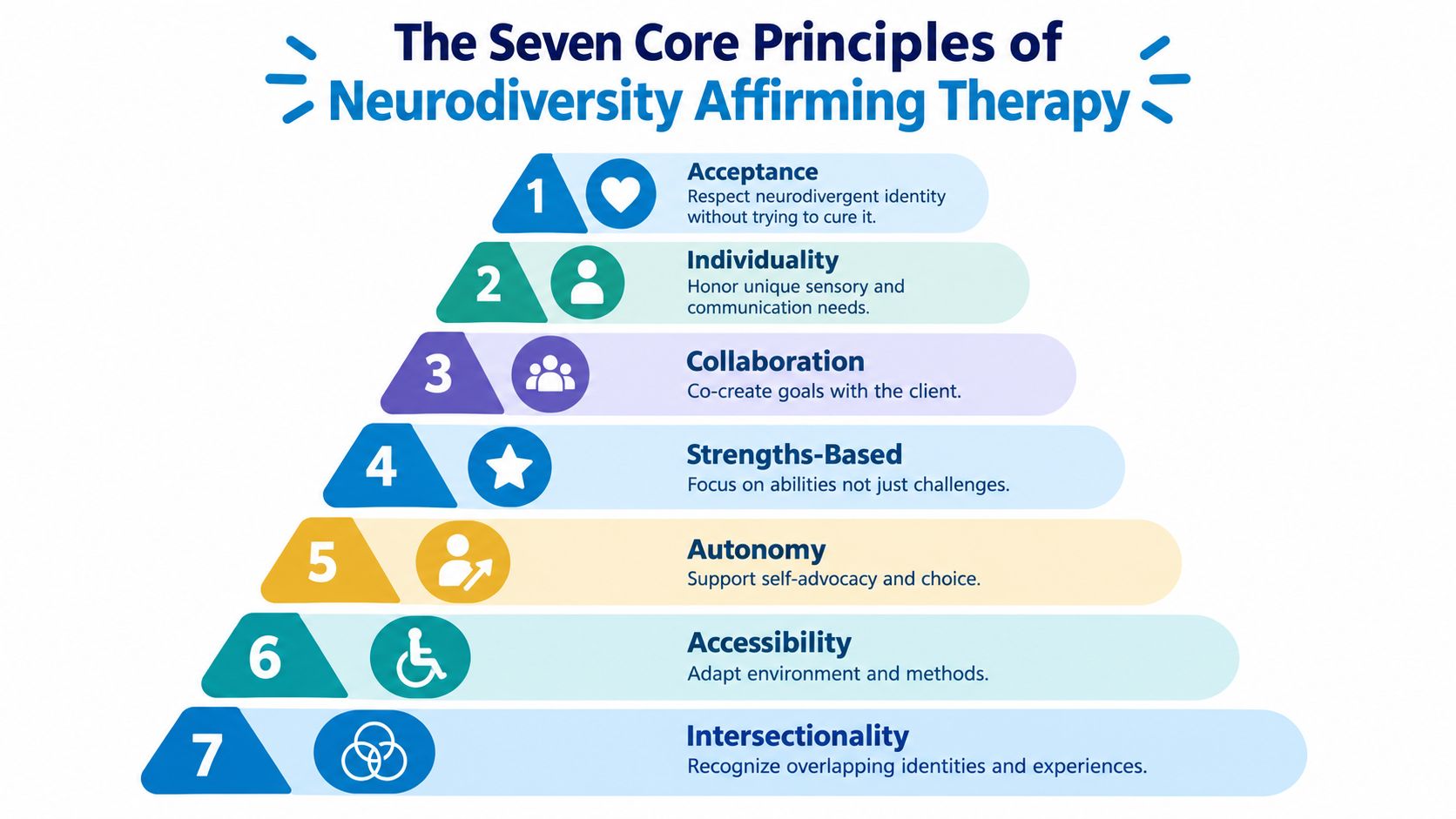
What do those principles look like in a real session?
Each principle changes something concrete about pace, interpretation, or environment. That is what they want to know before they book.
Continued learning about autism – The therapist doesn't rely on outdated training or stereotypes. If a client describes sensory pain, monotropism, or shutdowns, the therapist treats that as important clinical information, not as a side note.
Safety to be one's autistic self – The client doesn't need to hide stimming, scripting, flat affect, directness, or a need for breaks. Safety reduces the energy spent on self-monitoring, which often makes deeper work possible.
Finding a way to communicate – Some clients think best after a pause. Others prefer writing key points, using chat for scheduling, or receiving questions more directly. A therapist may adapt the format rather than reading those needs as lack of engagement.
A session can be emotionally deep even when it is quieter, more structured, or less conventionally conversational.
Authenticity and humility – The therapist doesn't assume expertise over the client's lived reality. Humility matters even more in intercultural therapy, where migration, bilingual life, race, gender, or disability can shape what safety means.
Validation of autistic experiences – If a client says they were bullied for being "too much" or exhausted by constant social decoding, the therapist doesn't rush to reinterpret that pain as a thinking error.
Autistic-informed person-centered support – Goals are built around the actual person. One client may want help with burnout and boundaries. Another may want support for relationships, executive function, or recovery after late identification.
Genuine acceptance and appreciation of autism – Acceptance isn't passive. It changes what gets reinforced in therapy. Curiosity, pattern recognition, deep interests, honesty, and unconventional social style may be treated as meaningful parts of identity.
Why does this overlap with trauma-informed care?
Many neurodivergent adults arrive in therapy after years of misunderstanding, masking, or pressure to comply. That history can shape the nervous system even when the original problem wasn't named as trauma.
A trauma-informed approach and an affirming approach often fit well together because both pay attention to safety, power, pacing, and consent. Readers who want that broader lens can also explore what trauma-informed care means in practice.
How Affirming Therapy Differs from Traditional Approaches
How is affirming therapy actually different?
The clearest differences show up in communication, assessment, and goal-setting. The contrast is easier to see in ordinary session moments than in theory.
A traditional therapist might focus on whether a client can tolerate more eye contact, speak more spontaneously, or reduce visible coping behaviors. An affirming therapist is more likely to ask whether those expectations are useful, harmful, or culturally familiar to the therapist.
In CBT, EMDR, Schema Therapy, or attachment-based work, the tools themselves aren't automatically the problem. The question is how they are used. A structured model can still be affirming when the therapist adapts the pace, language, environment, and goals around the person in front of them.
What changes in communication, assessment, and goals?
Affirming therapy doesn't remove challenge. It relocates the challenge from "be less yourself" to "understand what helps you function with less strain."
| Area | Traditional Approach | Affirming Approach |
|---|---|---|
| Communication | Assumes spoken, fast, reciprocal conversation is the default | Adapts to direct language, pauses, written notes, or lower social demand |
| Assessment | Focuses mainly on deficits, symptoms, or compliance with norms | Looks at stress, sensory load, masking, strengths, and person-environment fit |
| Goal-setting | Prioritizes appearing more typical or reducing visible difference | Builds goals around self-understanding, functioning, boundaries, and reduced mismatch |
| Emotional meaning | May treat shutdown, avoidance, or stimming as behavior to reduce | Explores these as signals, coping strategies, or responses to overload |
| Social expectations | Often assumes one ideal way to relate | Accepts different relational styles while still supporting connection |
| Environment | Treats room setup and admin process as neutral | Considers light, noise, predictability, and access as part of treatment |
The key mechanism is environmental and relational fit. When the pressure to perform drops, many clients can finally describe what has been difficult all along.
A 2025 review of therapy for autistic adults explains this mechanism clearly. It argues that the point isn't to normalize behavior, but to improve mental health by treating anxiety or depression while adapting the therapeutic environment to autistic cognitive and sensory needs, with better self-acceptance and mental health outcomes than deficit-focused models, while warning that efforts to change autistic people to fit normative standards can worsen well-being, as outlined in this review of neurodiversity-affirming therapy for autistic adults.
Does affirming mean a therapist avoids diagnosis or difficult topics?
No. Affirming doesn't mean vague positivity or avoiding hard conversations. It means the therapist interprets difficulty through a less stigmatizing and more collaborative lens.
A client can still work on panic, depression, OCD symptoms, grief, relationship conflict, trauma, or burnout. The difference is that the therapist doesn't assume the person's neurotype is the mistake to fix.
Does Neurodiversity Affirming Therapy Actually Work
Does it help, or does it just sound better?
The strongest evidence so far suggests that neurodiversity-affirming adaptations feel more helpful to autistic adults, while outcome research is promising but still mixed. That distinction matters.
In a 2025 study of autistic adults evaluating therapy adaptations, the item "used a neurodiversity-affirming approach" scored 4.71 out of 5, and 93.85% of participants rated it helpful or extremely helpful. In the same study, neurodiversity-affirming adaptations were rated highest overall, with an average of 4.22 out of 5 across the category, and they were favored above sensory, communication, and technique-based adjustments, according to this PubMed-indexed mixed-methods study of psychotherapy adaptations for autistic adults.
That doesn't mean the science is settled on every mental health outcome. It does mean the people using therapy can often tell the difference between feeling accommodated and feeling subtly pushed toward conformity.
What do broader mental health outcome studies show?
Outcome evidence is more cautious than preference evidence. Readers deserve both parts of the picture.
A 2026 meta-analysis of adult interventions reported small-to-moderate benefits overall, with the largest gains for identity acceptance and psychological well-being. A separate 2026 review of 10 randomized CBT trials in autistic adults involving 537 participants concluded that effects were very uncertain across most outcomes and may not meaningfully improve social anxiety, functioning, OCD symptoms, or discontinuation, as summarized in this evidence overview on therapy for autistic adults.
That mixed evidence can sound disappointing at first. In practice, it may mean the field is still learning how to measure the right things. If therapy reduces shame, improves fit, lowers masking pressure, and makes treatment feel accessible, that may matter clinically even when symptom scores don't tell the full story.
What seems to improve fit in practical terms?
Low-friction access and therapist understanding appear especially important. Practical barriers are often part of the treatment experience, not separate from it.
A 2025 mixed-methods study found that the highest-rated helpful modifications were therapists' autism expertise, a neurodiversity-affirming stance, individual sessions, and low-friction access features such as online booking and text-based appointment scheduling. These adaptations were rated 4.5 out of 5 on average, and the text-booking option was endorsed as helpful by at least 86.92% of participants, according to this study of psychotherapy adaptations for autistic adults.
For expats in Italy, that point often gets overlooked. Administrative friction, phone calls in a second language, and uncertainty about what a first session will be like can be enough to stop someone before therapy begins.
How to Find a Neurodiversity Affirming Therapist
How can someone tell if a therapist is actually affirming?
The clearest way is to ask concrete process questions, not just whether the therapist uses the word affirming. Most confusion disappears when the conversation gets specific.
Useful questions include these:
- Experience with adults – Does the therapist work with neurodivergent adults across different support profiles, or only with children?
- Understanding of masking – How does the therapist think about people who look high-functioning but feel exhausted, disconnected, or chronically overloaded?
- Session adaptations – Can sessions be adjusted for sensory load, pacing, direct communication, or online format?
- Goal-setting – Are goals built around reduced shame, better functioning, and self-advocacy, or around looking more socially typical?
- Intercultural awareness – Does the therapist understand how migration, bilingual life, race, gender, family culture, or visa stress can shape the therapy process?

What are the red flags?
Red flags usually appear when a therapist treats neurotypical behavior as the default endpoint. That can happen even when the therapist sounds warm.
Common warning signs include:
- Normalization as the main goal – The therapist talks mainly about helping the client appear more typical.
- Rigid communication expectations – The therapist insists on eye contact, quick verbal answers, or one fixed session style.
- Minimizing sensory needs – Overload gets treated as avoidance, drama, or poor motivation.
- Little curiosity about culture – The therapist ignores how living abroad may magnify stress, loneliness, or misunderstanding.
- Deficit-only framing – Strengths, identity, and environmental mismatch disappear from the conversation.
One practical way to test fit is the first consultation. A good opening conversation often feels collaborative, specific, and calm. It should leave room for the client to notice whether they felt understood, rushed, translated badly, or subtly corrected.
This is one area where structured human matching can help. Therapist matching at Therapsy is built around the Clinical Director's review rather than an algorithm, with therapy available in 14 languages, online and in person, and the first call free with the therapist chosen for that person. Therapsy also works across 21 Italian cities with 80 physical locations, supports 50+ therapists, and has provided 13,000+ sessions to 1,500+ clients since 2023, with first contact within 12 hours.
A therapist doesn't need to share every identity with a client. The therapist does need enough humility and flexibility to stop treating difference as noncompliance.
What to Expect in Your First Session
What usually happens in the first session?
A good first session usually focuses on fit, safety, and clarity before it goes deep into history. The therapist may ask what brings the person in, but also how they communicate best, what tends to overwhelm them, and what has or hasn't worked before.
That can include questions about sensory stress, masking, burnout, routines, sleep, migration stress, relationships, or whether online sessions feel easier than in-person ones. In an affirming setting, these details aren't side issues. They help shape the treatment itself.
For someone living abroad, language concordance can matter more than expected. Explaining distress in a second language can create distance from feelings, or make a person sound flatter, harsher, or less precise than they really are. That's one reason multilingual care can reduce strain before the therapeutic work even starts.
How should the session feel?
The first session should feel collaborative, not like an audition for being the right kind of client. It is normal if trust takes time.
Some people want a structured format and clear questions. Others need more pauses and less pressure. A thoughtful therapist can work within both styles, using frameworks such as CBT, EMDR, Schema Therapy, attachment-informed therapy, or intercultural therapy without forcing one rigid way of participating.
Readers who want a clearer picture of that first meeting can find it in this guide to the first psychological session. Therapsy also offers individual therapy from EUR 70, couple therapy from EUR 100, psychodiagnostic assessment from EUR 255 for 3 sessions, and psychiatric consultation from EUR 110, with a free first assessment call.
Therapsy offers human matching by the Clinical Director rather than an algorithm, therapy in the client's own language across 14 languages, and a choice between online sessions and in-person care across Italy. For expats and international clients looking for neurodiversity affirming support, the first call is free, it is with the therapist chosen for that person, and there is no obligation to continue. Readers can explore options at THERAPSY.